
When you hear "rental income tax," what comes to mind? For most people, it's the tax you owe on the rent checks you collect. That’s the starting point, but the real story is in the details.
Rental income tax is simply the tax you pay on the profit you make from your properties. You calculate this by taking your total rental income and subtracting all your allowable expenses. The key takeaway here is that it’s not just the rent check that’s taxable, and a whole host of expenses—from your mortgage interest to minor repairs—can seriously shrink your tax bill.
The Foundations of Rental Income Tax for Landlords

Here's the most important mindset shift you can make: start thinking of your rental property as a small business. Seriously. This isn't just an investment that sends you a check every month; it's an operation.
Like any business, your rental generates revenue (income) and has operating costs (expenses). The difference between those two numbers is your profit, and it's that profit the IRS wants to tax. Getting a handle on rental income tax is really just about learning the rules of this specific business game. Your goal isn't to scramble at the last minute to fill out a form; it's to manage your property's finances strategically all year long. That’s how you maximize your returns and avoid any nasty surprises come April.
What the IRS Considers Income
The monthly rent payment is the big, obvious piece of the income puzzle. But the IRS sees things a bit more broadly. They consider almost anything of value you receive from a tenant as income, and missing these other sources is a classic rookie mistake.
Your total reportable income will include things like:
- Advance Rent: Let’s say a tenant pays their first and last month's rent upfront. You have to report that entire amount as income in the year you received it, not when it technically applies.
- Lease Cancellation Fees: If a tenant pays a penalty to break their lease early, that fee is taxable rental income.
- Non-Cash Payments: This one catches people off guard. If your tenant is a painter and offers to paint the unit in exchange for a month's rent, you must report the fair market value of that paint job as income.
The core principle is straightforward: If you receive a financial benefit from a tenant in connection with your property, it's likely taxable income. Keeping detailed records of these transactions is non-negotiable for accurate reporting.
Understanding Your Business Expenses
Just as the IRS takes a wide view of income, it also gives you a lot of leeway to deduct the costs of running your rental business. These deductions are your single most powerful tool for lowering your taxable profit. The rule of thumb is that an expense is deductible if it is both ordinary and necessary for managing and maintaining your property.
This umbrella covers the big-ticket items you’d expect, like mortgage interest and property taxes. But it also includes all the smaller operational costs, from running ads for a vacant unit to paying for property management services. When you diligently track every single dollar spent, you get a crystal-clear financial picture that ensures you're only paying tax on what you actually earned. This basic understanding is what turns tax season from a chore into a strategic part of your investment plan.
Identifying All Your Taxable Rental Income

To get your rental income tax right, you first need a crystal-clear picture of what the IRS actually considers "income." It’s easy to think it’s just the monthly rent check, but that’s only scratching the surface. The IRS casts a much wider net, defining rental income as basically any payment you get for someone using your property.
This broad definition catches a lot of landlords by surprise, often leading to accidental underreporting and unwanted IRS attention. Think of it this way: the monthly rent is the main course, but there are plenty of side dishes that count, too. Let's make sure you're accounting for the whole meal.
Beyond the Monthly Rent Check
A lot of the money that changes hands between you and your tenant is considered taxable income. Getting a handle on these details is key to keeping your records clean and audit-proof.
Here are a few common examples that often get overlooked:
- Advance Rent: This one trips people up all the time. If a new tenant gives you the first and last month's rent upfront, that "last month's rent" is income in the year you received it—not the year it's eventually applied. So, if you get a check in December 2024 to cover January 2025's rent, that's 2024 income.
- Lease Cancellation Fees: A tenant breaks their lease and pays a penalty to get out of it. That fee feels like compensation for a headache, but to the IRS, it's just another form of fully taxable rental income.
- Tenant-Paid Expenses: Let's say your lease makes the tenant responsible for paying the property taxes or the water bill directly. Even though you never touched the money, the value of those payments is considered rental income to you. The good news? You can then turn around and deduct those same costs as expenses.
Handling Security Deposits Correctly
Security deposits are a special case. As long as it's a true security deposit—money you hold with the full intention of returning it when the tenant moves out—it is not income when you collect it. It's considered a liability, not a gain.
The game changes the moment you keep any portion of that deposit. If you withhold some of it to cover unpaid rent or repair damages that go beyond normal wear and tear, the amount you keep instantly becomes taxable income for that year.
Key Takeaway: Be careful how you structure your agreements. If you call something a "security deposit" but it's non-refundable or can be used to cover the final month's rent, the IRS will see it as advance rent. That means you have to claim it as income in the year you got the cash.
When Income Isn't Cash
Sometimes, your income doesn't come in the form of money at all. You might get paid in services or goods, and this is a huge, often-missed source of taxable income.
Let's say your tenant is a talented landscaper. They agree to do $600 worth of professional lawn and garden work each month in exchange for a $600 discount on their rent.
Here's how the accounting works:
- You must report the $600 fair market value of the landscaping services as rental income.
- You can then deduct that same $600 as a maintenance expense.
While it's a wash on your bottom line (income in, expense out), skipping the reporting is a mistake. Failing to log both the income and the expense can make your books look incomplete and raise red flags. Tracking every form of compensation is the only way to ensure your rental income tax reporting is buttoned up and accurate.
Unlocking Every Deduction to Reduce Your Taxes
Making a real profit on a rental property isn't just about the rent you collect—it's about how much of that cash you actually get to keep. This is where tax deductions become a landlord's best friend. Think of it this way: every dollar you spend to manage, operate, and maintain your property is a potential opportunity to lower your taxable income, which in turn lowers your rental income tax bill.
By tracking your expenses and claiming every deduction you're entitled to, you can turn your tax return into a powerful financial tool. It’s the single best way to maximize the return on your real estate investment.
Day-to-Day Operating Expenses
Let's start with the basics. The most common deductions are the everyday costs of simply keeping your rental business up and running. In IRS-speak, these are expenses that are both "ordinary and necessary" to your business. The great thing about these is you typically get to deduct them in the same year you pay for them.
Here are some of the most important operating costs you should be tracking like a hawk:
- Repairs and Maintenance: This covers the nitty-gritty stuff, from fixing a leaky toilet and patching a hole in the drywall to paying for monthly pest control. These are the fixes that keep your property safe and habitable.
- Property Management Fees: If you’ve handed the reins to a property manager to find tenants, collect rent, and handle late-night calls, their fees are 100% deductible.
- Insurance Premiums: The cost of your landlord insurance policy, along with any extra coverage like flood or liability insurance, is a necessary business expense.
- Advertising Costs: Did you pay for a listing on Zillow? Run a few ads on social media? Even the cost of that classic "For Rent" sign is deductible.
- Professional Services: Don't forget the pros. Fees you pay to lawyers to draft a lease, accountants to prepare your taxes, or other real estate professionals are all part of the cost of doing business.
For a deeper dive into all the expenses you can claim, it's worth reviewing these essential rental property tax deductions. Trust me, all those small, recurring expenses add up to some serious savings at the end of the year.
The Costs of Ownership
Beyond the daily grind, you have the major expenses that come with just owning the property itself. These two deductions are often the heavy hitters on a landlord's tax return and are fundamental to real estate investing.
- Mortgage Interest: For most investors, the interest paid on the mortgage is one of the biggest write-offs available. Just remember, you can only deduct the interest portion of your monthly payment, not the principal.
- Property Taxes: Those annual real estate taxes levied by your city or county are fully deductible as a rental expense.
These deductions work directly against the rent you bring in, which can dramatically lower your overall tax bill.
Depreciation: The Landlord’s Super-Deduction
Okay, now for the game-changer. Depreciation is a "non-cash" deduction that lets you write off the cost of your property over its "useful life." It might sound complicated, but the concept is simple: the IRS understands that buildings—the roof, plumbing, foundation—wear out over time. Depreciation allows you to deduct a portion of that wear and tear each year, even if you didn't actually spend a dime.
Depreciation is, without a doubt, one of the most powerful tax benefits in real estate. It creates a "paper loss" that shrinks your taxable income without touching your actual cash flow.
For any residential rental property in the U.S., the IRS has determined its useful life is 27.5 years. To figure out your annual deduction, you take the value of the building itself (you can't depreciate land, because it doesn't wear out), and divide it by 27.5.
Let's Run the Numbers
- Property Purchase Price: $350,000
- Value of the Land: $75,000
- Value of the Building (Your Depreciable Basis): $275,000
- Annual Depreciation Deduction: $275,000 / 27.5 years = $10,000 per year
That's an extra $10,000 you get to deduct from your rental income every single year for nearly three decades. It’s a massive, consistent tax shield that helps you keep more of your money.
Repairs vs. Capital Improvements
Here’s a distinction that trips up a lot of landlords. You have to know the difference between a repair (which you can deduct immediately) and a capital improvement (which you have to depreciate over time). Getting this wrong can be a costly mistake.
A repair simply keeps the property in good working order. A capital improvement, on the other hand, makes the property better, restores it, or adapts it for a new use.
| Expense Type | Example | How to Handle It on Your Taxes |
|---|---|---|
| Repair | Fixing a single broken window pane | Deduct the full cost this year. |
| Improvement | Replacing all the old windows with new energy-efficient ones | Add the cost to your property's basis and depreciate it over 27.5 years. |
| Repair | Patching a small leak in the roof | Deduct the full cost this year. |
| Improvement | Replacing the entire roof | Add the cost to your property's basis and depreciate it over 27.5 years. |
The difference really comes down to scope and intent. A repair maintains, while an improvement enhances. To get a better handle on this and other write-offs, take a look at our guide on comprehensive rental property tax deductions.
A Step-by-Step Guide to Reporting Rental Income
You've spent the year tracking every dollar that came in and went out. Now it's time to put it all together. Reporting your rental income isn't just a matter of filling out a form; it's where your careful record-keeping pays off, directly impacting your tax bill.
Let’s walk through this with a real-world example. Meet Alex, a landlord navigating his first tax season. By following his journey, we can translate the sometimes-confusing rules of IRS Schedule E into four clear, manageable steps.
Step 1 Tally Your Gross Rental Income
First things first, you need a starting number. For Alex, this means adding up every single dollar his property generated throughout the year. This isn't just the monthly rent checks; it also includes any late fees he collected or that portion of a security deposit he had to keep to cover damages.
To get this right, you need a solid system. Many landlords swear by a good rental income and expense tracking spreadsheet. For his one property, Alex’s total income for the year came to $24,000. This is the number he'll put at the very top of his tax form.
Step 2 Organize and Total Your Deductible Expenses
Next, Alex needs to gather all his expense receipts and records. The key here is to sort them into the same categories the IRS uses on Schedule E—things like advertising, insurance, repairs, property taxes, and mortgage interest. Staying organized isn't just for your own sanity; it’s your best defense if you ever face an audit.
Here’s what Alex spent over the year:
- Property Taxes: $4,000
- Landlord Insurance: $1,200
- Mortgage Interest: $7,000
- Repairs (plumbing and electrical): $1,500
- Property Management Fees: $2,400
Adding these up, Alex’s direct operating and ownership expenses total $16,100. But we're not done yet. We still need to account for one of the most powerful deductions available to landlords: depreciation.
This flow chart gives a great visual breakdown of how these deductions are grouped.
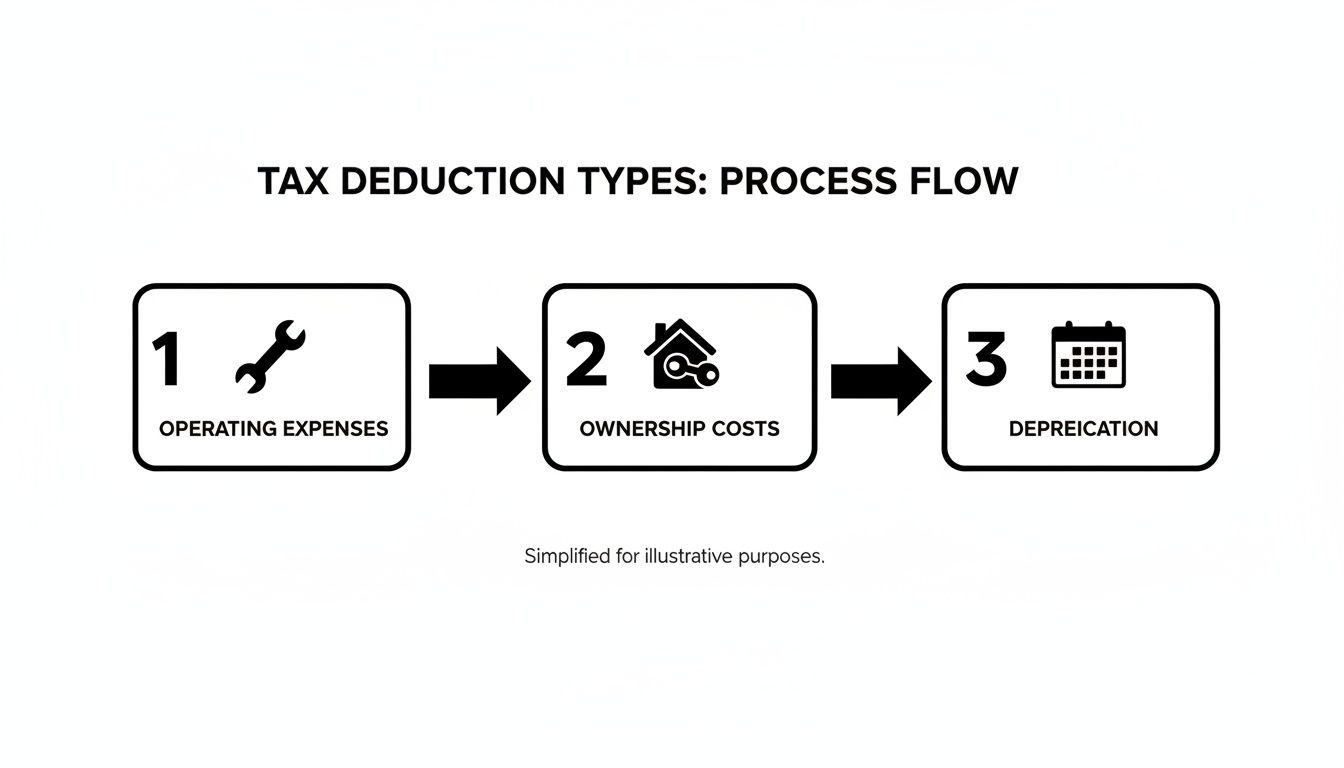
As you can see, your deductions fall into three main buckets. Each one is critical for shrinking your taxable income.
Step 3 Calculate Your Annual Depreciation
Like we touched on earlier, depreciation is a landlord's secret weapon. It’s a "paper expense" that lets you deduct a portion of your property's value each year. Alex’s property (just the building, not the land) is valued at $275,000. The IRS says residential real estate is depreciated over 27.5 years, so the math is simple.
He just divides the property's value by 27.5, which gives him a whopping $10,000 deduction for the year. This is a huge win because it reduces his taxable profit without costing him a single dime out-of-pocket. For a complete walkthrough of this form, check out our guide on how to fill out Schedule E for rental income at https://alliedtax.com/schedule-e-rental-income/.
Step 4 Determine Your Net Profit or Loss
Now for the moment of truth. Alex just needs to do some simple subtraction: take his gross income and subtract all his expenses, including that big depreciation number.
- Gross Income: $24,000
- Total Expenses ($16,100 + $10,000): $26,100
- Net Result: $24,000 – $26,100 = -$2,100
Wait, a negative number? That's right. On paper, Alex has a net loss of $2,100. This is where things get really interesting, thanks to a concept called the Passive Activity Loss (PAL) rules.
The PAL rules generally stop you from using losses from "passive" activities (like most rental properties) to cancel out income from your day job. But, there's a huge exception for landlords.
If your income is below a certain level, you can often deduct up to $25,000 in rental losses against your other income. This special allowance is an incredible benefit, turning a paper loss into real money back in your pocket at tax time.
Avoiding Common Rental Tax Filing Mistakes
Diving into rental income taxes can feel like a maze, but staying on the right side of the IRS often comes down to sidestepping a few common tripwires. Nobody wants to face an IRS audit, and the best defense is knowing where other landlords often go wrong. Simple mistakes can easily escalate into hefty penalties and a whole lot of stress.
Think of your tax return as the final exam for your rental business. The entire year is your study period, and your records are the notes. Filing an inaccurate return is like showing up for that exam completely unprepared—the outcome is never pretty. Let's walk through the most frequent blunders and how you can avoid them.
Misclassifying Major Improvements as Repairs
This is, hands down, one of the biggest and most costly mistakes landlords make. It’s easy to get these two mixed up. As we discussed earlier, a repair—like fixing a leaky pipe—is an expense you can deduct in the current year. Nice and simple. But an improvement—like a full kitchen gut renovation—is a capital expense you have to depreciate over 27.5 years.
It’s tempting to classify a big project as a repair to get the full deduction now, but the IRS is very clear on the distinction.
- A repair simply keeps your property in good working order.
- An improvement substantially betters, restores, or adapts the property.
Getting this wrong is a huge red flag. An audit could lead to that big deduction being disallowed, leaving you with a bill for back taxes and penalties. When in doubt, document everything and talk to a tax pro.
Failing to Keep Meticulous Records
"I'll get to it later" is the battle cry of a future audit victim. Your deductions are worthless without proof. The IRS isn't going to just take your word that you spent $5,000 on new flooring; they want to see the receipts, invoices, and bank statements to back it up.
A shoebox overflowing with faded receipts is not a system—it’s a liability waiting to happen. In this day and age, there's simply no excuse for poor record-keeping.
Get a system in place today. It doesn’t have to be complicated. Use accounting software or even a well-organized spreadsheet. The key is to log every single expense as it happens and scan a digital copy of every receipt. This simple habit turns tax time from a chaotic scavenger hunt into a straightforward reporting task. You can read more about some of the most common tax filing mistakes and how to fix them.
Incorrectly Handling Security Deposits
This is another area where landlords frequently trip up. A standard security deposit—the kind you hold and plan to return to the tenant—is a liability on your books, not income. You only claim it as income if, and when, you keep a portion to cover damages or unpaid rent.
The mistake happens when landlords treat the last month's rent as a security deposit or collect other non-refundable fees. The IRS sees that money as advance rent, which is taxable income in the year you receive it, not the year it applies to. It’s a crucial timing difference that can throw off your entire return.
Mixing Personal and Rental Use Expenses
Things get especially tricky if you personally use your rental property, like a vacation home you rent out for part of the year. You absolutely cannot deduct expenses for the days you or your family used the property.
You have to meticulously divide your expenses—like mortgage interest and property taxes—between personal use and rental use, based on the number of days for each. This requires careful tracking and is one of the most complex aspects of rental tax law, often making professional guidance a smart move.
Common Questions About Rental Income Tax
Getting into the landlord game inevitably brings up a lot of questions, especially around tax time. Let's tackle some of the most common ones we hear from property owners, whether they're just starting out or have been at it for years.
Do I Owe Taxes If My Rental Property Lost Money?
Here’s the short answer: no. If your expenses were greater than your income, you won’t owe tax on your rental for that year. But—and this is a big but—you still have to report everything to the IRS on Schedule E.
That net loss is what’s known in the tax world as a "passive loss." For most landlords, a special rule allows you to deduct up to $25,000 of that loss against your other income, like the salary from your day job. If your income is too high to qualify for this, don't worry. The loss isn't gone for good; you can carry it forward to offset rental profits in future years.
How Does an LLC Change My Rental Property Taxes?
For most landlords who own property by themselves, forming a single-owner LLC actually doesn't change a thing on your federal tax return. The IRS considers a single-member LLC a "disregarded entity," which is just a fancy way of saying all the income and expenses flow straight onto your personal tax forms.
You’ll report everything on Schedule E, exactly as you would if you owned the property under your own name. The real power of an LLC isn't about saving on taxes; it's about strong liability protection. It builds a wall between your personal finances and your rental business. If you have partners, however, the LLC is treated as a partnership and will need its own separate business tax return.
The real difference between a repair and an improvement comes down to intent and impact. A repair maintains the property's current condition, while an improvement enhances its value or extends its life.
What Is the Real Difference Between a Repair and an Improvement?
Think of it this way: a repair is like patching up a pair of well-loved jeans. You're just keeping them in good, usable condition. Fixing a leaky pipe or replacing a cracked pane of glass falls into this category. You get to deduct the entire cost of repairs in the year you make them.
An improvement, on the other hand, is like getting those jeans professionally tailored and adding a whole new design. It makes the property better, restores it to a like-new state, or adapts it for a new purpose. A full kitchen remodel or adding a brand-new deck are classic examples. These are bigger investments, so you can't write them off all at once. Instead, their cost is "capitalized" and deducted over several years through depreciation.
Can I Deduct Travel Expenses for My Rental Property?
Absolutely, as long as the trip is genuinely for business. If the main reason you're traveling is to collect rent, manage the property, or do maintenance, you can deduct your travel costs. This could be the standard mileage rate for your car or your actual costs for things like gas and oil.
Where it gets tricky is mixing business with pleasure. You can't write off a week-long beach vacation just because you spent an hour fixing a faucet at your rental condo. If the trip is a mix, you have to be meticulous about separating the costs. You can only deduct expenses for the specific days you were actively working on your rental property.
You don't have to figure out the maze of rental property taxes on your own. The team at Allied Tax Advisors provides expert guidance to make sure you’re taking advantage of every deduction and keeping everything above board. Schedule a consultation with our San Diego-based tax experts today.