
Yes, your rental income is taxed. The IRS views the money you collect from tenants as ordinary income, much like the salary you earn from a job. It gets added to your other income and is taxed at your regular federal income tax rate.
The Basics of How Your Rental Income Is Taxed

Getting a handle on how rental income tax works is the first real step toward building a solid financial strategy for your properties. The core idea is straightforward: the rent checks you deposit are part of your total annual income. This means the profit from your rental is taxed at your marginal tax rate, which is set by your total earnings for the year.
Think of it this way: your rental profits are stacked on top of your other income. Because the U.S. has a progressive tax system, as your total income climbs into higher brackets, so does the tax rate you pay on those top dollars. For any real estate investor, grasping this link between rental cash flow and your personal tax situation is absolutely fundamental.
How Your Rental Income Tax Rate Is Determined
Your final tax bill isn't based on one single factor. It's a combination of your total income, how you file, and whether certain other taxes apply. This table breaks down the core elements that dictate your tax liability, giving you a quick reference for understanding the moving parts of your rental income tax.
| Key Factor | What It Means for You | How It Affects Your Taxes |
|---|---|---|
| Filing Status | Your filing status (e.g., Single, Married Filing Jointly) determines the income thresholds for each tax bracket. | Different statuses have different bracket ranges. A higher income threshold means more of your money is taxed at lower rates. |
| Taxable Income | This is your total income (salary, rental profits, etc.) minus all your eligible deductions. | Your net rental income is added to your other income, and the total amount places you into a specific tax bracket. |
| Federal Tax Brackets | The U.S. has seven tax brackets with rates from 10% to 37%. Your rental income is taxed at your highest marginal rate. | The more you earn, the higher the tax rate on your last dollar of income. This is the rate your rental profit will be taxed at. |
| Net Investment Income Tax (NIIT) | A 3.8% surtax on investment income (including rent) for high earners whose income exceeds certain thresholds. | If your income is above the limit, this tax is an additional layer on top of your ordinary income tax rate. |
Ultimately, these pieces work together to calculate what you owe. The key is to remember that your rental income isn't taxed in a vacuum; it's part of your overall financial picture.
Understanding Tax Brackets and Rates
Here in the U.S., that rental profit is taxed at ordinary income rates, which currently range from 10% to 37%. The specific rate you pay depends entirely on your total taxable income and filing status (like single, or married filing jointly). Your income falls into one of seven federal tax brackets, and that determines your rate.
For landlords, it pays to keep an eye on tax law changes. For instance, the Qualified Business Income (QBI) deduction is a big one. It allows many landlords to deduct up to 20% of their qualified rental business income. You can find more helpful information about rental property tax rates on Landlord Studio.
This QBI deduction can be a game-changer, effectively dropping the top marginal tax rate on that rental income from 37% down to 29.6%. However, high-income earners might also get hit with an additional 3.8% Net Investment Income Tax (NIIT), making smart tax planning even more crucial.
The Net Investment Income Tax Explained
The NIIT is essentially a surcharge that applies to individuals, estates, and trusts once their income crosses a certain high threshold. If your modified adjusted gross income (MAGI) is over the line, you could owe this extra tax on your net investment income—which absolutely includes rental income.
Key Takeaway: The NIIT specifically targets passive income streams. For many landlords, rental activities are considered passive, placing them directly in the crosshairs of this additional tax if their income is high enough.
It’s vital to understand these two potential layers of tax: your ordinary income rate plus the possible NIIT. This really drives home the point that your rental income isn't isolated. It's woven into your complete financial profile, which is exactly why deductions are so powerful. As we'll get into next, every dollar you deduct is a dollar that isn't subject to these rates.
Finding Your True Taxable Rental Income

One of the most common—and costly—mistakes new landlords make is thinking the IRS taxes every dollar of rent that hits their bank account. That’s simply not the case. The real number you're taxed on is your net rental income.
Think of your rental property as a small business. If you ran a local bookstore, you wouldn't get taxed on the cover price of every book sold. You’d first deduct the cost of the books, employee salaries, and the shop's rent. The profit left over is what's taxable. Your rental property works the same way.
Getting this calculation right is the cornerstone of managing your rental finances. It ensures you're not paying a penny more in taxes than you owe, because the IRS is only interested in your actual profit, not your total revenue.
Calculating Your Net Rental Income
So, how do we get to that all-important net figure? The formula is straightforward: add up all the income the property generates, then subtract all your legitimate operating expenses for the year. That final number is your taxable rental income.
Let's walk through this process step-by-step.
Step 1: Add Up Your Gross Rental Income
First, you need to tally up your gross rental income, which is often more than just the monthly rent checks. The IRS has a broad definition of income, and you’ll need to include everything the property brings in.
This typically includes:
- Advance Rent: If a tenant pays January's rent in December, the IRS considers that income in the year you received it (December), not the month it was for.
- Late Fees: Those extra charges you collect for overdue rent? Yep, that's taxable income.
- Lease Cancellation Fees: If a tenant pays a penalty to break their lease early, that payment goes into your income column.
- Tenant-Paid Expenses: Did your tenant pay the water bill or for a minor repair directly, as required by the lease? You have to report that payment as income. The good news is you can then turn around and deduct that same amount as an expense.
Step 2: Subtract Your Allowable Expenses
With your total income calculated, it's time for the fun part: subtracting your expenses. The IRS allows you to deduct any costs that are "ordinary and necessary" for managing and maintaining your property. We're talking about things like mortgage interest, property taxes, insurance, repairs, and property management fees.
Let's See it in Action:
Say you collected $24,000 in rent and $200 in late fees over the year. Your gross rental income is $24,200.During that same year, you spent $11,000 on your mortgage interest, property taxes, insurance, and a few necessary repairs.
Your net taxable rental income is $13,200 ($24,200 – $11,000).
This simple math shifts the tax burden from your total collections to your actual profit. By carefully tracking every single expense, you take direct control over your tax bill. In the next section, we’ll dive deep into all the powerful deductions you can claim.
Unlocking Every Deduction to Lower Your Tax Bill
Once you’ve tallied up your gross rental income, we get to the fun part—subtracting all your expenses. Think of every legitimate deduction as a direct shot at lowering your tax bill. The more you claim, the less rental profit the IRS gets to tax.
It’s a shame, but countless landlords miss out on thousands of dollars in savings every year. They simply don’t know what they’re allowed to write off. These aren't sneaky loopholes; they're the standard, IRS-approved costs of doing business. As long as an expense is both “ordinary and necessary” for running your rental, it’s fair game.
Core Operating Expense Deductions
These are the bread-and-butter expenses you’ll face year in and year out. Keeping a close eye on these costs is the foundation of a smart tax strategy.
- Mortgage Interest: For most property owners, this is the single biggest write-off. You get to deduct the interest part of your mortgage payment (found on Form 1098), but not the principal that pays down your loan and builds equity.
- Property Taxes: Those local real estate taxes you pay every year are 100% deductible. If they’re paid through an escrow account with your mortgage, this amount will also show up on your Form 1098.
- Insurance Premiums: The cost of your landlord, flood, fire, and theft insurance policies is a necessary expense, and therefore, fully deductible.
- Management Fees: If you hire a pro to handle the day-to-day headaches like finding tenants, collecting rent, and coordinating maintenance, their fees are a deductible business expense.
- Advertising: Did you run an online listing, put an ad in the local paper, or even just print a "For Rent" sign? Those costs are all deductible.
- Professional Services: Don't forget the fees you pay to your accountant for tax prep or a lawyer for lease agreements. These costs are part of running your rental business.
The Critical Difference Between Repairs and Improvements
This is where a lot of landlords get tripped up, but getting it right is non-negotiable for filing an accurate tax return. A repair simply keeps your property in good working order, while an improvement makes it better, adapts it for a new use, or extends its life.
Key Insight: Repairs are deducted in full in the year you pay for them, giving you an immediate tax benefit. Improvements have to be capitalized and depreciated over their useful life—which for a residential rental property is a long 27.5 years.
That means fixing a leaky pipe gives you a nice write-off right now. A full kitchen gut-job, on the other hand, gives you a small deduction spread out over nearly three decades.
Here’s a table that breaks it down.
Repairs vs Improvements: A Landlord's Guide
This table clarifies the crucial distinction between immediate repairs and long-term improvements, helping you correctly classify expenses for maximum tax benefit.
| Expense Type | Classification | How It's Taxed with an Example |
|---|---|---|
| Fixing a Leaky Faucet | Repair | You pay a plumber $200. This is routine maintenance that just gets the faucet working again. You deduct the full $200 from your rental income this year. |
| Complete Kitchen Remodel | Improvement | You spend $20,000 on new cabinets, countertops, and appliances. This adds real value and is a major upgrade. You can't deduct the $20,000 today. Instead, you depreciate it over 27.5 years. |
| Replacing a Single Broken Window | Repair | The cost to replace one pane of glass is a simple repair. That expense is fully deductible in the year you paid for it. |
| Installing All New Energy-Efficient Windows | Improvement | Swapping out all the windows is a major project that enhances the property's value and efficiency. The total cost is an improvement that must be depreciated. |
Nailing this distinction is one of the most important parts of your tax strategy. To make sure you’re getting it right, you can dig deeper with this guide on rental property repair deductions.
Other Valuable Landlord Deductions
Beyond the big-ticket items, a lot of smaller expenses can still chip away at your taxable income. Don't let these slip through the cracks.
- Utilities: If your rental agreement has you paying for water, gas, electricity, or trash collection, those costs are fully deductible.
- Travel Expenses: Did you drive to the property to show it, collect rent, or meet a contractor? You can deduct the actual cost of gas and oil or, much easier, just use the standard mileage rate set by the IRS each year.
- Home Office: If you have a dedicated space in your home that you use exclusively and regularly for managing your rental business, you might qualify for the home office deduction.
- HOA and Condo Fees: Any recurring fees paid to a homeowners' association or condo board for your rental unit are a deductible operating expense.
By meticulously tracking every dollar spent on your property, you turn those expenses into tax savings. It’s this disciplined approach that ensures you pay tax only on your true profit, maximizing your real return on investment.
Mastering Depreciation: The Landlord's Best-Kept Secret
Of all the deductions available to landlords, one stands head and shoulders above the rest, and it’s the one that doesn’t cost you a dime out-of-pocket this year. It's called depreciation, and it’s arguably the most powerful tax break in real estate.
Think of it like this: if you bought a new work truck, you know it loses value every year from wear and tear. The IRS lets you write off that loss of value. Your rental property is treated the same way. The IRS considers that the physical building—not the land it sits on—is slowly wearing out over time.
This allows you to deduct a portion of the building's cost each year, creating a "paper loss" that can shield your actual cash profits from taxes. It’s entirely possible to have a property that’s putting cash in your pocket every month while reporting a taxable loss on paper, thanks to depreciation.
How Depreciation Works in the Real World
The IRS has a set lifespan for residential rental properties: 27.5 years. To figure out your annual deduction, you take the value of the building (your purchase price plus some closing costs, minus the value of the land) and simply divide it by 27.5.
Let’s walk through a quick example:
- Find Your Building's Value (Cost Basis): You buy a rental for $350,000. Looking at your appraisal or local tax records, you see the land is valued at $75,000. That means the building itself has a basis of $275,000 ($350,000 total – $75,000 land).
- Calculate the Annual Deduction: Now, just divide the building's basis by its useful life: $275,000 / 27.5 years = $10,000 per year.
- Claim Your Tax Break: You get to deduct that $10,000 from your rental income every single year for the next 27.5 years. You didn't actually spend that money, but it still lowers your tax bill.
This is a fundamental reason why real estate is such a fantastic, tax-advantaged investment. For a deeper dive into the mechanics, check out our complete guide on claiming depreciation on rental property.
The Other Side of the Coin: Depreciation Recapture
Depreciation feels like a free lunch, but the IRS always comes back for its slice of the pie. When you eventually sell your rental for a profit, you'll have to deal with something called depreciation recapture.
Basically, the IRS says, "Hey, we let you take all those deductions over the years, which lowered your taxes. Now that you're selling, we need to tax that benefit."
All the depreciation you claimed over your ownership period is "recaptured" at the time of sale and taxed at a special, fixed rate of up to 25%. This is a separate tax from the capital gains tax you'll pay on the property's appreciation.
A Quick Recapture Example:
Let's say you sell that same property after 10 years. You've claimed $100,000 in depreciation deductions ($10,000 x 10 years). That $100,000 portion of your gain will be taxed at the recapture rate, while the rest of your profit is treated as a capital gain.
Getting blindsided by depreciation recapture can turn a profitable sale into a tax nightmare. It's a critical piece of the puzzle to understand, balancing the fantastic tax savings you get now against the bill you'll have to pay later.
Getting Your Paperwork Right: Reporting Rental Income and Expenses
Knowing all the potential deductions is one half of the puzzle. The other half is reporting everything correctly to keep the IRS happy. For almost every landlord out there, your tax world revolves around a single, crucial document: IRS Form Schedule E, Supplemental Income and Loss.
Think of Schedule E as the official ledger for your rental property. It’s where you lay it all out for the government—your gross rental income goes right at the top, and then you systematically list every single one of your deductible expenses below. The form has dedicated lines for all the big ones we’ve covered, from mortgage interest and property taxes to insurance, repairs, and that all-important depreciation deduction.
How to Navigate Schedule E
The form itself is pretty straightforward. It’s designed to walk you through the calculation, with income at the top followed by a clean list of expense categories. You’ll plug in your totals for advertising, management fees, utilities, and everything else on their specific lines.
Once everything is entered, the form spits out your net rental income or loss for the year. That final number is what gets carried over from Schedule E to your main tax return, Form 1040, where it joins the rest of your income. To really get into the weeds of this essential form, you can learn more about how to complete Schedule E for rental income.
A Quick Word on Short-Term Rentals
The explosion of platforms like Airbnb and VRBO has created a whole different kind of landlord. If this is you, you need to know about a handy little guideline called the “14-day rule” (sometimes called the Augusta Rule).
It’s a simple but powerful rule with two sides:
- If you rent your property for 14 days or fewer during the entire year, you don’t have to report a dime of that income to the IRS. It's basically free money from a tax perspective.
- The catch? You can’t deduct any rental expenses, either. It’s an all-or-nothing deal, perfect for someone who just rents out their house for a couple of weeks during a big local festival or event.
But the moment you hit day 15, everything changes. You are now required to report all your rental income, but you also get to unlock all the associated expense deductions.
Key Takeaway: Meticulous tracking is non-negotiable here. A huge part of knowing how to prepare for tax season as a landlord is keeping good records all year long, not just scrambling in April.
Are Your Rentals a "Passive Activity"?
Now for a slightly more complex topic. The IRS generally considers rental real estate to be a passive activity. In simple terms, this means you usually can’t use losses from your rental property to offset your "active" income, like the salary from your day job. But, as with most things tax-related, there are some major exceptions.
This flowchart gives a great visual for figuring out depreciation, one of the key deductions that falls under these rules.
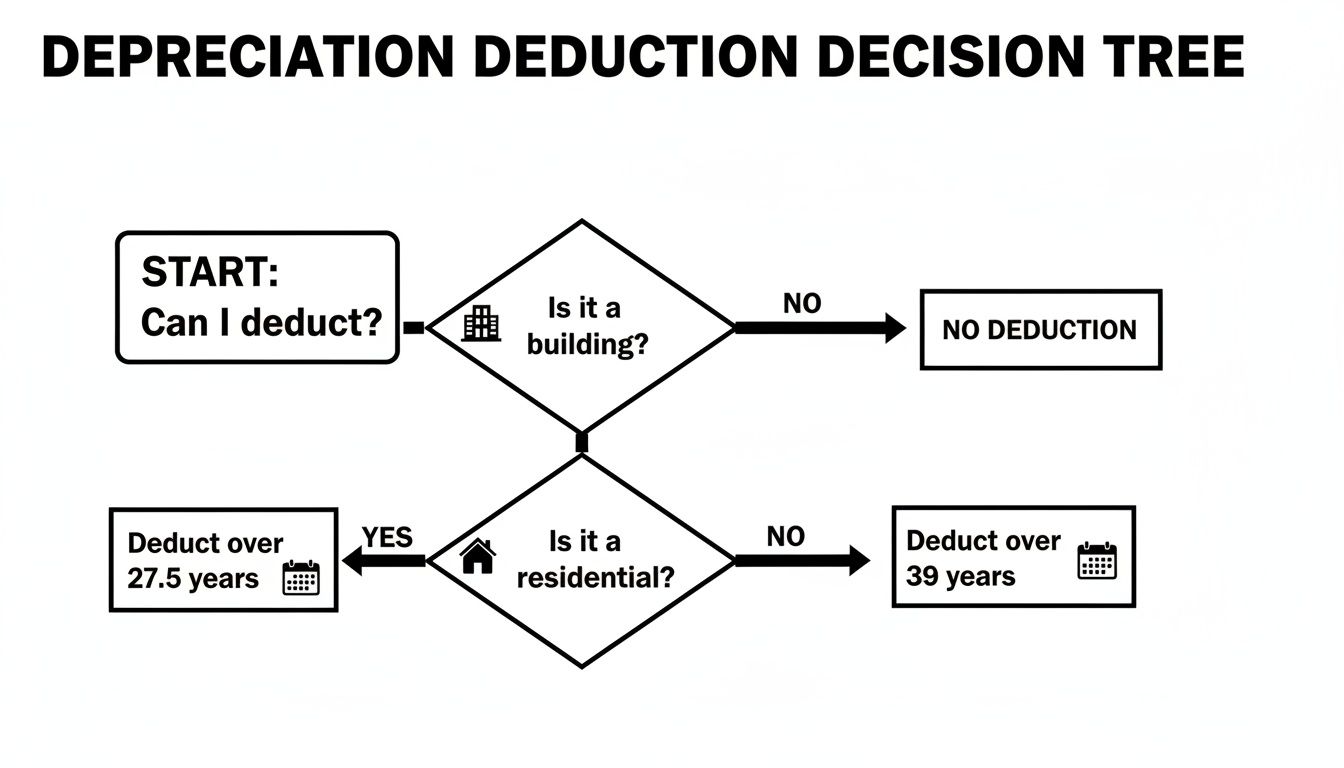
As you can see, for residential buildings, the depreciation clock is typically set to 27.5 years.
One of the biggest exceptions is for landlords who "actively participate" in their rentals. If your modified adjusted gross income is under $100,000, you can often deduct up to $25,000 in rental losses against your other income. This special allowance gradually disappears as your income climbs toward $150,000.
Then there’s the holy grail for serious investors: qualifying as a "real estate professional." If real estate is basically your full-time job and you spend a significant amount of your working hours on it, the IRS might grant you this status. If you qualify, your rental activities are no longer considered passive. That means any losses can be fully deducted against all your other income, blowing past that $25,000 ceiling.
Don't Forget About State and Local Rental Taxes
It’s a classic rookie mistake: you spend all your time worrying about the IRS and completely forget about state and local taxes. While federal taxes are the big one, your obligations don't stop there. A complex patchwork of state, city, and even county taxes can take a serious bite out of your profits, and claiming ignorance won't save you from penalties.
Think of it this way: federal tax rules are the main highway. But once you cross a state line, you're on their roads with their own set of rules and tolls. Most states with a personal income tax will want their share of your rental profits, and they generally follow the federal government's lead on what counts as income.
State Income Tax on Rental Properties
If you own a rental in a state that collects income tax, you'll almost certainly need to file a state tax return there—even if you don't live there. This trips up a lot of out-of-state investors. For example, if you live in Texas but own a rental property in California, get ready to file a non-resident California tax return to report that income.
This is where property location can really make a difference. If you're fortunate enough to invest in one of the states with no income tax, like Florida or Nevada, you can sidestep this entire layer of tax compliance. It significantly simplifies your financial life.
To put this in a global perspective, tax rules on rental income are all over the map. A review of over 80 countries shows wildly different tax rates and rules for non-resident property owners. It just goes to show you can't assume anything; you have to know the specific rules for the exact location of your property.
It's Not Just Income Tax: Local Levies and Fees
The tax maze gets even more complicated when you zoom in on the local level. Depending on where your property is, you could be on the hook for a handful of other taxes that catch landlords by surprise.
Keep an eye out for these:
- Gross Receipts Taxes: Some cities tax your top-line rental revenue, before you subtract a single expense.
- Business Licenses and Fees: Many municipalities consider landlording a business and require you to register and pay annual fees just to operate.
- Short-Term Rental (STR) Taxes: If you’re in the Airbnb or Vrbo world, you'll almost certainly have to collect and remit special occupancy or lodging taxes—just like a hotel. These can be high and come with strict rules.
The Bottom Line: State and local tax laws are anything but uniform. The rules in one city can be completely different from the town next door. Never, ever assume the tax code is the same for two different properties.
This hodgepodge of regulations is exactly why a one-size-fits-all approach to rental taxes is so risky. The rules are too varied, and the penalties for getting it wrong can be steep, ranging from fines to liens on your property.
This isn't a part of your business where you should just "wing it." Unless you're an expert in the specific state and local tax codes where your property is located, getting professional help is non-negotiable. Consulting a CPA or an enrolled agent with that specific local expertise isn't a cost—it's an essential investment to protect your assets.
Your Top Rental Tax Questions, Answered
Let's face it, diving into rental property taxes can feel overwhelming. To cut through the noise, I’ve put together straightforward answers to some of the most common questions I hear from landlords. We'll tackle everything from security deposits to that famous "14-day rule" so you can handle your rental finances with confidence.
Is a Security Deposit Taxable When I First Get It?
Nope. When you collect a security deposit, the IRS doesn't see it as income. Instead, it's considered a liability on your books because you're expected to return it. Think of it as just holding onto the tenant's money for them.
The situation flips, however, if you end up keeping some or all of that deposit. Let's say a tenant leaves without paying the last month's rent or causes damage beyond normal wear and tear. The moment you withhold that deposit money to cover those costs, it becomes taxable income. You'll need to report that amount in the year you officially decide to keep it.
Watch Out for This: Don't confuse a security deposit with advance rent. If a tenant pays you for the "last month's rent" at the start of the lease, that's rental income in the year you receive it—not in the year it's applied.
I Only Rented My Place for Two Weeks. Do I Have to Report the Income?
This is where the “14-day rule” becomes your best friend, especially for those dipping their toes into short-term rentals. It's a fantastic tax break. If you rent out your property for 14 days or fewer over the entire year, you don’t have to report a dime of that income to the IRS.
It really is that simple. The catch? You can't deduct any rental expenses related to it, like cleaning or booking fees. But once you hit that 15th rental day, the game changes. All the rental income for the entire year becomes taxable, but you can also start deducting all your eligible expenses.
How Can I Tell if Something Is a Repair vs. an Improvement?
Getting this right is one of the most important things for a landlord to understand. A repair is something that keeps your property in good working condition, and you can deduct the full cost in the year you paid for it. An improvement, on the other hand, makes your property better, more valuable, or extends its life, so you have to spread that cost out over time through depreciation.
Here’s an easy way to think about it:
- Repair (Deduct Now): You’re fixing a leaky faucet, patching drywall, or replacing a single cracked window. These are about maintenance and restoring things to how they were.
- Improvement (Depreciate Over 27.5 Years): You’re putting on a whole new roof, gutting and remodeling the kitchen, or adding a brand-new deck. These are major upgrades that add real value.
Can I Write Off Rental Losses Against My W-2 Salary?
The answer is a classic "it depends," but for many landlords, it's a qualified yes. By default, the IRS considers rental activities "passive," meaning you usually can't use those losses to offset "active" income from your day job.
But there's a big exception for hands-on landlords. If you actively participate in managing your property and your modified adjusted gross income (MAGI) is $100,000 or less, you can generally deduct up to $25,000 in rental losses against your other income. That deduction gradually disappears as your MAGI climbs toward $150,000. The rules get even more complex (and potentially more favorable) if you qualify as a "real estate professional."
At Allied Tax Advisors, we live and breathe this stuff. We specialize in helping real estate investors make sense of complex tax situations just like these. If you need an expert in your corner to ensure you're compliant and keeping as much of your return as possible, our team is here for you. Discover our personalized tax services at https://alliedtax.com.