
When you first get into rental properties, one of the most important things to wrap your head around is that almost every dollar you receive is taxable income. This includes the obvious stuff like monthly rent, but also advance rent payments and even parts of the security deposit you end up keeping.
The good news? While the income is taxable, almost every expense you incur to keep that property running can be used to lower your tax bill.
Demystifying Your Rental Income And Tax Obligations

The single best piece of advice I can give a new landlord is to start treating your property like a business from day one. It’s a simple but powerful mental shift. Every dollar it brings in is revenue, and every dollar you put into it is a potential business expense. This is the bedrock of a smart tax strategy.
The IRS casts a pretty wide net when defining rental income. It's much more than just the check that shows up on the first of the month. To stay on the right side of tax law, you have to be meticulous about tracking all the different ways you get paid.
What The IRS Considers Rental Income
At its core, any payment you receive for someone using or living in your property is going to count. But let's get into the specifics beyond just the standard monthly rent. You also have to report:
- Advance Rent: Let's say a new tenant pays their first and last month's rent upfront. That "last month's rent" is considered income in the year you receive it, not the year it actually applies to.
- Lease Cancellation Fees: If a tenant needs to break their lease and pays you a fee to do so, that money is fully taxable rental income.
- Expenses Paid by the Tenant: Imagine your lease makes you responsible for the water bill, but your tenant pays it directly one month to avoid a shutoff. The amount they paid is considered income to you. The flip side is that you can then deduct that same amount as a utility expense.
One of the most common mix-ups is around security deposits. A true security deposit—one you hold and plan to return to the tenant—is not income. But the moment you keep any part of it to cover, say, a hole in the wall or unpaid rent, that portion immediately becomes taxable income for that year.
To give you a clearer picture, here’s a quick breakdown of what the IRS is looking for.
What Counts as Taxable Rental Income
| Payment Type | Is It Taxable Income? | Key Consideration |
|---|---|---|
| Monthly Rent | Yes | This is the most straightforward form of rental income. |
| Advance Rent | Yes | Taxable in the year you receive it, regardless of the period it covers. |
| Security Deposit | No, unless… | It becomes taxable income only if you keep all or part of it. |
| Lease Cancellation Fee | Yes | This payment is considered compensation for breaking the contract. |
| Tenant-Paid Expenses | Yes | If they pay for something that is your responsibility (e.g., a utility bill). |
| Services in Lieu of Rent | Yes | If a tenant does work (like painting) instead of paying rent, the fair market value of that service is income. |
This table is a great starting point, but always remember to document everything. Clear records are your best defense.
Navigating Local And Market Nuances
The global real estate rental market is booming, with some projections showing it could hit $3.87 trillion by 2029. This isn't just an interesting statistic; it shows how financially significant these investments have become, which is why tax authorities are paying closer attention.
On top of federal rules, the game can change depending on your property's location and type. If you're in the short-term rental market, for instance, you'll find that local city or county rules add a whole other layer of complexity.
It's a really smart move to check out a detailed Short Term Rental (STR) Business License Tax Compliance Guide to make sure you’re squared away on all local and state requirements. A little proactive research here can save you a world of headaches and potential fines down the road.
Maximizing Your Deductions to Lower Taxes

While keeping tabs on your rental income is half the battle, the real power to reduce your tax bill lies in meticulously tracking every single legitimate deduction. The moment you own a rental, you're running a business. That means nearly every dollar you spend to operate and maintain it can be used to lower your taxable income.
This goes way beyond the obvious stuff. From the interest on your mortgage to the fees you pay a property manager, each expense chips away at your overall tax liability. The key, of course, is knowing what counts and keeping records that are beyond reproach.
Unpacking Your Ordinary and Necessary Expenses
The IRS gives us a fairly broad framework: you can deduct expenses that are both "ordinary" and "necessary" for your rental business. An ordinary expense is one that’s common in the industry, while a necessary expense is one that’s helpful and appropriate for running your property.
This simple rule covers a huge range of costs every landlord incurs. Here are some of the heavy hitters you absolutely shouldn't miss:
- Mortgage Interest: For most landlords, this is the single largest deductible expense you'll have, usually detailed on Form 1098 from your lender.
- Property Taxes: Those state and local property tax bills are fully deductible for your rental properties.
- Insurance Premiums: This includes landlord-specific policies, flood insurance, and any liability coverage you carry.
- Property Management Fees: If you hire a pro to handle the day-to-day, their fees are 100% deductible.
- Advertising Costs: Money spent on Zillow, "For Rent" signs, or other marketing to find tenants is a straightforward business expense.
- Utilities: If your rental agreement includes you paying for water, gas, electricity, or trash service, you can write off those costs.
On top of these operational deductions, actively pursuing property tax savings can give you another powerful way to cut down on one of your biggest ongoing costs.
The Crucial Difference Between Repairs and Improvements
This is a big one. It's an area where landlords frequently get tripped up, and the IRS pays close attention. A repair is something that keeps your property in good working order. An improvement, on the other hand, makes your property better, restores it, or adapts it for a new use.
Why does it matter so much? Because repairs are fully deductible in the year you pay for them, giving you an immediate tax benefit. Improvements have to be capitalized and depreciated, meaning you deduct a small piece of the cost each year over its useful life.
The question you should always ask is: "Did this expense just patch something up and return it to its original state, or did it make it fundamentally better?" Fixing a single broken window is a repair. Replacing all the old, drafty windows with brand-new, energy-efficient ones is an improvement.
Sorting your expenses into the right buckets is non-negotiable. Let’s break it down with a clear guide.
Repairs vs Improvements A Landlord's Guide
Here's a quick reference table to help you distinguish between a currently deductible repair and a capital improvement you'll need to depreciate.
| Expense Example | Classification | Tax Treatment |
|---|---|---|
| Fixing a leaky faucet | Repair | Deduct the full cost in the current tax year. |
| Replacing the entire roof | Improvement | Capitalize the cost and depreciate it over 27.5 years. |
| Repainting a single room | Repair | The cost of paint and supplies is a current-year expense. |
| Adding a new deck | Improvement | This adds value and must be capitalized and depreciated. |
| Replacing a broken light fixture | Repair | This restores the property to its previous working condition. |
| Upgrading the electrical system | Improvement | This enhances the property's value and function. |
Getting this right is essential for staying compliant and making smart financial decisions. A repair offers an immediate tax break, while an improvement provides a steady, smaller deduction for years to come. Understanding this distinction is fundamental to your tax strategy.
Using Depreciation to Your Advantage
Of all the tax perks available to real estate investors, depreciation is easily the most powerful—and the most misunderstood. I like to call it the "phantom deduction." It's a massive expense you can write off against your rental income, but here’s the best part: it costs you zero cash out of pocket in the year you claim it.
So, what is it? The IRS gets that buildings and their components don't last forever. They wear down, become obsolete, and lose value. Depreciation is simply a way to account for this gradual decay on your tax return, letting you deduct a piece of your property's cost each year. This is true even if your property is skyrocketing in market value. It's an absolute cornerstone of smart rental tax strategy.
How Rental Property Depreciation Works
For any residential rental property you own, the IRS has decided its "useful life" is 27.5 years. That's the timeline over which you'll deduct the building's value. The key word there is building. You can only depreciate the structure itself and any improvements; you can never depreciate the land it sits on, because land doesn't wear out.
To figure out your annual deduction, you start with your property's cost basis. This is generally the purchase price plus some of your closing costs, but you have to subtract the value of the land. Once you have the building's value, you just divide it by 27.5.
Let's say you bought a duplex for $350,000. Your tax pro or an appraiser determines the land is worth $75,000. That leaves a depreciable basis for the building of $275,000.
- Building Basis: $275,000
- Depreciation Period: 27.5 years
- Annual Deduction: $275,000 / 27.5 = $10,000 per year
That $10,000 deduction directly reduces your taxable rental income every single year, saving you real money without impacting your cash flow one bit. For a deeper dive into the nuts and bolts, check out this guide on depreciation on rental property.
Understanding Depreciation Recapture When You Sell
Depreciation is a fantastic benefit while you hold the property, but there's a "gotcha" when you decide to sell. The IRS doesn't just forget about the tax breaks you've been taking. They want to "recapture" that benefit, and this is aptly called depreciation recapture.
Every dollar you claim in depreciation lowers your property's cost basis on paper. When you sell, your taxable gain is the difference between the sale price and this artificially low basis. A chunk of that gain—specifically, the amount equal to all the depreciation you ever took—gets taxed at a special recapture rate.
Heads up: Depreciation recapture is taxed at your ordinary income tax rate, but it's capped at a maximum of 25%. This is almost always higher than the long-term capital gains rate, a critical detail that can lead to a surprise tax bill if you're not ready for it.
Let's walk through an example to see how this plays out from start to finish.
A Step-by-Step Depreciation Example
Imagine you hold that same property for five years and then sell it. Here’s the journey:
- Initial Purchase: You bought it for $350,000, with a building value of $275,000.
- Annual Depreciation: You correctly claimed a $10,000 deduction each year.
- Total Depreciation Claimed: Over five years, that’s a $50,000 tax deduction ($10,000 x 5).
- Adjusted Basis Calculation: Your original basis of $350,000 is now reduced by that $50,000 in depreciation. Your new adjusted basis is just $300,000.
- The Sale: You sell the property for a nice profit at $425,000.
- Calculating Total Gain: Your total taxable gain is the sale price minus your adjusted basis: $425,000 – $300,000 = $125,000.
Now for the crucial part. The IRS doesn't treat that $125,000 gain as one lump sum. It gets split into two distinct categories for tax purposes:
- Depreciation Recapture: The first $50,000 of your gain (the amount you depreciated) is taxed at your ordinary rate, up to that 25% cap.
- Capital Gain: The remaining $75,000 ($125,000 total gain – $50,000 recapture) is considered a pure capital gain, taxed at the much friendlier long-term capital gains rates.
Even with recapture on the back end, depreciation is a no-brainer. It effectively gives you an interest-free loan from the government, letting you defer taxes and keep more of your money working for you today. The key is to understand both sides of the coin—the annual benefit and the eventual payback—to truly master your rental property tax planning.
Navigating Passive Activity Loss Rules
So, you've tallied up your expenses, factored in that big depreciation deduction, and your rental property is showing a loss on paper. This is great for your tax bill, right? Well, not so fast. The IRS has a little something called the Passive Activity Loss (PAL) rules, and they can be a major roadblock.
In the eyes of the IRS, rental real estate is almost always considered a "passive activity," no matter how many late-night calls you take about a leaky faucet. This means any losses your property generates are stuck in a "passive" bucket. You can only use them to offset income from other passive activities. If you don't have any passive gains, those losses are essentially benched—suspended and carried forward to use in a future year.
But don't worry, it's not all bad news. There are two very powerful exceptions that allow many landlords to break out of this passive trap and use their losses to their advantage right now.
The $25,000 Special Allowance
The most common escape hatch is the $25,000 special allowance. Think of it as the IRS's nod to the hands-on, small-scale landlord. To get it, you just need to meet the standard of "active participation."
This doesn't mean you have to be a full-time property manager. Active participation is much simpler; it just means you're making the key management decisions.
- Screening and approving new tenants
- Deciding on the rent and lease terms
- Authorizing repairs or signing off on capital improvements
If you're calling the shots like this and own at least a 10% stake in the property, you've likely cleared the active participation hurdle. But there's a catch: this allowance is aimed at middle-income earners. The ability to take this deduction starts to phase out once your Modified Adjusted Gross Income (MAGI) climbs above $100,000, and it disappears completely once you hit $150,000.
For landlords who qualify, this rule is a game-changer. It lets you deduct up to $25,000 in rental losses directly against your non-passive income—like your W-2 salary—each year. That can create some serious, immediate tax savings.
For a deeper dive into the income caps and what it takes to qualify, it's worth learning more about how passive activity loss rules can impact your specific financial situation.
This flowchart gives you a quick look at the tax implications when you eventually sell a rental property.
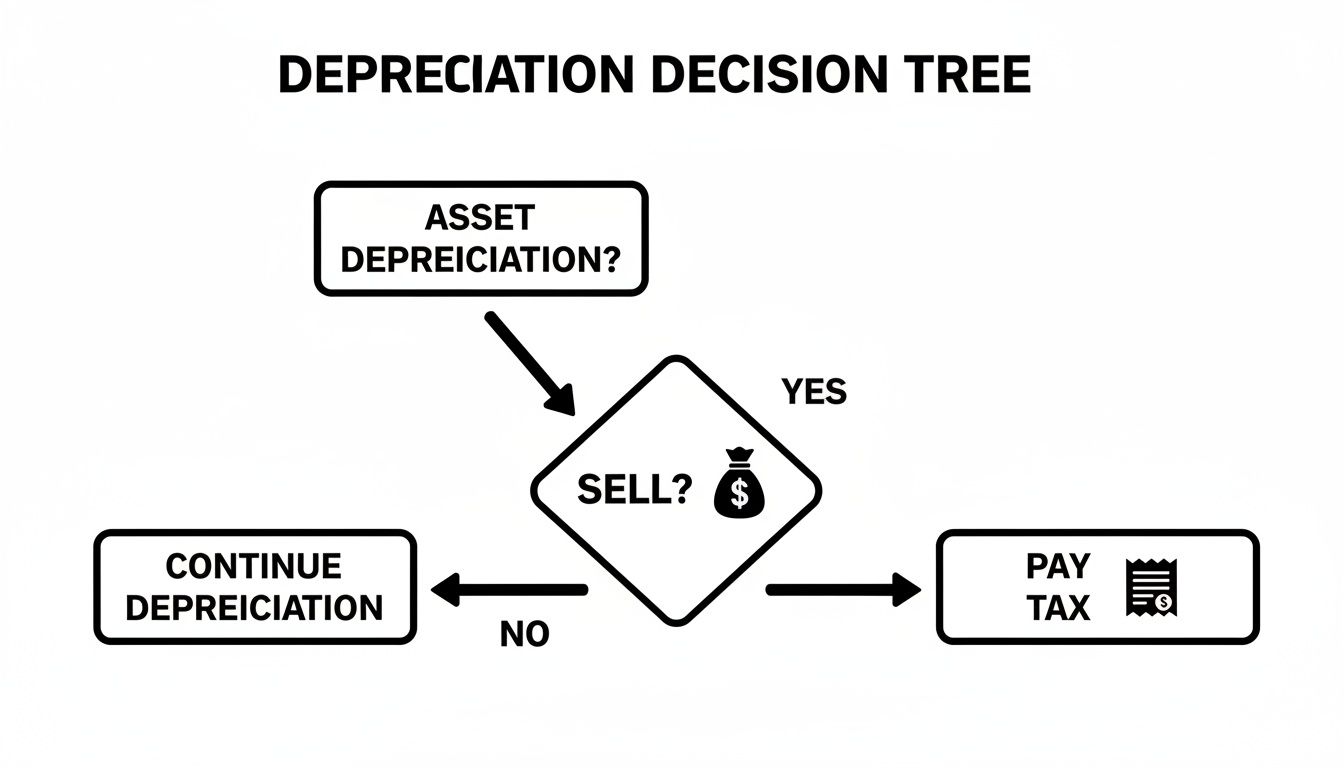
As the visual points out, selling the property is a final reckoning. It's the event that finally lets you "un-suspend" any carried-over passive losses to offset the gain from the sale.
Achieving Real Estate Professional Status
The second exception is a much higher mountain to climb, but the reward is huge: unlimited loss deductions. This is the highly sought-after Real Estate Professional Status. If you qualify, the IRS no longer automatically views your rental activities as passive. This completely changes the game, allowing you to deduct every dollar of your rental losses against any other income you have, with no income limits.
Getting there requires passing a strict, two-part test. You have to meet both of these conditions:
- More than half of all the personal services you perform during the year must be in real property trades or businesses. This is the big one. Real estate can't just be a side hustle; it has to be your main gig.
- You must log more than 750 hours of service during the tax year in real property trades or businesses where you materially participate.
This is a high bar, intentionally set for people whose careers are in the real estate world—think full-time developers, agents, brokers, or property managers. You'll need to keep meticulous, contemporaneous logs of your hours, because you can be sure the IRS will ask for proof. For those who meet these stringent requirements, it's the ultimate key to unlocking the most powerful tax strategy for rental property losses.
Smart Tax Strategies When Selling Your Property

Your annual tax filings are just one piece of the puzzle. The day you decide to sell your rental is a major financial event, and if you’re not prepared, the tax bill can be a real shock. Thinking through the sale is the final, crucial step in making sure you get the most out of your investment.
This isn't as simple as subtracting your purchase price from the sale price. To figure out your real profit for tax purposes, you have to calculate your capital gains correctly. That means tracking your initial cost, adding in all the capital improvements you've made, and—this is the big one—accounting for all the depreciation you’ve claimed over the years.
Calculating Your Capital Gain and Recapture
When you sell, the IRS doesn't care about simple profit; they look at the gain based on your adjusted basis. Think of your adjusted basis as your original cost (purchase price plus closing costs) minus all the depreciation you’ve taken.
Remember how depreciation lowered your taxable income each year? Well, it also lowered your property's basis on paper. This means that when you sell, a larger chunk of the money you receive is considered a taxable gain. This gain gets taxed in two different ways:
- Depreciation Recapture: The part of your gain that comes from the depreciation you claimed is taxed at a maximum rate of 25%. It's the IRS's way of "recapturing" the tax benefit you received.
- Capital Gains: Whatever profit is left over is taxed at the lower long-term capital gains rates.
If you don't plan for both of these, you could be in for a nasty surprise. For a deeper dive into these calculations, you can read more about the tax implications of selling your rental property.
The Power of a 1031 Exchange
Now, what if I told you that you could sell your property, pocket all the profits, and legally kick the tax can way down the road? That's the magic of a 1031 exchange, often called a like-kind exchange. It’s the ultimate upgrade button for your real estate portfolio.
A 1031 exchange lets you sell one investment property and roll the entire proceeds directly into a new, similar one. When you do this, you defer paying both capital gains and depreciation recapture taxes, which keeps every dollar of your money working for you.
This is hands-down one of the most powerful wealth-building tools for real estate investors. Instead of handing over a significant portion of your hard-earned profit to the government, you can use that cash to buy a bigger or better-performing property, letting your returns compound much faster.
Navigating the Strict 1031 Exchange Rules
The benefits are enormous, but the rules are ironclad. There’s no wiggle room. If you miss a deadline by a single day, the whole deal is off, and you'll get hit with the full tax bill. Here’s what you absolutely have to get right:
Like-Kind Property: You have to swap one investment property for another. The good news is that "like-kind" is defined very broadly. You can exchange a duplex for an office building, an apartment complex for raw land, and so on.
Use of a Qualified Intermediary: This is non-negotiable. You can never touch the money from the sale. The funds must go directly to a neutral third party, known as a Qualified Intermediary (QI), who holds them until you close on the new property.
The 45-Day Identification Period: The clock starts ticking the moment you close the sale on your old property. You have exactly 45 calendar days to formally identify potential replacement properties in writing and give that list to your QI.
The 180-Day Closing Period: You must complete the purchase of a property from your identified list within 180 calendar days of the original sale.
These two deadlines run at the same time and are strictly enforced. To pull this off, you need to have your team and a game plan ready before your property even hits the market.
In a climate of rising property values, deferring taxes becomes even more critical. For instance, some markets are booming; European all-property rents shot up by 4.1% in the year to September 2024. This level of appreciation makes tax-deferral strategies like the 1031 exchange an invaluable tool for any investor wanting to grow their portfolio without being slowed down by taxes.
Common Questions About Rental Property Taxes
Let's face it, the day-to-day reality of being a landlord brings up a lot of specific tax questions. You're not just dealing with big-picture concepts like depreciation; you're handling leaky faucets and security deposits. Here are some clear answers to the questions that pop up most often.
Can I Deduct My Own Labor for Repairs?
This is probably one of the most common questions I hear, and the IRS has a clear-cut answer: no. You can't deduct the value of your own time or labor. The logic is that you can't pay yourself a wage for fixing up your own property and then write it off as an expense.
But don't miss the real deduction here. You absolutely can—and should—deduct 100% of the cost of materials you use for those DIY projects. So, while you can't bill for the hours you spend repainting a unit, the cost of the paint, brushes, tape, and drop cloths are all perfectly legitimate expenses.
How Should I Handle Security Deposits?
When you first collect a security deposit, it's not income. Why? Because it isn't actually your money yet. You're simply holding it in trust, fully intending to return it to the tenant when they move out.
The deposit only becomes taxable income at the moment you have a legal right to keep it.
- Covering Damages: Let's say a tenant moves out and you need to keep $300 to repair a damaged wall. That $300 officially becomes rental income in the year you withhold it.
- Applying to Last Month's Rent: If your agreement states the deposit can cover the final month's rent, you'll report it as rental income for that last month.
What if I Live in the Property Part of the Year?
This scenario is common for vacation rentals or for landlords who live in one unit of a duplex or triplex. When a property is a mix of personal home and rental, you have to divide your expenses accordingly. You can only deduct the portion of your expenses that relates to the rental activity.
The most straightforward way to do this is based on the number of days the property was used for each purpose.
For example, imagine you rent out your beach house for 90 days and use it personally for 30 days. The total "use" days for the year are 120. You would be able to deduct 75% (90 rental days ÷ 120 total use days) of your total annual expenses—things like mortgage interest, property taxes, and insurance—on your Schedule E.
What Records Should I Keep for My Rental Property?
The best advice I can give? Keep everything. Solid, organized records are your single best defense in an audit and the only way to ensure you're not leaving any deductions on the table. One of the smartest things you can do from day one is open a separate bank account just for your rental property. It makes tracking income and expenses almost effortless.
Here’s a baseline for your record-keeping system:
- Bank statements showing every rental deposit.
- Scanned digital copies and the original paper receipts for every expense.
- Your annual mortgage interest statement (Form 1098).
- Property tax statements and proof of payment.
- Insurance policies and payment confirmations.
Keeping meticulous records isn't just about compliance; it's about smart business management. Understanding these nuances is what separates a stressed-out landlord from a savvy investor. For personalized guidance on your rental property portfolio, the team at Allied Tax Advisors is here to help you navigate every step. You can learn more about our specialized tax services.