
Think of a balance sheet as a financial snapshot for your small business. It's a single, clear picture showing everything your company owns (assets) and everything it owes (liabilities) on a particular day. In short, it’s a one-page summary of your company's financial health.
Why a Balance Sheet Is Your Financial Snapshot
Don't let the accounting jargon fool you; a balance sheet answers two very simple questions: What does my business own, and what does it owe? It’s one of the most critical financial statements you can have, acting as a real-time scorecard of your financial standing at a specific moment.
This is the document that potential lenders and investors will pour over to gauge your company's stability. In fact, many business loan applications, including some SBA loans, flat-out require one.
The Core Balancing Act
At its core, the balance sheet works off a simple but powerful formula:
Assets = Liabilities + Owner's Equity
This equation always has to balance—that's where the name comes from. It gives you a structured look at how your assets are funded, whether it's through debt (liabilities) or your own money (equity). Getting a handle on this relationship is the first real step toward making smarter financial decisions.
Let's break down what these pieces actually mean in the real world:
- Assets: This is all the valuable stuff your business owns. Think cash in the bank, the computers you use, company vehicles, or even money customers owe you (accounts receivable).
- Liabilities: This is everything your business owes to someone else. It covers vendor bills, credit card debt, and any business loans you've taken out.
- Owner's Equity: This is what you, the owner, have invested in the business. It’s the value of the assets you'd have left over if you paid off all your company's debts tomorrow.
A 2021 survey found that 67% of accountants see the balance sheet as the most important—yet most underused—tool for making business decisions. It's truly an unsung hero for smart planning.
Once you get comfortable with this formula, you can start managing your cash flow better, planning for growth, and building a more financially sound business. A well-kept balance sheet isn't just a document for your accountant; it’s a practical tool every owner should be using.
Breaking Down Your Business Assets
Alright, let's get practical. Enough with the textbook definitions. Your business assets are simply everything valuable your company owns.
If you run a coffee shop, that high-end espresso machine, the cash in the till, and even the beans in the stockroom are all assets. If you're a freelance web developer, your powerful laptop and the money a client owes you for that last big project are your assets. It's all about what the business owns.
On a balance sheet, we group these items based on their liquidity, which is just a fancy way of asking, "How quickly can I turn this into cash?" Getting this right is the key to understanding your company's financial flexibility, and it's the very first section you'll tackle on any sample balance sheet for small business.
Current Assets: The Lifeblood of Your Operations
Think of current assets as the fuel that keeps your business running day-to-day. These are all the resources you expect to either use up or convert into cash within the next 12 months.
Here are the usual suspects you'll find in this category:
- Cash and Equivalents: This is your most liquid asset, plain and simple. It includes the money sitting in your business bank accounts and any petty cash you have on hand.
- Accounts Receivable: This is the money your customers owe you for products or services you've already delivered. It’s a promise of cash that’s on its way.
- Inventory: If you're selling physical goods, this is the value of everything you have on the shelf ready to be sold. For that coffee shop, we're talking beans, milk, syrups, and paper cups.
Keeping a close eye on these numbers gives you a real-time snapshot of your short-term financial health. A small retail shop, for instance, might have $10,000 in cash, $5,000 in accounts receivable, and $15,000 in inventory. To see how your numbers stack up, it can be helpful to check out some general small business statistics.
Pro Tip: When you're listing accounts receivable, be honest with yourself. I always recommend setting up an "allowance for doubtful accounts." This is a small reserve you set aside for those invoices you have a nagging feeling might never get paid. It makes your financial picture much more realistic.
Non-Current Assets: The Foundation for Growth
Next up are your non-current assets, which you might also hear called long-term or fixed assets. These are the big-ticket items you've invested in for the long haul—the things you don't plan on converting to cash within a year. They're the foundation that allows your business to operate and expand over time.
What falls into this bucket?
- Property, Plant, and Equipment (PP&E): This is the heavy-duty stuff. Think land, buildings, company vehicles, machinery, and even your office furniture.
- Intangible Assets: These are valuable assets you can't physically touch. We're talking about things like patents, trademarks, copyrights, and the goodwill or brand recognition you've built.
Here's a crucial point: you must value these assets at their book value, not what you paid for them. To find the book value, you take the original cost and subtract all the depreciation that's occurred over time. It’s a common mistake to forget about depreciation, which can seriously inflate your company's net worth on paper. Getting this right ensures your balance sheet is a tool you can actually trust for making smart, long-term decisions.
Understanding Liabilities and Owner’s Equity
Alright, let's flip over to the other side of the balance sheet. We've talked about assets—what your business owns. Now, we need to look at how you paid for everything. That's where liabilities and owner's equity come in.
Think of this section as the story of where the money came from. Getting a handle on this half of your financial picture is absolutely essential for managing your debt and showing lenders or investors that your business is built to last.
Simply put, liabilities are what your business owes to someone else. They are financial obligations or claims against your assets. Just like with assets, we split them into two buckets based on when the bills come due.
What Are Current and Long-Term Liabilities
Current liabilities are your short-term debts—anything you need to pay off within the next 12 months. These are the bills you're juggling constantly, and they demand a close eye on your cash flow.
Some common examples I see every day include:
- Accounts Payable: This is the money you owe suppliers. If you run a small bakery, it’s the invoice for that big flour delivery you received last week.
- Credit Card Debt: The running balance on your company credit cards.
- Wages and Salaries: Paychecks you owe your team for work they've already done.
- Short-Term Loans: The portion of any loan that's due within the next year.
Then you have long-term liabilities. These are debts with a longer horizon, not coming due for more than a year. They typically represent major strategic investments you've made to grow the business. This could be a five-year loan you took out for a new piece of machinery or the mortgage on the building you operate from.
Expert Tip: One of the most common mistakes I see on a sample balance sheet for a small business is misclassifying debt. If you accidentally list a long-term loan as a current liability, you could make your business look like it's in a much tighter cash position than it really is. This can seriously spook a lender and hurt your chances of getting another loan.
The Role of Owner’s Equity
The final piece of the puzzle is owner's equity. This is your slice of the pie. It’s the value that truly belongs to you and any other owners.
Imagine you sold off every single asset your business owns and then used that cash to pay off every single liability. Whatever is left over? That's your equity.
Your equity grows in two main ways:
- Paid-in Capital: This is the money or other assets you personally put into the business to get it off the ground or to fund an expansion.
- Retained Earnings: These are the profits your business has generated over time that you’ve decided to plow back into the company rather than taking out as a personal payment.
Managing debt is a perpetual balancing act for any owner. The Bank of America Small Business Credit Card Database shows that average credit card balances have been creeping up. But interestingly, the ratio of bank loans to net worth for small businesses is still fairly low. This tells me that most owners are borrowing cautiously and maintaining healthy financials. You can dig into the numbers yourself in these small business financial trends.
Getting a firm grasp on your liabilities and equity isn't just an accounting exercise. It's about understanding how you're fueling your growth and managing financial risk for the long haul.
Your Free Small Business Balance Sheet Template
Alright, enough with the theory. Let's get our hands dirty with a practical tool you can use right away. We built a simple sample balance sheet for small business owners that cuts through the complexity. You can grab it for free in either Excel or Google Sheets.
This isn't some rigid, accountant-only document. It's a clean, straightforward template designed to give you a clear financial picture without the usual headache. The whole point is to help you get comfortable with your numbers and see your business’s health at a glance.
[Download Your Free Balance Sheet Template – Excel]
[Download Your Free Balance Sheet Template – Google Sheets]
Customizing Your Balance Sheet Template
Every business has its own quirks, and your balance sheet should absolutely reflect that. Think of this template as a solid starting point, not a one-size-fits-all solution. You'll want to tweak it to fit your specific industry and how you operate.
For instance, if you run a retail shop, your biggest current asset is probably inventory. You'll want that ‘Inventory’ line item to be front and center. But if you’re a consultant, you won't have physical inventory. Instead, you might have clients paying you upfront for work you haven't done yet. In that case, you’d add a current liability called ‘Unearned Revenue’ or ‘Client Retainers’.
A balance sheet is a living document. The best ones are customized to tell the unique financial story of that specific business. Don't be afraid to add or remove lines to make it truly yours.
Filling Out Your First Balance Sheet
Once you’ve downloaded the template and made your customizations, it’s time to plug in the numbers. This part can feel a little intimidating, but it’s just about gathering information you likely already have. This is the foundation for creating accurate financial statements.
Before you dive in, it helps to see how the different pieces fit together. Your balance sheet is made up of specific accounts that fall into one of three main categories: Assets, Liabilities, or Equity.
Here’s a quick breakdown of what you'll typically find in each section:
Balance Sheet Components Explained
| Category | Account Type | Common Examples |
|---|---|---|
| Assets | Current Assets | Cash, Accounts Receivable, Inventory, Prepaid Expenses |
| Fixed Assets | Buildings, Equipment, Vehicles, Land | |
| Liabilities | Current Liabilities | Accounts Payable, Credit Card Debt, Short-Term Loans |
| Long-Term Liabilities | Long-Term Loans, Bonds Payable, Deferred Tax Liabilities | |
| Equity | Owner's Equity | Common Stock, Paid-in Capital, Retained Earnings |
Understanding these accounts makes filling out your template much simpler. You're essentially just matching your financial data to the right category.
Now, let's get that data. You'll need to gather a few key pieces of information:
- Your Assets: This includes cash in your bank accounts, what customers owe you (accounts receivable), the value of your inventory, and the book value of your big-ticket items like equipment or property (that's the original cost minus depreciation).
- Your Liabilities: Pull together what you owe suppliers (accounts payable), any credit card balances, and outstanding loan amounts. Be sure to separate what’s due in the next year (short-term) from what's due later (long-term).
- Your Equity: This is your initial investment (paid-in capital) plus any profits you've plowed back into the business (retained earnings).
Gathering all this is the most important step. For a more detailed guide on this process, check out our complete guide on how to prepare financial statements.
Once you have everything entered, the magic happens. You'll see the fundamental accounting equation (Assets = Liabilities + Equity) click into place, giving you a powerful and clear snapshot of your business's financial position.
How to Read Your Balance Sheet for Smarter Decisions
An accurate balance sheet is so much more than a document you hand off to your accountant once a year. When you learn to read between the lines, it becomes one of your most powerful strategic tools. This is where your financial data stops being a boring report and starts guiding your business in real time.
The whole process boils down to understanding the relationship between what you own (assets), what you owe (liabilities), and what’s left over (equity).
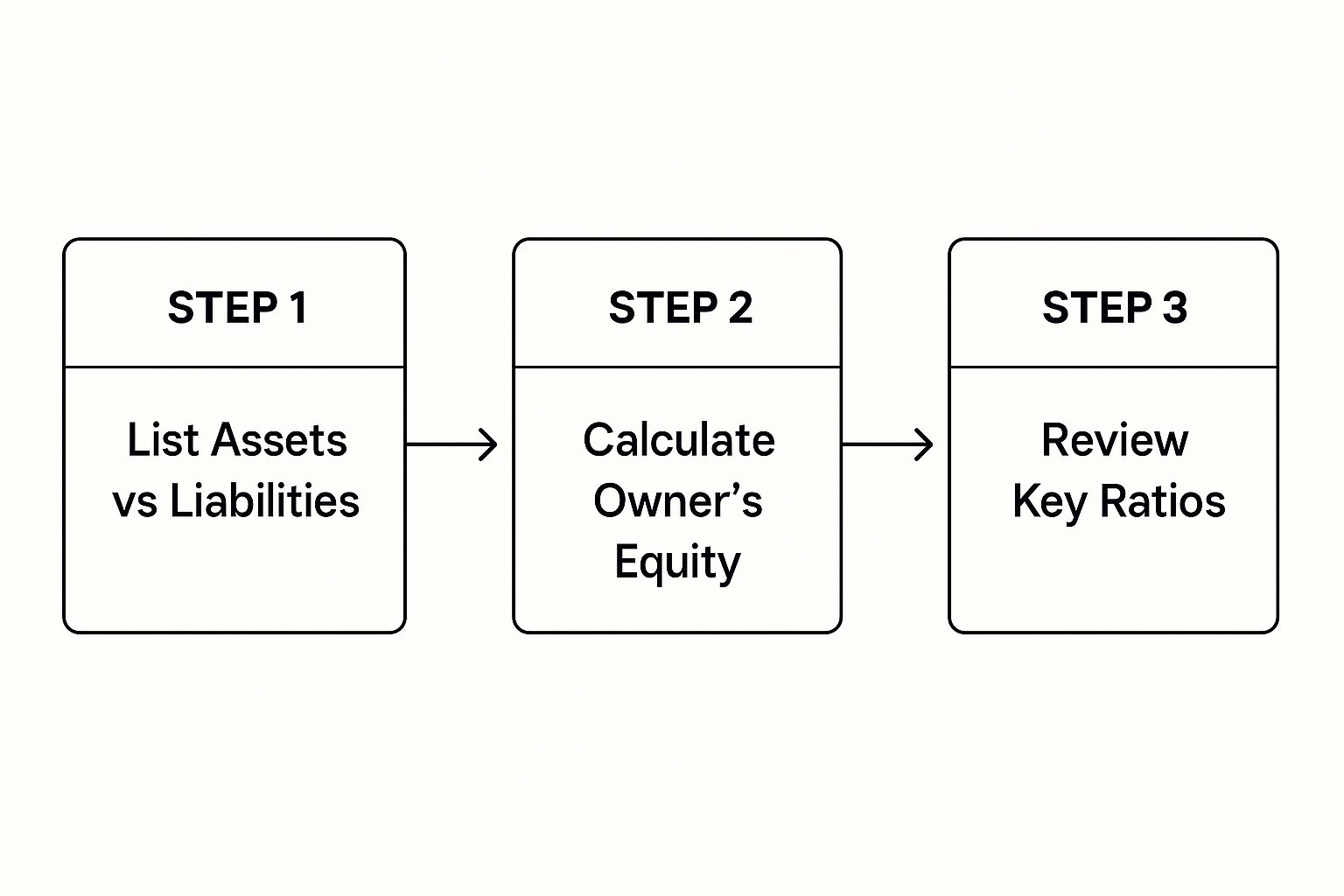
As this shows, it’s a logical flow: list what you own and owe, calculate your net worth, and then dig deeper to analyze your financial health. Instead of just staring at the final numbers on your sample balance sheet for small business, let's focus on what they actually mean by calculating a few simple but powerful financial ratios.
Unlock Insights with Key Financial Ratios
You don't need a finance degree for this. With just your balance sheet and a calculator, you can get a quick snapshot of your company's stability and operational readiness. We'll walk through three of the most important metrics: the current ratio, working capital, and the debt-to-equity ratio.
Expert Takeaway: Regularly calculating these ratios is like giving your business a routine check-up. It helps you spot potential issues, like a looming cash crunch or too much debt, long before they escalate into full-blown crises.
The Current Ratio: Your Short-Term Safety Net
The current ratio answers a simple but critical question: can you comfortably cover your bills for the next year? Think of it as your primary measure of liquidity.
- How to Calculate: Current Assets / Current Liabilities
- What It Means: A ratio above 1.0 is generally a good sign, showing you have more short-term assets than liabilities. For example, a ratio of 2.0 means you have $2 in current assets for every $1 of current debt. Knowing this can give you the confidence to invest in new inventory or take on a small project.
Working Capital: Your Operational Firepower
Closely related to the current ratio, working capital is the actual dollar amount you have on hand to run your day-to-day operations. It’s your breathing room.
- How to Calculate: Current Assets – Current Liabilities
- What It Means: This number is your operational buffer. A positive and growing working capital figure shows you have the financial cushion to handle payroll, pay suppliers, and manage unexpected expenses without breaking a sweat.
Gauging Your Long-Term Risk
Beyond immediate cash flow, you need a handle on your long-term financial structure and the level of risk you’re carrying. This is where the debt-to-equity ratio provides a clear picture of how your business is financed.
The Debt-to-Equity Ratio: How Much Risk Are You Carrying?
This ratio tells you how much your business relies on borrowing versus funding from owner investments. Lenders and investors watch this one very closely because it’s a key indicator of financial leverage and risk.
- How to Calculate: Total Liabilities / Owner’s Equity
- What It Means: A high ratio means your business is financed more by debt than by equity, which can be risky if your cash flow tightens. On the other hand, a low ratio suggests a more conservative and stable financial footing. If you see your debt-to-equity ratio creeping up over time, it’s a clear signal to focus on paying down loans before taking on any new ones.
Common Balance Sheet Mistakes to Avoid
Even the sharpest entrepreneurs can slip up on their balance sheets. These little mistakes might not seem like a big deal at first, but they can easily paint a skewed picture of your company's financial health. Knowing what these common pitfalls are is the best way to make sure your financial statements are accurate and trustworthy.
One of the most common errors I see is misclassifying liabilities. Let's say you have a five-year business loan—that's a long-term liability. If you accidentally stick it in the current liabilities section, you’ve just made your short-term debt look massive. To a lender, this makes your business seem way riskier than it actually is and could jeopardize your chances of getting another loan.
Another classic mistake happens with asset valuation. It’s easy to just plug in the original price you paid for a piece of equipment, but that’s not how it works. You have to use its book value, which is the original cost minus all the depreciation you've claimed over the years. Using the sale price or original cost inflates your assets and, in turn, your owner’s equity.
Failing to Reconcile and Record Regularly
A truly accurate balance sheet isn't something you create once and forget about; it requires constant attention. If you aren't regularly reconciling your accounts, you're just letting small errors pile up until they become a huge mess. You absolutely have to sit down and match your books to your bank statements at least once a month. It’s the only way to catch problems early.
It’s also surprisingly easy to forget about small, accrued expenses. Think about things like a few days of unpaid wages for your team at the end of the month, or interest that's built up on a loan but isn't officially due yet. Individually, they seem minor, but they add up and can seriously understate what you truly owe.
Key Takeaway: Your balance sheet is only as good as the data you feed it. Regular reconciliation and a commitment to recording every single transaction—no matter how small—are absolutely essential for keeping your finances in order and making smart decisions for your business.
The bigger picture matters, too. The NFIB Small Business Optimism Index recently sat at 98.6. But when you dig into those numbers, you see that 19% of owners called taxes their biggest problem, and 12% felt their inventories were "too high." These are real-world pressures that directly affect your balance sheet, and you can read more about these small business financial challenges.
At the end of the day, these mistakes almost always have tax implications. Misstating your assets or liabilities can lead to an incorrect tax bill, and that’s a headache nobody wants. To make sure you’re setting your business up for success, it’s worth checking out these essential tax-saving tips for business owners and investors.
Frequently Asked Questions
Diving into your business's finances often brings up more questions than answers. It's completely normal. Let's walk through some of the most common things small business owners ask when they first start working with a sample balance sheet for small business.
How Often Should I Create a Balance Sheet?
At the absolute minimum, you’ll need to put a balance sheet together at the end of your fiscal year for tax time. But if you want to actually manage your business effectively, that's not enough.
I always advise clients to generate one quarterly, or even monthly if possible. This rhythm gives you a much clearer picture of your financial trends. You can catch a cash flow issue before it becomes a crisis or spot an opportunity to expand when your assets are strong.
Do I Need an Accountant?
Not necessarily, at least not at first. You can absolutely create a balance sheet on your own, especially if you start with a solid template and have a grasp of the basics. Plenty of entrepreneurs handle their own books when they're just starting out.
However, as your business grows and your transactions get more complicated, bringing in an accountant becomes a very smart move. Having a professional review your statements, even just periodically, can save you from costly mistakes and ensure you're compliant with all the rules. It's an investment in peace of mind.
Key Insight: A balance sheet is like a photograph—it captures your financial position on a single day. In contrast, an income statement (P&L) is like a video, showing your performance over a period of time by tracking revenue, costs, and profit.
Do I Need a Balance Sheet to File Taxes?
This really depends on how your business is structured. Corporations (both S and C corps) and partnerships are typically required to file a balance sheet with their tax returns.
For sole proprietors, it's not always a strict requirement, but I can't recommend it enough for good financial management. The rules can also change based on your total assets or annual revenue, so it's a good habit to get into regardless.
Getting your classifications right on the balance sheet is critical because it directly affects what you owe in taxes. To get a better handle on this, you can explore these key small business tax deductions that might help you save some money.
At Allied Tax Advisors, our job is to make the complex world of tax and accounting simple. Our team provides one-on-one support to make sure your financial statements are accurate, compliant, and working for your success. Visit us at https://alliedtax.com to learn how we can help your business grow.