
If you’re collecting rent from a residential or commercial property, the IRS wants to hear about it on Schedule E. This is the go-to tax form for landlords. Think of it as your annual financial scorecard where you line up all your rental income against the expenses you incurred to keep the property running. The final number tells you your taxable profit or loss for the year.
Getting to Know Schedule E for Your Rentals

Once you become a landlord, you’re officially earning what the IRS calls “supplemental income.” This isn’t your typical W-2 wage. It’s money generated from an asset you own—in this case, your rental property. The IRS created Schedule E precisely for this purpose, giving you a dedicated place to report this income stream and all the costs that come with it.
Getting comfortable with this form isn’t just a good idea; it’s a fundamental part of your tax obligations as a real estate investor. It’s a non-negotiable step in your annual filing.
Who Actually Needs to File Schedule E?
If you’re an individual landlord, you almost certainly need to file Schedule E. This is true whether you rent out a single-family house, one side of a duplex, or even a commercial space. For most landlords, this is the standard form for reporting what’s considered a passive rental activity.
Now, you might have heard of another form, Schedule C, and it’s crucial to know the difference.
- Schedule E: This is for you. It’s designed for the typical landlord whose main activities are collecting rent and handling standard maintenance and repairs.
- Schedule C: This is for those whose rental activity is more of an active business. Think bed-and-breakfasts or short-term rentals where you provide significant services like cleaning, meals, or other hotel-like amenities.
For the overwhelming majority of landlords, Schedule E is the right choice. Getting this wrong from the start can cause major headaches down the road.
My Two Cents: Unless you’re changing sheets and leaving chocolates on pillows for your tenants, stick with Schedule E. This decision has real consequences for how your income is taxed and the rules that apply, so it’s important to get it right.
What Goes on the Form? A Quick Tour
Schedule E is all about the details. On the income side, you need to report every dollar you received from the property. This is a common trip-up. It’s not just the monthly rent. You also have to include any late fees, pet fees, application fees, or even security deposits you didn’t return to a tenant.
On the flip side, the form gives you clearly defined categories to deduct your expenses. This is where meticulous record-keeping pays off. You can itemize everything from your mortgage interest and property taxes to the cost of repairs, insurance, and professional fees. By tracking these expenses carefully, you can dramatically reduce the amount of your schedule e rental income that’s actually taxable. The goal is to get to your net taxable income—your gross rent minus all those deductions. That’s the number that really counts.
For a deeper dive into the specifics, you can explore our guide on https://alliedtax.com/taxes-on-rental-income/.
This structure is precisely why I tell every new landlord that solid bookkeeping is non-negotiable. It’s the only way to ensure you’re meeting your tax obligations while also making sure you don’t pay a dime more than you legally owe.
Reporting Every Dollar of Rental Income

When you hear schedule e rental income, you probably think of the monthly rent checks your tenants send. And while that’s the main event, the IRS sees “rental income” as a much bigger category. To keep your books clean and stay off the IRS’s radar, you really do have to report every dollar your property brings in.
This goes way beyond the base rent. Any extra fees you collect from tenants are considered gross rental income. That means late fees, bounced check fees, and even non-refundable pet fees all count. A good rule of thumb I tell my clients is this: if your tenant paid you for something connected to their lease, it’s almost certainly reportable income.
Handling Advance Rent and Security Deposits
Two of the trickiest areas for new landlords are advance rent and security deposits. The IRS has very specific rules for these, and getting them wrong can cause headaches down the road.
Let’s talk about advance rent first. If a tenant pays you in December for January’s rent, you must report that income in the year you actually received it—in this case, the year you collected the December payment. The IRS doesn’t care what period the rent covers; they care when the money landed in your bank account.
Security deposits work differently, though. A true security deposit—one you plan to return to the tenant at the end of their lease—is not income when you receive it. Think of it as a liability on your books, not revenue.
Key Takeaway: A security deposit only becomes taxable income if you end up keeping some or all of it. For example, if you withhold $500 from a deposit to fix a damaged wall after a tenant moves out, that $500 instantly converts to reportable income for that tax year.
This is a critical distinction. Simply tossing security deposit funds into your main operating account is a recipe for a bookkeeping disaster and can lead you to misreport your income.
Accounting for Non-Cash Payments
What happens if a tenant offers to do some work in exchange for rent? I’ve seen this happen plenty of times—a tenant might be a painter, a plumber, or a landscaper. While no cash changes hands, the IRS still views this as taxable income. You have to report the fair market value of those services as part of your schedule e rental income.
Let’s walk through an example. Your tenant is a professional painter who offers to paint the entire interior of the unit in exchange for a month’s rent.
- The rent is $2,000.
- The fair market value for that painting job is also $2,000.
Even though you never saw the money, you must report $2,000 as rental income. But here’s the other side of that coin: you can also claim a $2,000 expense for “Repairs” or “Maintenance.” The net effect on your profit is zero, but you absolutely have to report both sides of the transaction. Skipping this is a common error that can get you in trouble.
The Importance of Meticulous Record-Keeping
I can’t stress this enough: you have to track these different income streams as they happen. Trying to piece together a year’s worth of transactions in April is a nightmare waiting to happen. It leads to mistakes, missed deductions, and a whole lot of stress.
You don’t need to be a CPA to get this right. A simple spreadsheet you update regularly or user-friendly accounting software like QuickBooks can be a lifesaver. The most important thing is to pick a system and be disciplined about using it.
By logging every late fee and every forfeited security deposit the moment it happens, you create an unshakeable financial record. Come tax time, filling out Schedule E becomes a simple task of pulling numbers from your records, not a desperate hunt for old bank statements.
Getting Every Deduction You’re Entitled To

Alright, you’ve tallied up all your rental income. Now for the part every landlord actually enjoys: deductions. This is where your smart record-keeping throughout the year really pays off, letting you legally shrink your taxable schedule e rental income and keep more money in your pocket.
To do this right, you need to think like a business owner, because that’s what you are. Every dollar you spend on your rental property is a potential tax deduction. The most successful investors I know are meticulous about tracking every single expense, creating an audit-proof paper trail that supports their tax return.
The Big Three Foundational Deductions
Let’s start with the heavy hitters—the expenses that are usually the largest and most straightforward for any landlord. If you get these right, you’re already well on your way.
First and foremost is your mortgage interest. The interest portion of your monthly mortgage payment is 100% deductible. Your lender makes this incredibly easy by sending you Form 1098 at the end of the year, which spells out the exact amount of interest you paid.
Next up, property taxes. Whatever your local or county government charges you in property taxes for that rental is a direct deduction. You can find this number on your annual tax bill or, if you pay through an escrow account, on your year-end mortgage statement.
And don’t forget insurance. The premiums for your landlord policy, hazard insurance, and even specialized coverage like flood insurance are all deductible operating expenses. Just like mortgage interest, this is a clear-cut expense that reduces your taxable income dollar for dollar.
A Quick Note on Escrow: A common mix-up happens here. If your taxes and insurance are paid from an escrow account, you can only deduct what the lender actually paid out to the government and insurance company during the tax year. Don’t just look at what you contributed to the escrow account. Your year-end mortgage statement will have the precise figures you need.
Repairs vs. Improvements: Getting This Right is Crucial
This is probably the single most common—and potentially costly—mistake I see landlords make. The IRS has a very firm line between a “repair” and an “improvement,” and confusing the two is a major red flag.
Think of it this way: a repair keeps your property in good working order. It’s about maintenance. Fixing a leaky pipe, patching a hole in the drywall, or replacing a broken window pane are all repairs. These costs are fully deductible in the year you pay them.
An improvement, on the other hand, adds significant value to the property, extends its useful life, or adapts it for a new use. These are considered capital expenditures. Instead of deducting the full cost at once, you have to depreciate it over a set number of years.
Let’s make it real with a scenario:
- Repair (Deductible Now): Your tenant’s oven stops working. You call a technician who replaces the faulty heating element. You’ve simply restored the oven to its previous working condition. The cost is a current-year deduction.
- Improvement (Must Be Depreciated): You decide the old kitchen is dated. You tear it out and install brand-new cabinets, granite countertops, and a full suite of high-end appliances. This project clearly adds substantial value and must be depreciated.
Misclassifying a big-ticket item like a new roof (an improvement) as a simple “roof repair” is a classic error. Getting this distinction right is fundamental to accurate tax filing.
Digging Deeper for More Deductions
Beyond the big expenses, a whole world of smaller costs can add up to thousands in tax savings. This is where your detailed expense tracking really shines.
Operational Costs
These are the nuts and bolts of running your rental property day-to-day.
- Advertising: Did you list the unit on Zillow? Run a Facebook ad? Boost a post on Instagram to find a tenant? All of those marketing costs are deductible.
- Cleaning and Maintenance: This covers everything from professional cleaning between tenants to weekly lawn care, landscaping, and snow removal services.
- Property Management Fees: If you hire a property manager to handle the headaches, their fee is a straightforward business expense.
- Utilities: Any utilities you pay for directly—water, gas, electric, trash collection—are deductible. If a tenant reimburses you, just be sure to report that reimbursement as income, then take the corresponding deduction for the utility bill itself.
Professional and Administrative Expenses
Don’t forget the “back office” costs of being a landlord.
- Legal and Professional Fees: Did you pay an attorney to draft or review your lease? Or a CPA to help with your tax planning? Those fees are deductible. For a deeper dive, it’s worth reviewing a guide on the full scope of https://alliedtax.com/tax-deductions-for-real-estate-investors/ to make sure you’re not missing anything.
- Supplies: The cost of printer paper for leases, pens, file folders, and even small tools you use for minor fixes can be written off. It all adds up.
- Commissions: Paid a real estate agent a commission to find you a great tenant? That’s a deductible expense.
Don’t Forget to Deduct Your Travel and Vehicle Costs
One of the most overlooked deductions is for the travel you do for your rental. Every time you drive to the property to collect rent, meet a contractor, or show it to a potential tenant, those miles represent a real business expense.
The IRS gives you two ways to calculate this:
- Standard Mileage Rate: This is the simple way. You just track your business-related miles and multiply that number by the IRS’s standard rate for the year (for example, it’s 67 cents per mile for 2024).
- Actual Expense Method: This requires more work but can be worth it. You track the business-use percentage of all your car expenses—gas, oil changes, insurance, registration, and even depreciation on the vehicle itself.
Whichever method you pick, keeping a detailed mileage log is non-negotiable. You can use an app like MileIQ to automate it, but a simple notebook in your glove box works just as well. The key is to log the trips as they happen, not try to piece it together a year later. This diligence gives you the confidence to claim every last legitimate expense and truly maximize your schedule e rental income profit.
Making Sense of Rental Property Depreciation
Depreciation might be the single most powerful—and most misunderstood—deduction in a real estate investor’s toolkit. Think of it as your secret weapon. It allows you to write off a portion of your property’s cost each year, creating a significant “paper loss” that can slash your Schedule E rental income without you spending another dime.
The logic behind it is simple: the IRS knows that buildings wear out. To account for this gradual decline, they let you deduct the value of the building (not the land) over what they call its “useful life.” For any residential rental property in the U.S., that period is a firm 27.5 years. It doesn’t matter if your property’s market value is skyrocketing; you still get to claim this powerful deduction.
This chart really brings home how deductions like depreciation can dramatically change your tax picture.
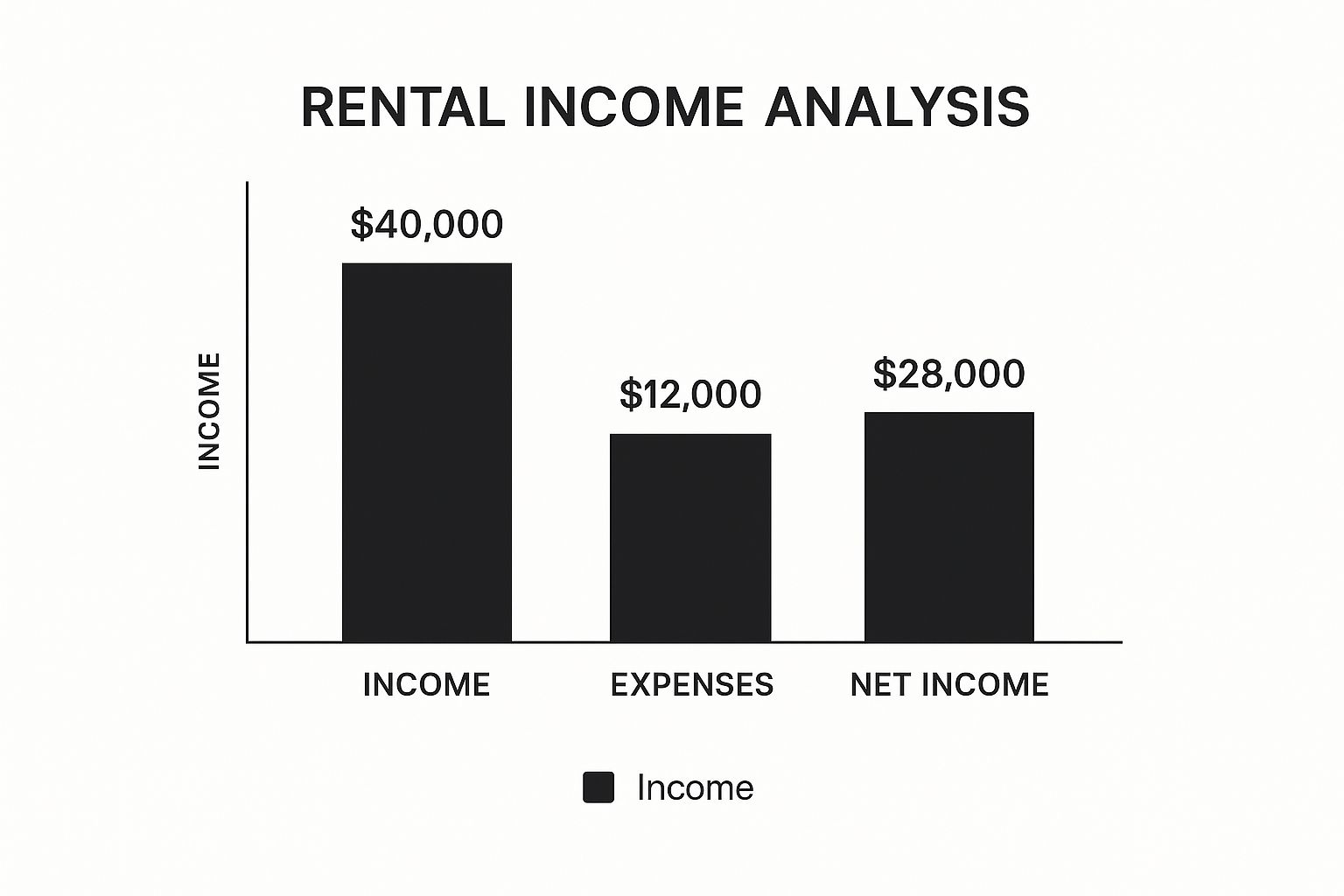
As you can see, once you factor in major expenses and non-cash deductions like depreciation, what initially looks like a healthy profit can shrink into a much smaller taxable amount, or even a loss.
Calculating Your Property’s Depreciable Basis
Before you can start depreciating, you need to figure out your property’s basis. This isn’t just the purchase price. Your basis is the price you paid plus certain closing costs, like title insurance or transfer taxes.
But you can’t depreciate the whole thing. The IRS correctly points out that land doesn’t wear out, so you have to split the value of the land from the value of the building.
Crucial Step: A classic rookie mistake is depreciating the entire purchase price. You absolutely must allocate a portion of your cost basis to the land, which is not depreciable. The easiest way to do this is usually by looking at your local property tax assessment, which almost always provides a separate value for the land and the building.
Let’s walk through a quick, real-world example:
- You buy a rental duplex for $400,000.
- Your county tax bill values the land at $80,000 (20%) and the structure at $320,000 (80%).
- Your depreciable basis is $320,000.
To get your annual deduction, just divide that basis by the useful life: $320,000 / 27.5 years = $11,636 per year. That’s a massive non-cash expense you can write off against your rental income every single year.
Depreciating Major Improvements
Depreciation doesn’t stop after the initial purchase. It also applies to any capital improvements you make down the road. A simple repair is a current-year expense, but a major improvement—like a new roof, a full kitchen remodel, or a new HVAC system—is treated differently. It must be capitalized and depreciated.
These big-ticket items are also depreciated over 27.5 years, starting from the year they are put into service. This is why meticulous record-keeping is so important. You need to track not just the property’s original basis but also the cost and date of every major improvement you make.
For a deeper dive into the specific rules, check out our detailed guide on how to handle depreciation on a rental property. Managing these separate depreciation schedules is key to accurate tax reporting and audit-proofing your returns.
Understanding Depreciation Recapture When You Sell
Depreciation is a fantastic tax break, but there’s a catch: depreciation recapture. This is how the IRS claws back some of that tax benefit when you eventually sell the property.
In short, all the depreciation you claimed over the years lowered your property’s cost basis. When you sell, the gap between your sale price and your adjusted basis is your gain. The part of that gain that comes from the depreciation you took is “recaptured” and taxed at a maximum rate of 25%—often higher than the normal long-term capital gains rates.
Let’s look at our example again, 10 years later:
- Original Building Basis: $320,000
- Total Depreciation Claimed (10 years): $116,360
- Your Adjusted Basis: $203,640 ($320,000 – $116,360)
If you sell, that $116,360 you wrote off will be subject to the recapture tax. This isn’t a reason to skip the deduction—in fact, the IRS requires you to account for it whether you claim it or not. But it’s a critical piece of the puzzle for your long-term financial planning.
Avoiding Costly Schedule E Mistakes
Even a tiny, innocent-looking mistake on your Schedule E can create big headaches. Best case scenario? You pay more tax than you owe, leaving your hard-earned money with the IRS. Worst case? You throw up a red flag that could trigger a full-blown audit. Knowing the common tripwires is the best way to keep your return accurate and audit-proof.
One of the easiest traps to fall into is confusing a repair with a capital improvement. I see this all the time. When you’re in the thick of managing a property, it’s easy to blur the lines. But the IRS has a very clear distinction: patching a leaky roof is a repair, but replacing the entire roof is an improvement. The patch is a simple deduction you take this year; the new roof has to be depreciated over 27.5 years. Getting this wrong is a major compliance issue.
The Personal Use vs. Rental Use Dilemma
Things get especially messy when your rental property is also your home. This is the reality for anyone renting out a room, an in-law suite, or “house hacking” a duplex. When your personal life and your rental business share a roof, you absolutely cannot deduct 100% of your property’s expenses on Schedule E. It just doesn’t work that way.
You have to be diligent about splitting costs between what’s personal and what’s for the rental. The most common and defensible method is using square footage.
Let’s run through a quick example. Say you own a 2,000-square-foot duplex and live in one half.
- Your Personal Side: 1,000 sq. ft. (50% of the total)
- The Rental Side: 1,000 sq. ft. (50% of the total)
For any expense that covers the whole building—like mortgage interest, property taxes, or insurance—you can only deduct 50% on your Schedule E. The other half might give you some benefit on your personal Schedule A, but it doesn’t belong on your rental schedule. On the other hand, if you pay for a plumber to fix a sink specifically inside the tenant’s unit, that’s 100% deductible.
A Word of Caution: If you’re house-hacking, resist the urge to fill out the “personal use days” field on Schedule E. That section is meant for properties like vacation homes that you use entirely for personal enjoyment for part of the year. For a multi-unit where you live in one part, you simply allocate the shared expenses.
Navigating the Passive Activity Loss Maze
Perhaps the most frustrating rule for new landlords is the Passive Activity Loss (PAL) limitation. It’s a shock to many investors when they realize that even with a big paper loss from their rental (thank you, depreciation!), they might not be able to use that loss to lower the tax bill from their day job.
The IRS generally classifies rental real estate as a “passive activity.” Your ability to actually use those passive losses often comes down to your income.
- If your Adjusted Gross Income (AGI) is under $100,000, you can usually deduct up to $25,000 in rental losses against your non-passive income (like your W-2 wages).
- If your AGI is between $100,000 and $150,000, that $25,000 allowance starts to shrink.
- Once your AGI tops $150,000, you generally can’t deduct any of your passive rental losses against your active income.
So, what happens to those losses you can’t use? Don’t worry, they don’t just vanish into thin air.
Understanding Your “Suspended” Losses
The losses you aren’t allowed to take are formally “suspended” and carried forward to future years on IRS Form 8582. You can use them down the road to offset any positive income (profit) your rentals generate.
Even better, all those banked-up suspended losses can be fully deducted in the year you sell the property. This can be a huge tax saver when you face a large capital gain.
While you don’t get the tax break today, keeping careful track of these losses ensures you’ll get the benefit eventually. This is why looking at your Form 8582 each year is just as crucial as checking your Schedule E. Think of it as a valuable tax asset you’ll cash in later. There are some exceptions, like qualifying as a Real Estate Professional, but for most landlords, these PAL rules are the law of the land for schedule e rental income.
Answering Your Top Schedule E Questions
Even after you think you’ve got Schedule E figured out, some specific questions always seem to pop up. Let’s tackle some of the most common ones I hear from landlords to clear up any lingering confusion.
Should I Issue a Form 1099 to Contractors?
This one trips up a lot of property owners. The rule of thumb is pretty clear: if your rental activities are considered a trade or business, you absolutely need to issue a Form 1099-NEC. You’ll send one to any unincorporated contractor—think plumbers, painters, or landscapers—whom you paid $600 or more for their services during the tax year.
So, how do you know if you meet the “trade or business” threshold? If you’re actively managing your properties and treating your rentals like a serious venture, you most likely do. It’s not just a hobby. And if you’re trying to claim certain tax breaks, like Real Estate Professional Status, the IRS will definitely expect you to act like a business, and that includes issuing 1099s. When in doubt, it’s always smarter to issue the form.
How Do I Handle a Property I Own with My Spouse?
When you and your spouse own a rental together, reporting can get a little messy, especially if you’re not in a community property state. The IRS can view this arrangement as a partnership, which would technically mean filing a separate, and often complicated, partnership tax return (Form 1065).
Thankfully, there’s a much easier way. You can make an election to be treated as a Qualified Joint Venture.
A Qualified Joint Venture is a lifesaver for married couples. It lets you avoid the partnership return entirely. Instead, you just split the income and expenses down the middle and report your respective shares on two separate Schedule E forms attached to your joint Form 1040.
This simple election keeps your tax filing straightforward and ensures both you and your spouse get proper credit for the rental activity.
Is My Airbnb Income Reported on Schedule E or Schedule C?
This is a hot topic, especially with the rise of short-term rentals. For most hosts, the answer is Schedule E. If you are mainly just providing the space for your guests to stay, your income goes on Schedule E.
The line gets crossed over to Schedule C only when you provide “substantial services”—things that make your rental feel more like a hotel or a bed and breakfast. What counts as substantial?
- Regular daily cleaning services
- Providing meals
- Offering concierge-style services like booking tours
Just providing Wi-Fi, fresh linens, and cleaning the unit between guests doesn’t cut it. For the vast majority of hosts, short-term rental income is still considered passive rental income, and its home is on Schedule E.
What if I Haven’t Received a K-1 from a Partnership?
Investing in a real estate syndication or partnership means you’ll get a Schedule K-1 that details your share of the income and losses. The frustrating part is that these forms are notoriously late, often showing up long after you’d planned to file your taxes.
You really have two choices here. The easiest and most common path is to just file for a tax extension. This gives the partnership more time to get you the K-1 and saves you the headache of filing an incomplete return.
Your other option is to file your return on time using the information you have and then file an amended return once the K-1 arrives. Honestly, this creates more paperwork and can lead to confusion down the road. Filing an extension is almost always the better strategy.
Navigating the ins and outs of schedule e rental income can feel overwhelming, but you don’t have to tackle it alone. The team at Allied Tax Advisors lives and breathes this stuff, helping real estate investors craft smart tax strategies and stay compliant. For personalized guidance on your rental property taxes, you can find us at https://alliedtax.com.