
So, you're wondering how your business can take advantage of the Section 179 deduction for a heavy vehicle. Let's cut right to the chase: businesses can often write off a huge chunk, sometimes even the entire cost, of a qualifying vehicle with a Gross Vehicle Weight Rating (GVWR) over 6,000 pounds in the very first year.
This part of the tax code is an incredibly powerful tool. It's designed to help you lower your taxable income by investing in the equipment you need to run and grow your business.

What Is This "Heavy Vehicle" Tax Deduction, Really?
Section 179 is easily one of the most valuable tax breaks available to small and medium-sized businesses. Think of it as the government's way of encouraging you to put money back into your own company.
Normally, when you buy a major asset, you have to deduct its cost a little bit at a time over several years through a process called depreciation. Section 179 flips that on its head, letting you expense the full purchase price (up to certain limits) in the same year you put the vehicle into service.
This immediate write-off can slash your taxable income for the year. That frees up cash you can use for marketing, hiring, or any other part of your business. For anyone relying on trucks, vans, or large SUVs, getting a handle on the rules for Section 179 vehicles over 6,000 pounds is a must.
Why All The Fuss About 6,000 Pounds?
That 6,000-pound GVWR mark is a bright red line in the tax code. It's what separates smaller passenger cars—which have very strict and much lower deduction limits—from the heavier workhorses that can qualify for massive write-offs.
Why the distinction? The IRS put this rule in place to prevent people from claiming huge business deductions on luxury sedans that are mostly used for personal trips. It keeps the big tax benefits focused on true business-use vehicles.
Here's what you need to know:
- What is GVWR? This isn't just what the vehicle weighs. Gross Vehicle Weight Rating is the maximum operating weight specified by the manufacturer. It includes the vehicle itself plus the engine, fuel, accessories, driver, passengers, and a full load of cargo.
- The Golden Rule: The vehicle must be used more than 50% for business. This is non-negotiable. If you can't prove it, you can't take the deduction, so keeping detailed logs is absolutely critical.
- Not All Heavyweights Are Equal: Even among vehicles over 6,000 pounds, the rules differ. A heavy SUV might have one deduction cap, while a cargo van with no rear seats could qualify for a full 100% write-off.
A Quick Look at the Deduction Limits
For many businesses, the Section 179 deduction for vehicles over 6,000 pounds GVWR has been a total game-changer, especially as the limits have grown.
For instance, a heavy SUV between 6,000 and 14,000 pounds GVWR—think a Chevrolet Tahoe or a Ford Expedition—has a specific first-year Section 179 write-off cap of $30,500 for 2023 (always check for the current tax year's limit). The remaining cost can often be depreciated using bonus depreciation.
To get the most up-to-date figures, a great resource is the official Section179.org website, which tracks the annual limits.
Of course, the purchase price is just the beginning. For long-term financial planning, you also need to factor in ongoing costs. Getting a clearer picture of things like vehicle-related taxes can be helpful; for example, you can find answers to common Road User Charges (RUC) questions to better understand the full financial picture of vehicle ownership.
Understanding the Core Rules for Vehicle Qualification
So, you're thinking about buying a new vehicle for your business and want to take advantage of a big tax write-off. It’s a smart move, but claiming a major deduction isn't as simple as just driving the car off the lot. The IRS has a very specific checklist, and you have to tick every single box to qualify for the Section 179 deduction on vehicles over 6,000 pounds.
It all starts with a term you need to know: Gross Vehicle Weight Rating (GVWR). This isn't just what the vehicle weighs; it's the maximum safe operating weight set by the manufacturer. Think of it as the total weight limit, including the vehicle itself, passengers, fuel, and any cargo you might be hauling. This one number is the gatekeeper to the most generous tax deductions.
The Magic Number: Why 6,000 Pounds Matters
Why is 6,000 pounds the golden ticket? The IRS uses this GVWR benchmark to separate typical passenger cars from heavier-duty vehicles that are genuinely built for work. Vehicles that fall under this weight limit are stuck with much lower, more restrictive deduction caps. But once you cross that 6,000-pound threshold, the door swings open to much larger write-offs.
You can usually find the GVWR printed on a sticker inside the driver's-side door jamb. It's absolutely critical to check this number for the exact model and trim you're buying, because it can change even between different versions of the same truck or SUV.
Timing is Everything: The "Placed in Service" Rule
Another non-negotiable rule is that the vehicle must be "placed in service" during the same tax year you claim the deduction. In plain English, this just means the vehicle has to be ready and available for you to use in your business.
This is a point that trips up a lot of business owners. It’s not just about when you buy it. If you purchase a work truck on December 31st and it's ready to go that day, you can claim the deduction for that year. But if you buy it on the same day and let it sit in your driveway until January, you'll have to wait until the next tax year to take the write-off.
The key here is "ready and available." You don't have to rack up a ton of miles by year-end, but the vehicle must be prepared for its intended business function. This rule stops people from buying an asset at the last minute just for a tax break without actually planning to use it.
The 50% Rule: Proving Your Business Use
This might be the most important rule of all. To even be eligible for a Section 179 deduction, you have to prove that you use the vehicle for business more than 50% of the time. And no, you can't just ballpark this number.
Here's how you stay on the right side of the IRS:
- Keep Meticulous Mileage Logs: A detailed, contemporaneous log is your single best defense if you're ever audited. For every business trip, you need to record the date, your starting and ending odometer readings, the total miles driven, and a clear note about the business purpose.
- Know the Difference Between Commuting and Business: Your drive from home to your main office or workshop is almost always considered personal commuting. Those miles don't count toward your business-use percentage.
- Track Your Total Miles: You need to know the vehicle's total mileage for the entire year to do the math correctly. The formula is simple: (Total Business Miles / Total Annual Miles) x 100.
Be warned: if your business use drops to 50% or below within the vehicle's first five years, you could face "recapture." That’s IRS-speak for having to pay back a portion of the tax deduction you already took. Those diligent logs are what protect you.
Heavy SUVs vs. Work Trucks: A Critical Distinction
Not all Section 179 vehicles over 6000 pounds get the same tax treatment. The IRS makes a very important distinction between different types of heavy vehicles, and it directly affects how much you can write off.
For 2024, heavy SUVs—those with a GVWR between 6,001 and 14,000 pounds—are capped at a specific Section 179 deduction limit of $30,500.
However, other types of heavy vehicles often escape this lower cap. This category includes vehicles that, by their design, are clearly not intended for everyday personal use, such as:
- Cargo vans that have no rear seating behind the driver's area.
- Heavy-duty pickup trucks with an integrated cargo bed of at least six feet.
- Shuttle vans built to seat more than nine passengers.
These true workhorses can often qualify for a write-off of their full purchase price under Section 179, right up to the overall annual limit. Understanding where your potential vehicle falls is crucial before you sign any paperwork. While Section 179 is about the tax benefits of the purchase, it's always smart to determine your car's true value to get a full financial picture. Knowing this helps you make a truly informed decision from every angle.
How to Maximize Your Deduction with Bonus Depreciation
Claiming the Section 179 deduction is a great start, but if you really want to make a dent in your tax bill, you need to bring in its powerful partner: bonus depreciation. Think of it as the ultimate one-two punch for maximizing your write-off on a vehicle over 6,000 pounds.
By combining these two incentives, you can potentially write off a massive chunk—sometimes even 100%—of the vehicle's cost in the very first year. You start by taking the Section 179 deduction up to its limit for that specific vehicle type. Then, bonus depreciation swoops in to handle most, if not all, of the remaining cost. It’s a game-changer.
The Power of Stacking Deductions
Let’s say you buy a qualifying heavy SUV for your business. Section 179 lets you immediately expense part of the cost, which is great. But what about the rest? That’s where bonus depreciation kicks in, allowing you to deduct a huge percentage of the leftover amount in the same tax year.
For any business making a significant investment, this strategy can seriously lower your taxable income. Congress put these tools in place to encourage businesses to invest and grow, so it's a strategic advantage you don't want to overlook. To get into the nitty-gritty, check out our guide that explains in detail how bonus depreciation works.
The flowchart below gives you a quick visual on how the qualification process works. It's more straightforward than you might think.
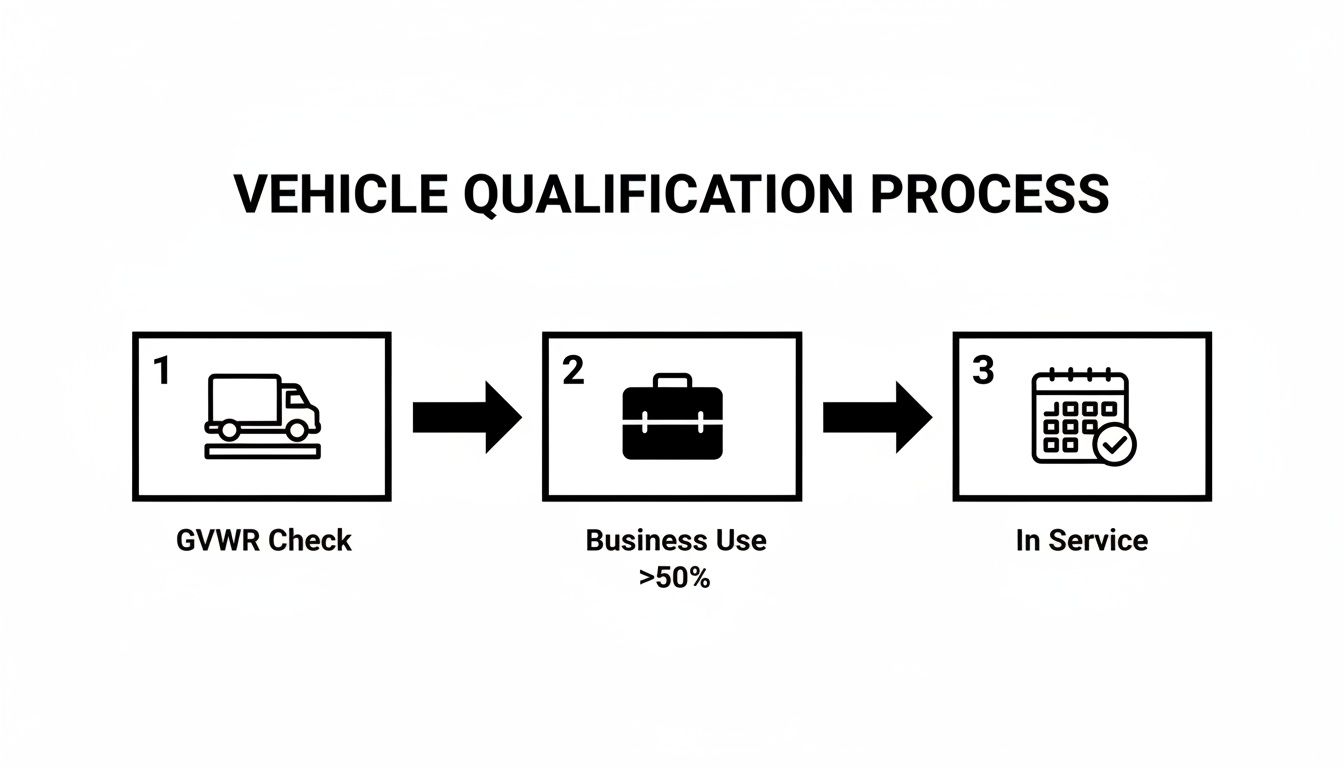
As you can see, it all comes down to a few key steps: verifying the GVWR, confirming your business-use percentage, and putting the vehicle into service.
A Practical Calculation Example
Okay, let's put some real numbers to this. Imagine your construction company buys a new heavy-duty truck for $85,000. The GVWR is well over 6,000 pounds, and you use it 100% for business.
Here’s how the write-off could break down, step by step:
- Apply Section 179 First: For this type of heavy vehicle, there's a specific limit. Let's use the $30,500 limit for qualifying SUVs and crossovers.
- Calculate the Remaining Basis: Simply subtract the Section 179 deduction from the purchase price: $85,000 – $30,500 = $54,500.
- Apply Bonus Depreciation: For 2024, bonus depreciation is at 80%. So, you can deduct another $43,600 ($54,500 x 0.80).
- Total First-Year Deduction: Add them together, and your total write-off for year one is a whopping $74,100 ($30,500 + $43,600).
This example shows just how powerful stacking these deductions can be. Instead of slowly depreciating the truck over several years, you recover the vast majority of its cost almost immediately.
Keep an Eye on Overall Spending Caps
Now, before you go all-in, there's one more piece to the puzzle: the overall Section 179 spending limits. These caps don't just apply to your vehicle; they apply to the total amount of all qualifying equipment your business finances or buys during the year.
For any given tax year, there’s a maximum total amount you can expense under Section 179. There's also a limit on how much you can spend on equipment in total before the deduction starts to phase out. Once you cross that spending threshold, your available Section 179 deduction begins to shrink, dollar-for-dollar.
This phase-out rule is incredibly important for growing businesses to track. If you’re planning to buy a new truck and also invest in other major assets like machinery or software, you need to make sure your total spending doesn't accidentally push you over the limit and reduce your deduction.
When used correctly, the tax code gives you a major leg up. For 2024, a business can expense up to $30,500 on a qualifying heavy SUV and then take 80% bonus depreciation on what's left. For other heavy vehicles without this specific limit, you could potentially write off the entire cost. Strategic planning is everything when it comes to getting the most out of these rules.
A Practical List of Qualifying Vehicle Models
Alright, let's move from theory to the dealership lot. Knowing the tax rules is great, but it doesn't mean much until you can point to a specific vehicle and know how it fits into your tax strategy. When you're ready to buy, you need to be confident that the Section 179 vehicles over 6000 pounds you're looking at will actually deliver the tax savings you expect.
The most important number isn't on the price tag—it's the Gross Vehicle Weight Rating (GVWR) printed on the manufacturer's sticker inside the driver's-side door. That number dictates everything.
This isn't just a random list of trucks and SUVs. Think of it as a strategic guide to matching your business needs with the right tax-advantaged vehicle. The IRS has different rules for different types of heavy vehicles, and those rules directly control how big of a deduction you can take.
Heavy SUVs and Crossovers
This is a popular category for a reason. Many of the SUVs that business owners already love happen to meet the over-6,000-pound GVWR rule. However, these vehicles are usually subject to a special, lower Section 179 deduction limit, which is $30,500 for 2024.
Even with that cap, it's still a significant tax break. Some common models that fit this description include:
- Ford Expedition
- Chevrolet Tahoe / Suburban
- Cadillac Escalade
- Lincoln Navigator
- Jeep Grand Cherokee L
- BMW X7
- Mercedes-Benz GLS-Class
These vehicles are perfect for professionals who need a mix of utility and comfort—think real estate agents, consultants, or anyone who transports clients while also needing space for gear. Once you hit that Section 179 limit, you can typically use bonus depreciation on the remaining cost to increase your first-year write-off.
Work Trucks, Vans, and Other Heavy Vehicles
Now we get to the category where the tax benefits really open up. Certain heavy vehicles aren't held back by that lower SUV deduction limit. This means they can often qualify for a much larger write-off under Section 179, sometimes up to the full purchase price (as long as you're under the overall annual cap).
The key difference is almost always the vehicle's design and primary function. If it’s built with specific work features—like a long cargo bed or a dedicated cargo area with no room for rear passengers—it’s far more likely to qualify for the bigger deduction.
The usual suspects here include:
- Heavy-Duty Pickup Trucks: Models like the Ford F-250/F-350, Ram 2500/3500, and Chevrolet Silverado 2500/3500 are built for work and almost always have a GVWR that clears the hurdle.
- Full-Size Cargo Vans: Vehicles like the Ford Transit, Mercedes-Benz Sprinter, or Ram ProMaster are purpose-built for hauling equipment and goods, making them prime candidates.
- Passenger Vans: Some large passenger vans can also qualify, but they typically need to be designed to seat more than nine passengers behind the driver.
Quick Reference Table of Popular Models
To put it all together, here’s a quick-glance table showing some popular models, their typical GVWR, and how the Section 179 rules generally apply. Just remember to always double-check the GVWR on the specific vehicle you're buying, as it can vary by trim and configuration.
Popular Vehicle Models Qualifying for Section 179
| Vehicle Model | Typical GVWR (lbs) | Applicable Section 179 Rule |
|---|---|---|
| Cadillac Escalade | 7,100 – 7,300 | Subject to the Heavy SUV limit |
| Ford F-250 Super Duty | 10,000+ | Often qualifies for full deduction |
| Chevrolet Suburban | 7,500 – 7,800 | Subject to the Heavy SUV limit |
| Ford Transit Cargo Van | 8,600 – 10,360 | Often qualifies for full deduction |
| Jeep Grand Cherokee L | 6,500 – 6,700 | Subject to the Heavy SUV limit |
| Tesla Model X | 6,000+ | Subject to the Heavy SUV limit |
If you need a more exhaustive list or want to check on a specific model you have in mind, our comprehensive guide on Section 179 vehicles that qualify has you covered. Making the right purchase starts with knowing exactly which vehicles unlock these powerful tax deductions.
Mastering the Paperwork and Documentation
Claiming the Section 179 deduction for a heavy vehicle is a fantastic move for your bottom line, but it all comes down to one thing: proof. The IRS operates on a "show, don't tell" basis, and without a solid paper trail, even a perfectly legitimate deduction can be questioned during an audit.
Let's walk through how to build an airtight file that supports your claim from the moment you drive that vehicle off the lot. Think of your documentation as the foundation of your tax strategy—if it's shaky, the whole thing can come crashing down.

The Official Filing: IRS Form 4562
The starting point for any depreciation or amortization deduction is IRS Form 4562, Depreciation and Amortization. This is where you officially declare your intent to take the Section 179 deduction for your new vehicle.
You’ll be working mostly in Part I of the form. This is where you'll list the vehicle, its total cost, and the specific amount you're expensing under Section 179. It’s crucial to be precise here; the numbers must line up perfectly with your bill of sale and other purchase records.
Remember, the tax code treats different vehicles differently. While the overall Section 179 limit is quite high, heavy SUVs and certain trucks between 6,000 and 14,000 pounds GVWR have their own specific deduction cap. For 2025, that cap is $31,300.
Your Most Important Tool: The Mileage Log
While Form 4562 is what you file, your mileage log is the day-to-day evidence that makes your claim legitimate. The IRS insists on "contemporaneous" records. That’s just their fancy way of saying you need to log your trips as they happen—not six months later when you're trying to piece together your year from calendar entries.
A bulletproof mileage log has to tell a clear and convincing story for every business trip. It must include:
- Date of the Trip: The specific day you were on the road.
- Starting and Ending Odometer Readings: This gives you the hard number for miles driven.
- Destination: Where did you go? Be specific (e.g., "123 Main St, Client Office," not just "city").
- Business Purpose: Why did you make the trip? (e.g., "Met with John Smith of ABC Corp to sign contract," or "Picked up lumber from Home Depot for the Miller project.")
Vague entries like "business" or "work" are a huge red flag for an auditor. The more detail you provide, the stronger your case. Each log entry should be a mini-story that leaves no doubt the trip was for business.
Understanding and Avoiding Recapture
Keeping great records isn't just about claiming the deduction; it's also about keeping it. There's a rule called "recapture," and it can force you to pay back some of the tax savings you enjoyed.
Recapture kicks in if your business use of the vehicle drops to 50% or below at any point during its normal depreciable life (which is typically the first five years you own it). Let's say the IRS questions your business-use percentage in year three. Those detailed mileage logs you kept from day one become your single best defense.
Without them, you're left with guesswork, and the IRS might force you to add a portion of that initial deduction back into your taxable income for the year. Your detailed logs are essentially an insurance policy against this painful and costly scenario. If you're interested in the math behind all this, you can learn more about how to calculate depreciation in our other guide.
Common Mistakes That Can Cost You the Heavy Vehicle Deduction
The Section 179 deduction for heavy vehicles is a fantastic tax break, but it's loaded with traps for the unwary. A simple mistake can wipe out your expected savings and might even trigger an audit. Let's walk through the most common pitfalls I see business owners fall into so you can steer clear of them.
Misjudging the Vehicle's Weight (GVWR)
This is probably the most frequent error I encounter. A business owner buys a truck advertised as "heavy-duty," assuming it qualifies, only to find out later it doesn't. You can't rely on marketing brochures or what a salesperson tells you.
The only number that matters is the Gross Vehicle Weight Rating (GVWR), which you can find on the manufacturer's sticker, usually inside the driver's-side door jamb. Check this specific number before you sign anything. Different trims and configurations of the exact same model can have different GVWRs, and getting this wrong is a costly, irreversible mistake.
Blurring the Line Between Commuting and Business Miles
Here's another big one: mixing up your daily commute with actual business driving. Your drive from home to your main office or workshop is not a business trip in the eyes of the IRS. It’s personal commuting, plain and simple.
Legitimate business miles are trips to visit a client, pick up supplies, or travel between job sites. This distinction is absolutely critical because you have to prove your vehicle was used more than 50% for business. If commuting miles dominate your logbook, you'll fall below that threshold and lose the entire deduction.
The IRS has a very firm stance on this: Commuting is a personal expense, not a business one. To build an audit-proof record, your mileage log needs to be crystal clear, detailing the who, what, when, where, and why of every single business trip.
"Guesstimating" Your Mileage
This is a surefire way to get your deduction denied. At the end of the year, trying to remember all your business trips and piece together a mileage log is a recipe for disaster. The IRS demands contemporaneous records—meaning you log the trip at or near the time it happens.
Without a detailed log showing the date, mileage, and business purpose for each drive, your claim is just a number on a form with no proof to back it up. If you're ever questioned, a shoddy or nonexistent log will cause your deduction to crumble instantly.
Forgetting the "Placed in Service" Rule
Finally, timing is everything. It's common to buy a vehicle late in the year to squeeze in a last-minute tax write-off. But just buying it isn't enough. The vehicle must be placed in service during the tax year you claim the deduction.
What does "placed in service" mean? It means the vehicle is ready and available for its specific business use. Buying a truck on December 31st and leaving it at the dealership until January means you've missed the window. You have to take possession and have it ready to roll for your business before the ball drops on New Year's Eve.
Avoiding these common blunders will help you file with confidence and make sure you get the full tax benefit you've earned.
Common Questions About Section 179 Vehicles
Even after getting the rules down for weight, business use, and record-keeping, a few specific questions always seem to pop up. Let's tackle some of the most common ones I hear from business owners who are thinking about buying a heavy vehicle. This is your final check-in to make sure you’re applying these powerful tax rules the right way.
Can I Write Off a Used Vehicle With Section 179?
Yes, you absolutely can. This is one of the best parts of the tax code—it’s flexible. The deduction applies to both new and used vehicles.
The key phrase here is "new to you." As long as you haven't owned the vehicle before and you’re putting it into service for your business, it’s eligible. This is a huge win for small businesses, as you don't have to spring for a brand-new model to get the tax break. A reliable, pre-owned truck or SUV that meets the Section 179 vehicles over 6000 pounds criteria is a smart, cost-effective way to go.
What if My Business Use Drops Below 50% Later On?
This is a big one, and you need to pay close attention. If your business use of the vehicle drops to 50% or less anytime during its five-year depreciation period, the IRS can claw back some of the tax benefit. This is known as "recapture."
What does that mean in plain English? You have to give back a portion of the deduction you took. The IRS makes you report the difference between the full Section 179 deduction you claimed and the standard depreciation you would have been allowed as extra income. This is exactly why keeping detailed, consistent mileage logs for those first five years is non-negotiable. It’s your only real defense against recapture.
The Bottom Line: That 50% business-use rule isn’t a one-time thing you meet in the first year. It’s an ongoing test, and your records are the only proof you have to protect those tax savings.
Does Section 179 Work for Leased Vehicles?
No, the Section 179 deduction is off the table for leased vehicles. This tax break is specifically for property you purchase, whether you pay in cash or finance it. The IRS sees ownership as the trigger for this deduction.
But that doesn't mean leasing is a bad move from a tax perspective. While you won't get that big, immediate Section 179 write-off, you can almost always deduct your monthly lease payments as a regular business expense. This creates a consistent, predictable deduction over the life of your lease.
Are There Caps on the Deduction Amount?
Yes, there are a few different limits to be aware of. First, for heavy SUVs and certain other vehicles with a GVWR between 6,001 and 14,000 pounds, there’s a specific deduction limit, which is $30,500 for 2024.
Beyond that, there's an overall cap on the total amount of equipment your business can write off using Section 179 in a single year. And finally, there's an investment limit—if your company spends too much on qualifying assets, your available deduction starts to shrink. It’s always best to talk with a tax pro to see exactly how these caps affect your business.
At Allied Tax Advisors, we live and breathe this stuff so you don't have to. We help business owners make sense of complex tax rules to maximize their savings and stay compliant. If you need a hand with Section 179 or any other part of your business taxes, check out how we can help at https://alliedtax.com.