
When it comes to the Section 179 deduction for vehicles, it really boils down to two critical questions: what does the vehicle weigh, and how much are you actually using it for work? The IRS has specific rules, but they all circle back to these two factors.
Generally, heavy vehicles over 6,000 pounds, purpose-built work vans, and certain passenger cars can qualify, but the deduction limits vary wildly between them.
Your Quick Guide to Qualifying Section 179 Vehicles
Think of Section 179 as the government's way of encouraging you to invest in your own business. For vehicles, this tax break is most generous for heavier models that are clearly built for work, not for running personal errands. The IRS draws a pretty clear line in the sand based on a vehicle’s size and design to figure out how much you can write off.
This decision tree gives you a great visual for the two most important questions you need to ask: is the vehicle used more than 50% for business, and does it weigh over 6,000 pounds?
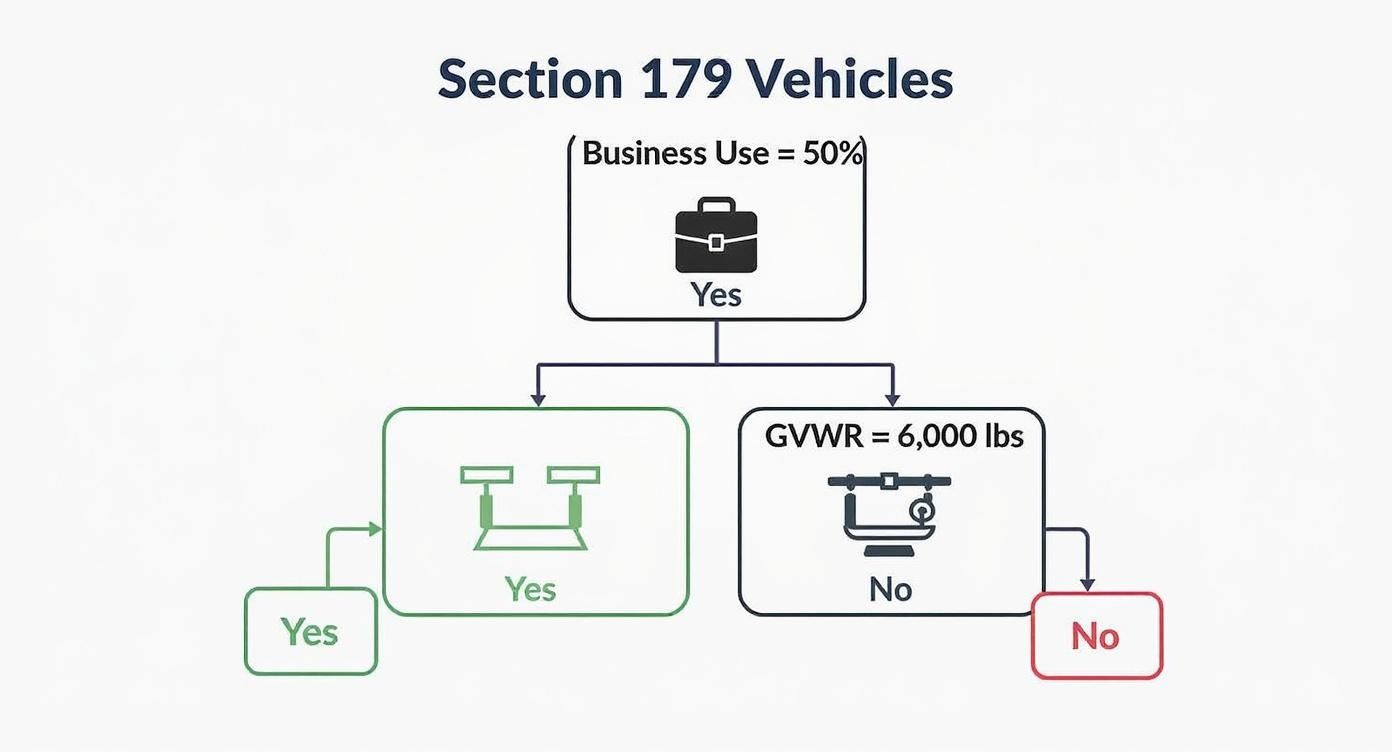
As you can see, getting a "yes" on both questions is the key to unlocking the biggest tax benefits. This simple flowchart is the perfect starting point to see if your new truck or van is going to lead to a major tax deduction.
Understanding the Key Vehicle Categories
To really get a handle on which section 179 vehicles that qualify, I find it helps to break them down into three main buckets. Each has its own rules and, more importantly, its own deduction limits.
- Heavy Vehicles (Over 6,000 lbs GVWR): This is the category you want to be in for the largest deductions. We're talking about heavy SUVs, full-size pickup trucks, and large cargo vans. These workhorses almost always qualify for a much higher write-off right out of the gate compared to smaller vehicles.
- Purpose-Built Vehicles: This group includes vehicles that are pretty much impossible to mistake for a family car. Think of a cargo van with no rear seats, a shuttle van that can haul more than nine passengers, or a truck with a fully-enclosed driver's compartment and a cargo bed that's at least six feet long. Their design screams "business," so the IRS treats them favorably.
- Lighter Passenger Vehicles (Under 6,000 lbs GVWR): Your standard sedans, smaller SUVs, and crossovers fit in here. They can still qualify for Section 179 as long as your business use is over 50%, but the first-year deduction is capped at a much, much lower amount.
To put it in perspective for the 2025 tax year, the first-year deduction for lighter passenger vehicles is capped at $12,200, while certain heavy trucks and SUVs have a limit of $31,300. That difference alone shows why understanding the weight rating is so important. You can find more details on business tax deductions for automobiles in 2025 to get the full picture.
Section 179 Vehicle Qualification at a Glance
To make it even simpler, this table lays out the core requirements and deduction limits side-by-side. It’s a handy cheat sheet for seeing where different vehicles stand.
| Vehicle Category | GVWR Requirement | Section 179 Deduction Limit | Bonus Depreciation Notes |
|---|---|---|---|
| Heavy SUVs, Trucks, & Vans | Over 6,000 lbs | Up to $31,300 in 2025 | Often eligible for bonus depreciation, which can significantly increase the first-year write-off. |
| Purpose-Built Commercial Vehicles | Over 6,000 lbs | Up to the full cost of the vehicle, subject to the overall Section 179 limit. | Typically qualifies for 100% deduction under Section 179; bonus depreciation may also apply. |
| Light Passenger Vehicles | Under 6,000 lbs | Capped at $12,200 in 2025 | Subject to luxury auto depreciation limits; bonus depreciation is also capped. |
Ultimately, the goal is to match the vehicle you buy to the work you do. The tax code is set up to reward businesses that invest in the heavy-duty tools they need to operate and grow.
What Section 179 Actually Means for Your Business
Let's cut through the tax jargon. The best way to think about Section 179 is as a powerful tool designed to help you grow your business. It's a government incentive, pure and simple, meant to encourage businesses like yours to invest in themselves.
Imagine getting a full, immediate rebate on a huge purchase, rather than tiny cash-back payments spread out over five or six years. That’s the essence of it.
Normally, when you buy a major piece of equipment like a vehicle, you write off its cost slowly over its useful life. This is a process called depreciation, which accounts for the asset's gradual decline in value. (Our guide on what is depreciation in accounting breaks this traditional method down in more detail). But Section 179 completely changes the game.
The Power of an Immediate Write-Off
Instead of those small, annual deductions, Section 179 lets you expense the entire purchase price of a qualifying vehicle or piece of equipment in the same year you put it into service.
This immediate, full write-off can dramatically lower your taxable income for the year. The result? A much smaller tax bill and a significant boost to your cash flow—money you can put right back into your operations, marketing, or next big project.
This is especially huge for vehicles, which are often one of the biggest checks a small business has to write. It directly benefits any company that relies on trucks, vans, or SUVs to get the job done.
At its heart, the idea behind Section 179 is straightforward: The government wants you to buy the equipment you need to grow, and it’s offering a massive, upfront tax break to help you do it.
Of course, the rules and limits aren't set in stone; they change based on economic policy and new legislation. We've seen these limits adjust for inflation and get updated over the years.
For instance, the One Big Beautiful Bill Act (OBBBA) in 2025 was a major update. It significantly expanded the benefit, pushing the maximum deduction up to $2.5 million and the investment phase-out threshold to $4 million. The act also brought back 100% bonus depreciation, giving business owners another powerful way to save. You can dive deeper into these legislative shifts and how they affect business investment in this detailed overview of Section 179 expensing changes.
Understanding the 6,000 Pound Rule for Vehicles
When you start digging into Section 179 for business vehicles, one number pops up over and over again: 6,000 pounds. This isn't just some arbitrary figure—it's the magic number that the IRS uses to separate smaller passenger vehicles from heavier, work-oriented ones.
Think of it as the line in the sand. Stay under it, and you’re looking at a pretty modest tax deduction. Cross over it, and you unlock the potential for a much, much bigger write-off.

What Exactly Is GVWR and How Do You Find It?
Before you can even think about the deduction, you need to know a vehicle's Gross Vehicle Weight Rating (GVWR). This is a common point of confusion, so let's clear it up.
GVWR is not the curb weight of the truck—that's how much it weighs sitting empty on the lot. Instead, GVWR is the maximum safe operating weight of the vehicle, as determined by the manufacturer. This number includes the weight of the vehicle itself, a full tank of gas, all your passengers, and any cargo you can safely haul.
So, where do you find this number? Thankfully, manufacturers make it easy.
- Check the Driver’s Side Doorjamb: This is the most common spot. Open the driver's door and look for a white and yellow sticker. The GVWR will be clearly printed on it.
- Consult the Owner's Manual: If the sticker is gone or you can't read it, the owner's manual will have all the vehicle's specifications, including the GVWR.
- Look Online: A quick Google search for the vehicle's year, make, and model will almost always pull up the official specs from the manufacturer.
Why This Weight Rating Is a Big Deal
The IRS's logic behind the 6,000-pound rule is pretty straightforward. Heavier vehicles, like a big pickup truck or a cargo van, are far more likely to be used for legitimate business purposes than a small sedan. The tax code reflects this assumption by offering a more generous incentive for buying these heavier assets.
For the 2025 tax year, this difference is huge. Heavy SUVs, trucks, and vans over 6,000 pounds GVWR can qualify for a Section 179 deduction of up to $31,300. That number dwarfs the cap for lighter passenger cars.
This massive gap in potential tax savings makes checking the GVWR a crucial first step when you're shopping for a new business vehicle. It can completely change the math on which truck or van gives you the best return on your investment.
Common Vehicles That Clear the 6,000 Pound Hurdle
While you always need to confirm the exact GVWR for the specific model and configuration you're buying, some vehicle classes almost always meet the requirement. Knowing this can help you focus your search from the very beginning.
Here are the types of vehicles that usually qualify:
- Full-Size Pickup Trucks: Think of the classics like the Ford F-150, Chevrolet Silverado 1500, and Ram 1500. Their GVWRs are typically well over the 6,000-pound mark.
- Heavy SUVs: We're talking about the big, truck-based SUVs. Models like the Chevrolet Tahoe, Ford Expedition, and Cadillac Escalade easily clear the weight threshold.
- Cargo and Passenger Vans: These are the true workhorses. Vehicles like the Ford Transit, Ram ProMaster, and Mercedes-Benz Sprinter are built to haul heavy loads and always qualify.
Getting a handle on the 6,000-pound rule helps you shop smarter. You can focus on vehicles that not only get the job done but also deliver the biggest possible tax advantage for your business.
What Kinds of Heavy Vehicles Actually Qualify?
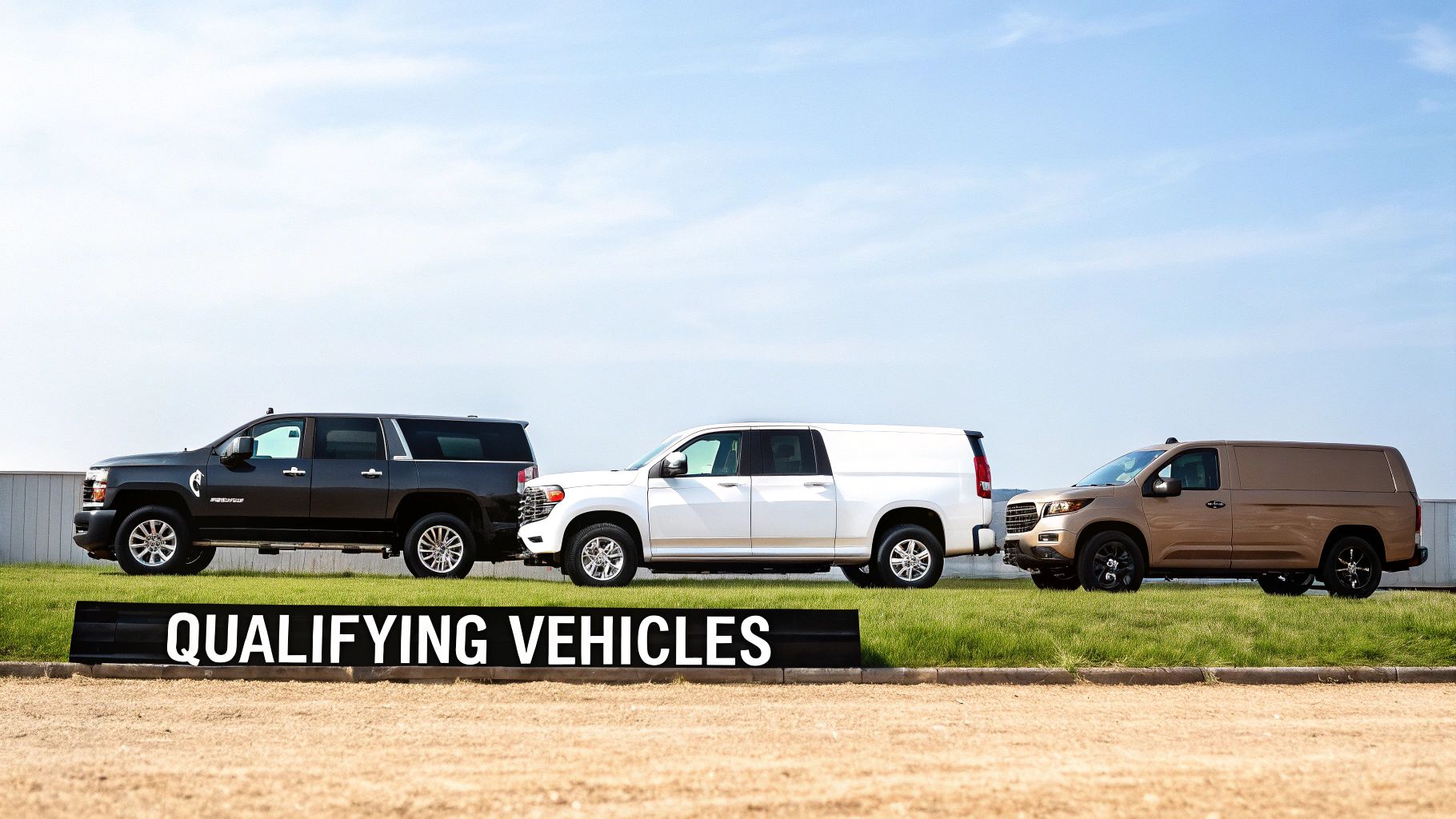
It’s one thing to talk about the 6,000-pound Gross Vehicle Weight Rating (GVWR) rule in theory, but what does that look like on the dealership lot? Let's bridge the gap between tax code jargon and the actual trucks, vans, and SUVs you might be considering for your business.
Seeing real-world examples makes it much easier to spot a potential Section 179 opportunity. You might be surprised to find that many of the most popular vehicles on the road are prime candidates for this powerful tax deduction.
Classic Workhorse Pickup Trucks
For countless businesses in construction, agriculture, and skilled trades, the pickup truck is the undisputed king. Their naturally high GVWRs mean they almost always sail past the 6,000-pound threshold, making them a go-to choice for maximizing the Section 179 deduction.
Think about it in practical terms:
- Ford F-150: As one of America's best-selling trucks, many F-150 configurations easily clear the weight requirement. A general contractor could use one to haul lumber from the supplier, tow a trailer loaded with equipment, and navigate muddy job sites.
- Chevrolet Silverado 1500: Just like the F-150, the Silverado is a staple for small business owners. Picture an electrician outfitting their truck with a ladder rack and specialized toolboxes, effectively turning it into a mobile workshop.
- Ram 1500: The Ram 1500 is another powerhouse that often qualifies. A property manager might rely on one for everything from hauling away debris to transporting a new water heater for an emergency repair.
And that's just the start. If you jump up to heavy-duty models like the Ford F-250, Chevy Silverado 2500, or Ram 2500, their GVWRs are so high that they are practically guaranteed qualifiers, assuming they meet the business-use test.
Heavy SUVs for Clients and Cargo
While we often picture SUVs in the school pickup line, many are built on rugged truck frames with GVWRs well over 6,000 pounds. For some businesses, they offer the perfect mix of professional polish and true utility.
For example, a real estate agent might choose a Cadillac Escalade (which typically has a GVWR over 7,100 lbs) to show clients high-end properties. It projects a professional image while easily qualifying for the deduction. In the same vein, a corporate transportation service could use a Chevrolet Suburban or Ford Expedition for airport runs, taking advantage of both the generous passenger space and the significant tax write-off.
The rule of thumb is simple: the vehicle must be used more than 50% for business. Whether that's driving clients, transporting goods, or traveling between work locations, business use has to be the primary purpose.
Indispensable Cargo and Passenger Vans
When your business is all about moving goods or people, nothing beats a dedicated van. These vehicles are designed for work from the ground up, and nearly all of them meet the weight requirements for the full Section 179 deduction.
- Ford Transit: Imagine a plumber or HVAC technician customizing a Transit van with permanent shelving and part organizers. It's no longer just a vehicle; it's a rolling command center that boosts efficiency on every service call.
- Ram ProMaster: A local catering company could use a high-roof ProMaster to deliver multi-course meals and bulky equipment to events, all while keeping everything secure and organized in its cavernous cargo bay.
- Mercedes-Benz Sprinter: An independent courier service could build their entire operation around a reliable Sprinter van, depending on its capacity and durability to handle demanding daily delivery routes.
Because these vehicles are so clearly built for work, justifying them as a business expense is often straightforward. Their entire design screams "business intent," making them ideal candidates for the tax benefits Section 179 offers.
To give you an even clearer picture, here is a breakdown of some popular models that often meet the heavy vehicle criteria.
Popular Heavy Vehicle Models That May Qualify for Section 179
| Vehicle Model | Typical GVWR Range | Common Business Use Cases | Notes on Qualification |
|---|---|---|---|
| Ford F-150 / F-Series | 6,100 – 7,850 lbs+ | Construction, landscaping, agriculture, mobile repair | Most configurations qualify. Heavier F-250/350 are near-certain qualifiers. |
| Chevy Silverado / GMC Sierra | 6,800 – 7,300 lbs+ | Trades, property management, equipment hauling | Similar to Ford, 1500 models often qualify, while 2500/3500 models easily exceed the threshold. |
| Ram 1500 / Heavy Duty | 6,800 – 7,800 lbs+ | General contracting, towing, field services | The 1500 is a frequent qualifier. Ram 2500/3500 are built for heavy work and qualify. |
| Ford Expedition | 7,300 – 7,625 lbs | Client transport, livery services, real estate | The standard and MAX versions both typically exceed 6,000 lbs GVWR. |
| Chevy Suburban / Tahoe | 7,400 – 7,700 lbs | Executive transport, airport shuttle, high-end taxi | Built on a truck platform, these SUVs have long been popular Section 179 choices. |
| Cadillac Escalade | 7,600 – 7,800 lbs | Luxury transport for clients, real estate professionals | Its high GVWR and professional image make it a dual-purpose qualifier. |
| Ford Transit Van | 8,550 – 11,000 lbs | Plumbing, electrical, delivery services, catering | As a purpose-built work van, it’s a clear and easy qualifier. |
| Mercedes-Benz Sprinter | 8,550 – 12,125 lbs | Expedited shipping, mobile workshops, passenger shuttle | Known for its utility and high GVWR across all configurations. |
This table isn't exhaustive, but it shows how many common vehicles can become powerful tax-saving tools. By connecting these real-world examples to the tax code, you can start to see how a new vehicle purchase could directly translate into significant savings for your own business.
Lighter Passenger Vehicles: Navigating the Rules
While heavy-duty trucks and vans unlock the biggest Section 179 benefits, let's be realistic—not every business needs a three-ton beast. Plenty of companies run on standard sedans, crossovers, and smaller SUVs for sales calls, client meetings, or local deliveries.
The good news? These lighter vehicles can still qualify for a tax deduction. The catch is that the rules are much stricter, and the financial reward is more modest.
The IRS puts passenger vehicles with a Gross Vehicle Weight Rating (GVWR) under 6,000 pounds into their own category with tighter limits. This is really just a safeguard to prevent people from claiming massive business deductions on what are essentially personal luxury cars. Think of it as the tax code’s way of keeping things fair: a smaller vehicle gets a smaller, but still valuable, tax break.
Understanding the Lower Deduction Limits
Here’s the biggest difference: the deduction cap. For 2025, the maximum first-year depreciation you can claim for these lighter passenger vehicles is capped at $12,200. That number includes any Section 179 expensing and bonus depreciation combined.
This is a fraction of the write-offs available for their heavier cousins, and it's a critical detail to factor into your purchasing decision. Overlooking this cap and expecting a six-figure deduction is one of the most common—and costly—mistakes business owners make. Always confirm the vehicle's GVWR and apply the correct deduction ceiling to avoid a nasty surprise at tax time.
For a deeper dive into the specifics, our guide on how to write off a car for your business offers a comprehensive overview.
The bottom line is simple: While a vehicle under 6,000 pounds can still give you a tax advantage, it will never generate the same level of immediate write-off as a qualifying heavy vehicle.
Key Exceptions for Lighter Vehicles
But the rules aren't completely black and white. A vehicle's design and function can sometimes allow it to bypass the strict passenger car limits, even if it's on the lighter side. The key is that the vehicle must be specifically built or modified for work in a way that makes personal use pretty unlikely.
Here are a few important exceptions to keep in mind:
- No Rear Seating: A small van or SUV with no seats at all behind the driver is a dead giveaway for business use.
- Permanent Interior Shelving: Think of a small cargo van used by a technician, outfitted with permanent shelving or racks. That qualifies.
- Exterior Business Branding: Painting or wrapping the vehicle with your company's name and logo also helps establish its primary role as a work vehicle.
These exceptions show that how a vehicle is used can be just as important as how much it weighs. By understanding these nuances, you can make sure you’re categorizing your vehicle correctly and taking every dollar you're legally entitled to.
Combining Deductions with Bonus Depreciation
Why take just one tax break when you can stack two? The real secret to maximizing your vehicle deduction is combining Section 179 with bonus depreciation. It’s like a one-two punch for your tax bill, potentially letting you write off the entire cost of a new business vehicle in the first year you own it.
This strategy is all about accelerating your return on investment. The process is simpler than it sounds: you take the Section 179 deduction first, and then apply bonus depreciation to whatever cost is left over.
How the One-Two Punch Works
Let's break down the math. You start by taking the maximum Section 179 deduction allowed for your specific vehicle. For those heavy vehicles over 6,000 pounds, this is a pretty significant chunk right off the top.
Then, bonus depreciation steps in. This is a completely separate tax incentive that lets you deduct an additional percentage of the remaining cost. When the rate is set to 100%, you can write off every single dollar of the vehicle's price in the same year you buy it. For a business’s cash flow, this is a total game-changer. For a deeper dive into this incentive, check out our guide on how bonus depreciation works.
A Real-World Example in Action
To see how this works in practice, imagine your construction company buys a new Chevrolet Tahoe for $75,000 and uses it exclusively for business. A Tahoe’s GVWR is 7,400 pounds, so it easily qualifies as a heavy vehicle.
Here’s how the deduction would be calculated for the 2025 tax year:
- Apply Section 179 First: You deduct the maximum for a heavy SUV, which is $31,300.
- Calculate the Remaining Cost: $75,000 (Purchase Price) – $31,300 (Section 179) = $43,700.
- Apply 100% Bonus Depreciation: Next, you deduct 100% of that remaining $43,700.
- Total First-Year Deduction: $31,300 + $43,700 = $75,000.
Just like that, you've written off the vehicle's entire purchase price in a single year, which can drastically lower your taxable income.
Recent tax law changes, like the One Big Beautiful Bill Act, have made this combination even more powerful. For 2025, the total Section 179 expensing limit for all equipment has been boosted to $2.5 million, with a phase-out threshold of $4 million. The law also locked in 100% bonus depreciation, making these strategies incredibly valuable. You can find more ideas by reviewing the list of vehicles over 6,000 pounds that qualify for Section 179 and see just how much these rules could help your business.
Got Questions About Section 179 Vehicles? We’ve Got Answers.
Alright, let's tackle a few of the questions that come up all the time when business owners start looking into the Section 179 deduction for their vehicles.
Can I Claim Section 179 on a Used Vehicle?
Yes, you absolutely can. The key rule here is that the vehicle has to be “new to you” and your business. It doesn’t matter if it’s brand new off the lot or a few years old—as long as you bought it and put it to work for your business in the same tax year, it’s eligible.
What Happens if My Business Use Drops Below 50 Percent?
This is a big one, so pay close attention. To qualify for Section 179, your vehicle must be used for business more than 50% of the time. If that usage drops below 50% at any point during the vehicle's normal depreciation lifespan (which is usually five years), you’ll likely face what’s called “tax recapture.”
Essentially, the IRS will want a portion of that deduction back. It's crucial to maintain that business-use percentage to keep your full tax break.
Does a Leased Vehicle Qualify for Section 179?
No, unfortunately leased vehicles don't make the cut. Section 179 is designed for property you purchase—whether you paid in cash or financed the deal.
That said, you can still get a tax benefit for a leased vehicle. You’re allowed to deduct the business-use portion of your monthly lease payments as a standard operating expense.
Tax rules can feel like a maze, but you don't have to navigate them on your own. The team at Allied Tax Advisors lives and breathes this stuff, and we're here to help you get the most out of every deduction while staying compliant. Reach out today and let's talk about a tax strategy that works for you at https://alliedtax.com.