
Welcome to the world of short-term rentals! It's an exciting venture, but it comes with a tax landscape that can feel a bit like a maze. Before you do anything else, the single most important concept you need to grasp is how the IRS sees your property: is it a passive rental activity or an active business?
Getting this right from the start is the bedrock of your entire tax strategy. It dictates how you report your income, what you can deduct, and ultimately, how much you keep.
Your Foundational Tax Question: Rental Or Business?
Think of it like this: are you a landlord or a hotelier? The IRS uses specific criteria to figure this out, and the label you get has massive financial consequences.
This isn't just about filling out a different form. How you classify your rental determines everything that follows, from the taxes you owe to the losses you can write off. For a deeper dive into the various tax types and obligations, this comprehensive guide to short term rental taxes is a fantastic resource.
The Vending Machine vs. The Coffee Shop Analogy
Let's break it down with a simple analogy.
-
Passive Rental Activity: This is like owning a vending machine. You stock it, collect the money, and handle maintenance here and there. It’s a hands-off operation that generates income with very little day-to-day effort. On your tax return, this income usually goes on Schedule E.
-
Active Business Activity: This is more like running a coffee shop. You're not just renting out space; you're providing significant services—fresh linens, daily cleaning, concierge-style help, maybe even breakfast. This level of hands-on involvement makes it a business, which means you'll report it on Schedule C and likely face self-employment taxes.
Why This Distinction Matters So Much
The vacation rental market has exploded, and you can bet tax authorities are paying close attention. The rules are always changing. For example, Delaware recently added a 4.5% lodging tax on all short-term rentals. Meanwhile, Hawaii is the only state where Airbnb doesn’t automatically handle state tax collection and remittance for hosts.
To help you get a clearer picture, here's a quick comparison of the two classifications.
Rental vs. Business Activity At a Glance
This table breaks down the key differences between treating your rental as a passive activity versus an active business. Think of it as your cheat sheet for understanding where your property fits.
| Characteristic | Rental Activity (Passive) | Business Activity (Active) |
|---|---|---|
| Tax Form | Schedule E (Supplemental Income and Loss) | Schedule C (Profit or Loss from Business) |
| Primary Goal | Generate rental income with minimal host involvement. | Provide hospitality services and generate profit through active management. |
| Services Provided | Basic services only (utilities, trash removal, basic upkeep). | Substantial services (daily cleaning, meals, concierge services, tours). |
| Self-Employment Tax | Not subject to the 15.3% self-employment tax. | Net earnings are subject to the 15.3% self-employment tax. |
| Loss Limitations | Losses are often "passive" and can only offset passive income. | Losses are "active" and can typically offset other ordinary income. |
Knowing where you stand is the first step toward smart tax planning. The right classification can save you thousands, while the wrong one can lead to costly surprises.
Understanding whether your property is a passive rental or an active business is the first step toward compliance and profitability. This classification directly impacts your tax forms, the types of deductions you can claim, and your obligation to pay self-employment tax—a potential 15.3% hit on your net earnings that surprises many new hosts.
This guide will walk you through making that determination, mastering deductions, and navigating local tax laws so you can build your rental venture on a solid financial footing.
Classifying Your Rental: A Business or Passive Income?
Figuring out your rental's tax identity is the single most important decision you'll make as a host. It's the fork in the road that determines your entire tax journey—from the forms you file and the deductions you can claim to whether you owe a hefty chunk in self-employment taxes. Get this right, and you're setting yourself up for success. Get it wrong, and you could be staring down a surprisingly large tax bill.
At the heart of this decision are two key factors the IRS cares about: the average length of your guests' stays and the level of service you provide. These two things will tell you whether your rental is more like a passive investment (think of it like a vending machine) or an active business (more like a coffee shop).
The Deciding Factor: The 7-Day Rule
The first big test is what I call the 7-day rule. If the average stay for your guests is 7 days or less during the tax year, the IRS generally sees your activity as a trade or business, not a "rental activity" in the classic sense. This is a critical distinction that completely changes how your income is treated.
On the flip side, if your average guest stays for more than 7 days but less than 30, it’s still a short-term rental. However, it will most likely be treated as a passive rental activity unless you start providing a lot of hands-on services.
What Are "Substantial Services"?
This is where the coffee shop analogy really comes into play. "Substantial services" are the hotel-like amenities you offer that go way beyond what a typical long-term landlord would ever do. We're talking about services you perform for the guest's convenience during their stay.
Let's break down the difference:
- Minimal Services (Passive Rental): Things like providing clean linens at the start of a stay, cleaning the unit between guests, and handling basic maintenance don't count as substantial. This kind of activity is generally reported on Schedule E.
- Substantial Services (Active Business): If you're offering daily cleaning, changing linens mid-stay, providing meals, acting as a personal concierge, or arranging local tours, you've crossed the line into business territory. This activity gets reported on Schedule C.
This decision tree gives you a great visual for how to classify your short-term rental tax obligations.
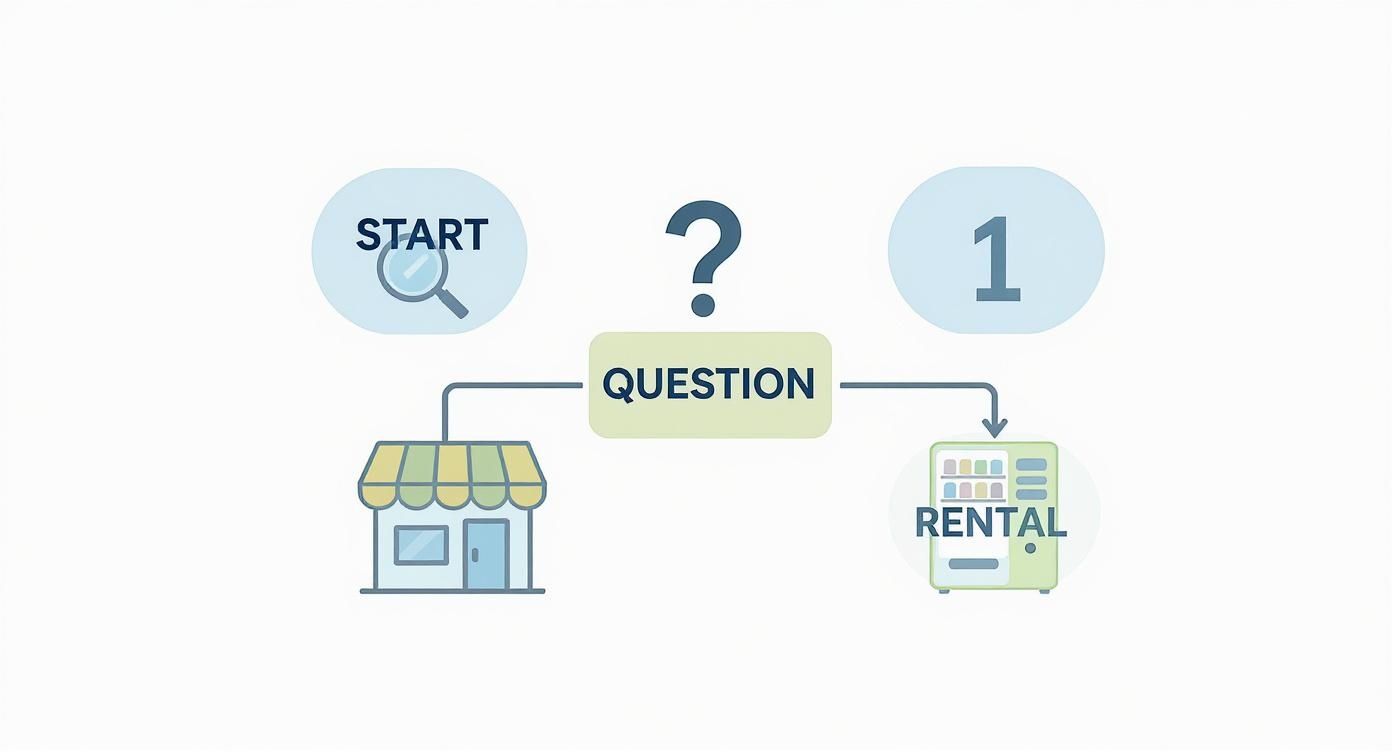
As you can see, it’s that combination of short guest stays and significant, hands-on involvement from you as the host that flips the switch from a passive rental to an active business.
The Self-Employment Tax Consequence
Choosing the right classification has a massive impact on your bottom line. If your rental is considered a business and you file a Schedule C, your net profit is subject to self-employment tax. This tax, which covers your Social Security and Medicare contributions, currently sits at a combined rate of 15.3%.
Here's a quick example: Let's say Sarah earns $20,000 in net profit from her short-term rental. If it's a passive activity (Schedule E), she just pays her regular income tax on that profit. But if it's an active business (Schedule C), she owes an extra $3,060 ($20,000 x 15.3%) in self-employment tax on top of her income tax.
That one factor can take a huge bite out of your earnings if you aren't ready for it. With the global vacation rental market now worth nearly USD $98 billion, tax compliance is getting stricter. You really need to get this right.
This distinction is also incredibly important for anyone hoping to use rental losses to offset other income. If you spend a significant amount of time managing your properties, it’s worth looking into what it takes to achieve real estate professional tax status for even more tax advantages. Ultimately, you have to take a hard, honest look at your hosting activities—from booking length to the services you offer—to confidently choose the right tax path and avoid any costly mistakes down the line.
Maximizing Your Tax Deductions And Depreciation
Here's where the real money is made (or saved) in the short-term rental game. It's not just about the nightly rate; it's about mastering your expenses. Every dollar you spend operating your rental is a potential tax deduction that lowers your taxable income, which means more cash stays in your bank account.
The most successful hosts I know treat their property like a serious business. They go way beyond just claiming the obvious things like mortgage interest. They track everything. From the welcome basket snacks to the platform service fees, these costs add up fast and can make a massive difference when you file your taxes.
Essential Deductions Every STR Host Should Track
So, what can you actually write off? The IRS rule of thumb is that an expense must be both "ordinary and necessary" for your business. If you spent the money to get your property rented, keep your guests happy, or maintain the unit, it’s probably deductible.
Here are the big categories you absolutely need to have on your radar:
- Operating Costs: Think of your non-negotiables. This includes utilities (power, water, Wi-Fi), cleaning fees, landscaping, and trash services.
- Supplies: Every item your guests use is a potential write-off. We're talking toiletries, cleaning products, coffee, linens, and paper towels.
- Marketing and Platform Fees: Any money spent on advertising, professional photos, or the service fees charged by Airbnb and Vrbo is 100% deductible.
- Professional Services: Did you pay a lawyer to draft a rental agreement or an accountant to help with your books? Those fees are a cost of doing business.
A quick heads-up on a common rookie mistake: knowing the difference between a repair and an improvement. A repair (like fixing a running toilet) is a current-year expense because it just maintains the property. An improvement (like a full kitchen remodel) adds value and has to be depreciated over several years.
To help you get a handle on all the moving parts, here’s a checklist of the most common deductions available to STR owners.
Common Short-Term Rental Tax Deductions Checklist
| Expense Category | Examples | Notes for Deduction |
|---|---|---|
| Mortgage & Property | Mortgage Interest, Property Taxes, Mortgage Insurance (PMI) | Deductible for the portion of the year the property was available for rent. |
| Insurance | Homeowner's Insurance, Landlord Insurance, Liability Insurance | The premiums paid for policies covering your rental business are fully deductible. |
| Utilities | Electricity, Gas, Water, Sewer, Trash, Internet, Cable | If you have personal use, you must prorate these expenses based on rental vs. personal days. |
| Repairs & Maintenance | Plumbing fixes, painting, pest control, landscaping, fixing broken items | These are expenses that keep the property in good working condition but don't add significant value. |
| Supplies | Toiletries, cleaning supplies, light bulbs, batteries, coffee, snacks, welcome gifts | The cost of consumable items provided to guests during their stay. |
| Cleaning & Management | Professional cleaning fees, property management fees | Fees paid to third parties for services are fully deductible. |
| Platform Fees | Service fees or commissions paid to Airbnb, Vrbo, Booking.com, etc. | These are a direct cost of securing bookings and are 100% deductible. |
| Professional Services | Legal fees, accounting fees, tax preparation costs | Fees paid for professional advice or services related to your rental business. |
| Marketing | Professional photography, listing site fees, advertising costs | Any money you spend to promote your property and attract guests. |
| Travel | Mileage or transportation costs for traveling to/from the rental property | Must be for business purposes, like maintenance or restocking supplies. Keep a detailed mileage log. |
| Depreciation | Building, furniture, appliances, major improvements (e.g., new roof) | A non-cash expense that allows you to deduct the cost of assets over their useful life. See notes below. |
Keeping a detailed record of every single one of these items might feel tedious, but that diligence pays off directly in the form of a lower tax bill.
The Power Of Depreciation: A Game Changer
While tracking day-to-day expenses is crucial, depreciation is the single most powerful tax tool for any property owner. It’s a bit of a mind-bender at first, but it allows you to deduct a portion of your property's cost each year, creating a "paper loss" that can slash your taxable income without you spending any actual cash.
You can't write off the entire price of your rental home the year you buy it. The IRS makes you spread that cost out. For a short-term rental, the building itself is generally depreciated over 39 years. The stuff inside—furniture, appliances, TVs—gets depreciated much faster, usually over 5 or 7 years. To really dig into this, our guide on the depreciation of rental property is a must-read.
Allocating Expenses For Personal Use
What happens if you block off a few weeks for your own family vacation at the property? The IRS is very picky about this. You have to split your expenses between personal use and rental use.
Here’s a simple example: You rented the property for 200 days and used it personally for 20 days. The total usage for the year was 220 days.
- Rental Use Percentage: 200 / 220 = 90.9%
- Personal Use Percentage: 20 / 220 = 9.1%
This calculation means you can only deduct 90.9% of your annual expenses like mortgage interest, property taxes, and insurance. This is why keeping a rock-solid calendar of every rental night and every personal night is absolutely essential to keep the IRS happy.
For a deeper dive into making these rules work for you, check out this excellent guide on how to maximize your short term rental tax deductions. Getting this right means you claim every penny you’re entitled to without ever stepping over the line.
Don't Forget About State and Local Occupancy Taxes
Federal income tax is a big piece of the puzzle, but it’s not the only one. When you're a short-term rental host, you also have to navigate a complex web of state, county, and city taxes. You'll hear them called different things—transient occupancy taxes (TOT), lodging taxes, hotel taxes, or tourist taxes—but they all mean the same thing.
Think of it as a local sales tax specifically for your rental. It's a percentage added to the booking amount that your guest pays, but it's your job to make sure that money gets to the right government agency. These funds are vital for communities, often going toward tourism promotion, road repairs, and other public services that your guests benefit from.
Are Booking Platforms Handling This for You?
A lot of hosts figure that platforms like Airbnb and Vrbo take care of all these local taxes automatically. And in many places, they do. These companies have agreements with thousands of local governments to collect and remit occupancy taxes directly, which is a massive time-saver for hosts.
But leaning on that assumption can be a costly mistake. It creates a dangerous false sense of security.
Crucial Warning: Never assume your booking platform is handling local taxes for you. While they cover thousands of cities, there are still plenty of jurisdictions where registering, collecting, and remitting transient occupancy tax is 100% on you, the host.
Getting this wrong, even if it's an honest mistake, can land you in a world of hurt. We're talking back taxes, hefty penalties, and interest that just keeps piling up.
How to Figure Out Your Local Tax Duties
Since you can't just set it and forget it, you have to get proactive. The first, most critical step is to become the go-to expert on the short-term rental tax rules in your specific area. This isn't optional; it's fundamental to running a legal and profitable rental business.
Here's a straightforward plan to figure out exactly what you owe:
- Start Local. Head to the official government website for the city or county your property is in. Search for terms like "transient occupancy tax," "lodging tax," or even "finance department." This is your most reliable source.
- Find the Registration Forms. If your town requires you to collect TOT, they'll almost certainly have a business license or registration process for rental operators. This paperwork will spell out the tax rates, when you need to file, and how to pay.
- Check Your Platform's Resources. Dive into the help center or professional hosting sections on Airbnb or Vrbo. They often have guides detailing which taxes they handle in your market and which ones are still your problem.
- Just Call Them. If the websites are confusing, don't guess. Pick up the phone and talk to someone in the local finance or tax department. A quick, direct conversation can give you clear answers and save you from making an expensive error.
A Real-World Example: The High Cost of an Assumption
Let me tell you about a host I know in a smaller, but very popular, tourist town. They were two years in, happily renting their place out, and assuming Airbnb was handling all the local tax stuff. Then, the letter from the city arrived.
They hadn't just failed to pay two years of occupancy taxes. The city also tacked on a 25% late payment penalty and daily compounding interest. The final bill was a staggering $8,000.
This entire nightmare was avoidable. A single 15-minute phone call to the city's finance office when they first started would have cleared everything up. Keeping up with local short-term rental tax laws isn’t just good business—it’s essential for protecting your investment and your sanity.
Building An Audit-Proof Bookkeeping System
Think of your recordkeeping not as a chore, but as your best line of defense against an IRS audit. It's the financial story of your property, and you want that story to be clear, accurate, and backed up with cold, hard proof.
A sloppy system where your personal groceries are mixed in with cleaning supply runs is a massive red flag for the IRS. It makes justifying your deductions a nightmare. On the other hand, clean books don't just protect you from scrutiny; they make tax season a whole lot less painful.
Start With a Dedicated Bank Account
This is the first and most critical step: open a dedicated business bank account and credit card for your rental. I can't stress this enough—it's non-negotiable. Every dollar of rental income goes in, and every single expense comes out of these accounts.
Doing this creates an undeniable paper trail. When your accountant needs your records, or if the IRS ever questions an expense, you can point directly to a specific transaction. This simple act of separation is the foundation of an audit-proof system.
By isolating your rental finances, you create a crystal-clear narrative for the IRS. It proves you are operating a legitimate business and substantiates every deduction you claim, turning potential audit headaches into straightforward conversations.
The global vacation rental market is exploding and is projected to hit $119 billion by 2030. But don't let the big numbers fool you; operating costs and taxes can easily eat up 50-60% of your gross bookings. Solid bookkeeping is your key to protecting your profit margins in this competitive game. You can learn more about how how regional economics and taxes shape rental viability to see the bigger picture.
Choosing Your Bookkeeping Tools
With your bank accounts separated, you need a system to track and categorize everything that flows through them. You've got a couple of good options here.
-
Simple Spreadsheets: If you only have one or two properties, a well-organized spreadsheet can work just fine. You just need columns for the date, vendor, expense category, and amount. It's a low-cost approach, but it demands consistent discipline to keep it updated.
-
Accounting Software: Once you start scaling up, software becomes a lifesaver. Platforms like QuickBooks or more specialized tools like Stessa can automate most of the heavy lifting. They sync with your bank accounts, help you categorize transactions, and can generate professional financial reports in just a few clicks.
If you're weighing your options, our guide on the best accounting software for rental property breaks down the pros and cons to help you find the right fit. Whichever route you go, consistency is what matters most.
Document Everything Meticulously
Your bookkeeping system isn't just about the numbers in a spreadsheet; it's about the proof behind those numbers. You need to keep a record of everything.
- Receipts: Get in the habit of saving digital copies of every receipt for every expense, from a bottle of Windex to a new sofa.
- Mileage Log: Do you drive to the property for maintenance or to meet a contractor? You need to track those miles. A simple app or a logbook in your glove compartment works perfectly—just note the date, purpose, and mileage for each trip.
- Usage Calendar: This is absolutely critical. Keep a detailed calendar that logs every single night. Was the property booked by a guest? Were you there for repairs? Or was it a personal weekend getaway? This record is essential for correctly prorating expenses between business and personal use.
Setting up this system takes some effort on the front end, but the peace of mind it provides is invaluable. It transforms tax time from a frantic scramble for receipts into a calm review of a well-documented year.
Knowing When to Call in a Professional Tax Advisor
It's tempting to tackle your short-term rental taxes yourself, especially when you're just getting your first property off the ground. But as your business grows or your finances get more complicated, going it alone can quickly turn into a high-stakes gamble. Deciding to hire a pro isn't throwing in the towel; it's a smart business move that can save you a ton of money and stress down the road.
Think of it this way: you can handle a minor cut with a bandage from your medicine cabinet, but you'd see a doctor for stitches. Your rental's finances are no different. A Certified Public Accountant (CPA) who specializes in real estate isn't just a number-cruncher for tax season. They're a strategic partner who can help you optimize your entire financial picture.
Red Flags That Scream "It's Time to Hire a CPA"
Certain situations are clear signals that you've graduated from DIY tax software. If any of these hit a little too close to home, it's probably time to get an expert on your team. Catching these early can mean the difference between a smooth tax season and a costly, frustrating mess.
-
You Own Properties in Multiple States: This is a big one. Every state plays by its own rules when it comes to income tax and deductions. A CPA who knows multi-state tax law is crucial for correctly allocating your finances and keeping you out of trouble with several departments of revenue at once.
-
You Did a Major Renovation: That beautiful new kitchen or deck you installed isn't just an expense; it changes your property's cost basis. A tax pro knows exactly how to classify these improvements to get you the best depreciation benefits over the long haul.
-
Your Rental is Showing a Big Loss (on paper): If you've had a cost segregation study done or incurred major one-time expenses, you might have a significant loss to report. An expert can make sure you're properly documenting everything to legally use those losses against other income without setting off alarm bells at the IRS.
A lot of people think you only hire a CPA when you’re already in hot water with the IRS. That’s a huge mistake. The best time to bring in an advisor is when things are going well, so they can proactively set you up for success instead of just cleaning up a mess.
Finding the Right Tax Partner for Your Business
Here’s the thing: not all CPAs are cut from the same cloth. You don't want a generalist who dabbles in real estate; you need a specialist who truly understands the ins and outs of the short-term rental world.
When you're interviewing potential advisors, don't be shy. You're hiring them for their specific expertise, so test it.
Questions to Ask a Potential Tax Advisor:
- How many short-term rental owners do you currently have as clients?
- Can you walk me through your approach to cost segregation and depreciation for properties like mine?
- Are you up-to-speed on the local transient occupancy tax rules for [Your City/County]?
- What strategies do you recommend for documenting material participation to make sure my losses aren't limited?
Finding the right advisor does more than just get your taxes filed. It gives you peace of mind and turns what used to be a major headache into a powerful part of your business strategy.
Your Top Short-Term Rental Tax Questions, Answered
Let's be honest, short-term rental taxes can get tricky. Once you get the basics down, a bunch of "what if" questions always seem to pop up. Here are some straight answers to the questions we hear most often from hosts just like you.
Do I Pay Taxes if I Only Rent My Property a Few Days a Year?
It really depends on how many days we're talking about. The IRS has a fantastic little loophole often called the "Masters Rule"—named for the folks in Augusta who rent out their homes during the big golf tournament.
If you rent out your personal home for fewer than 15 days during the entire year, you generally don't have to report that income on your federal tax return. It's tax-free money. But there's a catch: you also can't deduct any of your rental expenses, like cleaning fees or booking commissions. And don't forget, this rule only applies to federal income tax; you might still be on the hook for state or local occupancy taxes.
What’s the Difference Between a Repair and an Improvement?
This is one of the most important distinctions you'll make, and getting it wrong can cause headaches. It all comes down to whether you're maintaining the property or enhancing it.
Think of it like this:
-
A repair is like fixing a flat tire on your car. You’re just keeping it in good working order. Fixing a leaky faucet, patching a hole in the drywall, or replacing a single broken window pane all fall into this category. The best part? You can deduct the full cost of a repair in the same year you paid for it.
-
An improvement is like swapping out the old engine for a brand-new, more powerful one. You’re adding real value, extending the property's life, or adapting it for a new use. A full kitchen remodel, adding a deck, or replacing the entire roof are all improvements. You can't deduct these costs all at once. Instead, they must be capitalized and depreciated over many years.
Getting this right is a big deal. Trying to pass off a major renovation as a simple "repair" is a classic red flag for the IRS. When you're not sure, document everything and ask your tax advisor.
How Do I Handle Income if I Co-own a Rental Property?
When you own a property with someone else, you just split everything down the middle according to your ownership agreement. You report your share of the income and claim your share of the expenses. It's that simple in principle, but good record-keeping is key.
For example, if you and a friend own a cabin together with a 50% stake each, the math is straightforward. You’ll report exactly half of the total rental income on your tax return. In the same way, you get to claim 50% of all the deductible expenses—from the mortgage interest right down to the coffee you stock for guests.
At Allied Tax Advisors, we live and breathe the complexities of rental property tax. Our team can guide you through deductions, depreciation, and compliance to make sure your STR is as profitable as it can be. Visit us at https://alliedtax.com to schedule a consultation and get your tax strategy dialed in.