
When you're deciding how to structure your business, it feels a lot like choosing the right tool for a big job. The wrong one can make everything a headache, but the right one makes the work flow smoothly. For countless entrepreneurs, the Limited Liability Company (LLC) is that perfect multi-tool, offering a powerful mix of legal protection and serious tax flexibility.
Its biggest superpower? A simple but powerful concept called pass-through taxation.
The Problem: Double Taxation in C-Corporations
To really get why pass-through taxation is such a big deal, let's look at the alternative: the traditional C-corporation.
Think of your business's profit as a river. In a C-corp, that river gets dammed up twice. First, the corporation itself pays corporate income tax on its profits—that's Dam #1. Then, when the remaining money is paid out to the owners as dividends, those owners have to pay personal income tax on that same money. That's Dam #2. This is the infamous "double taxation," and it can take a huge bite out of your earnings.
The LLC Solution: Pass-Through Simplicity
An LLC, in its default setup, completely demolishes that first dam.
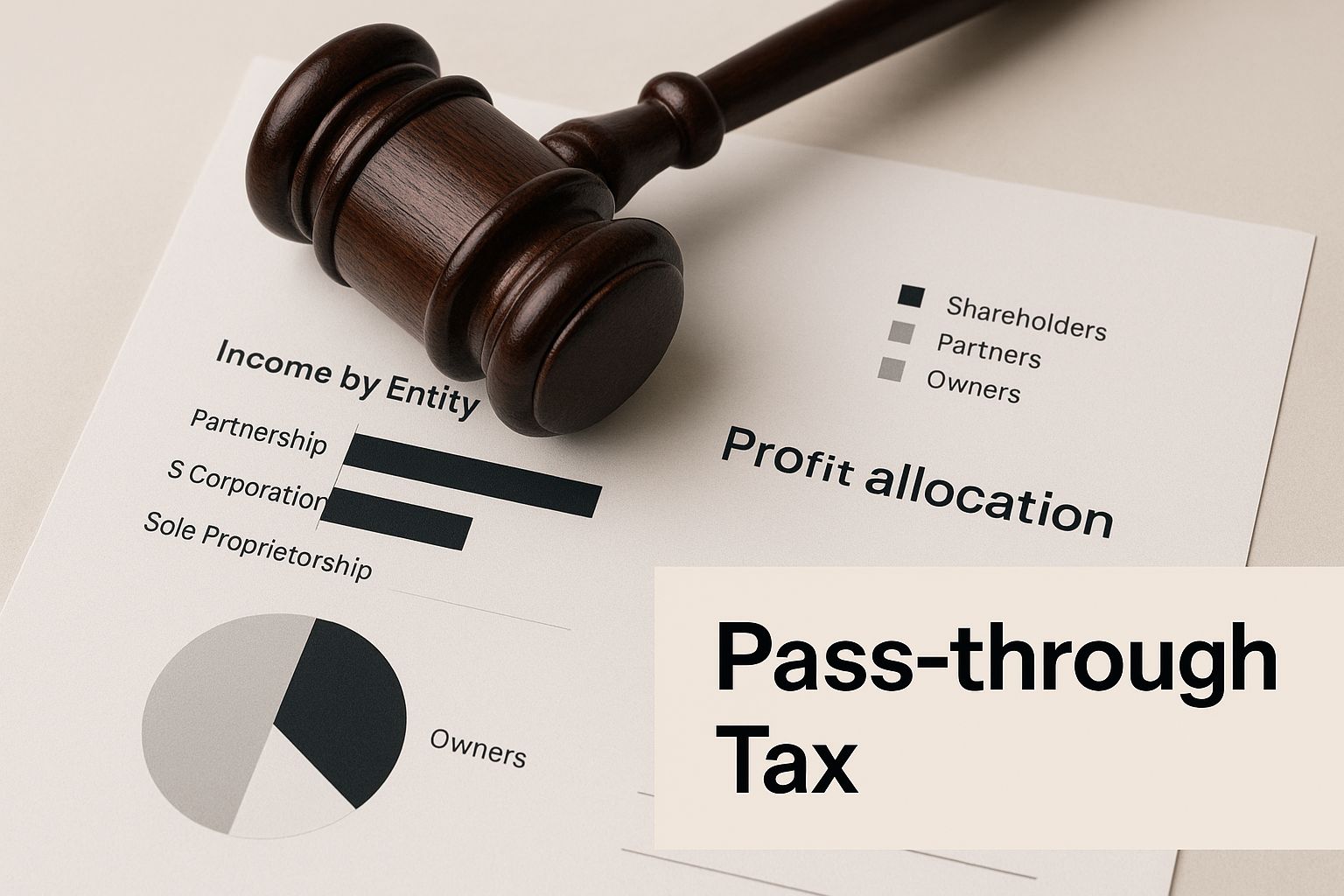
The business entity itself doesn't pay a dime in federal income tax. Instead, all the profits and losses "pass through" directly to the owners. You then report this income on your personal tax returns.
It creates a straight pipeline from your business's bottom line to your personal tax filing. The money is only taxed once, at your individual rate. This is the cornerstone of an LLC's tax advantage.
This foundational benefit not only saves you a significant amount of money but also dramatically simplifies your accounting. From here, all the other tax strategies—from maximizing deductions to making an S-Corp election—are built upon this single, powerful principle. To get a bigger picture of how this fits into your overall financial strategy, a solid overview of tax planning for small businesses can help you connect the dots from day one.
How Pass-Through Taxation Actually Works
The biggest financial perk of an LLC is baked right into its default tax setup: pass-through taxation. It's a straightforward idea, but the impact on your bottom line is huge. Instead of the LLC itself paying federal income taxes, all the profits (and losses) simply "pass through" the business and land on the owners' personal tax returns.
This single feature is the secret to avoiding the dreaded "double taxation" that plagues other business structures.
A Tale of Two Tax Bills
With an LLC, your business profits are only taxed once, at your individual income tax rate. This is a night-and-day difference from a C-Corporation, where the taxman takes two big bites. First, the C-Corp pays a 21% federal corporate tax on its profits. Then, when the company distributes what's left to shareholders as dividends, those dividends get taxed again on each shareholder's personal return.
Let’s see what this looks like with real numbers. Imagine two businesses—one an LLC, the other a C-Corp—that each made a $100,000 profit this year.
- The C-Corp: Right off the top, it owes 21% in corporate taxes ($21,000), leaving $79,000. If the owner takes that remainder as a dividend, they'll pay personal taxes on it. Assuming a 15% qualified dividend rate, that's another $11,850 gone. The owner actually pockets just $67,150.
- The LLC: The entire $100,000 profit passes directly to the owner's personal tax return. If they're in a 24% tax bracket, they'll owe $24,000. Their final take-home pay is $76,000.
In this head-to-head comparison, the LLC owner walks away with nearly $9,000 more in their pocket. That's a massive difference, all thanks to the tax structure.
To really nail down this difference, let's break it down side-by-side.
LLC Pass-Through vs. C-Corp Double Taxation: A Quick Comparison
| Tax Stage | LLC (Pass-Through) | C-Corporation (Double Taxation) |
|---|---|---|
| Corporate Level | $0 – Profits pass directly to owners. | 21% corporate income tax on all profits. |
| Personal Level | Income is taxed once at the owner's personal tax rate. | Dividends are taxed again at the shareholder's personal rate. |
This table clearly shows why pass-through taxation is so powerful. By eliminating that first layer of corporate tax, you keep significantly more of what your business earns.
It's All About Your Personal Tax Rate
When you run an LLC, your business income gets added to any other income you have (like a spouse's salary, for instance) and is taxed at your personal marginal rate. This gives you a lot of flexibility.
If your business has a slow year, the tax rate on those profits will be lower. As you grow and start earning more, your rate will adjust along with your income. This direct link keeps things simple and often much more efficient.
For business owners in pass-through entities, getting comfortable with the paperwork is key. A big part of that is decoding your real estate tax documents like the K-1, which is the specific IRS form used to report your share of the business's income and losses.
Turning Business Expenses Into Tax Savings
Pass-through taxation is a great starting point, but the real magic for an LLC owner happens when you learn to turn your everyday business costs into tax deductions. It’s a simple but powerful concept: start with your total revenue, and for every legitimate business expense, you subtract it. What’s left is your taxable profit.
This isn't a passive process. You're actively reducing the amount of income you'll be taxed on by accounting for every single dollar you put back into running and growing your company.
So, What Can You Actually Write Off?
The IRS has a surprisingly straightforward two-part test for this. To be deductible, an expense must be both "ordinary and necessary."
- Ordinary: Think of this as "normal" for your industry. A web developer buying a new laptop is ordinary. A plumber buying a new wrench is ordinary. It's an expense that others in your field would also incur.
- Necessary: This just means the expense is helpful and appropriate for your business. It doesn't have to be indispensable, just something that helps you do your job. That new laptop helps the developer write code more efficiently, making it necessary.
This "ordinary and necessary" standard gives you a lot of flexibility. It’s not a rigid list of rules, but a framework you can apply to almost any cost that helps your business run.
Common Write-Offs Most LLCs Can Claim
While the exact deductions depend on what you do, a lot of expenses are common across many different industries. The absolute key here is to keep flawless records. You can't deduct what you can't prove, which is why figuring out how to track business expenses is non-negotiable.
Here are some of the heavy hitters you should be tracking:
- Home Office Deduction: If you have a dedicated space in your home used exclusively for your business, you can write off a percentage of your housing costs—things like rent, mortgage interest, utilities, and insurance.
- Vehicle Expenses: Driving for business? You have two options. You can either deduct the actual costs (gas, oil, insurance, repairs) or take the standard mileage rate. For 2024, that's a straightforward 67 cents per mile.
- Software and Subscriptions: All those monthly fees add up. Your accounting software (like QuickBooks), project management tools, professional journals, and even stock photo subscriptions are all 100% deductible.
- Professional Development: Any money you spend to get better at your job is a write-off. This includes online courses, industry conferences, workshops, or certifications that enhance your existing skills.
- Travel Costs: When you travel for business, you can deduct your airfare, hotels, and 50% of your meal costs. The main rule is that the trip's primary purpose must be for business, not a vacation with a little work sprinkled in.
Think of it this way: every receipt for a legitimate business expense is a tool. It’s a tool that shaves down your taxable income, letting you keep more of the money you worked so hard to earn.
Let's put it into practice. Imagine a freelance marketing consultant. She flies to another city to meet a potential client—the flight and hotel are deductible. While there, she attends a one-day workshop on social media ads; that's deductible, too. And back at home, her monthly subscription to a CRM platform is another expense that lowers her taxable profit.
Individually, these might seem like small amounts. But when you add them up over an entire year, the savings can be massive. By making expense tracking a core part of your business routine, you tap into one of the most immediate and impactful tax benefits of having an LLC. You're simply making sure you don't pay tax on the money you had to spend just to make a living.
Unlocking Advanced Savings with an S-Corp Election
For many successful LLCs, there's a tipping point where the standard tax setup just isn't cutting it anymore. This is where a game-changing strategy comes into play: electing to have your LLC taxed as an S-Corporation. As a business grows, this is one of the most powerful tax moves you can make.
Let's be clear about one thing: this is purely a tax designation. You aren't legally turning your LLC into a corporation. Your business stays an LLC for all legal and operational purposes, keeping that same great liability protection. You're simply filing a form with the IRS to say, "Hey, I'd like to be taxed under a different set of rules," specifically, Subchapter S of the Internal Revenue Code.
Splitting Your Income to Save on Taxes
So, what’s the big deal? The entire strategy boils down to a single, powerful concept: splitting your income. With a standard LLC, every single dollar of profit gets hit with self-employment taxes—that's a hefty 15.3% for Social Security and Medicare. As your profits climb, that tax bill can get really big, really fast.
When you elect S-Corp status, you change the game. You now must pay yourself a "reasonable salary" as a W-2 employee. That salary is subject to the usual payroll taxes (which are basically the same as self-employment taxes). But here's the magic part: any profit left over can be taken as a distribution, and distributions are not subject to self-employment tax. This is where the real savings kick in. You can get a fuller picture by exploring the various S Corporation Pros and Cons.
The core idea is simple: You only pay self-employment taxes on your reasonable salary, not on the entire profit of the business. The rest of your earnings come to you as a distribution, saving you thousands.
Let's put some real numbers to this to see the impact.
An S-Corp Election in Action
Imagine your design agency LLC has a great year and brings in a net profit of $150,000.
- As a standard LLC: The entire $150,000 is subject to that 15.3% self-employment tax. That’s a $22,950 tax bill right off the top, and you haven't even paid your income tax yet.
- As an LLC taxed as an S-Corp: You do some research and determine a "reasonable salary" for your role is $70,000. You'll pay the 15.3% payroll tax on this salary, which comes out to $10,710. The remaining $80,000 in profit? You can take that as a distribution, which is not subject to self-employment tax.
Just by making this election, you’ve put $12,240 back in your pocket for the year. That's real money you can reinvest in the business or take home. Having a solid grasp on your options is crucial, and learning more about what tax classification for an LLC means can help you see how these pieces fit together.
Now, this strategy isn't for everyone right out of the gate. It adds a layer of complexity—you'll need to run payroll, for example. But once your LLC's profits are consistently higher than what you’d consider a reasonable salary for the work you do, the S-Corp election becomes one of the most valuable tax tools available to you.

Finding Tax Advantages at the State Level
Getting your federal taxes right is a huge part of the puzzle, but don't stop there. Maximizing the tax advantages of an LLC means looking closely at your home state. This is where you can often find another layer of significant savings, but only if you know where to look.
Every state has its own unique playbook for income taxes, franchise taxes, and business credits. This patchwork of rules means that where you register and operate your LLC can have a massive impact on your bottom line. Some states are famously business-friendly with low or no income tax, while others roll out the red carpet with incentives for specific industries. A smart tax strategy always has one eye on federal rules and the other on state-specific opportunities.

A California Case Study
Let's take a real-world look at California. It's known for having high taxes, but even there, the LLC structure offers a clear advantage. Thanks to pass-through taxation, LLC profits in California are taxed at the owner's personal income rates, which can range from 1% to 13.3%.
Now, compare that to a traditional C-Corp. A C-Corp in California pays a flat 8.84% state corporate tax before any profits are distributed to shareholders. That's on top of the 21% federal corporate tax. The savings with an LLC can be substantial right out of the gate.
But it doesn't end there. California actively sweetens the deal with various tax credits. The California Competes Tax Credit, for example, has an annual budget of around $180 million to reward companies for creating jobs and investing in the state's economy. These credits aren't just deductions; they directly slash the tax you owe, turning what feels like a compliance headache into a genuine savings opportunity. You can dig into more details about how these state-level incentives work on nsktglobal.com.
State tax law isn't just another hurdle to clear; it's a strategic playing field. By understanding local incentives and tax structures, you can find powerful advantages that your competitors might overlook.
Leveraging Local Incentives
California is just one example, of course. Plenty of other states offer their own menu of benefits to attract and keep businesses around. You'll often find things like:
- Job Creation Credits: Get a tax credit for each new full-time employee you hire who meets certain local requirements.
- Research & Development (R&D) Credits: These are designed to encourage innovation by giving you back a portion of your R&D spending as a credit.
- Industry-Specific Incentives: Many states offer special tax breaks to businesses in key sectors they want to grow, like technology, manufacturing, or renewable energy.
The bottom line is that your LLC's tax strategy has to be local. Getting a firm grip on your state's tax code is absolutely essential if you want to minimize what you owe and take advantage of every benefit on the table.
Got Questions About LLC Taxes? Let's Clear Things Up.
It's one thing to understand the big ideas behind LLC taxes, like pass-through status and writing off expenses. But when you get down to the nitty-gritty, specific questions always seem to pop up. It's totally normal.
Let's walk through some of the most common sticking points for LLC owners. My goal here is to give you direct, practical answers that you can actually use to make smart decisions for your business.
When is the Right Time to Elect S-Corp Status?
This is a question I get all the time, especially from businesses that are starting to see real growth. There isn’t a magic number that works for everyone, but I have a solid rule of thumb: start seriously thinking about the S-Corp election when your business profits are consistently higher than what you’d pay yourself as a reasonable salary.
Let me break that down. Imagine a fair salary for the work you do is $60,000 a year. But your LLC is bringing in $110,000 in profit. Without an S-Corp election, that entire $110,000 gets hit with the 15.3% self-employment tax.
But if you make the switch? You’d pay yourself that $60,000 salary (which is subject to payroll taxes, similar to self-employment tax). The remaining $50,000 can be taken as a distribution—which is not subject to that 15.3% tax. The savings can be significant and often more than cover the extra administrative costs, like running payroll.
How Does the QBI Deduction Actually Help My LLC?
The Qualified Business Income (QBI) deduction is easily one of the best tax breaks out there for LLC owners today. It came out of the 2017 Tax Cuts and Jobs Act (TCJA) and was a game-changer for pass-through businesses. You can get more background on how the TCJA reshaped business taxes on youtube.com.
Essentially, it allows you to deduct up to 20% of your qualified business income right off the top.
Think of it like this: If your LLC has $100,000 in qualified profit, the QBI deduction could let you slice $20,000 off your taxable income. You're not taxed on that portion at all. It’s a direct boost designed to help small and medium-sized businesses thrive.
Just keep in mind, there are income limits and some tricky rules depending on your line of work, so you'll want to be sure you qualify.
Can I Still Write Off Expenses if My Business Hasn't Made a Profit Yet?
Yes, a thousand times yes! It’s a huge misconception that you need to be profitable to deduct expenses. The IRS is well aware that most new businesses spend their first year or two in the red.
You absolutely can—and should—deduct every single ordinary and necessary business expense. If those expenses add up to more than your income, you have what's called a net operating loss (NOL).
An NOL isn't a bad thing; it can actually be a powerful financial tool. You can often carry that loss forward into future, profitable years. Doing so reduces your taxable income down the road, meaning you'll pay less in taxes once your business really takes off.
Here’s a quick recap of the key takeaways on these common LLC tax questions:
- S-Corp Election: The sweet spot is when your profits start to significantly outpace a fair salary for your role.
- QBI Deduction: This is a potential 20% reduction in your taxable business income, so don't leave it on the table.
- Business Losses: Your expenses are still deductible, even in the early days. Those losses can be used to lower your tax bill in future years.
Getting a handle on these key areas is what separates a good business owner from a great one. It's about moving beyond the basics to make strategic moves that protect your bottom line.
At Allied Tax Advisors, we turn confusing tax codes into clear, actionable strategies that help your business grow. Let our team of experts manage the complexities so you can stay focused on what you do best. Contact us today to optimize your LLC's tax advantages.