
Owning a rental property is much more than just a way to collect a monthly rent check. It’s one of the most powerful wealth-building tools available, and a huge part of that power comes from the unique tax advantages of rental property. In many ways, the government treats your rental like a small business, offering a special set of financial perks to encourage you to provide housing.
Your Guide to Real Estate Tax Benefits

This guide is designed to pull back the curtain on those benefits. We’ll move past the basics of rent collection and dive into the world of strategic financial management. You’ll learn how to legally deduct all sorts of everyday expenses, use depreciation to shield your income from taxes, and even manage capital gains when it’s time to sell.
The goal here isn’t just to list rules, but to give you clear, actionable insights. Think of it as a roadmap to turning your rental property from a simple asset into a highly efficient financial engine. When you get a handle on these concepts, you can dramatically lower your tax bill and boost your overall returns.
What You’ll Learn in This Guide
We’re going to break down the most important tax benefits every landlord needs to understand.
We’ll cover:
- Powerful Deductions: We’ll explore how you can write off costs like mortgage interest, property taxes, insurance, and routine maintenance to directly increase your net profit.
- The Magic of Depreciation: This is a big one. We’ll look at how this non-cash deduction can create a “paper loss,” which often means you pay little to no tax on your rental income.
- Smart Capital Gains Management: Discover strategies like the 1031 Exchange that can help you defer—or sometimes even eliminate—taxes when you sell one property to buy another.
Think of tax planning not as a seasonal chore but as a year-round strategy. A proactive approach ensures you claim every legitimate deduction and are prepared for any changes in tax law.
Before we dive into the nitty-gritty of each benefit, let’s start with a quick overview. The table below gives you a snapshot of the key advantages we’ll be discussing in detail.
Key Tax Advantages at a Glance
| Tax Advantage | What It Means for You |
|---|---|
| Expense Deductions | Lower your taxable income by writing off costs directly related to managing your property. |
| Depreciation | Deduct the “wear and tear” on your property over 27.5 years, creating a substantial non-cash expense. |
| Capital Gains Deferral | Use strategies like a 1031 Exchange to postpone paying taxes when selling and reinvesting profits. |
| Pass-Through Deduction | Qualified individuals may be able to deduct up to 20% of their net rental income. |
This table serves as a quick reference, but the real value comes from understanding how to apply these concepts to your own portfolio. Let’s get started.
Deducting Expenses for Higher Returns

Here’s one of the most straightforward tax perks of owning a rental property: you can deduct the costs of running it. The best way to think about your rental is as a small business. Just like any other business, the “ordinary and necessary” expenses you pay to keep it going can be subtracted directly from your rental income. This simple step lowers your taxable profit and puts more money back in your pocket.
This is where sharp record-keeping shifts from a tedious chore into a powerful tool for boosting your returns.
These deductions aren’t just limited to the big, obvious costs. Most landlords know they can write off their mortgage interest and property taxes, but that’s just scratching the surface. The list of eligible expenses is surprisingly long. In fact, pretty much every dollar you spend to manage, conserve, and maintain your property is a potential tax deduction.
For example, the premiums for your landlord insurance—including fire, flood, and theft policies—are 100% deductible. The same goes for any utilities you cover for your tenants, like water, gas, or trash pickup. These expenses might seem small month-to-month, but they add up to significant savings over the year.
Common Deductible Rental Expenses
The secret is to track everything. Seriously, every single expense. New landlords often leave a lot of money on the table simply because they overlook common write-offs. To make sure that doesn’t happen to you, here’s a quick list of expenses you should be tracking all year long:
- Mortgage Interest: This is often the single largest deduction for most rental property owners.
- Property Taxes: Your state and local property tax bills are fully deductible.
- Operating Costs: Think insurance premiums, utilities you pay, and any homeowners association (HOA) fees.
- Repairs and Maintenance: From fixing a leaky faucet and patching drywall to paying for appliance repairs, the costs of labor and materials are deductible.
- Professional Fees: Did you hire a property manager, an accountant, or a lawyer for rental-related advice? Those fees are deductible.
It’s absolutely crucial to understand the difference between a repair and an improvement. A repair, like fixing a broken window, is a deductible expense for the year. An improvement, like replacing all the windows, is a capital expense that you have to depreciate over time.
Differentiating Repairs from Capital Improvements
Getting this distinction right is essential for your tax filings. The IRS sees repairs as costs that keep your property in good working order but don’t significantly add to its value or extend its life. You can expense these costs in the same year you pay for them.
Capital improvements, on the other hand, are major investments that better your property, restore it to a like-new condition, or adapt it for a new use. You can’t deduct these large costs all at once. Instead, you recover the cost through depreciation over the property’s useful life. You can get a deeper dive into how rental property income is taxed in our comprehensive guide.
Let’s look at a real-world example.
Example of a Repair:
The water heater in your rental unit is on the fritz. You call a plumber, who comes out and replaces a faulty heating element for $250. This is a repair. You get to deduct the full $250 on this year’s tax return.
Example of a Capital Improvement:
That same 15-year-old water heater finally gives out completely. You decide to replace it with a brand-new, high-efficiency tankless model for $2,500. This is a capital improvement because it makes the property better. You’ll add that $2,500 to your property’s cost basis and depreciate it over several years.
By correctly categorizing every expense, you’re not just doing paperwork—you’re actively managing your investment, lowering your tax bill, and improving your overall return.
Of all the tax breaks available to landlords, depreciation is easily the most powerful and, frankly, the most misunderstood. It’s the closest thing real estate investors have to a secret weapon—a massive “on paper” deduction for the wear and tear on your property, even while its market value is going up.
This is a non-cash expense, meaning you get to claim the deduction without actually spending any money out of pocket. The IRS basically says, “We know your building won’t last forever, so you can write off a piece of its value each year.” This creates what many experienced investors call a “phantom expense” that can slash your tax bill.
What makes it so potent? This deduction can often transform a cash-flowing property into a “paper loss” for tax purposes. This doesn’t just shelter your rental income; it can sometimes offset your other earnings, too.
Understanding the 27.5-Year Schedule
For residential rental properties in the United States, the IRS has determined the “useful life” of the building itself to be 27.5 years. To figure out your annual deduction, you simply take the value of your building (not the land—land never depreciates) and divide it by 27.5.
A crucial point here is that you start depreciating the property as soon as it’s “placed in service.” This means it’s ready and available for rent, not necessarily when your first tenant officially moves in. Getting this timing right can make a big difference in your first year.
Let’s look at a quick, real-world example to see how this plays out.
A Quick Example of Depreciation in Action
Imagine you just purchased a single-family rental for $400,000. Through an appraisal or a reasonable assessment, you determine the land is worth $100,000 and the physical structure (the house) is worth $300,000.
Your math would look like this:
- Building’s Value (Cost Basis): $300,000
- IRS Depreciation Period: 27.5 years
- Annual Depreciation Deduction: $300,000 / 27.5 = $10,909
That’s $10,909 you can deduct from your rental income every single year, all without spending another dollar. It’s a consistent, predictable way to lower your taxable income. For a deeper dive into all the rules, check out our complete guide to depreciation on rental property.
The Power of Stacking Your Deductions
This is where things get really interesting. Depreciation is powerful on its own, but it becomes a game-changer when you combine it with all your other operational expenses.
Think about it: You’re already deducting mortgage interest, property taxes, insurance, and maintenance costs. When you stack the hefty depreciation deduction on top of all that, the tax savings multiply. It’s this “stacking” effect that makes rental properties one of the most tax-efficient investments out there. A property that’s putting cash in your pocket every month could still show a paper loss of $10,000 or more after depreciation, potentially wiping out your tax liability on that income.
This visual gives you a better idea of how all these expenses come together.
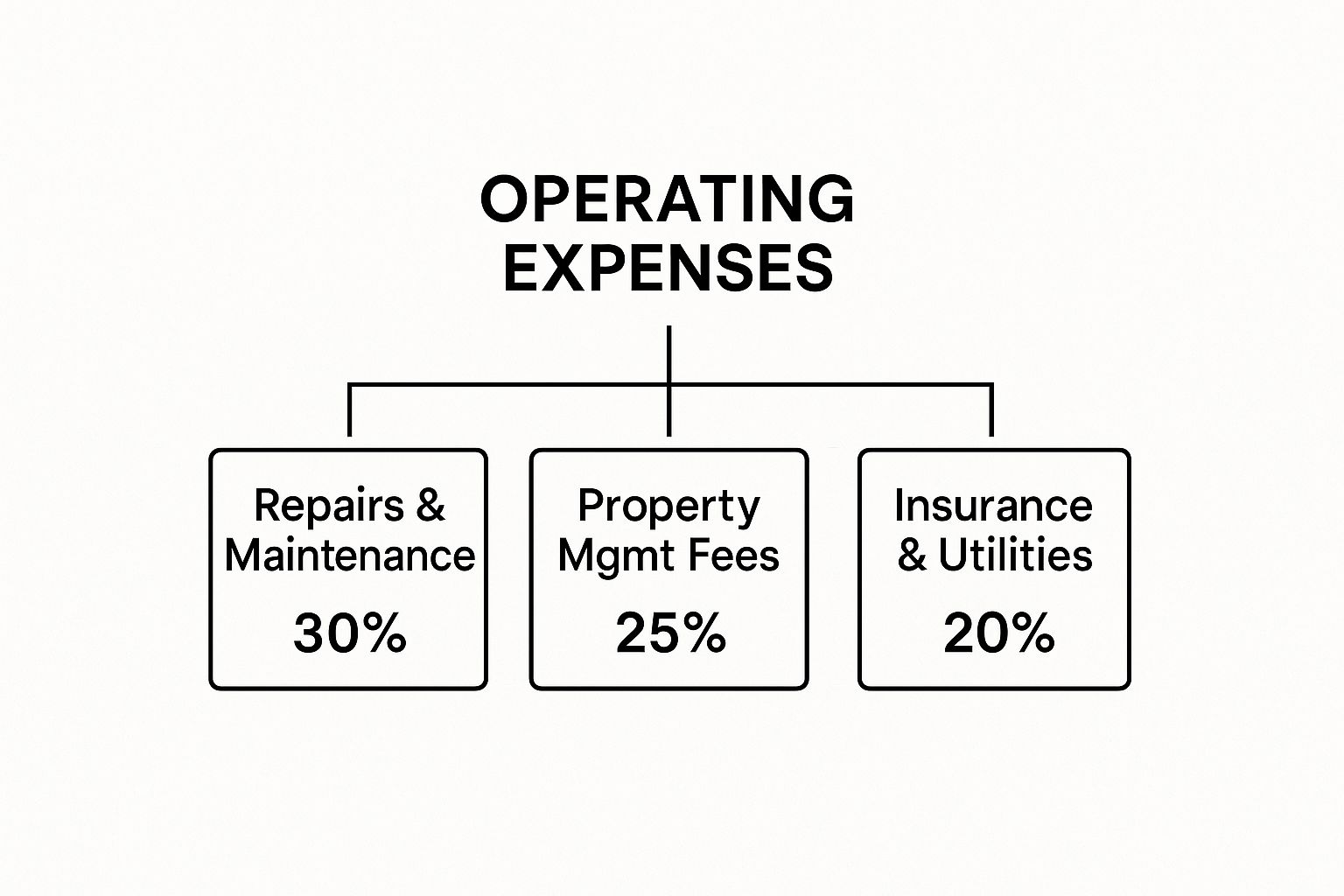
As you can see, everyday costs like repairs and management fees are the foundation. Depreciation is the final, heavy-hitting layer that maximizes your tax benefit.
Managing Capital Gains When You Sell

While the tax breaks you get year after year are great, some of the most powerful advantages of owning rental property kick in when it’s time to sell. When you sell a property for more than you paid for it, that profit is subject to capital gains tax. But with a bit of smart planning, you can keep a huge chunk of that money out of the IRS’s hands.
First things first: you have to know the difference between short-term and long-term gains. If you flip a property in a year or less, your profit is treated as a short-term capital gain. This means it gets taxed at your regular income tax rate, which can take a serious bite out of your earnings.
The game changes entirely if you hold onto that property for more than a year. Suddenly, that profit qualifies as a long-term capital gain, which comes with much friendlier tax rates. Just by being patient, you can potentially save thousands of dollars.
The Power of the 1031 Exchange
Now, what if you could sell your rental, pocket the gains, and legally hit the pause button on paying taxes? That’s precisely what a 1031 Exchange lets you do. This incredible tool in the tax code allows you to defer your capital gains taxes by taking the full proceeds from one sale and reinvesting them into another “like-kind” property.
It’s a lot like trading in your car. Instead of selling your old vehicle, paying taxes on the profit, and then using what’s left to buy a new one, you trade it in. The dealership applies the full value of your old car to the new one. A 1031 Exchange works the same way for real estate, letting your investment capital continue to grow without being diminished by a tax bill.
A 1031 Exchange allows an investor to defer taxes indefinitely. As long as you continue to roll your gains from one investment property to the next, you can postpone the tax bill, allowing your portfolio to grow much faster.
This strategy is a cornerstone for any serious investor focused on building long-term wealth. You can dive deeper into the rules and details in our guide to understanding capital gains taxes.
Other Strategic Capital Gains Exclusions
The 1031 Exchange is a fantastic tool, but it’s not your only option. Another major tax break is available if you’ve actually lived in the rental property yourself.
Known as the “Section 121 Exclusion,” this rule lets you exclude up to $250,000 of capital gains from your taxes ($500,000 if you’re married and file jointly). To qualify, you must have used the property as your primary home for at least two out of the five years leading up to the sale.
This presents a huge opportunity for landlords who might be able to move into their rental for a couple of years before putting it on the market. These kinds of favorable tax laws are common globally, designed to encourage real estate investment, as you can see in this overview of how rental laws shape global tax policies on ineomobility.com.
Developing Your Landlord Tax Strategy
Smart investors know that managing rental property taxes isn’t just a frantic scramble every April. It’s a year-round discipline. Getting beyond a simple list of deductions means building a real system—one that turns tax compliance into a powerful tool for building wealth. When you’re proactive, you’re always prepared, compliant, and ready to maximize your returns.
At its heart, a solid tax strategy begins with meticulous record-keeping. Every single receipt, invoice, and bank statement tells a piece of your financial story. If you fail to capture these details, you’re basically just giving your money away.
Building Your Record-Keeping System
Stop thinking of record-keeping as a chore. It’s your first and best line of defense against overpaying the IRS. A simple, consistent system can make all the difference in the world.
- Dedicated Bank Account: The first thing you should do is open a separate checking account just for your rental property. All rental income goes in, and every single expense comes out. This one move instantly creates a clean, clear record of your cash flow.
- Digital Organization: Use a spreadsheet or bookkeeping software like QuickBooks to track and categorize every transaction right when it happens. Don’t let it pile up until the end of the year. This simple habit ensures all those small, deductible expenses don’t slip through the cracks.
- Scan Everything: Keep a digital copy of every receipt and invoice. A quick photo with your phone or a scanning app is all it takes to have bulletproof evidence for every deduction you claim.
This level of organization does more than just make tax time easier. It gives you a real-time snapshot of your property’s financial health, empowering you to make smarter business decisions all year long.
The single biggest mistake new landlords make is mixing personal and business funds. It’s not just a nightmare for your accountant; if you hold your property in an LLC, it can even threaten the liability protection you worked to set up.
The Value of a Professional Partnership
While doing it yourself is a great way to start, the real estate tax code is a complicated beast that’s always changing. This is exactly why partnering with a tax professional who specializes in real estate isn’t an expense—it’s an investment. They can spot savings you’d never find on your own, keep you compliant with shifting laws, and help you structure your investments for the best possible outcome.
The rules around property taxes are getting more complex everywhere. In fact, the global market for property tax services is expected to hit $3.57 billion in 2025 and is projected to grow at an annual rate of 7.2% through 2033. This shows a clear trend: savvy investors are increasingly relying on expert guidance to handle the complicated rules and boost their financial results. You can read more about these market trends and their drivers on datainsightsmarket.com.
A good advisor transforms your tax strategy from a defensive chore into a core component of your investment success.
Common Tax Mistakes Landlords Make
Knowing about the powerful tax advantages of real estate investing is one thing. Actually putting them to work correctly is a whole different ballgame. I’ve seen even seasoned landlords stumble over simple mistakes that cost them thousands in overpaid taxes or, worse, trigger a dreaded IRS audit.
Learning from these common blunders is the fastest way to keep your hard-earned profits in your pocket.
One of the biggest trip-ups is getting expenses wrong. It’s incredibly common to mix up a currently deductible repair with a capital improvement, which has to be depreciated over time. Think of it this way: replacing a single cracked tile in the kitchen is a repair you can deduct this year. Retiling the entire kitchen floor? That’s an improvement, and its cost gets written off over many years.
Forgetting About Depreciation
This one is a classic, and it’s a doozy. Some landlords just completely forget to claim depreciation. This is a massive “phantom” deduction—meaning you don’t spend any cash to get it—and skipping it is literally like saying “no, thanks” to free money from the IRS.
Even worse, the IRS assumes you took the deduction whether you did or not. When you eventually sell the property, you’ll have to pay “depreciation recapture” tax on the amount you should have claimed. Ouch.
How to Avoid It: Always, always claim your depreciation deduction. You’ll calculate it each year based on the property’s value (minus the land) spread out over 27.5 years. Your best bet is to work with a tax professional to get this right from the very beginning.
Mixing Personal and Business Finances
Messy records are a landlord’s kryptonite, and the fastest way to get there is by mixing personal and business money. When you deposit rent checks into your personal checking account and pay for the new water heater with your personal credit card, you create a tangled mess. It makes it nearly impossible to prove your deductions if you’re ever questioned.
- How to Avoid It: Before you do anything else, open a separate business bank account for your rental property. All rental income goes into this account, and every single expense comes out of it. This simple step creates a clean paper trail that makes tax time a breeze.
By sidestepping these common pitfalls, you can be confident that your tax filings are not only compliant but are structured to squeeze every last dollar of benefit out of your investment property.
Answering Your Top Rental Tax Questions
Even seasoned investors run into tricky situations with rental property taxes. Let’s clear up some of the most common questions we get, so you can apply these powerful tax advantages the right way.
Can I Really Deduct a Home Office?
Yes, you absolutely can, but the IRS is a stickler on this one. To claim a home office deduction for managing your rental, the space must be used exclusively and regularly for your real estate business.
This can’t just be the corner of the dining room table. It needs to be a dedicated area—a separate room or a specific part of a room—where you only conduct your rental activities. Think screening tenants, managing the books, and coordinating repairs. If you’ve hired a property manager who handles all the day-to-day work, justifying this deduction becomes much more difficult.
What Exactly Is Depreciation Recapture?
When you sell a rental property, the IRS essentially says, “Hey, remember all those depreciation deductions you took? It’s time to pay tax on that benefit.” This is depreciation recapture.
Imagine you’ve claimed $50,000 in depreciation over the years you owned the property. When you sell, that $50,000 is taxed, but at its own special rate—a maximum of 25%. It’s not treated like your other profit, which usually gets the lower long-term capital gains rate. It’s the government’s way of ensuring that the income you sheltered with a non-cash expense is eventually taxed.
Here’s the critical part: The IRS doesn’t care if you actually claimed the depreciation. They assume you took the deduction you were entitled to every single year. So, even if you forgot, you’ll still face the recapture tax when you sell.
Are There Limits on Deducting Rental Losses?
Yes, and this is a big one. The IRS categorizes rental income as a “passive activity” for most people. That means if your rental property generates a loss (your expenses are more than your income), you generally can’t use that loss to reduce the taxable income from your day job.
However, there’s an important exception for active participants. If your modified adjusted gross income (MAGI) is below $100,000, you can often deduct up to $25,000 in rental losses against your other income. This benefit gradually disappears as your income rises and is completely phased out once your MAGI hits $150,000.
Navigating these rules is where having an expert in your corner truly pays off. At Allied Tax Advisors, we live and breathe real estate tax strategy, helping investors like you maximize returns and stay compliant. To make sure you’re not leaving money on the table, schedule a chat with our team. Learn more about our services at alliedtax.com.