
That letter from the IRS can feel like a personal attack, but it’s often just part of a much bigger picture. In today’s climate of heightened scrutiny, preparing a strong tax audit defense isn’t just for major corporations anymore. It’s become a critical financial necessity for everyone from freelancers to established small businesses.
Why Tax Audits Are on the Rise

If it feels like tax authorities are watching more closely than ever, you’re not wrong. The entire landscape of tax enforcement is shifting, powered by sophisticated new tools and immense pressure on governments to close the “tax gap.” This isn’t some random surge; it’s a calculated, data-backed effort to boost compliance across the board.
A major reason for this is the leap forward in data analytics. The IRS and state agencies now have incredibly powerful software that cross-references massive pools of information. They can instantly compare the income you reported with data from your bank, payment processors like PayPal, and even cryptocurrency exchanges. Any mismatch, no matter how tiny, can automatically flag your return for a closer look.
This heavy reliance on technology means audits are less about random chance and more about data-driven targeting. A solid tax audit defense begins with the understanding that your financial data is more visible than ever before.
Key Triggers in the Modern Tax Environment
Certain financial activities are drawing way more heat now than they did a few years ago. Knowing what they are is the first step in being prepared. If your tax return includes any of the following, your audit risk is almost certainly higher:
- Cryptocurrency Transactions: The IRS is actively going after unreported gains from crypto sales. They receive data directly from major exchanges, which makes it simple for them to spot who isn’t reporting their trades.
- Large Business Deductions: Aggressive write-offs are a classic audit trigger, especially for things like meals, travel, and entertainment. Auditors will demand meticulous proof that every dollar was a legitimate business expense.
- High Home Office Deductions: With remote work becoming so common, more people are claiming this deduction. The IRS is scrutinizing these claims to ensure taxpayers meet the very strict “exclusive and regular use” tests.
- International Financial Activity: Any foreign accounts, assets, or income dramatically increase your return’s complexity and, with it, the likelihood of an audit.
This isn’t just happening in the U.S., either. A global survey by PwC found that a staggering 71% of businesses saw a notable increase in tax inquiries over the last few years. This points to a worldwide trend toward tougher enforcement, making audit readiness a fundamental skill.
Understanding these specific red flags is the cornerstone of being prepared. For a deeper look into the common mistakes that can land you in an auditor’s sights, check out our guide on what triggers an IRS tax audit and how to prepare. In this new era of enforcement, a well-planned tax audit defense strategy is simply an essential part of smart financial management.
That envelope from the IRS or your state tax agency has arrived. Your heart probably just skipped a beat, and that’s a completely normal reaction. But before you let panic set in, take a deep breath. Your first few moves are critical and can set the tone for the entire audit process.
The very first thing to do is read the notice—every single word. Don’t just skim it. This letter is your roadmap. It tells you why you were selected and, most importantly, what kind of audit you’re facing. Is it a simple correspondence audit asking for a few documents? Or is it a more serious field audit where an agent will want to visit your business? Knowing the difference right away is the foundation of your tax audit defense.
What to Look For in the Audit Notice
The notice itself contains crucial clues. Zero in on these specific details immediately:
- The Audit Type and Scope: The letter will specify what they’re looking into (e.g., business expenses, unreported income) and for which tax years. This helps you anticipate the questions and documents they’ll want.
- Response Deadlines: This is non-negotiable. Missed deadlines can lead to automatic penalties and make you look uncooperative. Mark these dates on your calendar in bright red.
- Requested Documents: The notice will often include an initial list of documents. This is your starting point for gathering evidence.
- Auditor’s Contact Info: You’ll see the name and contact details for the assigned auditor. This will be your single point of contact.
Understanding these elements from the get-go helps you take control of the situation rather than just reacting to it.
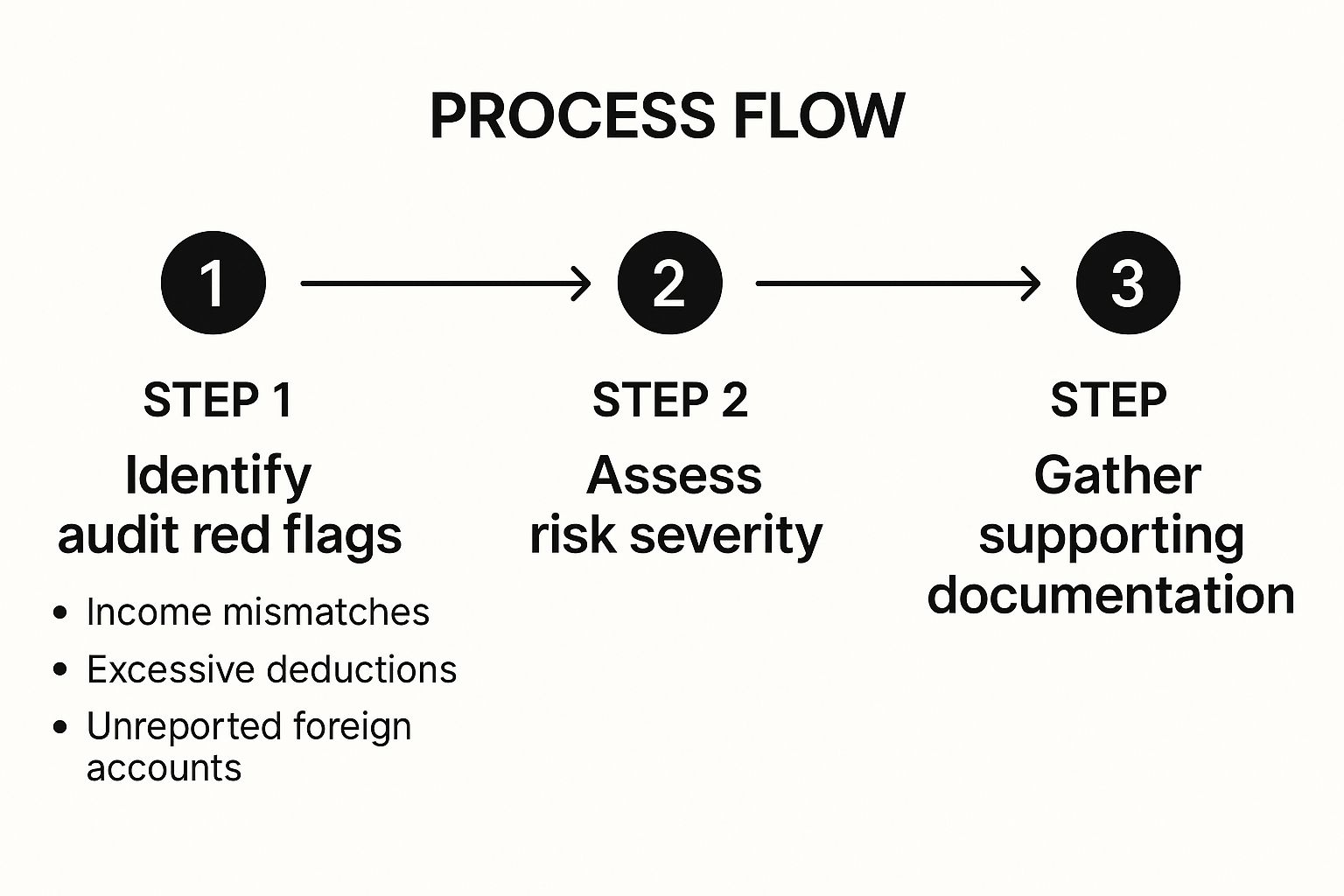
As you can see, your first job is to spot the red flags mentioned in the notice. This initial assessment guides every step that follows, from how you gather your records to how you communicate with the tax authorities.
Your First Call Should Be to a Professional
Before you even think about picking up the phone to call the auditor or drafting a response, stop. Your next move should be to hire a qualified tax professional. I’ve seen too many well-meaning taxpayers say the wrong thing and accidentally dig themselves into a deeper hole. A professional acts as a crucial buffer.
But who should you call?
- A CPA is ideal if the audit involves complex financial statements or accounting methods.
- An Enrolled Agent (EA) specializes in IRS representation and is often a fantastic choice for navigating the ins and outs of the agency’s procedures.
- A Tax Attorney is essential when you’re concerned about potential criminal liability or need the protection of attorney-client privilege.
Once you have an expert on your team, they become the designated point of contact. This is a game-changer. It prevents you from making off-the-cuff remarks or contradictory statements that could be used against you.
Initial Audit Response Checklist
Getting that notice can feel chaotic. This checklist brings order to the chaos, outlining the immediate, concrete steps to take. Following it helps you build a strong, controlled foundation for your defense from day one.
| Action Item | Why It’s Important | Pro Tip |
|---|---|---|
| Review the Notice Meticulously | Clarifies exactly what the IRS wants, the specific years in question, and your deadlines. | Use a highlighter to mark all dates, requested items, and the auditor’s contact information. |
| Engage a Tax Professional | Provides expert guidance, ensures all communications are precise, and prevents costly missteps. | Ask potential advisors about their direct experience with your specific type of audit. |
| Set Up a Secure Document Hub | Creates one central, organized place for all records, preventing lost evidence and confusion. | Use a dedicated, password-protected folder in a cloud storage service like Google Drive or Dropbox. |
| Establish a Single Point of Contact | Funnels all communication through one person (ideally your tax pro) to avoid conflicting statements. | Inform your team that all inquiries from the tax agency must be routed to your designated representative. |
By systematically working through this checklist, you move from a reactive state of panic to a proactive position of control. You’ll be organized and ready for the next phase: assembling your documentation.
A senior audit manager with over a decade of experience told me, “A well-organized initial response can reduce audit stress by 70% and dramatically cuts down on the back-and-forth with the agency.”
Keep a Detailed Interaction Log
From this moment forward, document everything. I mean everything. Every phone call, email, and letter exchanged with the auditor or your representative should be logged.
Create a simple log with the date, time, who you spoke with, and a summary of the conversation. This record is invaluable. It prevents “he said, she said” disputes and creates an official timeline of your audit that can be essential if you need to appeal a decision later.
These initial moves are the bedrock of a successful tax audit defense. Get them right, and you’ll be in a much stronger position as you move on to gathering the evidence needed to build an airtight case.
How to Build an Airtight Case with Documentation

When it comes down to it, an audit is a battle of records. The quality of your documentation can mean the difference between a quick, painless process and a drawn-out, expensive dispute. It’s about more than just “keeping good records”; the real goal is to build a persuasive and organized case file that directly answers the auditor’s questions before they even have to dig.
The cornerstone of a solid tax audit defense is simply how you organize your documents. Don’t be the person who shows up with a shoebox full of crumpled receipts. Group your evidence by category and by year, making sure it aligns perfectly with the line items on the tax return being examined. This simple act shows the auditor you’re organized, serious, and ready to cooperate, which can set a positive tone for the entire audit.
Focusing on Common Audit Triggers
From experience, I can tell you that auditors have a checklist of things they look for, especially with certain deductions. If you can anticipate their requests and have the proof ready to go, you can dramatically smooth out the whole process.
Here are a few of the big ones:
- Business Expenses: A credit card statement just won’t cut it. For every meal, travel expense, or supply purchase, you need the itemized receipt. It has to show what you bought, the date, the amount, and a clear note explaining the business purpose.
- Charitable Donations: If you gave $250 or more in cash, you absolutely must have a formal written acknowledgment from the charity dated around the time of the donation. For items you donated, you’ll need to document their fair market value and get a receipt from the organization.
- Home Office Deduction: This is a classic red flag, so your proof has to be rock-solid. Be ready with photos or even a simple floor plan of your exclusive business space. You’ll also need to show how you calculated expenses, like the percentage of utility bills or rent you’re claiming.
An auditor isn’t there to be your friend; they are there to verify the numbers on your return. Presenting them with a clean, organized, and complete set of documents makes their job easier and makes you look credible. This alone can positively influence the audit’s outcome.
Reconstructing Missing or Incomplete Records
So, what do you do when you can’t find a critical receipt? First, don’t panic. You are legally allowed to reconstruct missing records using secondary evidence. It’s not as good as the original, of course, but it’s infinitely better than showing up with nothing. This is a vital skill for a successful tax audit defense.
Let’s say you’re trying to prove the business use of your car, but your mileage log is spotty. It happens. Here’s a practical way to fix it:
- Start with Your Calendar: Pull up your digital or paper calendar for the year in question. Pinpoint every single business appointment, client visit, and trip to the supply store.
- Map It Out: Use a tool like Google Maps to calculate the round-trip mileage for every trip you identified.
- Cross-Reference Everything: Now, match this reconstructed log with other proof. Think oil change receipts, maintenance records, and repair bills that show your car’s odometer reading at various times throughout the year.
This approach takes a potential weak spot and turns it into a credible, well-supported claim. The trick is to weave a believable story backed by different forms of secondary evidence. Bank statements, old credit card bills, and even digital receipts you find in your email can all be powerful substitutes for lost paper records. When you present this information clearly, you show the auditor you’ve made a genuine effort to prove your claims, which goes a long way.
Why Professional Representation Is a Game Changer
Trying to handle an IRS audit on your own is a bit like performing surgery on yourself after watching a few YouTube videos. You might save some money upfront, but the risk of a catastrophic mistake is incredibly high. When it comes to your financial health, going it alone in a tax audit defense is a gamble you just shouldn’t take.
This is where bringing in a professional changes everything. A seasoned CPA, Enrolled Agent, or Tax Attorney acts as a critical buffer between you and the IRS. They take over all the communication, which immediately lowers the temperature. You’re no longer in the hot seat, susceptible to making emotional decisions or accidentally saying something that opens up a whole new can of worms.
Let’s be blunt: IRS auditors are skilled at their jobs. They know how to ask seemingly innocent questions that are designed to expand the scope of the audit. A simple question about a business lunch could spiral into a deep dive into your entire year’s travel and entertainment expenses. An expert representative knows how to provide precisely the information requested—and not a single word more. Their job is to keep the audit tightly focused on the original inquiry.
Choosing Your Defender
Not all tax professionals are the same, and the right choice really hinges on the specifics of your case. Each brings a different specialty to the table.
- Certified Public Accountant (CPA): If your audit centers on complex business finances, accounting records, or verifying financial statements, a CPA is your best bet. They live and breathe the numbers.
- Enrolled Agent (EA): EAs are federally-licensed tax specialists with unlimited rights to practice before the IRS. I often find they are the perfect fit for navigating the IRS’s labyrinth of procedures and negotiating settlements.
- Tax Attorney: This is non-negotiable if there’s even a hint of a criminal investigation or if you need the strong shield of attorney-client privilege. Their legal training is indispensable when the stakes are at their highest.
Here’s a piece of advice from my years in this field: A great representative knows more than just the tax code; they know the auditors. They understand the unwritten rules, the agency’s internal processes, and how to negotiate effectively. This inside knowledge is what truly levels the playing field.
The need for this kind of expert tax audit defense is growing. The global market for tax audit services is expected to surge from $13.758 billion to over $21.114 billion by 2033. This trend, which you can read more about in this tax advisory market report, shows just how much more complex navigating tax issues has become for everyone.
Hiring an expert is an investment in your own peace of mind. They deal with the deadlines, the paperwork, and the back-and-forth, freeing you up to run your business and live your life. You can get a better sense of what this looks like by reading our guide on how to resolve IRS issues with a professional tax accountant.
Ultimately, having an expert on your side transforms a high-stress confrontation into a manageable business negotiation, dramatically improving your odds of walking away with a favorable outcome.
Closing Out the Audit: Strategy for the Final Stretch

The end of the audit is in sight, and this is where all your hard work and meticulous preparation really come into play. It’s easy to want to just get it over with, but now is the time for sharp, strategic thinking. The way these final negotiations are handled can make a huge difference in what you ultimately owe.
A crucial part of a solid tax audit defense is knowing the art of the deal—when to give a little and when to hold your ground. I’ve seen cases where conceding a minor, well-documented point builds goodwill and makes an auditor more flexible on a much bigger issue. An experienced representative knows the difference between a small concession and a point that could create problems in future tax years.
What to Expect: The Three Likely Outcomes
As the audit concludes, you’re generally heading toward one of three results. It pays to be ready for any of them.
- The “No-Change” Letter: This is the home run. It means the auditor examined your return and found nothing to change. A no-change letter is a direct result of having your ducks in a row with organized, ironclad records.
- An Agreed-Upon Adjustment: This is probably the most common outcome. The auditor proposes changes, and after some back-and-forth, you and your representative agree to them. It’s a negotiated settlement where both sides land on a figure they can live with.
- A Disputed Finding: This happens when you and the auditor are at an impasse. You fundamentally disagree with their proposed changes. Don’t panic. This isn’t the end of the road; it just means it’s time to take your case to the next level.
No matter which path you’re on, the single most critical step is to meticulously review the auditor’s final report. I can’t stress this enough. These reports can have simple math errors, misapplied tax laws, or evidence that was completely ignored. Finding just one of these mistakes can flip the entire outcome in your favor.
Challenging a Bad Result: Your Right to Appeal
If the final report contains findings you just can’t accept, your tax audit defense shifts into the appeals phase. You have a legal right to challenge the auditor’s decision, and if your position is solid, you absolutely should. This is where your representative drafts a formal protest letter, laying out the facts, citing the specific laws that back you up, and detailing precisely why the auditor’s conclusions are wrong.
This action moves your case up the ladder to the IRS Appeals Office. Think of this as a fresh start. The Appeals Office is an independent division within the IRS, and their whole job is to settle tax disputes without going to court.
Appeals officers have more leeway to settle cases than auditors do. They can consider the “hazards of litigation”—the chance the IRS could lose in court. This gives you a powerful opportunity to present your arguments to a more neutral party who is motivated to find a resolution.
This is more important than ever. The IRS is getting smarter, using advanced data analytics and new reporting rules to zero in on potential issues. You can discover more about in this tax controversy guide to see how these tactics are evolving. In this environment, knowing your appeal rights isn’t just a backup plan; it’s a core part of a strong defense, giving you a clear path forward when you and the auditor hit a wall.
Common Questions About Tax Audit Defense
Even the most buttoned-up taxpayers get a knot in their stomach when they think about audits. It’s a naturally intimidating process, but having a clear understanding of what you’re up against can make all the difference. Let’s walk through some of the questions I hear most often from clients facing a tax audit.
What Are the Biggest Audit Red Flags?
From my experience, I can tell you that IRS auditors are trained to spot patterns and outliers. Certain things on a tax return just beg for a second look. Think of it as knowing where the tripwires are so you can step around them.
Here are some of the most common triggers I see:
- Unusually High Deductions: If your income is $80,000 but you’re claiming $30,000 in charitable donations, that’s going to raise an eyebrow. The same goes for business expenses that seem way out of proportion to your revenue.
- Income Mismatches: The IRS has a powerful computer matching system. It compares the income on your return to every W-2 and 1099 issued in your name. A discrepancy is one of the easiest and most common reasons an audit notice gets sent.
- Claiming 100% Business Use of a Vehicle: This is a classic red flag. Auditors are real people who know that almost nobody uses a vehicle exclusively for business without a single personal trip. A 100% claim invites them to dig deeper.
- Repeated Business Losses: A business loss in a startup year is normal. Claiming losses year after year, however, makes the IRS suspect you might have an expensive hobby, not a for-profit business, and the tax rules for hobbies are far less generous.
Many of these issues pop up from simple, honest mistakes. That’s why being proactive and learning about common tax filing mistakes to avoid and how to fix them is so crucial.
A piece of advice I give every client: If you don’t have a receipt and can’t clearly explain the business purpose, don’t claim the deduction. It’s that simple. Defending a guess is a losing battle.
How Long Does a Tax Audit Take?
This is the million-dollar question, and unfortunately, there’s no set timeline. It really depends on the type of audit and how complex your situation is.
A simple correspondence audit, where you just mail in a few documents, can be over and done with in a couple of months.
But a more intensive office audit at an IRS facility or a full-blown field audit at your home or business is a different beast entirely. These can easily drag on for six months, a year, or even longer. The key factors are how organized your records are, how complicated the tax issues are, and how quickly everyone responds to requests.
Can I Just Ignore an Audit Notice?
In a word: no. This is single-handedly the worst thing you can do. The IRS will not forget or give up.
If you ignore the notice, the audit proceeds without you. The auditor will make their determinations based solely on the information they have, disallowing every deduction and credit in question. This results in what’s called a “Notice of Deficiency” for the maximum possible tax, plus steep penalties and interest.
From there, it only gets worse. The debt becomes official, and the IRS can start collection actions like filing a federal tax lien against your property or levying your bank account. Your only real choice is to face the audit head-on, preferably with an expert in your corner.
At Allied Tax Advisors, we navigate the complexities of IRS and state audits so you don’t have to. If you’ve received a notice or want to ensure you’re prepared, our team of CPAs and Enrolled Agents is ready to build your defense. Get in touch with us today for a consultation.