
If you’re like most small business owners, you probably think about taxes once a year—right before the deadline. But treating tax planning as a last-minute scramble is one of the costliest mistakes you can make. It’s time to shift your thinking.
Effective tax planning for small businesses isn’t about frantically gathering receipts in April. It’s a year-round discipline, a strategic part of your financial operations designed to legally reduce your tax burden, improve cash flow, and help you hit your biggest business goals.
Why Tax Planning Is More Than Just a Year-End Task

Let’s be real—tax season can feel like a mad dash. For many entrepreneurs, it’s a dreaded chore. This reactive approach, however, means you’re almost certainly leaving money on the table. When you reframe tax planning from a yearly headache into an ongoing strategy, you unlock a powerful tool for building a more profitable and stable company.
When you do it right, proactive tax planning is woven into the fabric of your financial management. It gives you the foresight to understand the tax impact of every big decision, whether you’re buying a new piece of equipment or bringing on your next team member. This forward-thinking approach is key to managing cash flow, funding growth, and avoiding those dreaded surprise bills from the IRS.
Building a Strategic Financial Foundation
The whole idea is to turn your tax strategy into a competitive edge. Instead of just reacting to a tax bill, you’re actively shaping your financial decisions all year to get the best possible outcome. This isn’t about finding sketchy loopholes. It’s simply about understanding the rules and making them work for you.
This guide will help you get there. We’ll cut through the noise and complexity of the tax code to focus on practical, actionable steps. You’ll learn how to:
- Structure your business in the most tax-efficient way.
- Find and claim every deduction and credit you’re entitled to.
- Time your income and expenses to lower your tax bill.
- Stay compliant without the stress and confusion.
By shifting from a reactive, year-end task to a proactive, year-round strategy, you transform your tax obligations from a liability into an asset that supports sustainable growth.
The Power of Proactive Decisions
Let’s look at a simple example. Say a small marketing agency needs to buy new computers. A reactive owner buys them whenever the old ones die. A strategic owner, on the other hand, thinks about the timing.
They might choose to make that purchase before December 31st. Why? To claim the depreciation deduction in the current tax year, which lowers their immediate tax bill. That one small, smart decision can lead to thousands in savings.
Now, imagine applying that same strategic thinking to every financial move you make. It’s about making smarter choices every day, not just when the tax deadline is looming. This guide will show you exactly how to do it.
Choosing Your Business Structure for Tax Savings
One of the first, and most critical, decisions you’ll make as a business owner is choosing your legal structure. This isn’t just about paperwork; it’s a decision with huge, long-term tax consequences. It determines exactly how your profits are taxed and what kind of liability protection you have. Getting this right from the start is the foundation of smart tax planning for small businesses.
Many entrepreneurs just default to a sole proprietorship because it’s easy. But that simplicity comes at a cost. There’s no legal firewall between you and your business, putting your personal assets on the line. On top of that, every dollar of profit gets hit with self-employment taxes.
Understanding Pass-Through Taxation
For most small businesses, the magic words are “pass-through taxation.” This applies to entities like sole proprietorships, partnerships, LLCs, and S corporations. What it means is the business itself doesn’t pay income tax. Instead, the profits (or losses) are “passed through” to the owners, who then report them on their personal tax returns.
This setup helps you avoid the double taxation that C corporations face—where the company pays corporate tax, and then shareholders are taxed again on any dividends. But how those profits pass through can look very different depending on the structure you choose. This is where the strategy comes in.
Think about a freelance web developer just starting out. As a sole proprietor, their income grows, but so does the bite from the 15.3% self-employment tax. That tax applies to all their net earnings and can quickly become a serious financial drain. For many, that’s the moment they realize it’s time to look at other options.
The goal isn’t just to pick a structure for today. It’s about aligning your entity with your profitability, growth plans, and personal financial situation. The best choice now might not be the best one in three years.
Comparing Key Business Entities
So, let’s break down the common options and see how they really affect your tax bill. Each one has its own set of pros and cons that hinge entirely on your business model and revenue.
To make this clearer, let’s look at how the tax treatment differs across these common structures.
Business Entity Tax Treatment Comparison
The table below summarizes how each entity is taxed and what it means for you as the owner.
| Business Structure | Taxation Method | Key Owner Tax Implication | Best For |
|---|---|---|---|
| Sole Proprietorship | Pass-through. Reported on owner’s personal return (Schedule C). | All net profit is subject to self-employment tax. No liability protection. | Freelancers, new businesses with low risk and low profit. |
| LLC (Single-Member) | Pass-through (disregarded entity). Taxed like a sole proprietorship. | Provides liability protection, but all net profit is still subject to self-employment tax. | Solo owners who need liability protection but have simple tax needs. |
| LLC (Multi-Member) | Pass-through. Taxed like a partnership. | Liability protection. Profits and losses are passed to partners. | Businesses with two or more owners seeking liability protection and flexibility. |
| S Corporation | Pass-through. A tax election, not a legal entity. | Owner must take a “reasonable salary.” Remaining profits are distributions, not subject to self-employment tax. | Profitable LLCs or C Corps looking to minimize self-employment taxes. |
As you can see, the S Corporation offers a unique advantage for businesses with healthy profits.
Let’s put this into a real-world context. Imagine a growing coffee shop, set up as an LLC, that’s pulling in consistent profits. The owners can elect to have their LLC taxed as an S Corp. This move allows them to pay themselves a fair salary (which is subject to normal payroll taxes) and take the rest of the profits as distributions. Those distributions are not subject to the hefty self-employment tax, which can save them thousands of dollars and free up cash to reinvest in the business.
Choosing between these structures involves weighing multiple factors. For a more detailed breakdown, you can explore this comparison of an S Corp vs LLC for your small business to see which might be a better fit.
No matter which entity you choose, success hinges on meticulous expense tracking. It’s the only way to ensure you can claim every deduction you’re entitled to.
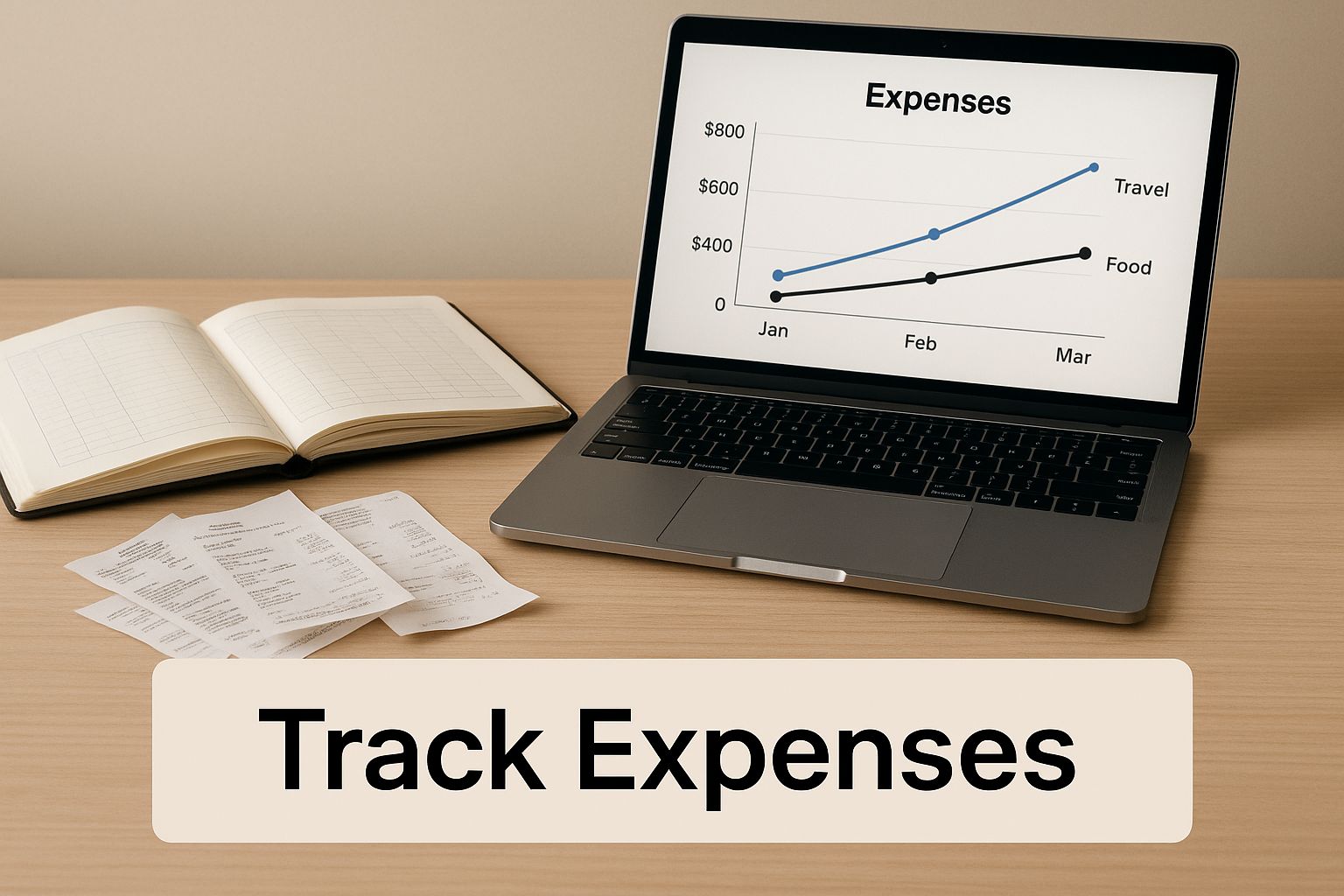
As the image highlights, having the right tools for financial record-keeping is the bedrock of any solid tax strategy. Without organized books, you can’t possibly take full advantage of the tax benefits your business structure provides.
Making the Right Choice with Your Advisor
While this guide gives you a solid framework, the best choice is deeply personal to your business. Things like your projected income, how many owners you have, your need for liability protection, and future growth plans all weigh heavily on the decision.
This isn’t a choice to make in a vacuum. It’s a strategic conversation to have with your CPA or tax advisor. They can run the numbers and show you exactly what the potential tax savings of an S Corp election would be versus staying a standard LLC. That way, you’re making a data-driven decision that turns your business structure from a simple legal filing into a powerful tool for building wealth.
Uncovering Deductions and Credits You Might Be Missing

This is where smart tax planning for small businesses really shines. It’s all about finding every legitimate way to lower your taxable income. Most business owners know the basics—office supplies, software subscriptions—but every year, a surprising number of powerful deductions and credits are left on the table.
To truly make a difference, you have to look beyond the obvious. I’m talking about correctly deducting vehicle mileage, navigating the strict IRS rules for a home office, and capitalizing on team-related costs like health benefits and retirement contributions. These aren’t sneaky loopholes; they’re established provisions in the tax code put there to help business owners like you succeed.
Deductions Versus Credits: The Critical Difference
Before we get into the nitty-gritty, it’s crucial to grasp the powerful distinction between a tax deduction and a tax credit. People often use these terms interchangeably, but they have completely different impacts on your tax bill.
- A tax deduction lowers your taxable income. For example, if you’re in the 22% tax bracket, a $1,000 deduction saves you $220.
- A tax credit reduces your tax bill dollar-for-dollar. That means a $1,000 credit saves you a full $1,000.
Deductions are great, but credits are pure gold. They directly slash the amount of tax you owe, making them incredibly valuable. The goal is to maximize both, but always be on the lookout for credits your business might be eligible for.
Digging Deeper into Common Deductions
Let’s explore some of the most frequently missed or misunderstood deductions that can lead to big savings when you handle them the right way.
The Home Office Deduction Demystified
The home office deduction is a perfect example of a valuable write-off that many owners are too nervous to take. The IRS rules are strict, but they’re not impossible: you must use a specific area of your home exclusively and regularly for your business. This just means your “office” can’t double as the family TV room.
If you qualify, you have two ways to calculate it:
- The Simplified Method: This is a standard rate of $5 per square foot, capped at 300 square feet, for a maximum deduction of $1,500. It’s easy, but you might be leaving money on the table.
- The Regular Method: This requires a bit more work. You calculate the percentage of your home used for business and apply that percentage to actual expenses like mortgage interest, insurance, utilities, and repairs. It demands better records, but it can often result in a much larger deduction.
Vehicle Use and Travel Expenses
Do you use your personal car for business? Driving to meet clients, picking up supplies, or heading to a conference all count. Here again, you have two options: the standard mileage rate (a set rate per business mile, which the IRS adjusts annually) or tracking your actual expenses, like gas, oil changes, repairs, and insurance.
Business travel is another key area. You can deduct the cost of your transportation and lodging for business trips. As for meals, you can generally deduct 50% of the cost, but diligent record-keeping is absolutely non-negotiable to prove the business purpose.
Leveraging Powerful Business Tax Credits
While deductions are plentiful, tax credits are the real heavy hitters in your tax-planning arsenal. They’re designed to incentivize specific business activities, from hiring certain workers to investing in innovation.
Here are a few credits worth investigating for your business:
- Work Opportunity Tax Credit (WOTC): This is a federal credit that rewards you for hiring people from certain groups who have faced barriers to employment, like qualified veterans or individuals receiving SNAP benefits. This credit can be worth up to $9,600 per eligible employee.
- Research and Development (R&D) Credit: Don’t let the name fool you—this isn’t just for scientists in lab coats. If your business develops new products, processes, or software, or even just improves existing ones, you may qualify. I’ve seen businesses in manufacturing, software development, and even architecture completely overlook this valuable credit.
- Small Business Health Care Tax Credit: This one is for smaller employers. If you have fewer than 25 full-time equivalent employees, pay average wages below a certain annual threshold, and cover at least 50% of your employees’ health insurance premiums, you could be eligible for a significant credit.
By methodically reviewing your business operations, you can start to identify these opportunities. For an even broader look at potential savings, check out our guide on tax-saving tips every business owner should know. Turning these overlooked areas into real savings is what transforms tax compliance from a painful chore into a strategic advantage.
Using Financial Timing to Your Advantage
When it comes to smart tax planning for small businesses, timing is everything. It’s not just about what you buy or sell; it’s about when you do it. Learning to time your income and expenses can genuinely shift your tax bill from one year to the next, giving you much-needed control over your cash flow. This is where you start thinking less like a business owner and more like a CFO.
The whole strategy hinges on your accounting method. Most small businesses fall into one of two camps, and your choice directly affects when you officially recognize income and expenses.
- Cash Method: This is the simple one. You count income when the cash actually hits your bank account and expenses when you actually pay the bill. It’s a direct reflection of your cash on hand.
- Accrual Method: This method records income when you earn it (like when you send an invoice) and expenses when you incur them, even if no money has moved yet. It provides a truer picture of your long-term profitability but adds a layer of complexity.
For most small businesses I work with, the cash method is the way to go for tax planning. It offers far more flexibility to move transactions across the year-end line.
Making Smart Year-End Moves
As December approaches, you have a golden opportunity to influence your tax bill. By actively managing what you owe and what you’re owed, you can quite literally dial your net income up or down for the year. This isn’t about shady accounting—it’s about legally and strategically controlling the timing for your own benefit.
My Two Cents: Think of December 31st as a finish line you can strategically move. Pushing an expense into this year or delaying income until next year are some of the most powerful—and simplest—levers you can pull.
Here are a couple of real-world examples I see all the time with cash-basis businesses:
- Pre-Paying for Expenses: Imagine a photography studio owner who knows they’ll need new lighting gear in the new year. Instead of waiting until January, they buy and pay for it in late December. By doing this, they pull that deduction into the current, more profitable year and lower their immediate tax bill.
- Delaying Invoices: A consultant I know finishes a big project in the last week of December. They’ve had a fantastic year and are facing a high tax bracket. Instead of invoicing right away, they simply wait until the first week of January. The client pays them in the new year, effectively pushing that income—and the tax hit—into the next tax period.
This kind of forward-thinking requires you to have a solid grasp on your numbers. It’s about making calculated decisions instead of letting the calendar dictate your financial fate.
Don’t Forget Your Estimated Taxes
One of the biggest tripwires for new entrepreneurs is handling estimated tax payments. Since nobody is withholding taxes from your business income like an employer would, the IRS expects you to pay up as you go through quarterly installments. If you ignore this, you’re setting yourself up for a monster bill in April, not to mention some painful underpayment penalties.
To figure out your payments, you’ll need to project your annual income and all your potential deductions. The goal is to pay at least 90% of what you’ll owe for the current year or 100% of what you paid the previous year (it’s 110% if you’re a higher-income earner) to stay out of trouble.
Treating your quarterly payments as a non-negotiable part of your cash flow management is key. Set aside a percentage of every payment you receive just for taxes. This simple discipline ensures the money is ready and waiting when the due dates roll around, keeping you compliant and preventing a nasty cash flow crunch.
Assembling Your Tax Support System
You don’t have to become a tax guru to run your business, but let’s be honest—you absolutely need one on your team. I’ve seen firsthand that effective tax planning for small businesses isn’t a solo sport. It’s a smart blend of professional expertise and the right technology that keeps your financial house in order. Think of it less as an expense and more as a strategic investment in your company’s future.
The reality is that most business owners find taxes overwhelming. It’s not just you. A recent survey found that only a startling 26% of small business owners felt completely confident about their tax filings. The biggest roadblocks? Wrangling financial documents, deciphering complex laws, and figuring out which deductions apply—all things a solid support system is built to handle. You can read the full research about small business tax trends to see the whole picture.
Knowing When to Hire a Professional
So, when is it time to bring in a Certified Public Accountant (CPA) or tax advisor? While DIY software might get you by in the very early days, certain triggers should tell you it’s time to call in a pro.
It’s time to get an expert involved if you:
- Are forming a new business and need to pick the most tax-efficient entity structure from the get-go.
- See your profits growing and get that nagging feeling you could be saving more, especially on self-employment taxes.
- Plan to hire your first employees, which opens up a whole new world of payroll taxes and compliance rules.
- Receive an unwelcome letter from the IRS or, even worse, are facing an audit.
- Feel constantly stressed or just plain unsure about your financial compliance.
A great advisor does so much more than just file your annual return. They become a year-round guide, helping you forecast tax payments and representing you if the IRS ever has questions. Their real magic is in proactive planning, not just reactive filing after the year is over.
Your tax advisor should be a strategic partner who understands your business goals. They are your first line of defense and your best guide for navigating the complexities of the tax code.
The Essential Role of Technology
Professional guidance is one half of the equation; technology is the other. In this day and age, modern accounting software like QuickBooks is non-negotiable for any serious business. It creates a single, reliable hub for all your financial data—the foundation of every tax planning move you make.
Clean, organized books are your best friend. They ensure every single potential deduction is captured and categorized correctly as it happens. This not only prevents a massive headache during tax season but also gives you the real-time financial data you need to make smart decisions all year. Plus, well-maintained records are your strongest defense in an audit. To get your documents in order, you can use our 2024 tax filing checklist to prepare for tax season.
When you combine the strategic oversight of a skilled tax pro with the daily discipline of good accounting software, you create a support system that turns tax planning from a source of anxiety into a powerful tool for growth.
Here is the rewritten section, designed to sound human-written and natural, following all your requirements.
Keeping Up with Tax Rules Without Losing Your Mind
Let’s be honest: tax compliance isn’t the most exciting part of running a business. The rules can feel like they’re in a constant state of flux, and keeping up can be a real headache. But getting compliance right is absolutely non-negotiable. The secret is shifting from a last-minute panic to a state of year-round readiness. When you have solid systems in place, you’re prepared for anything—no matter what new laws come out of Washington.
The absolute bedrock of staying compliant is keeping immaculate records. It’s not just about having the numbers; it’s about holding onto the right documents for the right amount of time. The IRS is pretty clear about its expectations here.
- Employment Tax Records: You need to hang onto these for at least four years after the tax was due or paid, whichever date is later.
- Property Records: For things like buildings or major equipment, you need the records until the statute of limitations runs out for the year you sell or dispose of the property. This is crucial for figuring out depreciation and calculating your gain or loss correctly.
- General Records: A good rule of thumb for most of your income and expense records is three years. But if you want to be extra safe (and I usually recommend it), keeping them for seven years covers nearly every possibility.
Staying on Top of Changing Tax Laws
It’s completely normal to feel like your head is spinning when you hear politicians debating tax legislation. You’re not alone in this. A recent Goldman Sachs survey found that 82% of small business owners feel the tax code is unfair and makes planning a nightmare. And over 90% said that predictable tax rules are essential for them to succeed. You can dig into the specifics in their report on challenges facing small businesses.
So, what can you do? You don’t need to become a tax policy wonk. Instead, concentrate on building a financial foundation that’s flexible.
The goal isn’t to predict the future of tax policy. It’s to build a business that’s so financially organized and resilient it can adapt to whatever comes next.
This is where a great relationship with your tax advisor really pays off. A good CPA won’t just file your return; they’ll keep you in the loop about potential changes that could specifically affect your business. They’ll help you pivot your strategy when needed.
When you have this kind of support, compliance stops being a source of anxiety. It just becomes another well-managed part of your business, giving you the confidence to make smart decisions and focus on growth.
Common Questions on Small Business Tax Planning
Even with the best-laid plans, tax questions are bound to come up. I’ve spent years helping business owners navigate these very issues, so let’s tackle some of the most common uncertainties I hear. Think of this as your quick-reference guide to clear up those nagging doubts.
What’s the Biggest Tax Mistake Small Businesses Make?
Hands down, the most frequent—and costly—mistake is sloppy record-keeping. It’s not just about missing a few deductions. When you fail to track expenses meticulously or, even worse, mingle personal and business funds, you’re creating a massive headache for yourself and sending up a flare for the IRS.
The fix is simple but non-negotiable: open a dedicated business bank account and credit card from day one. When you pair that with good accounting software, you create a clean, auditable trail. This isn’t just about compliance; it’s your single best defense if you’re ever questioned.
Can I Actually Deduct My Home Office?
Yes, you certainly can, but you have to play by the IRS’s rules, and they are very specific. The most important rule is that the space must be used exclusively and regularly for your business. That means your home office can’t also be the family playroom or a guest bedroom. It needs to be a dedicated area.
Once you meet that test, you have two options for calculating the deduction:
- The Simplified Method: This is the easy route. You get to deduct $5 per square foot, capped at 300 square feet. No fuss, no tracking tiny utility bills.
- The Regular Method: This requires more work but can lead to a bigger write-off. You’ll calculate the percentage of your home that the office occupies and then apply that percentage to actual home expenses like mortgage interest, insurance, and utilities.
Honestly, figuring out which home office method saves you more money is a perfect conversation to have with a tax pro. They can run the numbers for your specific situation and make sure you’re not leaving money on the table or making a mistake that could cost you later.
When Should I Switch to an LLC or S Corp?
Deciding to move from a sole proprietorship to an LLC or S Corp is a major milestone, and it’s almost always tied to your success. There isn’t a magic income number that tells you when to switch, but a big trigger is usually when your self-employment tax bill starts to feel painful.
For example, choosing to be taxed as an S Corp can slash those self-employment taxes because you can pay yourself a reasonable salary and take the rest of the profits as distributions, which aren’t subject to that tax. The other huge motivator is liability. An LLC or corporation separates your business from your personal life, shielding your home and savings from business debts or lawsuits. Once your business starts generating real profits and accumulating assets, that legal protection is priceless.
Ready to put these strategies into action and see real savings? The team at Allied Tax Advisors has the expertise you need to handle every part of your business’s tax picture, from choosing the right entity to year-round planning. Visit us at Allied Tax Advisors to schedule a consultation and build your strategic tax plan today.