
You're probably in one of two spots right now. You either want a fast path into paid seasonal tax work, or you're in San Diego looking for a course that helps you meet California rules instead of dropping you into a generic national program. That's why a search for tax preparer classes near me gets frustrating fast. Half the results are broad directories, and the other half tell you almost nothing about whether the class is useful for California practice.
The better approach is to judge each option by what happens after class. Can it help you qualify for California work, build local contacts, and prepare real returns with confidence? Some programs are best for storefront employment. Others work better if you want flexibility, bilingual instruction, or a stronger foothold in the San Diego market. If your long-term plan includes bigger credentials, you can also prepare for the CPA exam while building tax experience step by step.
Table of Contents
- 1. H&R Block – Income Tax Course
- 2. Jackson Hewitt – Tax Preparation Classes
- 3. Liberty Tax – Tax School
- 5. Surgent Income Tax School – Comprehensive Tax Course
- 5. Surgent Income Tax School – Comprehensive Tax Course
- 6. Golden State Tax Training Institute – CTEC 60-Hour QE
- 7. California Society of Tax Consultants – 60-Hour QE In-Person
- Top 7 Tax Preparer Classes Near Me, Comparison
- How to Choose Your Course and Enroll
1. H&R Block – Income Tax Course

H&R Block Income Tax Course is one of the most familiar starting points for people searching for tax preparer classes near me, and that matters more than many beginners realize. Brand recognition can help when you're trying to get your first interviews, first client conversations, or first season of hands-on return work.
For San Diego learners, the practical value is simple. Local office-based cohorts can give you face time with instructors and other aspiring preparers, and the California edition is built for the state's qualifying education path. That makes it easier to move from classroom learning into actual seasonal work without patching together multiple providers.
Why it works in San Diego
H&R Block works best for someone who wants structure. If you need deadlines, guided exercises, and a recognizable employment lane, this is a strong option. It also helps if you want exposure to the pace of storefront tax prep, where preparers handle a steady stream of individual returns and client questions.
- Best for job seekers: Many students choose this route because it can connect naturally to work at a local H&R Block office.
- Best for routine and accountability: Instructor-led formats are useful if self-study tends to stall out for you.
- Best for trust-building: A national brand can make early client conversations easier.
Practical rule: If you think you may want to work independently or with another firm soon after training, read the enrollment terms carefully before you commit.
The downside is that convenience can come with strings. Some national chains use training as part of their recruiting funnel, so you need to be clear about your freedom to work elsewhere later. I'd also treat schedules as location-specific, not universal. San Diego availability can change by office and season.
If your end goal is broader tax work beyond simple returns, this is a good launchpad but not the whole journey. Once you start handling clients, you'll quickly see why choosing the right professional for complex cases matters, whether that means a preparer, EA, or CPA. That's where guides on finding the right tax professional become useful.
2. Jackson Hewitt – Tax Preparation Classes

Jackson Hewitt Tax Preparation Classes lean into practical beginner training. If you want to learn the rhythm of common Form 1040 work, this is the type of program that usually focuses on the issues entry-level preparers see first: filing status, dependents, credits, and basic self-employment situations.
That storefront orientation is a real advantage for some students. It's less ideal if you want an academic deep dive, but strong if your goal is to get job-ready for the filing season and build confidence talking with walk-in clients.
Best fit and main trade-off
Jackson Hewitt fits learners who want direct exposure to the kind of returns handled in high-volume retail settings. In practice, that means repetition. Repetition is what helps a new preparer stop freezing when a client drops off a W-2, a 1099, and a stack of childcare receipts.
The best beginner courses don't try to teach every corner of tax law. They teach you how to complete common returns accurately, ask better follow-up questions, and know when to escalate.
A major caution for California students is verification. If you need a course that satisfies California qualifying education expectations, don't assume every local cohort does. Confirm the California-specific status before enrolling, especially if the class description looks national rather than state-specific.
This option also works well for people who expect to serve wage earners, gig workers, and simple family returns first. That's often the fastest route to useful experience. Later, if you want to support sole proprietors or owner-operators more extensively, it helps to study how tax prep connects with bookkeeping, entity choice, and ongoing compliance. That's why a practical overview of tax preparation for small businesses can sharpen your judgment even while you're still training.
One more thing matters in this category. The tax preparation services industry is projected at a $15.0 billion market size in 2026, with 127,000 businesses and a 1.5% compound annual growth rate from 2021 to 2026. That isn't explosive growth, but it does signal a stable, established market where practical training still has room.
3. Liberty Tax – Tax School
Liberty Tax Education sits in the same broad category as the major storefront chains, but the feel is often more franchise-driven. That can be a plus or a minus depending on your local office. A strong franchise location can give you practical instruction and a direct employment lane. A weak one may offer less clarity on curriculum depth and follow-through.
For San Diego-area students, that means Liberty is worth evaluating office by office, not just by brand name.
What to confirm before enrolling
Ask direct questions before you sign up. I wouldn't rely on broad marketing language alone.
- Confirm the delivery format: Some locations blend online and in-center instruction, while others may emphasize one format more heavily.
- Confirm California relevance: If you need California qualifying education, ask whether the specific course meets that requirement.
- Confirm post-course opportunity: Find out whether completion leads to active hiring consideration at nearby Liberty offices.
Liberty tends to work best for students who want training that mirrors real franchise workflows. You learn in an environment closer to where you may work. That's useful because tax prep is not just about forms. It's also about intake, document organization, client communication, and recognizing when a return is outside your comfort zone.
The weaker point is transparency. Public details on tuition, scheduling, and content depth can vary a lot by franchise. That doesn't make it a bad option. It just means you need to interview the program the same way the program interviews you.
For students thinking beyond entry-level preparation, keep perspective. A storefront class can get you started, but some clients eventually need deeper analysis on entities, notices, and strategy. When you reach that point, it helps to understand how to find a good CPA and how that role differs from a seasonal preparer's scope.
5. Surgent Income Tax School – Comprehensive Tax Course

A San Diego student working full time usually has one hard constraint. Time. Surgent Income Tax School Comprehensive Tax Course fits that reality better than classroom-based programs because the schedule is flexible and the coursework is built for independent study.
That flexibility matters, but so does the trade-off. If your goal is to meet California entry requirements and start building local connections, a national self-study provider will not give you the same California-specific orientation you get from a CTEC-centered course or an in-person program with local peers. In this market, that difference shows up quickly. San Diego preparers need to understand federal returns, California filing rules, and how to build trust with local clients and referral partners.
Who should pick Surgent
Surgent works best for disciplined students who do not need weekly class meetings to stay on pace. I would put it near the top for bookkeepers, payroll staff, finance assistants, and career changers who already know how to study on their own and want a structured tax curriculum without commuting across town.
It is also a reasonable choice for someone who wants a stronger technical base before stepping into paid return preparation.
What you gain is control over your schedule, organized course materials, and a provider with a long track record in professional tax education. What you give up is the live classroom energy that often helps new preparers ask better questions, compare notes with classmates, and hear how local offices hire.
Here is the practical read from a California perspective:
- Best for self-motivated learners: Students who finish online courses successfully usually already have steady study habits.
- Less California-specific than CTEC-focused providers: Confirm whether the version you are considering matches your licensing or qualifying education needs in California before you enroll.
- Weaker local networking value: You can build tax knowledge here, but you will likely need to create your own San Diego connections through professional groups, offices, or local events.
- Good technical foundation: For students who want more than a fast seasonal overview, the course depth can be useful.
The risk is simple. Some new preparers mistake flexible for easy. It is not easy. A self-paced tax course only works if you block the hours, finish the assignments, and review mistakes until the rules start to stick.
For students who are serious about tax as a long-term skill, Surgent can be a solid training option. For students who need California-first guidance, live accountability, or a direct path into a local office, other programs on this list will usually be the better fit.
5. Surgent Income Tax School – Comprehensive Tax Course
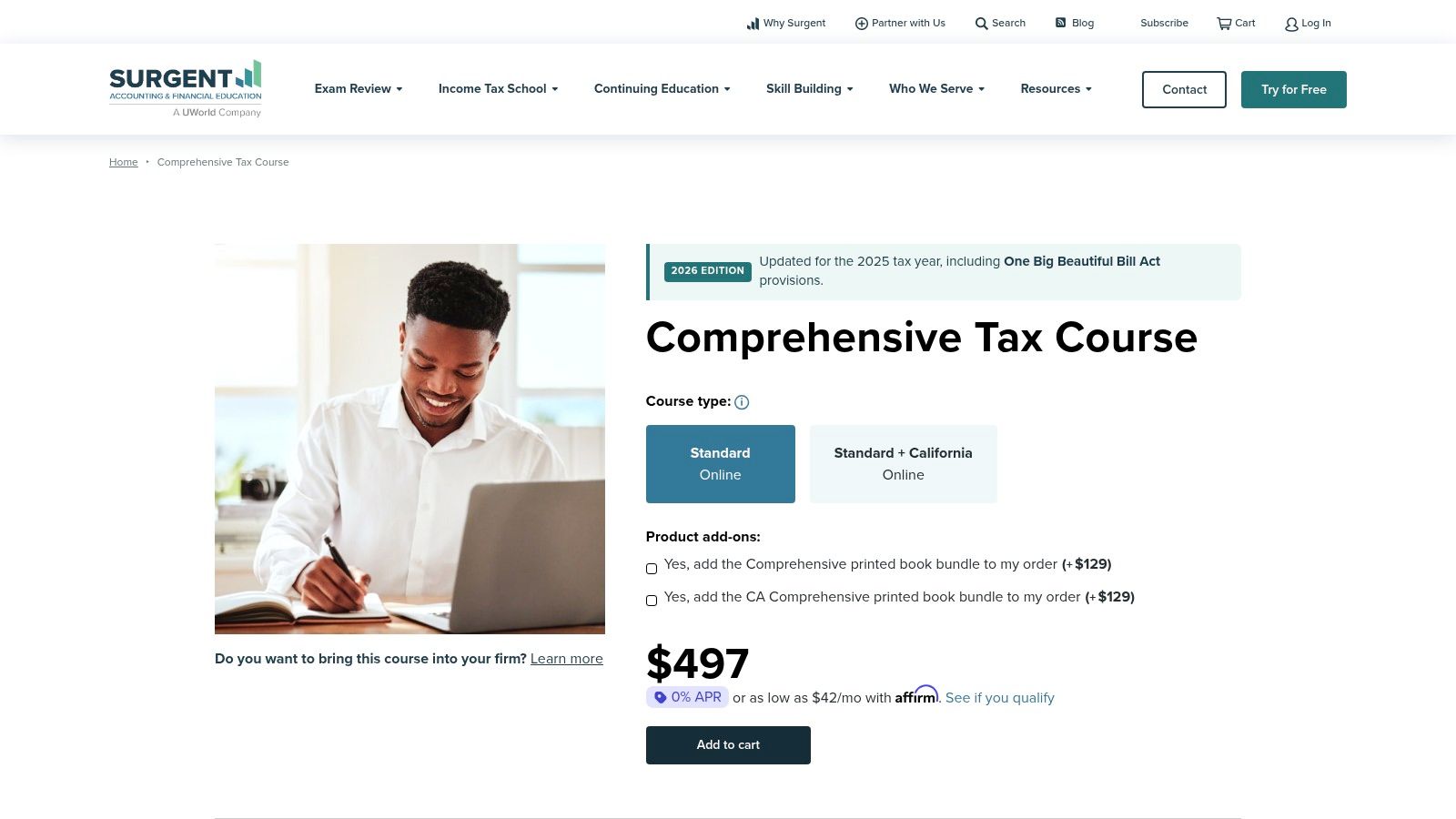
Surgent Income Tax School Comprehensive Tax Course is the cleanest choice here for disciplined self-starters. Some students don't need a classroom. They need reliable materials, structured assessments, and a provider that understands compliance reporting. That's where Surgent fits.
If you're balancing a day job, family obligations, or an irregular schedule, self-paced training can be the difference between finishing and quitting halfway through.
Who should pick Surgent
Surgent is best for students who already know how they learn. If you can set your own study blocks and keep moving without weekly classroom accountability, online self-study can be efficient and practical. It also works well for professionals crossing over from bookkeeping, payroll, or finance support roles who need tax-specific education without commuting to a campus.
The trade-off is the obvious one. Flexibility and networking rarely come together in the same package. If you want spontaneous instructor Q&A, local peers, and job leads from a classroom, a self-paced course can feel isolating.
That said, there's value in a formal provider that reports completions and offers a path for continued education. Tax is one of those fields where your first course matters, but your second and third learning steps matter just as much. In New York, for example, commercial tax return preparers face a compliance framework that includes continuing professional education through the state's SLMS system, with either 16 qualifying or 4 CPE credits depending on registration history, plus a $100 registration fee for commercial entities. California works differently, but the lesson is the same. This profession rewards people who get comfortable with ongoing education early.
6. Golden State Tax Training Institute – CTEC 60-Hour QE
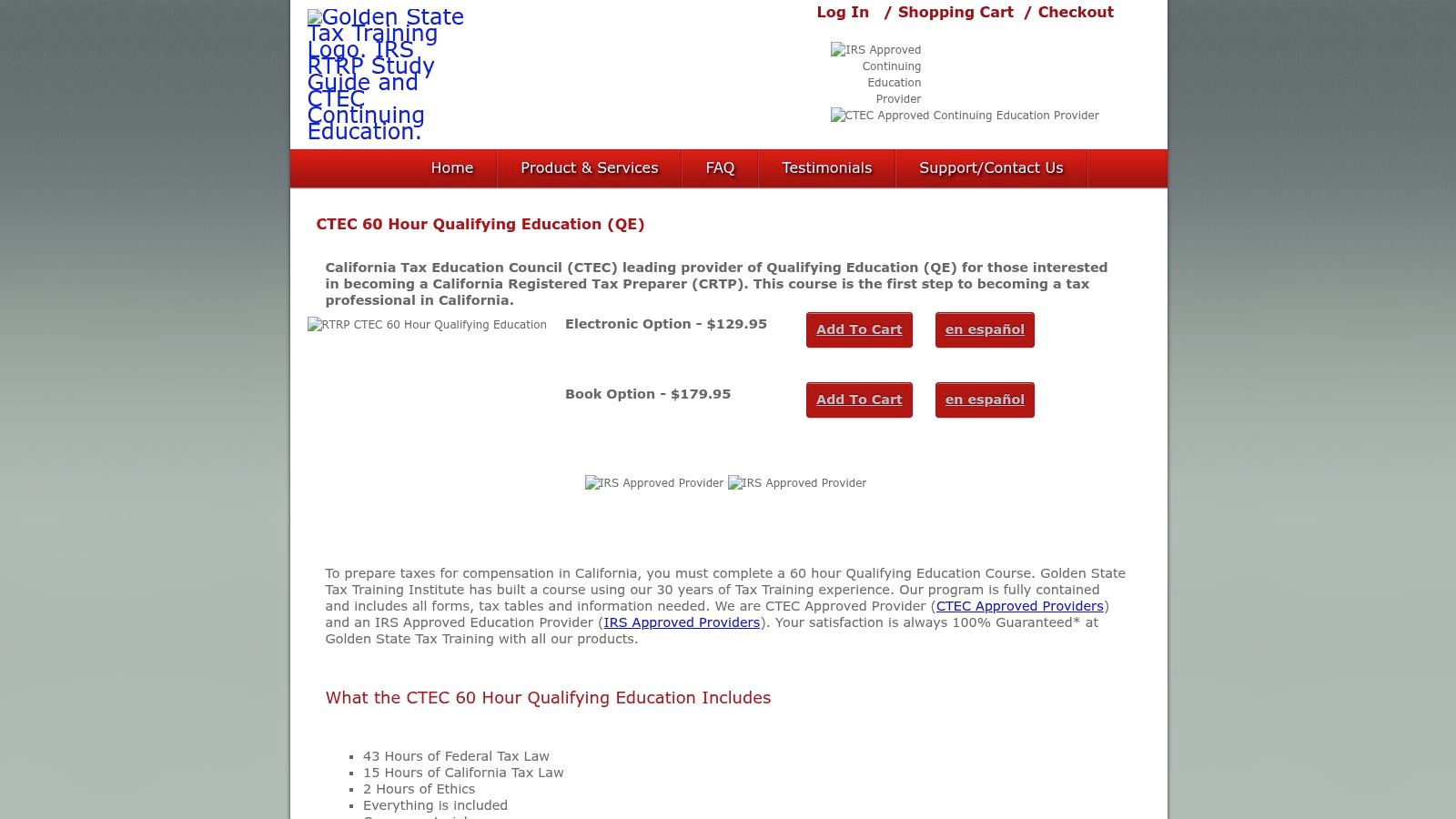
Golden State Tax Training Institute 60-Hour QE is the practical minimalist's option. It's straightforward, California-focused, and easy to understand. For some students, that's ideal. They don't want bells and whistles. They want approved education, clear materials, and a manageable path to completion.
This kind of provider often appeals to career changers who are cost-conscious and don't need a polished classroom experience to stay on track.
What works and what does not
What works is the simplicity. You can usually choose electronic or printed materials, move through self-study at your pace, and handle exams in a format that suits you. That removes a lot of friction for students who just need to get started.
What doesn't work for everyone is the limited live interaction. If you learn best by raising your hand, talking through examples, and hearing how an instructor handles gray areas, self-study can leave gaps. Tax law is full of details, and beginners often don't know which questions they should even be asking yet.
A low-friction course is great. A low-support course can be a problem if you freeze when the material gets more complex.
This route makes the most sense when you're motivated, organized, and willing to supplement your education with practical exposure, office mentoring, or additional review.
7. California Society of Tax Consultants – 60-Hour QE In-Person
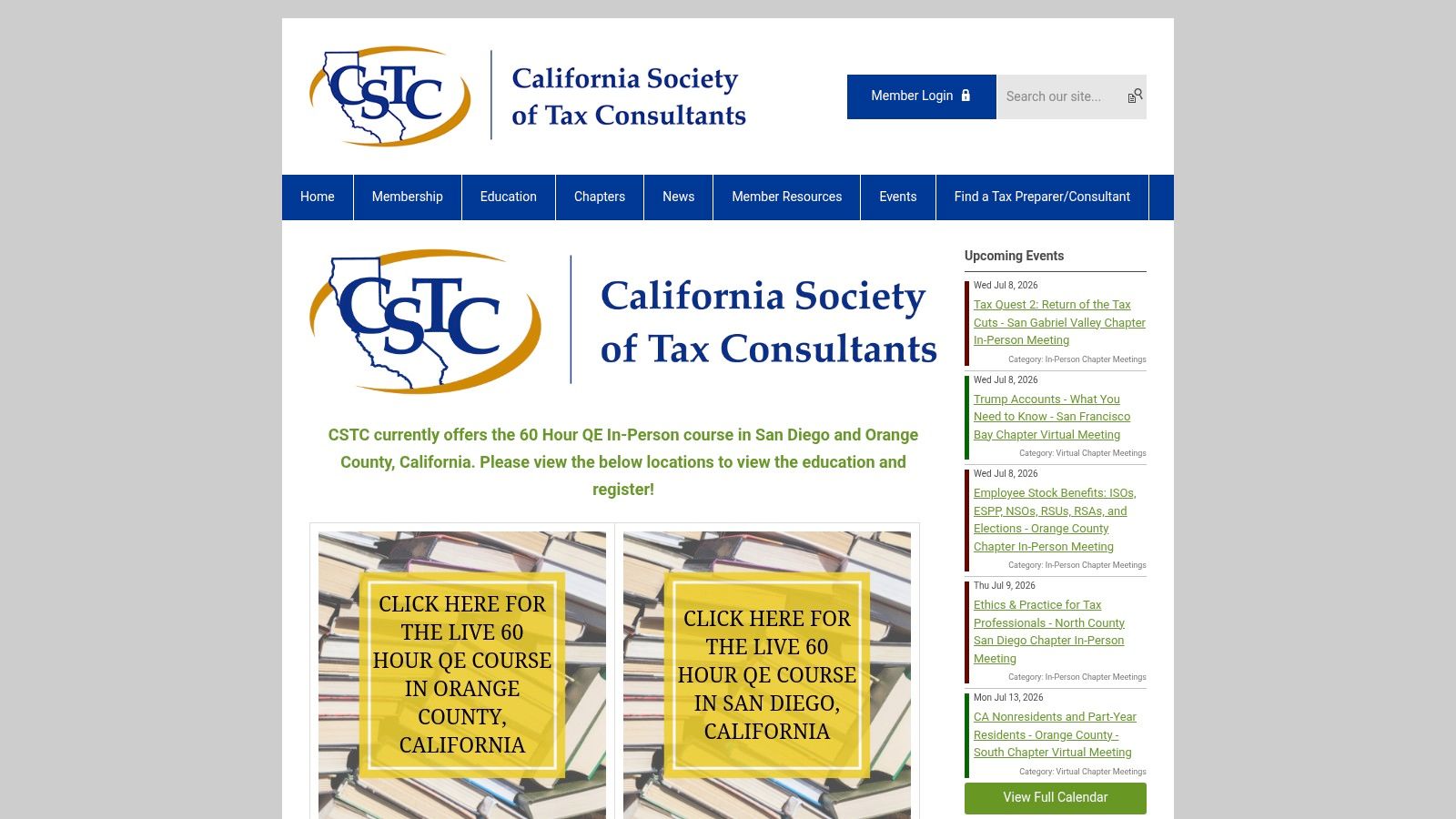
California Society of Tax Consultants 60-Hour location options is the most locally grounded option on this list. For San Diego students, that local angle matters. A class isn't only about information. It's also about who you meet, who answers your questions, and who might remember your name when seasonal opportunities open up.
If I were advising someone who wants to build a San Diego client base over time, I'd take this format seriously.
Why local professionals like this route
Face-to-face instruction changes the learning experience. You can ask follow-up questions in real time, compare notes with peers, and hear from people who work in your regional market. That's a major advantage over generic online content.
A local chapter connection stands out as a differentiator. Professional association environments tend to expose students to practicing tax professionals, ongoing education, and a more serious view of the field. That helps if your long game is not just to get licensed or registered, but to become competent enough that clients trust you year after year.
The trade-off is rigidity. In-person courses usually mean fixed dates, fixed locations, and fewer start options. For some people, that's a problem. For others, that structure is exactly why they finish.
One overlooked option deserves mention here. Not everyone needs a paid commercial course to begin building tax experience. The free credential pathway through VITA is often left out of roundups like this, even though VITA offers free online training on IRS software with a certifying credential upon completion, and commercial search results frequently omit it. If your budget is tight, that's worth exploring alongside formal California-focused education.
Top 7 Tax Preparer Classes Near Me, Comparison
| Program | Delivery & Complexity 🔄 | Resources & Requirements ⚡ | Expected Outcomes ⭐ 📊 | Ideal Use Cases 💡 |
|---|---|---|---|---|
| H&R Block – Income Tax Course | Instructor‑led, self‑paced online, and in‑person cohorts; moderate structure and scheduling coordination. | Multiple local offices (San Diego), scheduled cohorts; potential employer contracts/non‑compete considerations. | ⭐ CTEC 60‑hr CA edition; strong brand recognition and seasonal hiring pipeline. | Those seeking recognized credential plus local in‑person networking and fast entry into storefront work. |
| Jackson Hewitt – Tax Preparation Classes (Tax School) | Seasonal online and classroom delivery; low‑to‑moderate complexity focused on Form 1040 basics. | Varies by office; tuition and availability inconsistent; confirm CA CTEC compliance locally. | ⭐ Practical entry‑level readiness for seasonal storefront roles; solid basics for 1040 issues. | Quick training for seasonal hires and beginners aiming for retail tax preparer roles. |
| Liberty Tax – Tax School | Franchise‑run mix of online and local center classes; moderate complexity aligned to franchise workflows. | Local franchise scheduling and variable tuition; verify CA 60‑hr coverage per location. | ⭐ Storefront‑oriented skills and potential consideration for Liberty employment. | Learners who want training tailored to franchise/storefront procedures and bilingual options. |
| Latino Tax Pro – California 60‑Hour CTEC QE | CTEC‑approved in‑person and live webinar delivery; instructor‑led with community events. | Bilingual instruction (EN/ES); clear pricing and scheduled dates; strong CA focus. | ⭐ CTEC 60‑hr (45 federal/15 CA+ethics); pathway to CRTP and community networking. | Spanish‑speaking learners and those prioritizing CA‑specific, bilingual QE and community support. |
| Surgent Income Tax School – Comprehensive Tax Course (CA) | Self‑paced online with structured assessments; low logistical complexity, high self‑discipline required. | Online materials, assessments, completions reported to CTEC/IRS; stackable CE options. | ⭐ Comprehensive CA edition 60‑hr; formal reporting and career advancement pathways. | Working adults needing flexible, accredited self‑study with clear certification reporting. |
| Golden State Tax Training Institute – CTEC 60‑Hour QE | Primarily self‑study with optional printed/electronic materials; low complexity and straightforward process. | Low, clearly posted pricing; online or paper exam options; mostly self‑directed study. | ⭐ CTEC 60‑hr at budget pricing; longstanding CA provider with CE offerings. | Cost‑conscious learners who prefer self‑study and a simple sign‑up/process. |
| California Society of Tax Consultants (CSTC) – 60‑Hour QE In‑Person | Face‑to‑face, cohort‑based instruction with fixed schedule; higher coordination complexity. | Local chapter calendars (San Diego/OC); in‑person attendance required; variable cohort dates/pricing. | ⭐ Live CTEC 60‑hr instruction with direct access to practicing professionals and networking. | Professionals seeking live instruction, peer networking, and local professional referrals. |
How to Choose Your Course and Enroll
A San Diego student usually faces the same fork in the road. One course promises a quick start with a national chain. Another checks the California boxes but asks for more self-discipline. The right choice depends on where you want to work after training, what kind of clients you expect to serve, and whether you need a CTEC-qualifying path from day one.
Start with the job outcome, not the course description. If your goal is a seasonal position with a large retail tax office, H&R Block, Jackson Hewitt, and Liberty Tax can make sense because training often connects to hiring needs. If you want to prepare returns in California under the rules that matter here, I would put more weight on Latino Tax Pro, Surgent, Golden State Tax Training Institute, and CSTC because they are built around CTEC relevance and California practice.
San Diego also changes the equation. A program that looks fine in a national directory may still leave gaps if it does not address California filing issues, CTEC registration expectations, or local professional contacts. For new preparers here, those details affect how quickly you can get to work and who can refer clients or job leads once tax season starts.
Learning style matters, but only after compliance and job fit. Live classroom instruction helps students who need deadlines, direct feedback, and a place to ask basic questions without falling behind. Self-paced programs work well for disciplined adults with full-time jobs, but they can produce weak results if you rush through the material and never practice real return flow. Bilingual instruction also has practical value in San Diego. It helps both the student and the future client base.
What should a good course equip you with?
It should teach you how to complete common individual returns, spot issues that need escalation, document your work, and explain results to a client in plain language. A certificate by itself does not make someone ready for tax season. The stronger programs build judgment. That is what keeps errors down and gives an entry-level preparer a path to better work next year.
Use a short screening process before you enroll:
- Match the course to your target job. Decide whether you want chain employment, independent California registration, or a foundation for long-term tax work.
- Confirm California applicability. Check whether the program satisfies CTEC qualifying education if that is your goal.
- Review the format carefully. Pick live instruction if you need structure. Pick self-study only if you know you will finish it.
- Ask about practice work. Look for return exercises, case work, or access to working professionals, not just reading modules.
- Check the local upside. In San Diego, networking through instructors, chapter events, and nearby offices can matter as much as the tuition difference.
Enrollment itself is usually straightforward. Gather your ID, payment method, and calendar before you sign up. Then verify the start date, completion deadlines, and any reporting steps tied to California requirements. Students who wait until the peak hiring window often end up choosing from what is left instead of what fits.
If you're in San Diego and want help beyond coursework, Allied Tax Advisors is a strong local firm to know. They work with individuals, families, business owners, and taxpayers facing complex issues, and they also give aspiring professionals a useful model of what full-service tax support looks like in practice. If your goal is to move from basic return prep into stronger judgment on planning, compliance, and real client service, studying how an experienced local firm operates can be just as valuable as picking the right class.