
When you own an investment property, you take on new tax responsibilities. But here’s the upside: you also gain access to some significant tax deductions. While the rent you collect is considered taxable income, you can subtract a whole host of legitimate business expenses—things like repairs, insurance, and property management fees—to lower your overall tax bill. This is where savvy investors turn everyday costs into real savings.
Getting a Handle on Property Investment Taxes

It helps to think of your rental property as a small business. You have income from your customers (tenants), and you have costs associated with running the operation. The IRS gets this. They allow you to deduct the “cost of doing business” from your rental income, which shrinks the amount of profit you actually pay taxes on. Mastering this simple concept is the foundation of smart tax management for any property investor.
Generally, the taxes you’ll face as a real estate investor fall into three main buckets. Getting to know each one gives you a clear financial roadmap for both year-to-year operations and the eventual sale of your property.
The Three Main Tax Categories
First up is income tax. This is the tax you pay on the net profit your property brings in each year. You calculate it by taking your total rental income and subtracting all your allowable operating expenses. Your goal here is to legally maximize every single deduction to minimize that taxable profit.
Next, you have property tax. This is a local tax, not a federal one. Your city or county charges it based on the assessed value of your property. While it’s a mandatory cost of ownership, the good news is that it’s also 100% deductible against your rental income. Property tax rates can differ wildly from one place to another. For example, investors in Maui currently face a property tax rate of around 1.185% on short-term rentals, a crucial number to factor into your financial projections.
Finally, there’s capital gains tax. This one only comes into play when you sell your property for more than you paid for it. The tax is calculated on the profit—the difference between your sale price and what’s called your “adjusted cost basis” (basically, your original purchase price plus any major improvements you made). With some strategic planning, you can often reduce this tax hit or sometimes even put it off entirely.
Pro Tip: Think of it this way: every dollar you spend on necessary business expenses, from paying mortgage interest to advertising for new tenants, is a potential tax deduction. This makes meticulous record-keeping more than just good bookkeeping—it’s your most powerful tool for cutting your tax bill.
To help you keep these concepts straight, here’s a quick summary table.
Key Tax Concepts for Real Estate Investors at a Glance
This table breaks down the fundamental tax types every real estate investor needs to understand.
| Tax Concept | What It Means for You | When It Applies |
|---|---|---|
| Income Tax | This is the tax you owe on your annual rental profits (Income – Expenses). | Annually, when you file your tax return. |
| Property Tax | This is a local tax based on your property’s assessed value. It’s a deductible expense. | Annually or semi-annually, paid directly to your local government. |
| Capital Gains Tax | This is the tax on the profit you make when you eventually sell the property. | Only at the time of sale. |
Getting comfortable with these three areas will put you in a much stronger position to manage your investment effectively and maximize your returns.
Unlocking Your Rental Property Tax Deductions

This is where savvy investors really pull ahead of the pack. Yes, your rental income is taxable, but the IRS allows you to deduct a whole host of expenses tied to owning and managing your property. These deductions are your single best tool for chipping away at your tax bill.
The absolute key here is meticulous record-keeping. Seriously, track every single dollar. When you keep detailed records throughout the year, you’re not just doing bookkeeping; you’re building a case to claim every deduction you’re legally entitled to. It’s the only way to ensure you don’t leave money on the table come April.
Common Operating Expense Deductions
The everyday costs of keeping your rental property up and running are called operating expenses, and the good news is that almost all of them are deductible. Think of these as the ordinary and necessary costs you pay to keep the property in good shape and your tenants happy.
Here are some of the most common ones you’ll encounter:
- Mortgage Interest: For most landlords, the interest portion of the monthly mortgage payment is the single biggest deduction you’ll take.
- Property Taxes: As we touched on before, the property taxes you pay to your city or county are fully deductible.
- Insurance Premiums: The cost of your landlord insurance, as well as any specific policies for things like floods or liability, can be written off.
- Professional Fees: Did you pay a property manager, an accountant, or a lawyer? Those fees are deductible.
- Advertising Costs: Money you spent on ads to find your next great tenant is a business expense you can deduct.
- Utilities: If you, the landlord, pay for things like water, gas, electricity, or trash service, those costs are deductible.
For a more in-depth look at how these work in practice, our complete guide to tax on rental income breaks it down even further.
Repairs vs. Capital Improvements: A Crucial Distinction
If there’s one concept you need to burn into your memory, it’s the difference between a repair and a capital improvement. Getting this right is critical because the IRS has very different rules for each.
A repair simply keeps your property in good operating condition. An improvement, on the other hand, adds significant value, adapts the property to a new use, or substantially extends its life. Repairs get deducted now, while improvements get deducted slowly over many years.
Let’s use an analogy. Fixing a single leaky faucet under the kitchen sink? That’s a repair. You can deduct the full cost of that plumber’s visit on this year’s tax return. But if you decide to gut the entire kitchen and install brand-new plumbing, countertops, and appliances? That’s a capital improvement.
Here’s a quick cheat sheet to make it clearer:
| Type of Expense | Example | How It’s Handled on Your Taxes |
|---|---|---|
| Repair | Fixing a broken window pane | Deducted fully in the current tax year |
| Improvement | Installing all new energy-efficient windows | Depreciated over 27.5 years |
| Repair | Patching a few storm-damaged roof shingles | Deducted fully in the current tax year |
| Improvement | Replacing the entire roof | Depreciated over 27.5 years |
Understanding this difference is fundamental. A repair gives you an immediate financial benefit by lowering your taxable income right now, whereas a capital improvement provides its tax benefit over the long haul through depreciation.
Using Depreciation as Your Biggest Tax Advantage

When it comes to lowering your tax bill on a rental property, depreciation is hands-down the most powerful tool in your arsenal. It’s also one of the most misunderstood concepts for new investors.
Think of it as a “phantom deduction.” It’s a substantial tax write-off you get every single year, but it doesn’t require you to spend a dime out-of-pocket. The IRS understands that buildings, like any physical asset, wear down over time. Depreciation is simply the way you account for this gradual wear and tear, allowing you to deduct a piece of your property’s value each year. This is how you can have a cash-flowing property but legally show a lower profit—or even a loss—on your tax return.
Calculating Your Property’s Depreciable Basis
Before you can start writing anything off, you need to figure out your property’s cost basis. This isn’t just the price you paid for the house. It’s your total investment to get the property up and running.
Here’s the basic formula to find your starting point:
- Begin with the property’s purchase price.
- Add certain closing costs you paid to acquire the property, like legal fees, title insurance, and recording fees. (Fees related to your lender, like loan origination fees, typically don’t count here).
- This total gives you the initial cost basis.
But here’s a critical step: you can only depreciate the building, never the land. Why? Because land doesn’t wear out or become obsolete. You have to split the total value between the structure and the land it sits on. The easiest way to find this split is by looking at your local property tax assessment, which usually breaks down the value for you.
For example: Let’s say you buy a rental for $400,000. Your property tax bill shows the land is valued at $80,000 and the building at $320,000. Your depreciable basis—the number you’ll use for your tax deduction—is $320,000.
Understanding the 27.5-Year Schedule
The IRS sets the “useful life” for any residential rental property at 27.5 years. This means you get to write off your building’s cost basis in equal chunks over that timeframe. The official name for this method is the Modified Accelerated Cost Recovery System (MACRS), but all it really means is straight-line depreciation over 27.5 years.
The math is refreshingly simple. Just divide your building’s basis by 27.5.
Let’s stick with our example:
- Depreciable Basis: $320,000
- Useful Life: 27.5 years
- Annual Depreciation Deduction: $320,000 / 27.5 = $11,636
That $11,636 is a non-cash expense you can deduct from your rental income every year. It directly reduces your taxable profit and puts more money back into your pocket.
Key Takeaway: You can’t just choose to skip depreciation. The IRS considers it mandatory. If you don’t claim it and then sell the property down the road, the IRS will calculate your capital gains as if you did take the deduction. This is a concept called “depreciation recapture,” and ignoring it can lead to a nasty tax surprise.
Depreciation is a core strategy for any serious real estate investor, but it has some nuances, especially when you make improvements or sell the property. To get a better handle on the rules, you can learn more about how depreciation on rental property works. Mastering this concept is absolutely essential to maximizing your returns.
Navigating Capital Gains Tax When You Sell
Your tax journey with a rental property doesn’t stop with the yearly filings. The biggest tax event usually happens when you sell. This is where capital gains tax comes into play—it’s simply the tax on the profit you make when you sell an asset. Getting a handle on how this works is absolutely key to protecting the wealth you’ve worked hard to build.
Now, don’t just subtract what you paid from the sale price. The IRS has a more specific way of looking at your actual profit. This is where all that diligent record-keeping you’ve been doing really pays off, because every number affects your final tax bill.
Short-Term vs. Long-Term Gains
First things first, the IRS cares a lot about how long you owned the property. They draw a hard line at the one-year mark, which splits your potential profit into two very different tax buckets.
- Short-Term Capital Gains: If you sell a property you’ve owned for one year or less, the profit gets taxed as ordinary income. That means you’ll pay the same high rate you pay on your salary, which can climb all the way up to 37%. The IRS does this to discourage people from quickly flipping properties for a fast profit.
- Long-Term Capital Gains: Hold onto that property for more than one year, and you get access to much friendlier long-term capital gains rates. For most real estate investors, these rates are 0%, 15%, or 20%, depending on your overall taxable income.
Seriously, holding a property for just one extra day past the year mark could be the difference between a 37% tax hit and a 15% one. The savings can be massive.
Calculating Your True Taxable Gain
To figure out your taxable profit, you need two key figures: the final sale price and your adjusted cost basis. Think of the adjusted basis as your total investment in the property over its entire life, not just the purchase price.
Here’s the simple formula:
- Start with your original purchase price.
- Add in your closing costs from when you bought it (like title insurance or legal fees).
- Add the cost of any major capital improvements—we’re talking a new roof, a full kitchen remodel, or a new HVAC system.
- Subtract all the depreciation deductions you’ve claimed over the years. This is a critical step many people forget!
The number you end up with is your adjusted cost basis. Your taxable gain is just the sale price minus this adjusted basis. If you want to dive deeper into specific scenarios, our full guide on understanding capital gains taxes and what to know for 2024 is a great resource.
The Power of Deferral with a 1031 Exchange
So, what if you want to sell but would rather roll that money into another property instead of handing a chunk of it to the IRS right away? That’s where the 1031 exchange becomes an investor’s best friend.
A 1031 exchange, also called a like-kind exchange, lets you postpone paying capital gains tax on the sale of an investment property. The catch? You have to reinvest the proceeds into another “like-kind” property following a strict set of rules and timelines. It’s a powerful way to keep your entire investment growing for you.
This infographic breaks down the essential parts of this powerful tax-deferral strategy.
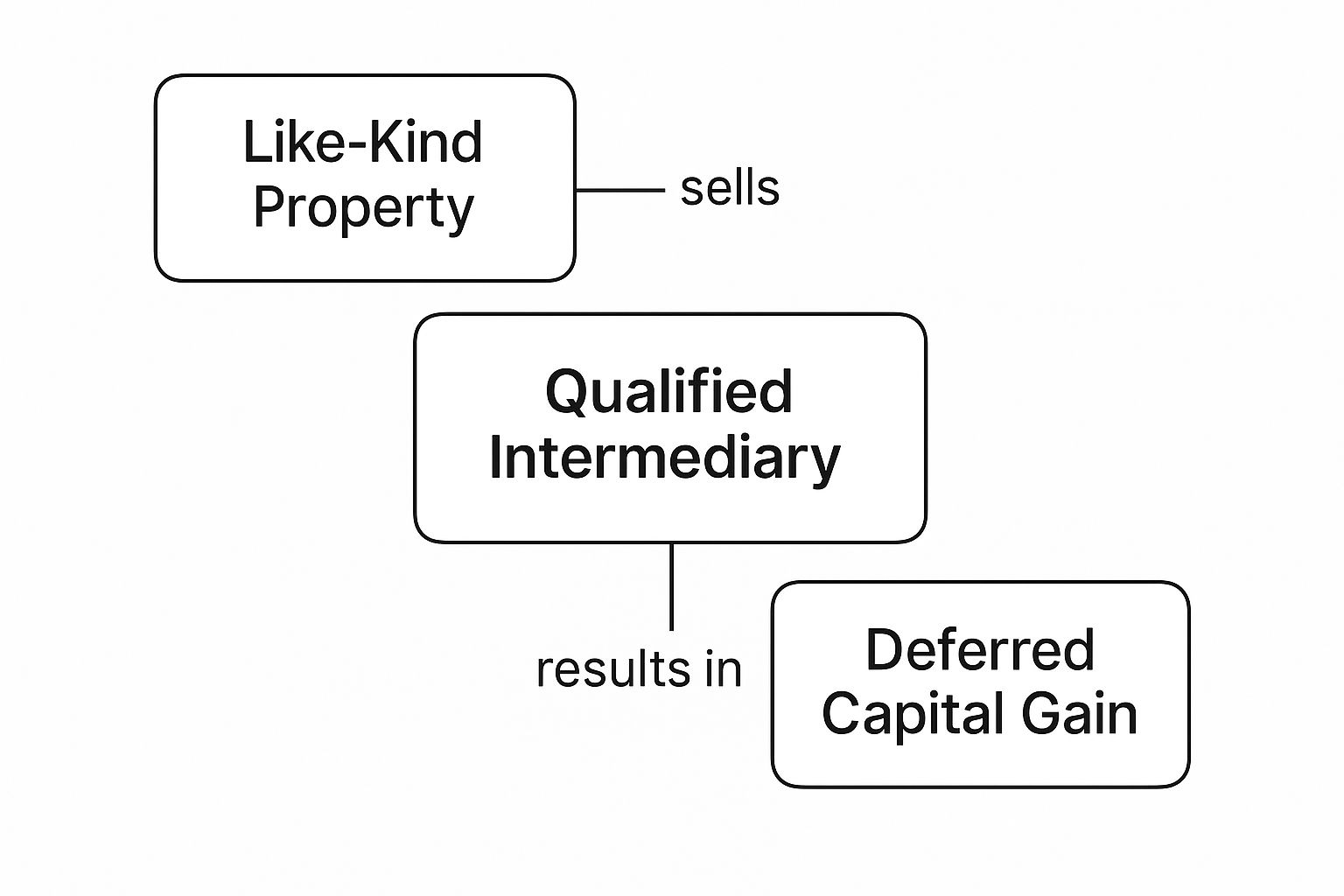
As the visual shows, using a Qualified Intermediary and properly identifying your replacement property are non-negotiable steps for a successful exchange.
Knowing these tax strategies is especially vital in today’s shifting market. While financing got a bit easier in 2024, lingering questions about tax policy have made some investors hesitant. In fact, global commercial real estate deals saw a 31% drop year-over-year through mid-2024, partly driven by this uncertainty. Being smart about capital gains and knowing your deferral options gives you a real edge, no matter what the market is doing.
Advanced Tax Strategies for Savvy Investors
Once you’ve got the basics of deductions and depreciation down, you can start using the same powerful strategies that serious real estate investors rely on to build and protect their wealth. These aren’t just about filing your taxes correctly each year; they’re proactive tools for growing your portfolio and slashing your tax bill. Honestly, understanding these concepts can completely change how you look at buying, holding, and selling properties.
Let’s start with a common scenario: you want to sell one rental and buy another. Normally, that would mean a hefty capital gains tax bill. But it doesn’t have to.
Deferring Gains with a 1031 Exchange
This is where the famous 1031 exchange comes in. Think of it like hitting a pause button on your tax bill. Instead of selling a property, paying taxes on the profit, and then reinvesting the depleted funds, a 1031 lets you roll the entire sale proceeds into a new, similar property. This keeps 100% of your capital working for you, which can dramatically speed up your portfolio’s growth.
Of course, a benefit this good comes with some very strict, non-negotiable rules. You have to get the timing perfect.
- The 45-Day Identification Period: From the moment you close the sale of your old property, the clock starts ticking. You have exactly 45 days to officially identify, in writing, the potential properties you want to buy.
- The 180-Day Closing Period: You then have to close on one of those identified properties within 180 days from your original sale date.
These two deadlines run at the same time, not one after the other. It’s a tight squeeze, and it’s why you absolutely need a professional Qualified Intermediary to make sure everything goes smoothly.
Becoming a Real Estate Professional
For investors who are truly hands-on, qualifying as a Real Estate Professional in the eyes of the IRS is a total game-changer. Here’s why: rental income is usually considered “passive,” meaning any losses you have can typically only offset other passive income. If you don’t have enough passive gains, those losses just get carried over to future years, doing nothing to help your current tax situation.
Key Advantage: If you achieve Real Estate Professional status, you can deduct your rental losses against all of your other income—including your W-2 salary. This can result in a massive tax refund.
To get this status, you have to prove you’re serious. You need to spend more than 750 hours a year on real estate activities, and this must be more than half of your total working time.
Accelerating Depreciation with Cost Segregation
The standard 27.5-year depreciation schedule is helpful, but a cost segregation study puts it on steroids. This is a detailed engineering analysis of your property that breaks it down into individual components. The goal is to identify assets that can be depreciated much faster—over 5, 7, or 15 years—instead of the sluggish 27.5-year timeline for the building itself.
Think of it this way: your building’s foundation will last decades, but the carpet won’t. A cost segregation study might find things like:
- Carpeting, certain light fixtures, and cabinetry (5-year property)
- Fences, sidewalks, and landscaping (15-year property)
By reclassifying these items, you pull huge depreciation deductions into the early years of ownership. This creates a significant immediate tax shield and gives your cash flow a major boost.
These kinds of strategies are especially valuable when the market gets shaky. For example, MSCI data showed a 2% dip in global real estate investment in early 2025, as different regions responded to unique tax and market pressures. You can see how market conditions and tax planning connect in this detailed analysis of these investment trends.
How Global Tax Policies Can Sway Your Investments
It’s easy to think of your investment property as its own little world, governed by local property taxes and tenant needs. But the truth is, your property doesn’t exist in a vacuum. Major shifts happening on the global stage can send ripples through the real estate market, quietly influencing your returns. Keeping an eye on these bigger trends is smart investing.
This is especially critical if you own property overseas or have money in Real Estate Investment Trusts (REITs). When governments around the world change the rules of the game with new fiscal and tax policies, it can shake up the entire economic landscape. These shifts can create both risk and opportunity, impacting everything from property values to how many deals are getting done.
A New Global Tax Rule Enters the Scene
One of the biggest changes to watch is the move toward a global minimum tax. You’ve probably heard stories about giant corporations stashing their profits in countries with super-low tax rates. Well, governments are finally teaming up to put a stop to it, and their solution could have a trickle-down effect on real estate investors.
The result is a landmark agreement that establishes a 15% global minimum corporate tax rate, often called Pillar Two. Slated to take effect around 2024-2025, this rule is aimed at making sure massive multinational companies pay a fair share of tax, no matter where their headquarters are. While it’s designed for corporate giants, the impact will be felt by investment vehicles like REITs and other large funds that hold global property portfolios. For a deeper dive, you can see how these global tax policies are being implemented and what it means for the market.
This new standard changes the entire calculation for the effective tax rate on rental income flowing through these large-scale entities.
Key Insight: Even if all your properties are in the US, these global rules still matter. They change how the big institutional investors—the “whales” in the real estate ocean—behave. When they make different moves, it can influence property values and market confidence right in your own neighborhood.
How This All Connects to Your Wallet
So, what does a global minimum tax in Europe or Asia really have to do with the taxes you pay on your rental property? It’s all about a push for a more stable and predictable economic climate.
Here’s how to think about the connection:
- Higher Costs for the Big Fish: Large real estate funds and international REITs might find their tax bills going up. This could make them a bit more conservative with their investments, potentially cooling down the pace of their acquisitions.
- A Pause for Uncertainty: Any major change to tax policy, especially when combined with fluctuating interest rates, makes big-money investors nervous. This can cause a temporary slowdown in large transactions as everyone hits pause to see how the new rules will shake out.
- A Return to the Basics: When complex tax loopholes in certain countries start to disappear, investors are forced to go back to what really matters: the property itself. A great location, solid rental income, and good condition become far more important than clever tax strategies.
At the end of the day, staying informed about these macro-level trends gives you a strategic edge. It helps you see the bigger picture, anticipate market shifts, and ultimately, protect the long-term health of your investments.
Frequently Asked Questions About Property Taxes
When you’re dealing with taxes on an investment property, a lot of specific “what if” scenarios tend to pop up. Let’s tackle some of the most common questions we hear from investors to clear up any lingering confusion.
How Long Should I Keep My Property Records?
This is a big one. Good records are your best friend at tax time, but it’s easy to wonder when it’s safe to finally clean out that filing cabinet.
The general rule from the IRS is to hang onto your records for at least three years after you file your tax return. This three-year window is the standard “look-back” period for most audits, covering things like your rental income and day-to-day operating expenses.
But—and this is a big but for property owners—some records have a much longer shelf life.
Crucial Tip: Never, ever toss out documents related to your property’s cost basis. This means your original closing statements, receipts for capital improvements (like a new roof or a kitchen remodel), and proof of any other costs that add to your investment in the property. You’ll need this paper trail, even if it’s decades old, to correctly calculate your gains when you eventually sell.
The best practice? Keep these specific documents for as long as you own the property, plus at least three years after you sell it. Without them, you risk a much bigger capital gains tax bill than you actually owe.
Can I Deduct My Own Labor for Repairs?
It’s a logical question for any hands-on landlord. You spend a whole weekend fixing a leaky faucet or repainting a bedroom—that time is valuable, right?
While it certainly is valuable to your business, the IRS has a firm rule here. You can absolutely deduct the cost of any materials you buy for repairs. That new paint, the replacement faucet, the drywall patch kit—all of those are legitimate, deductible expenses.
What you cannot deduct is the monetary value of your own time and labor. Think of it this way: you can’t pay yourself a wage and then deduct that same wage as an expense. The IRS views this as “sweat equity,” and it’s not a deductible business cost.
So, if you spend $150 on paint and supplies to refresh a unit, you can deduct the $150. You can’t, however, add another $500 to your deductions because you believe that’s what your 10 hours of work were worth.
What Happens If My Rental Property Is Vacant?
A vacant unit can be stressful, but the good news is that from a tax perspective, it doesn’t just fall off the map. As long as your property is genuinely available for rent, you can continue to deduct your expenses just like you would with a tenant in place.
The key is that you have to be actively trying to fill the vacancy—running ads, showing the property, and making it ready for a new tenant. If you’re doing that, you can still deduct all the usual operating costs, including:
- Mortgage interest
- Property taxes
- Insurance premiums
- Utilities
- Advertising and marketing costs
The deductions only stop if you take the property off the market for personal use. During a normal turnover period, your property is still a business, and its expenses remain deductible.
Managing rental property taxes can feel like a full-time job in itself, but you don’t have to navigate it alone. The team at Allied Tax Advisors specializes in helping real estate investors stay compliant, find every rightful deduction, and build a portfolio that works smarter. Let us help you build a smarter tax strategy for your portfolio.