
So, you’re a landlord. That’s a fantastic step, but it’s time to talk about everyone’s favorite topic: taxes. Let’s get straight to the point. Is the money you get from tenants taxable? Yes, absolutely. Every dollar of rent you collect needs to be reported to the IRS.
But here’s the good news, and it’s a big one. You aren’t taxed on the total rent you bring in. You’re only taxed on your net profit—the money left over after you’ve subtracted all your legitimate expenses. That distinction is everything.
Getting Started With Rental Income Taxes

When you become a landlord, you’re not just collecting rent; you’re essentially running a small business. The best way to approach your new tax situation is to think like a business owner from day one.
The rent payments are your revenue. All the money you spend to keep the property running—from fixing a leaky faucet to paying the mortgage interest—are your business expenses. The IRS taxes your rental income as ordinary income, which just means it gets added to your other income (like your salary) and taxed at your regular rate. The key is that the final tax bill is based on your profit, not the gross rent you collected.
The Foundation of a Smart Rental Tax Strategy
At its core, the math is simple: Gross Rental Income – Operating Expenses = Taxable Income. To make this formula work for you, your most powerful tool is meticulous record-keeping. Seriously, this is non-negotiable.
Every receipt for a repair, every utility bill you cover, and every bank statement showing a mortgage interest payment is a potential tax deduction that lowers your taxable income. Start a spreadsheet, use an app, or keep a dedicated folder—whatever it takes. Staying organized is the single best way to make sure you don’t hand over more money to the IRS than you have to.
The Big Idea: In the eyes of the IRS, your rental property is a business. Treat it that way. Keeping clean records and understanding the difference between income and expenses is the first—and most important—step to mastering your rental property taxes.
Before we dive deeper, it’s helpful to have a clear grasp of the basic terms you’ll encounter.
Key Rental Tax Concepts at a Glance
This table breaks down the fundamental ideas every landlord needs to know. Understanding these concepts is the first step toward confidently managing your tax obligations.
| Concept | Brief Explanation |
|---|---|
| Gross Rental Income | The total amount of rent you collect before any deductions are taken out. |
| Operating Expenses | The day-to-day costs of keeping your rental property running (e.g., repairs, insurance). |
| Net Rental Income | Your profit. This is your Gross Rental Income minus all your allowable Operating Expenses. |
| Ordinary Income | The tax category for rental profits. It’s taxed at the same marginal rates as your wages or salary. |
| Depreciation | An annual deduction that accounts for the wear and tear on your property over time. |
With these core ideas in your back pocket, you’re ready to tackle the specifics of calculating your income and maximizing every deduction you’re entitled to. Let’s get into it.
Calculating Your Total Rental Income

Before you can even think about deductions, you first need to get a firm handle on your total rental income. This number is the bedrock for calculating your taxes on rental income, and you might be surprised by what the IRS considers “income.” It’s a lot more than just the rent checks you deposit each month.
Your gross rental income includes every payment you get from tenants for using or living in your property. Nailing this figure is the single most important step for filing an accurate tax return. Pro tip: Smart landlords open a separate bank account just for their rental business. It makes tracking everything a breeze and gives you a clean, easy-to-follow paper trail.
Identifying All Sources of Rental Income
The IRS has a broad definition of rental income, and it’s your job to report it all. Missing a source can lead to underreporting, which can bring on unwanted headaches and potential penalties.
When you add everything up, make sure your calculation includes these items:
- Advance Rent: Did you collect the first and last month’s rent upfront? That entire amount is considered income in the year you received it, not the year it applies to.
- Late Fees: Those extra charges you collect when a tenant pays late? Yep, that’s rental income, too.
- Lease Cancellation Fees: If a tenant pays a penalty to break their lease early, that payment goes right into your income column.
- Forfeited Security Deposits: A security deposit isn’t income when you first collect it. But if you have to keep some (or all) of it to cover unpaid rent or damages, that amount becomes taxable income in the year the tenant forfeits it.
This wide-ranging definition isn’t unique to the U.S. Around the world, rental income is a key part of personal tax systems. Take Denmark, for example, which has some of the highest personal income tax rates on the planet—topping 55.9% in 2025. There, rental profits are taxed heavily as part of their national fiscal strategy. The U.S. takes a different path. Here, your rental income is taxed at your personal income tax rate, which goes up to 37%. But don’t panic—your effective rate is almost always much lower once you factor in all the available deductions. You can see how different countries approach this on the Tax Foundation’s global data platform.
Accounting for Non-Cash Income
What happens when a tenant offers to do work on the property instead of paying rent? This kind of barter arrangement still counts as taxable income in the eyes of the IRS.
Key Takeaway: If a tenant provides a service in lieu of rent, you must report the fair market value of that service as income. For instance, if your tenant is a professional painter and they paint the unit in exchange for a month’s rent valued at $2,000, you have to report that $2,000 as income.
The good news is that this often creates a corresponding deduction. In our painter example, you’d report $2,000 in rental income, but you could also claim a $2,000 deduction for the painting and maintenance expense. While the two transactions wash out, you still have to report both of them properly on your return. For a full breakdown of what counts, our comprehensive guide to rental income tax has you covered.
Unlocking Your Maximum Landlord Deductions
Once you’ve tallied up your total rental income for the year, the really important work begins: shrinking your tax bill. This is where savvy landlords turn their everyday expenses into powerful tax savings. Getting a firm grip on your deductions is absolutely essential for lowering the taxes on rental income you’ll ultimately have to pay.
Think of it this way: every legitimate expense is a tool you can use to chisel away at your taxable profit. Any cost that the IRS considers “ordinary and necessary” for managing and maintaining your property can be subtracted from your gross income. The less profit left over, the less the IRS can tax.
This image breaks it down perfectly, showing how your expenses directly reduce your taxable income.
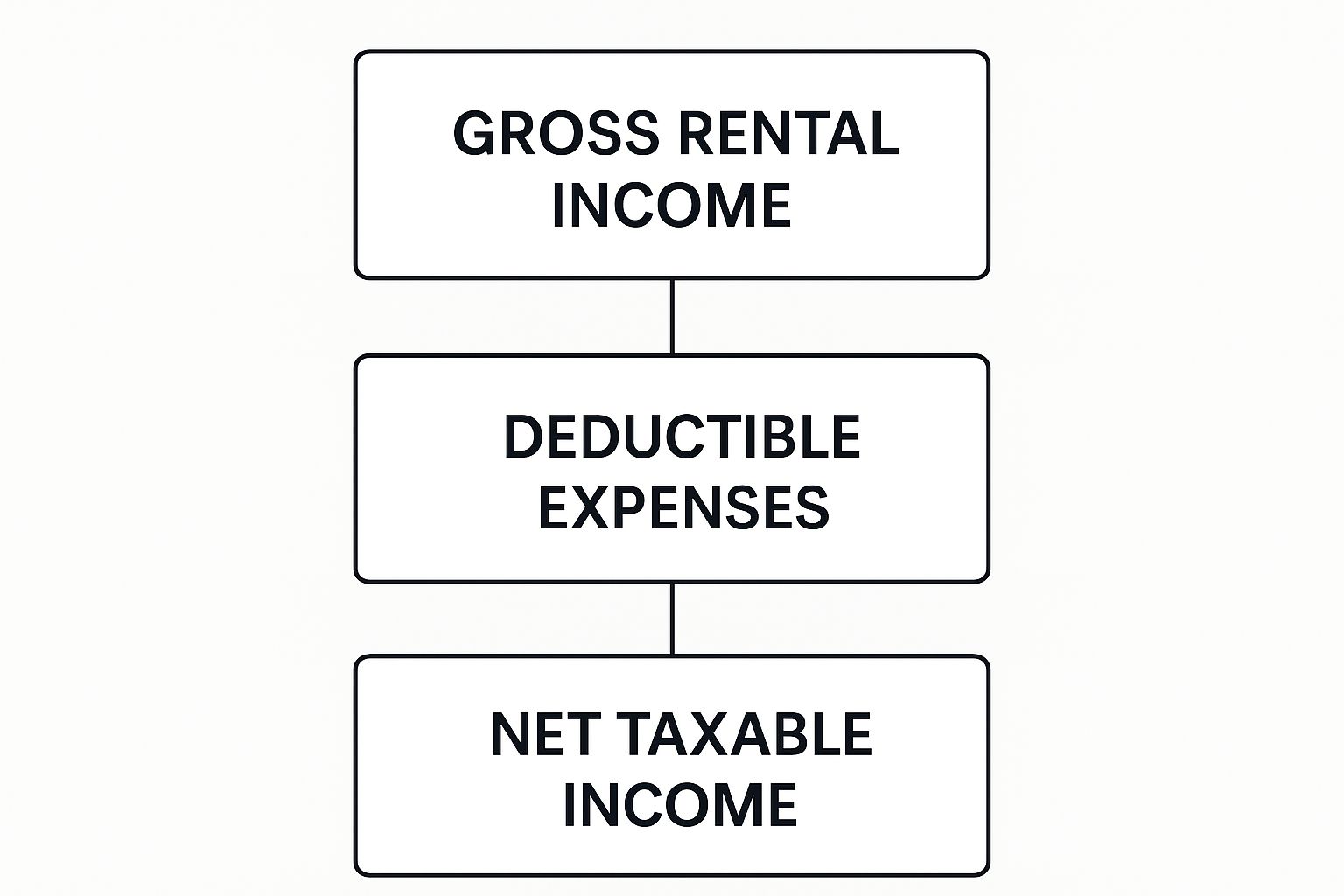
As you can see, your deductions are the critical bridge between what you earned and what you’re actually taxed on. The more legitimate expenses you claim, the smaller that final taxable number becomes.
The Most Common Landlord Deductions
Every rental property is different, but certain expenses are practically universal for landlords. These are the costs you should be tracking meticulously all year long. Seriously, don’t wait until April to go digging through a shoebox of crumpled receipts—keep detailed records as you go.
Here are some of the biggest and most common deductions you can take:
- Mortgage Interest: For most landlords, this is the single largest deduction. You can deduct the interest you pay on the loan used to buy or even improve your rental. You’ll find this amount on Form 1098 from your lender.
- Property Taxes: Those state and local property taxes you pay on the rental are 100% deductible.
- Insurance Premiums: Landlord insurance, fire, theft, flood—whatever policies you have for your rental property, the premiums are a deductible business expense.
- Advertising: Did you pay to list your property online? Run an ad in the local paper? Even the cost of a simple “For Rent” sign is deductible.
- Maintenance and Cleaning: All the costs to keep your property in good shape between tenants are fully deductible. This includes things like painting, hiring a cleaning service, or paying for lawn care.
To help you keep track of everything, here is a handy checklist of potential deductions. Go through it and make sure you’re not leaving any money on the table.
Comprehensive Rental Deduction Checklist
| Expense Category | Examples | Key Consideration |
|---|---|---|
| Financing Costs | Mortgage interest, HELOC interest | The interest must be for a loan secured by the rental property itself. |
| Taxes | State & local property taxes, payroll taxes for employees | Federal income taxes are not deductible. |
| Insurance | Landlord liability, fire, flood, theft insurance | Only premiums for policies covering the rental business are deductible. |
| Professional Services | Legal fees, accounting fees, property manager fees | These must be for services directly related to the rental activity. |
| Maintenance & Repairs | Fixing leaks, painting, replacing broken glass, pest control | These are costs to maintain the property, not improve it. Deductible in full. |
| Advertising | Online listing fees, newspaper ads, “For Rent” signs | Any cost to find and screen tenants is a valid deduction. |
| Utilities | Water, gas, electricity, trash collection | Only deductible if you, the landlord, are paying for them, not the tenant. |
| Travel | Mileage for property visits, supply runs, or repairs | You can use the standard mileage rate or track actual vehicle expenses. |
| Supplies | Office supplies, cleaning supplies, lightbulbs | Keep receipts for all the small things; they add up quickly. |
| Depreciation | Gradual deduction for the cost of the building & improvements | This is a non-cash expense that must be calculated over 27.5 years. |
This checklist is a great starting point, but always remember to keep good records to back up every single deduction you claim.
Repairs vs. Improvements: A Critical Distinction
Here’s where many landlords get tripped up. The IRS sees a big difference between a “repair” and an “improvement,” and how you categorize an expense has a major impact on your taxes for the year.
The Golden Rule: A repair is something you do to keep your property in its current working condition. Think fixing a broken pipe or patching a hole in the drywall. You can deduct the entire cost of a repair in the year you pay for it.
An improvement, however, is something that adds significant value to your property, adapts it for a new use, or substantially extends its life. You can’t write off the whole cost at once. Instead, you have to capitalize it and deduct a small piece of the cost each year through depreciation, typically over 27.5 years.
Here’s a simple way to think about it:
- Repair: Fixing a leaky faucet. Tax Treatment: Deduct the plumber’s bill this year.
- Improvement: A full kitchen remodel with new cabinets and appliances. Tax Treatment: Spread the cost out over 27.5 years.
Mistaking a major improvement for a simple repair is a common—and potentially costly—red flag for the IRS. When in doubt, it’s always wise to consult with a tax professional.
Overlooked (But Valuable) Deductions
Beyond the obvious big-ticket items, there are plenty of smaller expenses that can add up to huge tax savings. Smart investors know that every dollar spent on the business counts.
Don’t forget to track these often-missed deductions:
- Travel Expenses: If you drive to your property to collect rent, show it to prospective tenants, or handle a repair, you can deduct your mileage using the standard IRS rate or by tracking your actual car expenses.
- Legal and Professional Fees: Did you pay a lawyer to draft a lease or an accountant to prepare your Schedule E? Those fees are deductible.
- Utilities: If you pay the water or trash bill for your tenants as part of the lease agreement, you can deduct those costs.
- Office Supplies: The cost of paper for printing leases, bookkeeping software, pens, and folders used for managing your rental is a legitimate business expense.
By keeping organized records and understanding the full scope of what you can claim, you can turn your operational costs into a strategic tax advantage. For a deeper dive into the rules, you can learn more about the general taxation of rental properties. This comprehensive approach ensures you never overpay on the taxes on rental income.
Using Depreciation to Reduce Your Taxable Income
When it comes to lowering your tax bill as a landlord, depreciation is arguably the most powerful tool in your entire arsenal. It’s a bit of a strange concept at first because it’s a deduction you can take every year without actually spending any money.
Think of it as the IRS’s way of acknowledging that your property—the building itself—is slowly getting older and wearing out. Mastering this concept is a complete game-changer for your bottom line. It creates a significant “phantom expense” that directly cuts into your taxable profit, year after year. Let’s dig into how it works.
Calculating Your Property’s Basis
Before you can start taking deductions, you need to figure out your property’s basis. This is simply the starting number you’ll use for your depreciation calculation. For a property you buy, the basis is generally what it cost you, but it’s a little more involved than just the price on the sales contract.
Your initial basis includes the purchase price plus certain settlement fees and closing costs you paid to acquire the property. Here’s the crucial part, though: you can only depreciate the building. You can’t depreciate the land it sits on. Why? Because in the eyes of the IRS, land doesn’t wear out or become obsolete.
So, your first job is to split the total cost between the building and the land. You can usually find a reasonable allocation on your latest property tax assessment or by using a professional appraisal.
For instance, let’s say you buy a rental house for $400,000. You look at the county’s tax records and see they’ve valued the land at $80,000 and the building at $320,000. Bingo. Your depreciable basis is $320,000.
The Depreciation Timeline and Calculation
The IRS has a very specific lifespan for residential rental properties: 27.5 years. This means you get to deduct a slice of your property’s basis every single year for nearly three decades.
The math to figure out your annual deduction is surprisingly simple. This is called the “straight-line method.”
- Take your depreciable basis (the building’s value, not the land).
- Divide that number by 27.5.
That’s it. The result is the amount you can deduct for depreciation each year.
Let’s See it in Action: Using our $320,000 basis from the example above:
$320,000 ÷ 27.5 years = $11,636 per year.
You can now subtract $11,636 from your rental income annually. This is a massive deduction that doesn’t cost you a dime out-of-pocket.
What About Major Improvements?
Depreciation isn’t a one-and-done deal at purchase. It also applies to any major improvements you make along the way—things that add significant value or extend the life of your property, like a new roof or a full kitchen remodel.
You can’t just write off the entire cost of that new HVAC system in the year you installed it. Instead, you treat that improvement as its own new asset. You’ll depreciate its cost over its own 27.5-year schedule, starting from when it was placed in service.
The Catch: Understanding Depreciation Recapture
Depreciation feels like a free lunch while you own the property, but the IRS always gets its share in the end. When you eventually sell, you’ll face something called depreciation recapture.
Basically, the IRS wants to tax you on the benefit you received over all those years. When you sell for a profit, the portion of your gain that comes from the depreciation you claimed is taxed at a special recapture rate, which can be up to 25%. This is often higher than the more favorable long-term capital gains rates.
- During ownership: You took depreciation deductions, which lowered your regular taxable income each year.
- At the sale: The total amount of depreciation you claimed is “recaptured” and taxed as part of your gain.
So, is it still worth it? Absolutely. Depreciation allows you to defer taxes, not eliminate them. It gives you significant tax savings now—cash you can use to reinvest and grow your portfolio. That immediate benefit makes it a cornerstone strategy for any savvy real estate investor looking to manage their taxes on rental income effectively.
Alright, you’ve diligently tracked your income and every last expense. Now it’s time to put it all together for the IRS. This is where your careful record-keeping really pays off, turning what could be a frantic tax-time scramble into a much calmer, fill-in-the-blanks exercise.
For almost every landlord, this process centers on one key document.
The main stage for reporting your rental property’s financial life is Schedule E (Supplemental Income and Loss). You can think of it as the annual P&L statement for your rental business. You’ll attach this completed form to your personal Form 1040, giving the IRS the full picture of your property’s performance over the year.
Navigating IRS Schedule E
Schedule E is structured to logically walk you through your rental’s finances. You’ll report your total income, list out all your deductible expenses, and arrive at your final profit or loss. That bottom-line number is what gets carried over to your personal tax return, influencing how much tax you’ll ultimately owe.
The form is broken down into a few key areas:
- Part I – Income: This is where you’ll list your gross rental income—the total of all rent checks, late fees, and any other payments you received.
- Part I – Expenses: You’ll find specific lines for all the usual suspects: advertising, insurance, mortgage interest, property taxes, repairs, and more. This is exactly why organizing your receipts by category throughout the year is a lifesaver.
- Depreciation: Your yearly depreciation allowance gets its own line item, but the heavy lifting for that calculation happens on a different form.
Key Takeaway: If you’re claiming depreciation—and you absolutely should be—you’ll also need to file Form 4562, Depreciation and Amortization. The final number from Form 4562 is what you’ll enter on the depreciation line of your Schedule E.
Tying It All Together on Your Tax Return
After you’ve entered all your income and subtracted every expense (including that crucial depreciation figure), Schedule E will show your net rental income or loss. This single number then travels over to your Form 1040.
On your 1040, your rental profit or loss joins your other income sources, like your job’s salary or any investment gains. How all this income stacks up determines your final tax bill. To learn more about this, see our guide on how California income tax brackets affect your taxes.
The level of detail required on these forms underscores just how seriously governments take this income stream. Individual income taxes, which include what you make from rentals, are the financial bedrock for most developed nations. In OECD member countries, these taxes account for an average of 25.5% of all government revenue. For a closer look at these global figures, you can discover more insights on TaxFoundation.org. This context really drives home why getting your Schedule E right isn’t just good practice—it’s essential for staying compliant.
Common Questions About Taxes on Rental Income

When you get into the world of being a landlord, you quickly realize that the same questions tend to pop up year after year, especially around tax time. Getting a handle on these common issues is the key to filing with confidence and making sure you’re doing everything by the book. Let’s tackle some of the most frequent sticking points for property owners.
Do I Have to Pay Taxes If My Rental Property Lost Money?
This is a big one. It’s not uncommon for a rental property to end the year in the red after you add up all the expenses. Even if your property lost money, you still have to report everything to the IRS.
The good news? A net rental loss can actually work in your favor. These are considered “passive activity losses,” and for many people, they can be deducted against other income, like your W-2 salary. The IRS generally allows you to deduct up to $25,000 in rental losses, though this benefit starts to phase out as your income climbs. It’s crucial to report these losses correctly, as any amount you can’t use this year can often be carried forward to offset profits in future years.
What Is the Difference Between a Repair and an Improvement?
Getting this right is absolutely critical, and it’s one of the most common mistakes I see landlords make. The distinction between a repair and an improvement can have a huge impact on your tax bill.
- A repair is something that keeps your property in good working order. Think of it as maintenance. Fixing a leaky pipe, patching a hole in the wall, or replacing a broken pane of glass are all repairs. You get to deduct the entire cost in the same year you pay for it.
- An improvement, on the other hand, adds significant value to the property, adapts it for a new use, or substantially extends its life. A complete kitchen renovation, adding a new bathroom, or replacing the entire roof are all improvements. You can’t write off the whole cost at once. Instead, you have to capitalize it and spread the deduction over the property’s useful life—typically 27.5 years for residential rentals.
How Do I Handle Security Deposits for Tax Purposes?
When a new tenant hands you a security deposit, that money isn’t considered income. At that moment, it’s a liability. You’re just holding onto it with the expectation of giving it back.
Key Insight: A security deposit only becomes taxable income when you actually earn the right to keep it. If a tenant moves out and you withhold part or all of the deposit to cover unpaid rent or to fix damages they caused, that specific amount becomes income for you in the year you keep it.
So, if a tenant leaves in November 2024 and you use $500 of their deposit to repair a damaged floor, that $500 is income on your 2024 tax return.
Can I Deduct My Entire Mortgage Payment?
This is another area that trips up a lot of new investors. The short answer is no, you can’t deduct the entire mortgage payment you send to the bank each month.
Your payment is made up of several parts, and only some are deductible. You can deduct the mortgage interest (your lender will send you Form 1098 showing this amount), your property taxes, and any mortgage insurance premiums. The portion of your payment that goes toward the principal balance of the loan is not deductible. Why? Because that’s you paying down your debt and building equity in your asset, not an expense.
Navigating the finer points of rental property taxes can feel overwhelming, but you don’t have to figure it all out on your own. The team at Allied Tax Advisors has spent decades helping real estate investors maximize their deductions and stay compliant. To make your financial journey simpler, learn more at Allied Tax Advisors.