
IRS Schedule E is where you report your supplemental income or loss—think rental properties, royalties, and income from partnerships or S corporations. Essentially, it's the dedicated tax form for your passive income ventures. This separates them from the "active" income you earn from your job, a distinction that's crucial for getting your taxes right.
What Is Schedule E and Who Should File It

Officially titled "Supplemental Income and Loss," Schedule E serves as a financial ledger for a specific slice of your earnings. It’s for the money that doesn't come from a W-2 paycheck. This is the IRS's way of tracking income from assets you own, not from services you perform day in and day out.
Let's say you're a real estate investor in San Diego with a couple of rental properties in Clairemont. Come tax season, you need to report that rental income correctly to stay off the IRS's radar. Schedule E is the exact form, tucked into your Form 1040, designed for that. The popularity of Schedule E has tracked right alongside the boom in passive investments, particularly rentals, which have exploded since the 1980s. You can actually see these trends by exploring IRS form statistics.
Who Needs to File Schedule E
Figuring out if you need this form is the first hurdle. You’ll almost certainly use taxes Schedule E if you're pulling in income from any of these sources:
- Rental Real Estate: This is the big one. If you own single-family homes, duplexes, or even just rent out a room in your primary residence, the income and all your related expenses land here.
- Royalties: Earning money from oil and gas rights? What about a patent or a book you wrote? That royalty income gets reported on Schedule E.
- Partnerships and S Corporations: As a partner or S corp shareholder, you'll get a Schedule K-1 from the business each year. The income or loss shown on that K-1 flows directly onto your Schedule E.
- Estates and Trusts: If you’re the beneficiary of an estate or trust and receive income distributions, you'll use this form to report them.
Schedule E consolidates these diverse income streams, making sure they're all accounted for on your main tax return.
The Critical Difference Between Schedule E and Schedule C
One of the most common points of confusion for investors is whether to use Schedule E or Schedule C (Profit or Loss from Business). The decision boils down to a single, critical question: Is the income passive or active?
Think of it this way: Schedule C is for the business you run—your hands-on, daily grind. Schedule E is for the assets you own—the investments that work for you in the background.
This isn't just a matter of picking the right form; it has massive tax implications. Knowing when to use Schedule E versus Schedule C is fundamental for any investor or business owner.
Here's a breakdown to help clarify the distinction.
Who Should Use Schedule E vs Schedule C
| Filing Consideration | Schedule E (Supplemental Income) | Schedule C (Profit or Loss from Business) |
|---|---|---|
| Primary Income Source | Passive activities: Rental properties, royalties, income from partnerships, S corps, estates, and trusts. | Active trade or business: Freelancing, consulting, running a shop, or providing services as an independent contractor. |
| Your Level of Involvement | You are generally not involved on a regular, continuous, and substantial basis. You're an owner or investor. | You materially participate in the business operations. It's your primary work or a significant side hustle. |
| Self-Employment Tax | Exempt. Rental income is not subject to the 15.3% Social Security and Medicare tax. | Subject to tax. Net profit is subject to the full 15.3% self-employment tax. |
| Typical Filer | A landlord, an investor in a small business, a patent holder, or a trust beneficiary. | A freelance graphic designer, a rideshare driver, a real estate agent, or a general contractor. |
| Common Expenses | Mortgage interest, property taxes, depreciation, repairs, insurance, property management fees. | Advertising, office supplies, vehicle mileage, professional development, software subscriptions. |
The main takeaway? Income reported on Schedule C gets hit with self-employment taxes—a hefty 15.3% for Social Security and Medicare. In contrast, rental income on Schedule E is generally considered passive and is not subject to self-employment tax. For a real estate investor, that distinction alone can mean saving thousands of dollars every single year.
A Practical Guide to Part I for Rentals and Royalties

For most people filing Schedule E, Part I is where the action is. This is the heart of reporting for landlords and anyone earning royalties, transforming a year's worth of financial activity into just a few lines on your tax return. Think of it as telling the financial story for each of your rental properties, one by one.
You’ll start by listing the basics: the physical address and the type of property (single-family, duplex, etc.) for each rental you own. After that, you report the gross rental income you collected all year. This is the total rent you brought in before you subtract a single expense.
Once your income is on the books, the real work begins—and this is where you can find significant tax savings. Part I lays out a comprehensive list of expense categories to capture nearly every dollar you spent keeping your property up and running. This is why meticulous tracking is so important; claiming these deductions correctly is the key to shrinking your taxable rental profit.
Maximizing Your Rental Deductions
The IRS gives you a roadmap of common landlord costs right on the form. Let's walk through some of the biggest ones you’ll see on Schedule E.
- Advertising: This covers everything from listing your property on Zillow to running a few social media ads or even just sticking a "For Rent" sign in the yard.
- Auto and Travel: Did you drive to the property for repairs, to show it to prospective tenants, or to meet a contractor? You can deduct that mileage using the standard rate or by tracking your actual vehicle expenses.
- Insurance: This is where you’ll list the premiums for your landlord, hazard, and flood insurance policies.
- Mortgage Interest: One of the largest deductions for most. This is the interest portion of your mortgage payments, which your lender reports to you on Form 1098.
- Property Management Fees: If you hire a company to handle the day-to-day, their fees are fully deductible.
- Taxes: This line is for the state and local property taxes you paid on the rental.
- Utilities: If you pay for services like water, electricity, or gas—even if your tenant reimburses you—those costs are deducted here.
Each of these deductions chips away at your taxable income, so good records are your best friend. To get the most out of your write-offs, it helps to be aware of the Top 8 Short Term Rental Tax Deductions for 2025, as many of these strategies apply to long-term rentals, too.
Repairs vs. Improvements: A Critical Distinction
One of the trickiest areas for landlords is telling the difference between a deductible repair and a capital improvement. This is a common tripwire that can attract unwanted attention from the IRS.
A repair is simply an expense that keeps your property in good working order. It's about maintenance, not a major upgrade. Patching a leaky roof, fixing a broken window, or having a plumber unclog a drain are all classic repairs. You can deduct the full cost in the year you pay for it.
A capital improvement, on the other hand, is something that adds significant value to the property, extends its useful life, or adapts it for a new use. Think bigger: a full kitchen remodel, replacing the entire roof, or adding a brand-new deck.
You cannot deduct the full cost of an improvement in a single year. Instead, you must recover the cost over time through depreciation. This distinction is fundamental to correctly completing your Schedule E.
Mistaking a major renovation for a simple repair can cause you to overstate your expenses and underpay your taxes—a red flag for auditors.
Understanding Depreciation: The Landlord’s Best Friend
Depreciation is, without a doubt, the most powerful tax deduction for real estate investors. It’s a "phantom" expense—you get to claim it without spending any actual money that year. In short, it allows you to deduct the cost of your rental building (but not the land it sits on) over its official "useful life."
The IRS has set the useful life for residential rental properties at 27.5 years. This means you get to write off a slice of your property's value every single year you own it and have it available for rent.
Here’s a quick look at how it works:
- Figure Out Your Basis: This is generally what you paid for the property, plus certain closing costs.
- Separate Land from Building: Land never depreciates. You have to split your basis between the structure and the land. A common way to do this is by using the ratio from your local property tax assessment.
- Calculate the Annual Deduction: Divide the building's basis by 27.5. That number is your annual depreciation deduction.
Let's say the basis of your rental house itself (minus the land) is $275,000. Your annual depreciation deduction would be $10,000 ($275,000 / 27.5). That's a $10,000 reduction in your taxable income, even though no cash left your wallet. For a deeper dive, our guide on the tax on rental income breaks it down with more examples.
Where K-1 Income from Partnerships and S Corps Fits In
Unlike owning a rental property where you see every dollar come in and go out, investing in a partnership or S corporation is a different beast. You're a part-owner, not the day-to-day manager. So, how do you know your share of the business's financial performance?
That’s what the Schedule K-1 is for.
Think of the partnership or S corp as a big kitchen that cooks up a financial meal all year long. At the end of the year, they don't just give you a plate. They hand you a detailed recipe card—the K-1—that breaks down your exact portion of the profits, losses, and deductions.
This K-1 is your personal guide, showing you exactly what numbers to report on your tax return, and those numbers land right on Schedule E.
It’s All About "Pass-Through" Taxation
Partnerships and S corporations are what the IRS calls pass-through entities. This is a fancy way of saying the business itself doesn't pay income tax. Instead, all the profits and losses "pass through" directly to the owners' or shareholders' tax returns.
This setup is hugely popular because it avoids the dreaded "double taxation" that hits traditional C corporations—where the company pays tax on its profits, and then shareholders pay tax again on the dividends they receive. It’s no surprise that, according to the Tax Foundation, pass-through businesses now generate more than half of all business income in the U.S.
The Schedule K-1 is the bridge connecting the business's tax return (like Form 1120-S for an S corp or Form 1065 for a partnership) to your personal Form 1040. Without it, you’d just be guessing your share of the year's results.
Because everything passes through, your K-1 will show a mix of different income types and deductions, and it’s your job to report them correctly.
From K-1 Box to Your Schedule E
The first time you see a Schedule K-1, it can look a little overwhelming with all its boxes and codes. But for Schedule E, you’re usually only concerned with a few specific lines that report your slice of the net income or loss.
Here's how the process generally works:
- You Get Your K-1: The business is required to send you one, typically by mid-March. Don't be surprised if it arrives later, as business tax extensions are very common.
- Find the Key Boxes: Scan the form for the numbers you need. For instance, on a K-1 from a partnership (Form 1065), you'll often be looking at Box 2 for "Net rental real estate income (loss)."
- Plug It into Schedule E, Part II: You’ll transfer the figures from the K-1 directly onto Part II of Schedule E. You need to list the business's name, its EIN, and then enter the passive income or loss figures in the appropriate columns.
Be meticulous here. The IRS also gets a copy of that K-1, and its systems are designed to automatically check if the numbers on your Schedule E match what the partnership reported.
A Heads-Up on Loss Limitations
Now, here’s a crucial point: just because your K-1 shows a big loss doesn't mean you get a big tax deduction. You can't automatically use that loss to wipe out the income from your day job.
Why? Because income from these K-1s is almost always considered passive. That means it’s subject to two major hurdles:
- At-Risk Rules: You generally can't deduct a loss that’s greater than the amount you have "at risk" in the deal. Think of this as the money you've personally invested or are liable for on a loan.
- Passive Activity Loss (PAL) Rules: Just like with your rental properties, any passive losses from a K-1 can usually only offset passive income from other sources. They can't touch your active income, like wages.
We'll dive deeper into these complex rules later on. For now, just remember that a loss on a K-1 is the starting line for a calculation, not the finish line for your deduction.
Navigating The Passive Activity Loss Rules
Here’s a concept that trips up even the most experienced investors: the Passive Activity Loss (PAL) rules. Let's break it down. The IRS created these rules for one big reason—to stop people from using "paper losses" from investments (like rental property depreciation) to wipe out the taxes they owe on their regular job income.
At its core, the principle is straightforward: passive losses can generally only offset passive gains. They can't be used to reduce your active income (like your salary) or your portfolio income (like stock dividends). Think of it like the IRS creating separate buckets for your money. A loss in the passive bucket has to stay in that bucket.
So, if your rental property shows a $5,000 loss on paper for the year, but you have no other passive income to offset it with, you usually can't use that loss to get a bigger tax refund from your day job. Instead, that loss is "suspended" and carried forward to use in future years.
This flowchart gives you a great visual of how income from passive investments, which is often reported on a Schedule K-1, finds its way onto your Schedule E.
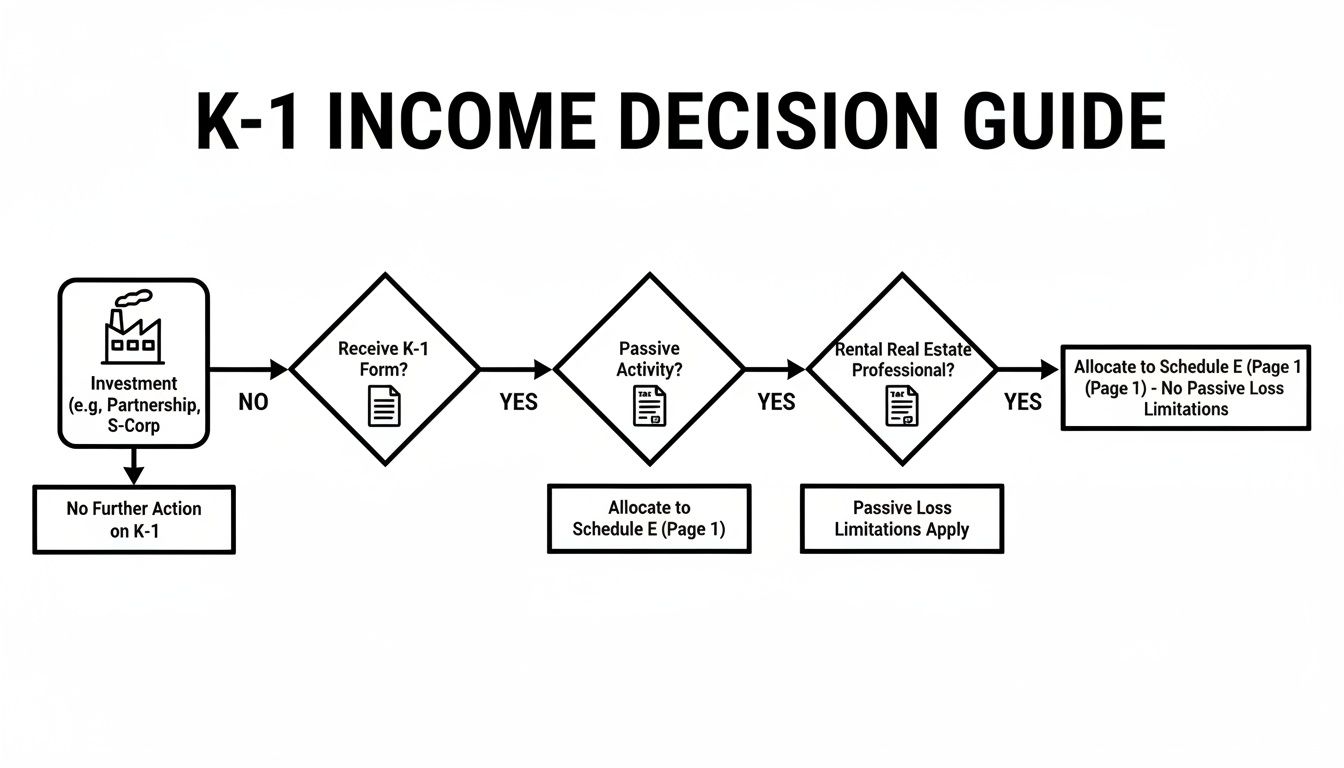
As you can see, there's a specific, structured path this type of income has to follow before it lands on your tax return.
The Special Allowance For Real Estate Investors
Now for the good news. The IRS knows most small-scale landlords aren't trying to run elaborate tax shelters. That's why they created a powerful exception to the PAL rules: the $25,000 Special Allowance.
This exception is a game-changer. It allows you to deduct up to $25,000 in rental real estate losses directly against your non-passive income, like your salary. To qualify for this valuable break, you have to meet one key requirement: active participation.
Don't let the term "active participation" intimidate you. It doesn't mean you have to be a full-time property manager. The bar is much lower. It just means you're involved in making significant management decisions.
You most likely meet the active participation test if you:
- Set rental terms and have the final say on new tenants.
- Make decisions about major repairs or approve capital improvements.
- Handle other management tasks yourself, even if you hire a property manager for the day-to-day stuff.
The $25,000 allowance is a lifeline for many middle-income landlords. It transforms a paper loss into a real, tangible tax deduction that can significantly lower your overall tax bill for the year.
This allowance isn't for everyone, though. It comes with an income limit. The ability to claim this $25,000 deduction starts to phase out once your modified adjusted gross income (MAGI) tops $100,000. By the time your MAGI hits $150,000, the allowance is gone completely. The phase-out works like this: for every $2 your income is over the $100,000 threshold, your potential deduction is reduced by $1.
This table summarizes the key rules for this important exception.
Passive Activity Loss Limitations for Rental Real Estate
| Rule/Allowance | Eligibility Requirement | Deduction Limit | Income Phase-Out Range (MAGI) |
|---|---|---|---|
| Special Allowance | Must "Actively Participate" in the rental activity. | Up to $25,000 of losses against non-passive income. | Begins at $100,000 and fully phases out at $150,000. |
| Suspended Losses | Incurred when losses exceed passive income and special allowance. | No limit; carried forward indefinitely. | Not applicable. |
Understanding these thresholds is crucial for maximizing your deductions each year.
Understanding Suspended Losses
So what happens to the losses you can't deduct because of the PAL rules or those income limitations? They don't just disappear. They go into a "suspended loss" account, patiently waiting for their turn to be used.
These suspended losses are carried forward indefinitely. You can tap into them in future years to offset any passive income you might have. For instance, if you have $10,000 in suspended losses and next year your rentals generate a $12,000 profit, you can use those old losses to make $10,000 of that new profit completely tax-free.
The real payoff comes when you sell the property. In the year you sell, all of your accumulated suspended losses for that specific property are finally "freed up." You can then use them to offset any gain from the sale, and even other types of income if any losses remain. This is why meticulously tracking suspended losses on Form 8582 is absolutely critical. Our firm provides detailed guidance on how the passive activity loss rules can impact your long-term investment strategy.
Common Schedule E Mistakes That Trigger IRS Audits

Getting your Schedule E right is the surest way to a smooth tax season. Unfortunately, a handful of common slip-ups can act like a beacon, drawing unwanted attention from the IRS. Knowing what these tripwires are is the first step to bulletproofing your return and keeping auditors away.
One of the biggest mistakes we see is mixing up repairs and improvements. It seems simple, but the IRS sees them very differently. A repair, like fixing a leaky faucet, is a current-year expense you can deduct right away. A capital improvement—think a full kitchen remodel—is an investment in the property's future and must be depreciated over 27.5 years.
When you treat a big renovation like a simple repair, you're massively inflating your current-year expenses and artificially tanking your taxable income. That’s a huge red flag for the IRS, and getting it wrong can lead straight to an audit, back taxes, and penalties.
Failing to Claim Depreciation
This one feels backward, but not taking a deduction you're entitled to can be a colossal error. Depreciation is arguably the most powerful tool a real estate investor has, letting you write off the cost of your building over time without spending a dime. Skipping it is one of the worst mistakes you can make.
Here’s why: The IRS views depreciation as an "allowed or allowable" deduction. That means they treat you as if you took the deduction, even if you didn't. When you eventually sell the property, you'll be on the hook for "depreciation recapture" taxes on the amount you should have claimed all along.
In short, failing to claim depreciation means you get none of the tax-saving benefits during your ownership years, but you still get stuck with the tax bill for it when you sell. It’s truly the worst of both worlds.
Fixing this later involves filing amended returns, which can be a real headache. It's much, much easier to just get it right from the start.
Ignoring Suspended Passive Loss Rules
The passive activity loss (PAL) rules are notoriously tricky, and getting them wrong is another common way to get on the IRS's radar. As we covered earlier, if your passive losses exceed your passive income, the excess is "suspended" and carried forward to future years.
A surprisingly frequent error is simply forgetting about these suspended losses. They don't just disappear; they're a valuable asset you can use to offset future passive income or gains from the property's sale. Forgetting to track and carry them forward on Form 8582 is like leaving a pile of money on the table for the IRS to sweep up.
Other Major Red Flags
Beyond those big three, a few other issues can put your Schedule E directly under the microscope. Staying mindful of these can help you file a much more defensible tax return.
Here are some of the top audit triggers we see time and again:
- Reporting Large Losses Year After Year: While rental properties often show a paper loss (thanks to depreciation), consistently reporting huge losses might signal to the IRS that your property isn't a for-profit business or that your expenses are inflated.
- Unusually High Expenses: If your expenses look way out of line with your rental income, it's going to raise questions. Claiming repair costs that equal 50% or more of your annual rent, for example, will almost certainly get a second look unless you have ironclad proof of a major issue.
- Rounding Numbers: Filing a return with nice, round numbers—like $5,000 for repairs or $1,000 for supplies—screams "estimate." It looks like you're guessing, not reporting actual costs. Always use the exact figures from your receipts.
- Poor Record-Keeping: At the end of the day, your best defense against an audit is a bulletproof set of records. If you can’t produce receipts, bank statements, and mileage logs to back up every single number on your Schedule E, you will lose those deductions if questioned.
By sidestepping these common pitfalls and keeping meticulous records, you can file your Schedule E with the confidence that you've done everything by the book.
When It's Time to Call in a Tax Pro
Sure, DIY tax software is great for simple W-2 returns. But once you've got a Schedule E in the mix, you're playing a different ballgame. Knowing when to hand the ball to a professional isn't giving up; it’s a smart, strategic play to protect your assets and make your investments work harder for you.
So, what's the tipping point? If you find yourself juggling multiple rental properties, trying to qualify for that coveted Real Estate Professional Status, or staring at a complex K-1 form from a partnership, you’re probably there. The sale of a rental is another big one—navigating depreciation recapture is notoriously tricky and a costly mistake to make on your own.
A good tax advisor does so much more than just plug numbers into a form.
More Than Just Filling Out Forms
They're looking ahead, helping you plan your next move to maximize deductions and keep you on the right side of the IRS's more confusing rules. For any serious investor, that kind of forward-looking strategy is essential.
An experienced tax professional can often save you far more than their fee by identifying missed opportunities and preventing costly errors, turning tax compliance into a valuable part of your investment strategy.
Think about it. Understanding the finer points of depreciation or figuring out how to properly handle suspended passive losses isn't something you can learn from a software prompt. This is where real expertise makes a difference. For many investors, using outsourced accounting services for small business can also be a game-changer, keeping your books clean and giving you a clear financial picture year-round.
At the end of the day, working with an expert is about making sure your financial house is built on a solid foundation. If you're ready to find the right partner, our guide on choosing the best tax advisors near you is a great place to start.
Frequently Asked Questions About Schedule E
Diving into Schedule E for the first time? You're not alone. Landlords and investors often run into the same handful of tricky questions. Let's clear up some of the most common ones.
Can I Deduct My Mortgage Principal on Schedule E?
This is a big one, and the answer is a firm no. You can't deduct payments you make toward your mortgage principal. Think of it this way: paying down your loan isn't an expense—it's you building equity and ownership in your asset. It’s more of a wealth-building move than a day-to-day operating cost.
What you absolutely can deduct is the mortgage interest. This is often one of the largest write-offs for a rental property owner and gets reported on line 12. The same goes for property taxes; those are fully deductible, too.
What Happens If I Sell My Rental Property?
When it’s time to sell, you won't report the sale on Schedule E. That form is for your annual rental income and expenses. Instead, the sale of a business asset like a rental property is handled on Form 4797 and then flows over to Schedule D (Capital Gains and Losses).
Be ready for something called "depreciation recapture." The IRS essentially wants you to pay tax on all the depreciation deductions you took over the years you owned the property. This recaptured amount is typically taxed at a maximum rate of 25%, so it can create a substantial tax bill. Seriously, this is one area where planning ahead with a professional can save you a world of financial pain.
Forgetting about depreciation recapture is a classic mistake. It can turn what looks like a profitable sale into a nasty surprise come tax time, taking a huge bite out of your proceeds.
Do I Need Schedule E for Renting a Room in My Home?
Absolutely. If you're renting out a room in the house you live in, the income you receive is rental income, and its proper home is on Schedule E.
But here’s the good news: you also get to deduct a portion of your household expenses to offset that income. You'll just have to do a little math. The most common way is to calculate the percentage of your home's total square footage that the rented room occupies.
For example, if the room is 15% of your home's square footage, you can generally deduct 15% of shared costs, such as:
- Mortgage interest
- Property taxes
- Homeowners insurance
- Utilities (electricity, water, gas)
- General repairs that benefit the entire house
This makes sure you're only paying tax on your actual profit, not the gross rent you collect.
From navigating the fine points of depreciation to understanding how passive loss rules impact your bottom line, Schedule E demands attention to detail. At Allied Tax Advisors, we live and breathe this stuff. Our team specializes in helping real estate investors find every legitimate deduction and stay compliant. Let us help you turn tax time into a strategic advantage. To learn more or schedule a consultation, visit us at https://alliedtax.com.