
When you run payroll, you’re not just paying your team; you're also handling money that belongs to other entities. These funds, known as payroll liabilities, are the amounts your business owes but hasn't yet paid out. This includes things like withheld taxes and benefit contributions.
It's critical to understand that this money is not yours to spend. Your business is just holding it temporarily before sending it on to the right government agencies and service providers.
Understanding the Core Concept of Payroll Liabilities
Think of your business as a temporary safe-keeper. You collect money from your employees' gross paychecks, add your own employer contributions to the pot, and then you're responsible for delivering those funds to their final destinations—the IRS, state tax agencies, retirement plan administrators, and insurance companies.
The time between when you collect this money and when you pay it is what creates the "liability." On your balance sheet, you'll see these listed as current liabilities, since they're short-term debts you need to clear quickly, usually within the same month or quarter. Getting this right isn't just good accounting; it's a legal must. Mishandling these funds can bring on some serious penalties.
The Role of Your Business
Your job in this process boils down to two key functions: collecting the funds and remitting them. This dual role ensures all the moving parts of payroll compliance are handled correctly.
Your main responsibilities include:
- Accurate Calculation: Nailing down the exact amounts to withhold from employee pay and calculating what your business owes as an employer.
- Secure Segregation: Keeping these funds separate from your company's operating cash. This prevents you from accidentally spending money that isn't yours.
- Timely Remittance: Making sure every dollar gets to the right agency or provider by the legal deadline.
At its heart, a payroll liability is a promise. It’s a promise to your employees that their tax and benefit contributions will be handled correctly, and a promise to the government that you will fulfill your tax obligations as an employer.
To really get a handle on this, it helps to look at how these systems are structured. For instance, the UK's PAYE (Pay As You Earn) system is a great example of how governments build frameworks for collecting taxes directly from wages. Reading up on What Is PAYE for Employers? can offer a clearer picture.
Likewise, digging into the specifics of payroll withholding is the foundation for managing these liabilities effectively in the U.S.
Breaking Down the Four Main Types of Payroll Liabilities
Payroll liabilities aren't just one big debt you owe. It’s better to think of them as a collection of separate obligations to different groups of people and agencies. Getting a handle on what goes where is the first, most crucial step in managing payroll correctly.
Think of your business as a central sorting station. When you run payroll, you're taking an employee's gross pay and carefully sorting those funds into different bins—some for the government, some for benefit providers, and what's left for the employee. Your job is to make sure every dollar ends up in the right bin and gets delivered on time.
This diagram really clarifies your role in the process, showing how your business sits in the middle, collecting and distributing funds.
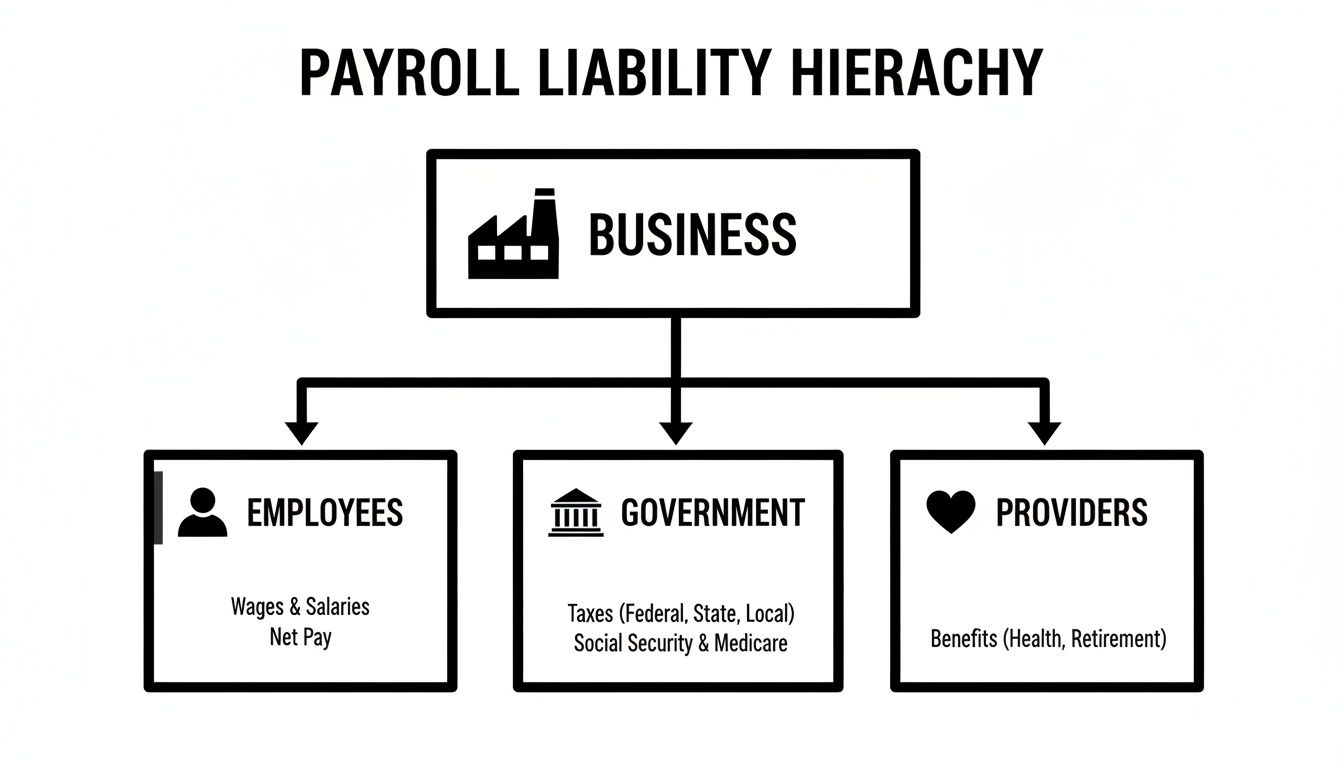
As you can see, you're at the center of these financial flows. That’s a big responsibility, and managing it accurately is key to keeping everyone happy and staying compliant. Let's break down the four main types of liabilities you'll be dealing with.
Employee Tax Withholdings
First up are the taxes you withhold from your employees' paychecks. The moment you run payroll, the government essentially deputizes you to act as its tax collector. You’re required by law to pull out specific amounts for taxes and hang onto that money until it’s time to send it to the right tax agencies.
It’s important to remember this money isn't a business expense for you. You're simply a pass-through, holding your employee's money in trust for the government.
The most common withholdings include:
- Federal Income Tax: The amount you withhold here is determined by the employee's Form W-4.
- State and Local Income Taxes: These work much like federal taxes but vary quite a bit depending on where your business operates and where your employees live.
- FICA Taxes (The Employee's Half): This is a federal tax that funds Social Security and Medicare. You’ll withhold 6.2% for Social Security and 1.45% for Medicare, for a total of 7.65% from each employee's wages.
Employer Payroll Taxes
This next category is completely different because this money comes directly from your company’s bank account. These are your taxes as an employer, and they represent a true cost of having employees on your payroll. They are calculated based on your employees' wages but are not taken from their pay.
This distinction is absolutely critical: employee withholdings are funds you hold for someone else, while employer taxes are a direct operating expense. Confusing the two can cause major accounting headaches and serious cash flow problems.
Here are the main employer payroll taxes you'll pay:
- FICA Taxes (The Employer's Half): That's right—you have to match what your employees contribute. That means you also pay 6.2% for Social Security and 1.45% for Medicare for each employee.
- Federal Unemployment Tax (FUTA): This federal tax helps fund state workforce agencies.
- State Unemployment Tax (SUTA): This state-level tax is what funds the unemployment benefits for workers who have lost their jobs.
If you want to get into the nitty-gritty of the calculations, our guide on how to calculate payroll taxes is a great resource.
Employee Benefits Withholdings
Beyond taxes, you’ll likely find yourself withholding money for various employee benefits. Once again, you’re playing the role of the middleman, collecting funds from your employees to pass along to insurance companies, retirement plan administrators, or other providers.
These often include things like:
- The employee's share of health, dental, or vision insurance premiums.
- Contributions to retirement plans, like a 401(k) or 403(b).
- Premiums for other benefits like life insurance or long-term disability.
Wage Garnishments
Finally, you might receive a legal order requiring you to withhold a portion of an employee’s wages to pay off a debt they owe. These are court-ordered, so they must be handled with extreme care, precision, and confidentiality.
Common examples include garnishments for child support, back taxes, or unpaid loans. You'll receive a legal document that spells out exactly how much to withhold per pay period and where to send the money.
Getting any of this wrong can be costly. Businesses that fail to remit these liabilities accurately and on time can face stiff penalties and damage to their reputation. This is precisely why 61% of businesses say legal and regulatory compliance is their single biggest payroll challenge.
How to Record Payroll Liabilities in Your Books
Knowing what payroll liabilities are is one thing, but getting them into your company’s accounting records correctly is where the real work begins. This isn't just a bookkeeping chore; it's how you ensure your financial statements, especially your balance sheet, give you a true picture of what your business owes at any given time.
When you run payroll, you’re creating both an expense for the company and a liability. Think of them as two sides of the same coin. Using double-entry bookkeeping to capture both sides accurately is absolutely essential for maintaining a clear and honest financial picture.

The Two-Step Journal Entry Process
Think of recording payroll like a two-part story. Part one happens the moment you process payroll. Part two happens when you actually pay the tax agencies and other parties what you owe. Each of these moments needs its own journal entry to keep your books perfectly balanced.
This whole process hinges on debits and credits. A simple way to keep it straight is that debits increase expense and asset accounts, while credits increase liability and equity accounts. Let's walk through how this works with a real-world example.
Example: The First Journal Entry When You Run Payroll
Let's say you're processing payroll for one employee with a gross pay of $2,000. This single event triggers a handful of financial movements that need to be recorded right away.
First up, you record the costs to your company. The employee’s total earnings and your share of payroll taxes are recorded as expenses, which means you’ll debit those accounts.
- Salary Expense: This is the employee’s full $2,000 gross pay, before a single deduction is taken out.
- Payroll Tax Expense: This is what your company owes for its share of FICA and unemployment taxes.
At the exact same time, you're creating liabilities—the money you now owe to the employee and various government agencies. These are recorded as credits because they increase your liability accounts.
- Wages Payable: The employee’s net (take-home) pay after all deductions.
- Federal Income Tax Payable: The income tax you withheld from their check.
- FICA Tax Payable: This is a big one—it includes both the employee's withheld portion and your matching employer portion.
- SUTA Tax Payable: Your state unemployment tax obligation.
To put it all together, we can use a table to show how these journal entries work in practice.
Sample Payroll Journal Entries Explained
The table below provides a simplified look at the two-part process: first, recording the payroll expense and all related liabilities, and second, clearing those liabilities when you make the payments.
| Transaction | Account | Debit ($) | Credit ($) |
|---|---|---|---|
| Record Payroll | Salary Expense | 2,000.00 | |
| Payroll Tax Expense | 170.00 | ||
| Wages Payable | 1,657.00 | ||
| Federal Tax Payable | 200.00 | ||
| FICA Tax Payable | 306.00 | ||
| SUTA Tax Payable | 7.00 |
Notice how it all balances? Your total expenses ($2,170) perfectly match your total liabilities ($2,170). This is the foundation of sound accounting.
Example: The Second Journal Entry When You Pay the Liabilities
But the story isn’t finished. You still have that money sitting in your bank account, waiting to be sent out. When you pay your employee and remit the taxes to the government, you need a second set of journal entries to "zero out" those liabilities.
This entry is much simpler. You will debit the liability accounts (to show you're decreasing what you owe) and credit your cash account (to show the money has left your bank).
This second entry is crucial. It closes the loop, officially clearing the debt from your books and demonstrating that you have fulfilled your obligations as an employer.
Here’s what those payment entries look like, continuing our example:
| Transaction | Account | Debit ($) | Credit ($) |
|---|---|---|---|
| Pay Employee | Wages Payable | 1,657.00 | |
| Cash | 1,657.00 | ||
| Remit Taxes | Federal Tax Payable | 200.00 | |
| FICA Tax Payable | 306.00 | ||
| SUTA Tax Payable | 7.00 | ||
| Cash | 513.00 |
After these final entries, your "Payable" accounts all return to zero. Your books now accurately show that everyone—from your employee to the IRS—has been paid.
Staying Ahead of Compliance Deadlines and Penalties
Knowing what you owe is one thing, but knowing exactly when you owe it is what keeps you out of hot water. Payroll liabilities aren't just an accounting entry; they come with strict payment schedules set by government agencies. Think of these deadlines less as friendly suggestions and more as non-negotiable legal requirements. Miss them, and you’ll find yourself dealing with a whole host of problems that are much more expensive and stressful than simply paying on time.
For federal taxes, most businesses fall into either a monthly or semi-weekly deposit schedule. The one you use depends on how much tax you reported during a "lookback period." On top of that, every state has its own set of rules and deadlines, which can really complicate things. The first rule of sound payroll management is treating these dates as immovable.
The High Cost of Falling Behind
The government doesn't take kindly to late payments, and the penalties can pile up frighteningly fast. The IRS, for instance, has a Failure to Deposit Penalty that starts small but grows quickly. It's 2% for payments that are 1-5 days late, but that escalates to 10% once you're more than 15 days behind. If they have to send you a notice demanding payment, it jumps to 15%.
And that’s just the start. They’ll also tack on interest charges for the entire unpaid balance. In situations where the failure to pay is deemed intentional, you could even be looking at criminal charges. What might begin as a small cash flow hiccup can easily spiral into a major financial crisis that puts your entire business at risk.
This isn’t just a U.S. problem. A study by PwC highlights that payroll regulations are changing faster than ever, with compliance getting more and more scrutiny worldwide. In fact, the United States is ranked among the top 10 most challenging countries for getting employee payments right. You can dive deeper into PwC's global payroll research to see the full picture.
Key Deadlines to Watch
While your specific tax deposit schedule is unique to your business, there are a few key federal forms and deadlines that are universal for most employers. Keeping these on your radar is absolutely critical.
- Form 941 (Employer's Quarterly Federal Tax Return): This is where you report the income, Social Security, and Medicare taxes you withheld, plus your own employer share. It’s due by the last day of the month following the end of each quarter.
- Form 940 (Employer's Annual Federal Unemployment Tax Return): This form reports your annual FUTA tax liability. It’s always due by January 31st of the next year.
Remember, meeting deadlines isn't just about cutting a check. It’s about maintaining trust—with your employees, who count on you to handle their withholdings correctly, and with the government. Staying on top of every penny and every due date reinforces your reputation as a reliable employer. Meticulous tracking isn’t just good practice; it's your best defense against a world of financial and legal trouble.
Best Practices for Managing Payroll Liabilities
When it comes to handling payroll liabilities, the secret isn't some complex financial trick. It's all about having solid, repeatable systems and paying attention to the details. Let's walk through some proven practices that will help you build a compliant, stress-free payroll process and protect your business from expensive mistakes.

Start With Accurate Data Collection
The old saying "garbage in, garbage out" has never been more true than in payroll. The accuracy of your entire system depends entirely on the quality of information you collect from your employees right from the start. This means getting Form W-4 filled out correctly by every new hire and making sure your time-tracking methods are precise and used by everyone, every time.
In fact, poor data inputs are the number one cause of payroll mistakes, with sloppy time-tracking coming in a close second. What’s truly alarming is that 38% of companies don't even measure how well their payroll process is working, which makes spotting and fixing these problems almost impossible.
Embrace Technology and Automation
Trying to calculate payroll taxes and all the various withholdings by hand is a recipe for disaster. It’s not just slow and tedious; it leaves the door wide open for human error. A single misplaced decimal point can snowball into a major compliance headache down the line.
This is exactly where technology can save the day. To sidestep these complex tasks and lock in accuracy, many businesses rely on dedicated tools. A great first step is to review the best payroll software for small business options available today. These platforms automate all the tricky calculations, keep you on track with payment schedules, and generate the reports you need, dramatically cutting your risk.
A dedicated payroll bank account acts as a financial firewall. It protects liability funds from being used for operating expenses, ensuring the money is always there when tax deadlines arrive.
Maintain a Separate Payroll Bank Account
One of the simplest yet most effective habits you can build is keeping a separate bank account just for payroll. Each pay period, transfer the total amount needed—that’s net pay plus all the liabilities—into this dedicated account.
This one small step achieves two huge goals:
- Prevents Commingling Funds: It puts a wall between your payroll money and your general operating cash. This removes the temptation to "borrow" from funds that are already earmarked for the government or your employees.
- Simplifies Reconciliation: It makes tracking payroll expenses and balancing your books incredibly straightforward, so you know exactly where every dollar went.
Putting these strategies into place can turn payroll from a source of constant anxiety into a smooth, well-oiled part of your business. For a deeper dive, check out our complete guide on how to do small business payroll.
Common Payroll Liability Questions Answered
Let’s wrap up by tackling a few of the most common questions we hear from business owners about payroll liabilities. Think of this as a quick-reference guide to clear up any lingering confusion and help you handle these situations with confidence.
Are Accrued Wages Considered a Payroll Liability?
Yes, absolutely. Accrued wages are simply the earnings your employees have racked up but haven't been paid for yet. A perfect example is the time worked between the end of a pay period and the day you actually issue checks.
Because you owe that money to your team, it sits on your balance sheet as a current liability until payday. Recording this accurately is critical for getting a true picture of your finances, especially when you're closing out an accounting period.
What Is the Difference Between Payroll Liabilities and Payroll Expenses?
This is a fantastic question, and getting the distinction right is key. A payroll expense is the total cost of employing someone. It’s what shows up on your income statement and includes not just their gross pay but also your share of payroll taxes.
In short, the expense is the total cost of an employee for a period, while the liability is the portion of that cost you owe to someone else (the government, a benefits provider, etc.) at a specific point in time.
For instance, if you pay an employee a $1,000 salary, that full amount is an expense. The $76.50 in FICA taxes you withheld from their check, however, is a liability you hold until you send it to the IRS.
How Long Do I Need to Keep Payroll Records?
Federal rules are pretty specific here, and it's better to be safe than sorry. The Fair Labor Standards Act (FLSA) says you need to hang on to basic records for at least three years.
But the IRS has its own rule: keep all employment tax records for at least four years after the date the taxes were due or paid, whichever is later. Because the IRS rule is stricter, the gold standard is to keep everything filed away for a minimum of four years.
Managing every detail of payroll liabilities, from nailing the journal entries to making timely payments, isn't just good practice—it's essential for a healthy business. At Allied Tax Advisors, we specialize in turning these complex payroll and accounting challenges into simple, straightforward solutions. Let us worry about the compliance details so you can get back to what you do best: growing your company.