
Ever glanced at your paystub, seen the letters 'FIT' next to a deduction, and scratched your head? You're definitely not the only one. Those three little letters simply stand for Federal Income Tax.
Think of it as the government's "pay-as-you-go" plan for your annual taxes. Instead of you having to save up all year and pay one giant, daunting bill to the IRS in April, your employer withholds a portion of your earnings from each paycheck and sends it in on your behalf.
Decoding Your Paystub: What FIT Really Means

So, what’s really happening behind the scenes? When you started your job, you filled out a Form W-4. The information you provided there—like your filing status (single, married, etc.), number of dependents, and any other adjustments—is exactly what your employer uses to calculate how much FIT to withhold.
This system is designed to make life easier for both you and the government. It helps the government maintain a steady, predictable stream of revenue to fund public services. For you, it breaks down your total tax obligation into manageable, bite-sized pieces, preventing a major financial shock during tax season.
Essentially, every time you get paid, your employer acts as the middleman, calculating the tax and sending it directly to the IRS for you. This process is a core part of how the U.S. tax system functions. To dig deeper into how this looks on paper, you can find a detailed breakdown of paystub deductions and see more examples in action.
Key Takeaway: FIT isn't an optional saving or a company fee. It is your estimated federal income tax being paid in installments with every paycheck you receive.
While FIT reduces your immediate take-home pay, understanding it is the first real step toward mastering your personal finances and seeing how your earnings connect to the bigger picture.
Common Paystub Deductions at a Glance
FIT is the headliner, but it's usually not the only deduction you'll see. Your paystub is full of abbreviations for various taxes and benefits. Here’s a quick reference table to help you decipher some of the other common codes you might find.
| Abbreviation | Full Name | What It Is |
|---|---|---|
| SIT | State Income Tax | Similar to FIT, but this is the tax withheld for the state you work in. Not all states have an income tax. |
| FICA | Federal Insurance Contributions Act | A mandatory payroll tax that funds Social Security and Medicare. You might see it split into two line items. |
| OASDI | Old-Age, Survivors, and Disability Insurance | The Social Security portion of FICA. There's an annual income limit on how much you contribute. |
| HI | Hospital Insurance | The Medicare portion of FICA. There is no income limit for this tax. |
| 401(k) | (Named after a section of the tax code) | A pre-tax contribution to your company-sponsored retirement savings plan. |
| Med | Medical Insurance | Your contribution toward your health insurance premium, typically deducted pre-tax. |
This table isn't exhaustive, as you might also have deductions for dental, vision, life insurance, or a Health Savings Account (HSA). Getting familiar with these terms will give you a much clearer understanding of where your money is going each pay period.
How Your FIT Withholding Is Calculated
Ever look at your paystub and wonder how your employer lands on that exact dollar amount for your Federal Income Tax (FIT)? It’s not just a guess. That number is calculated directly from the personal financial information you provided on your Form W-4 when you first started your job.
Think of your Form W-4 as a set of instructions you give your employer. It’s the blueprint they use to figure out precisely how much to set aside for taxes from each paycheck.
This visual below gives you a glimpse into how your W-4 inputs kickstart the whole tax calculation process.
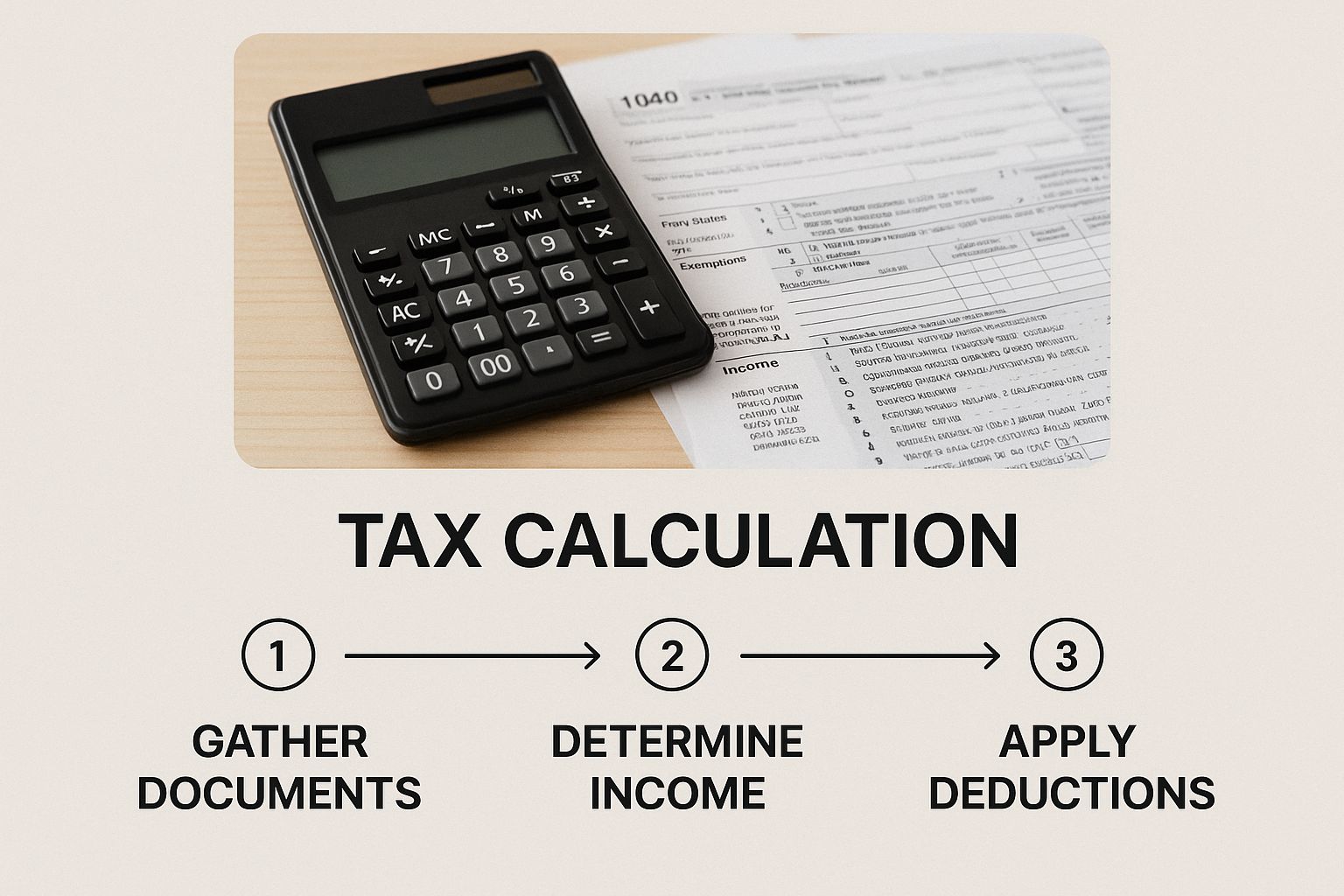
As you can see, the process relies on official tools and forms. Your W-4 is the key that gets this entire engine running.
The Key Ingredients in Your FIT Calculation
So, what exactly from that form goes into the calculation? A few key pieces of information do most of the heavy lifting, each playing a critical role in determining what's withheld from your gross pay.
The most important factors are:
- Filing Status: This is a big one. Whether you file as Single, Married Filing Jointly, or Head of Household dramatically changes your tax bracket and the standard deduction you get.
- Dependents Claimed: Each qualifying child or other dependent you claim gives you a tax credit. This isn't just a deduction from your income; it’s a dollar-for-dollar reduction in the tax you actually owe.
- Other Adjustments: The W-4 also lets you account for other income (like from a side hustle) or claim specific deductions, such as for student loan interest. This helps fine-tune the withholding for better accuracy.
- Extra Withholding: You can also choose to have an additional flat-dollar amount taken out of each paycheck. This is a great strategy if you have other income sources and want to avoid a surprise tax bill.
Your employer takes all this information and plugs it into the official IRS withholding tables for the current year. These tables are essentially a giant lookup chart that matches your income, pay frequency, and W-4 details to a specific tax amount.
This whole system is a fundamental part of running payroll. For business owners wanting a look behind the curtain, you can learn more about how to do payroll for small business and see the software that handles these calculations.
At the end of the day, the goal is simple: the more accurate your W-4 is, the closer your total withholding will be to your actual tax bill at the end of the year.
How Your Taxable Wages Are Calculated for FIT

Ever look at your paystub and notice your 'taxable wages' are less than your total 'gross pay'? Don't worry, it's not a mistake. In fact, it’s a good thing, and it all comes down to something called pre-tax deductions.
Think of your gross pay as the total amount you earned before anything is taken out. But before the IRS calculates your FIT, you get to subtract the cost of certain approved benefits. This lowers your official income in the eyes of the government, which in turn lowers your tax bill.
The Power of Pre-Tax Deductions
These deductions are one of the best ways to legally and strategically lower the amount of tax you pay right now. By reducing your taxable income, the amount of Federal Income Tax withheld from each check is calculated on a smaller number. The result? You get to keep more of your hard-earned money.
So, what kind of deductions are we talking about? The most common ones that lower your FIT taxable wages include:
- Health Insurance Premiums: Your share of the cost for medical, dental, or vision coverage.
- 401(k) or 403(b) Contributions: Money you’re setting aside for retirement through your job.
- Health Savings Account (HSA) Funds: Contributions to a special savings account for medical expenses.
- Flexible Spending Account (FSA) Funds: Money you earmark for healthcare or dependent care needs.
The concept is simple but incredibly effective: when you pay for these benefits with pre-tax dollars, you shrink the amount of your income that can be taxed. A smaller target for the IRS means a smaller tax bill for you.
Let’s put it into practice. Say your gross pay for the month is $4,000. If you contribute $500 toward your 401(k) and health insurance, your FIT taxable wages drop to $3,500. Your employer then uses that lower $3,500 figure to figure out how much federal income tax to withhold. You can find more detail on how taxable wages are determined on ThePayStubs.com.
Getting a handle on this is key to understanding your paycheck. It shows that signing up for your company’s benefits does more than just give you insurance or a retirement nest egg—it actively helps you manage and reduce what you owe in taxes today.
The Bigger Picture: Where Your FIT Dollars Go

It can be a little jarring to see a chunk of your hard-earned money go missing from your paycheck, especially under that "FIT" line. It's easy to feel like it just vanished, but those dollars don't disappear into a black hole. They are the financial engine that keeps the country running.
Think of it this way: your FIT contribution is your share in maintaining the society we all live in. It’s the federal government’s primary source of revenue, and it’s what pays for the services and infrastructure that shape our daily lives.
What Your Federal Income Tax Actually Funds
In 2023, federal income tax revenue hit about $1.9 trillion. That’s a staggering number, making up nearly half of all federal income. That money is put to work in countless ways that you might not even think about. If you're curious about the mechanics of federal taxes, you can get more details on how federal income tax functions on BambooHR.com.
So where does it all go? Your FIT dollars are spread across a huge range of essential public services.
- National Defense: This covers everything from funding for the military and its operations to veterans' benefits.
- Infrastructure: Think of the roads, bridges, and airports you use. This also includes maintaining our beautiful national parks.
- Health Programs: Major initiatives like Medicare and Medicaid, plus critical public health research, are funded by these taxes.
- Social Programs: This is where funding for Social Security, unemployment benefits, and food assistance programs comes from.
- Education and Research: Your taxes support federal student aid, grants for schools, and a wide array of scientific research.
Key Insight: Try to view your FIT contribution not as a loss, but as an investment in shared public resources. It's the reason the roads are paved and why you can visit a national park.
This context helps reframe what FIT on your paystub really means. It's more than just a deduction; it’s your contribution to the country's stability and public well-being. Of course, federal tax is only one piece of the puzzle. State taxes also play a significant role, which you can see in our guide to the 2024 California tax brackets.
When and How to Adjust Your FIT Withholding
Life changes, and your tax withholding should change right along with it. The numbers you put on your Form W-4 when you first started your job aren't meant to be permanent. It’s best to think of your FIT withholding as a dial you can turn up or down to match what's happening in your financial life.
Major life events are the most common reason to revisit that form. If something big happens, your total tax bill for the year is likely to change. Forgetting to update your W-4 can lead to a nasty surprise at tax time—either you've paid way too much or, even worse, far too little.
Common Reasons to Update Your W-4
Think of these events as a bright, flashing sign telling you it's time to check your withholding. If any of these sound familiar, you'll want to hand a new Form W-4 to your employer to make sure your FIT calculation is still on track.
- Getting Married or Divorced: Your filing status is one of the biggest factors in how you're taxed. Changing from "Single" to "Married Filing Jointly," for instance, completely alters your tax bracket and standard deduction.
- Having or Adopting a Child: A new dependent often means new tax credits, like the Child Tax Credit. These credits directly lower the amount of tax you owe, so you can safely reduce your withholding and keep more money in each paycheck.
- Starting a Side Gig or Your Spouse Gets a Job: More income is great, but the IRS wants its cut. If you don't account for that extra money through withholding, you’re setting yourself up for a big, unexpected tax bill later.
- A Major Change in Non-Job Income: Did you sell some stock or a rental property? This kind of income isn't subject to automatic payroll withholding, so you have to manually adjust your W-4 to cover the taxes on it.
The Balancing Act: Think of your withholding like a scale. If you over-withhold, you’re essentially giving the government an interest-free loan all year, which they'll pay back as a large refund. If you under-withhold, you get more cash in each paycheck, but you risk owing a hefty sum—and possibly penalties—when you file your return.
How to Make Adjustments
The good news? Changing your withholding is surprisingly simple. Just ask your HR or payroll department for a new Form W-4 to fill out.
If your situation is a bit complicated—maybe you and your spouse both work, or you have that side hustle—the IRS has your back. They offer a free Tax Withholding Estimator tool on their website. It’s a fantastic resource that walks you through everything, helping you dial in your withholding with precision.
This kind of control is crucial, especially since federal and state tax rules can be very different. To get a better handle on how things work at the state level, you can check out our guide on how to navigate the California tax brackets. By staying on top of your W-4, you can make sure your paychecks work for you and avoid any unwelcome surprises come April.
Answering Your Top Questions About FIT
Even after you get the hang of what FIT is, a few questions almost always come up. Seeing money come out of your check can be confusing, so let's clear up some of the most common points of uncertainty.
Why Is My FIT Different From My Coworker’s?
This is a classic head-scratcher. You and the person at the next desk earn the exact same salary, yet your FIT deductions are worlds apart. What gives?
The answer nearly always lies in your individual Form W-4 settings. Every employee’s tax situation is unique.
Your coworker might be:
- Using a different filing status, like Married Filing Jointly instead of Single.
- Claiming dependents, which gives them access to tax credits you might not have.
- Requesting extra withholding to cover income from a side gig or a spouse’s job.
- Putting more pre-tax money into a 401(k) or HSA, which lowers their taxable income from the get-go.
Think of your W-4 as your personal financial fingerprint. That's why two identical salaries almost never lead to identical tax withholding.
Key Insight: Your FIT deduction is personalized. It’s a direct reflection of your life circumstances and the specific instructions you give your employer on your Form W-4—it's not just about your gross pay.
What's the Difference Between FIT and FICA?
It’s easy to lump all payroll taxes together, but FIT and FICA are two completely different things that fund separate government functions. Knowing the difference is crucial for making sense of your paystub.
- FIT (Federal Income Tax): This is the tax we've been talking about. It funds the U.S. government's general budget—everything from national parks to defense. The amount you pay is flexible, based on your income and W-4 choices.
- FICA (Federal Insurance Contributions Act): This is a fixed, flat-rate tax. It’s not for general spending; it’s your direct contribution to two major social insurance programs: Social Security and Medicare.
Simply put, FIT pays for running the country today, while FICA is an investment in your own future Social Security and Medicare benefits.
What Should I Do if I Think My FIT Is Wrong?
If you look at your paystub and the FIT deduction just feels wrong, don’t panic. There’s usually a simple explanation.
Your first move should be to grab your latest paystub and compare it to the information you put on your most recent Form W-4. More often than not, the problem is a simple data entry error or an outdated form.
If you spot a mistake, or if your financial situation has changed (you got married, had a child, etc.), just ask your HR or payroll team for a new W-4. Submitting an updated form is the official way to adjust your withholding and get things back on track.
Navigating the world of federal and state taxes can feel overwhelming. If you need an expert to help make sure your tax situation is set up correctly, the team at Allied Tax Advisors is here for you. We offer clear, personalized solutions for everything from individual tax planning to business payroll, putting you back in control of your finances. Find out more by visiting us at https://alliedtax.com.