
At its core, payroll is simply the entire system a company uses to pay its employees. But it's so much more than just a number on a paycheck. It involves calculating what each person has earned, carefully withholding the right amount for taxes and other deductions, and finally, getting their take-home pay to them.
Think of it as the financial heartbeat of your business. When it's running smoothly, everything else just works better.
What Payroll Actually Means for Your Business

It’s a common misconception for business owners to think payroll is just about cutting checks. The reality is far more complex. It's a highly regulated system designed to make sure your team is paid correctly, on time, and in full compliance with a web of government rules. Getting a solid grasp of what payroll really means is fundamental to your company's financial health and legal standing.
Let's try an analogy. If your business is an engine, revenue is the fuel, and your employees are the pistons and gears making it run. Payroll is the sophisticated system that not only distributes that fuel (pay) to the moving parts but also handles its own critical maintenance—managing taxes and ensuring you stay on the right side of the law.
This system breaks down into a few key jobs:
- Calculating gross pay: This is the starting point—the total amount an employee earns before anything is taken out.
- Handling withholdings: Next, you subtract all the required federal, state, and local taxes, along with any other deductions like health insurance or retirement contributions.
- Paying employer taxes: Your company also has its own tax obligations to manage, like your share of Social Security and unemployment taxes.
- Distributing net pay: This is the final step, making sure the correct, final amount lands in each employee's bank account.
Payroll isn't just another line item on your expense report. It's a core operational function that touches everything from employee morale and financial accuracy to your relationship with the IRS. Getting it right isn't just important—it's non-negotiable.
Ultimately, a well-oiled payroll system is a sign of a healthy, organized business. For those looking to get this process under control, the first step is understanding your options. You can explore professional payroll services to see how outsourcing might support your business.
Breaking Down The Four Parts of Every Paycheck
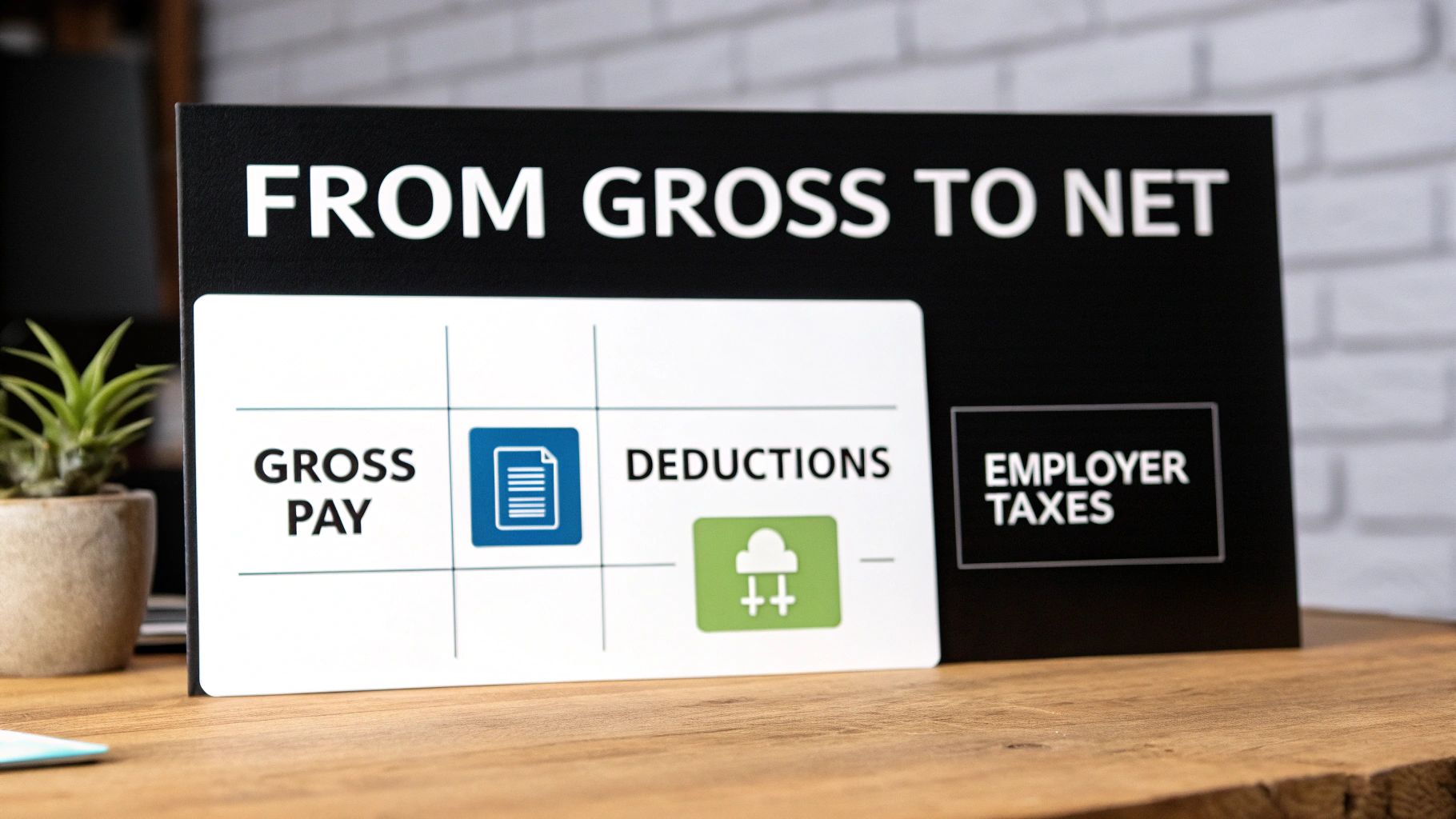
Every paycheck tells a story, walking you from what an employee earns to what they actually take home. Getting a handle on this process is the first real step to mastering payroll for your business. It's not as complicated as it looks, and it all boils down to four key parts that flow in a specific order.
Think of it like building with LEGOs. You start with a big pile of bricks (Gross Pay), set some aside for taxes and benefits (Deductions), grab a few extra bricks from your own stash for your employer share (Employer Taxes), and what's left is the final creation (Net Pay).
Gross Pay: The Starting Point
Gross pay is the big number—it's the full amount an employee earns before anything is taken out. For an hourly employee, you just multiply their rate by the hours they worked. For someone on salary, it's their annual salary broken down by how often you pay them.
This is your "top-line" figure, the total compensation an employee has earned for their time. It’s the number you agreed on when they were hired and the foundation for every other calculation that follows.
Deductions and Withholdings: What Comes Out
Next, you start subtracting. These subtractions, called deductions or withholdings, fall into two buckets: mandatory and voluntary.
- Mandatory Deductions: You have no choice here; these are required by law. This includes federal, state, and local income taxes, plus FICA taxes for Social Security and Medicare.
- Voluntary Deductions: These are the things your employee has opted into. Think health insurance premiums, contributions to a retirement plan like a 401(k), or life insurance payments.
The amount you withhold for federal income tax (FIT) depends on the information an employee gives you on their Form W-4. If you want a deeper dive into that specific piece, you can learn more about what FIT means on a paystub in our detailed guide.
Employer Taxes: The Hidden Costs
This is the part of payroll that trips up a lot of new business owners. Employer taxes are expenses you, the employer, pay on top of an employee's gross pay. These are not taken out of an employee's check; they are a direct cost to your business.
These taxes are your skin in the game. Forgetting to budget for them is a rookie mistake that can cause serious cash flow headaches and land you in hot water with the IRS.
Major employer taxes include matching your employees' FICA contributions (Social Security and Medicare) and paying federal and state unemployment taxes (FUTA and SUTA).
Net Pay: The Bottom Line
After all the math is done, you arrive at net pay. This is the famous "take-home pay"—the actual amount of money that lands in your employee's bank account.
This is the number your team cares about most. Getting it right every single time is non-negotiable for keeping your employees happy and your business compliant.
Here's a simple table to visualize how it all fits together.
From Gross Pay to Net Pay A Simple Breakdown
The journey from the total earned amount to the final deposit is a straightforward process of subtraction. This table shows how an employee's Gross Pay is reduced by various deductions to arrive at their Net Pay.
| Payroll Component | Description | Example Amount |
|---|---|---|
| Gross Pay | The total earnings before any deductions. | $1,000.00 |
| Federal Tax | Income tax withheld for the federal government. | -$75.00 |
| FICA Taxes | Social Security and Medicare withholdings. | -$76.50 |
| State Tax | Income tax withheld for the state government. | -$30.00 |
| Health Insurance | Employee's contribution to their health plan. | -$50.00 |
| Net Pay | The final take-home pay after all deductions. | $768.50 |
As you can see, the final amount is what’s left after the government and other benefit providers get their share.
Your Payroll Responsibilities vs. Your Employee's
When it comes to payroll, think of it as a partnership where you, the employer, are doing almost all of the heavy lifting. The legal and financial weight rests squarely on your shoulders.
It's a bit like being the captain of a ship. Your employee, the passenger, just needs to show up with their ticket and get on board. But you're the one responsible for navigating, running the engine room, and making sure the entire journey is safe, legal, and on schedule.
Your job as the "captain" is pretty extensive. You're legally on the hook for calculating gross pay, meticulously withholding the right amount of taxes, and sending those funds to the government on time. On top of that, you have to pay your own share of employer taxes, like FUTA and your half of FICA. Keeping detailed records isn't optional—it's a requirement that leads to critical year-end reporting, like issuing W-2 forms.
The Employee’s Simple but Crucial Role
So, what's the employee's part in all this? It's small but absolutely essential. Their main job is to correctly fill out their Form W-4, the Employee's Withholding Certificate.
This single form is their instruction manual to you, telling you exactly how much federal income tax to hold back from each paycheck. If they get it wrong, it can cause headaches for them down the line—either by not withholding enough (leading to a nasty surprise tax bill) or withholding too much (shrinking their take-home pay for no reason).
While you can point them to the form, you can't legally tell them how to fill it out. It's their responsibility, but its accuracy impacts your entire process.
Ultimately, the IRS and state tax agencies hold you, the business owner, responsible for any payroll mistakes. An employee's error on their W-4 doesn't get you off the hook for withholding and remitting taxes based on the information they provided.
A key piece of your employer duties involves understanding what a Business Number is and how it relates to payroll program accounts. This is especially critical for Canadian businesses, as it’s how tax authorities track your remittances. This division of labor—heavy for the employer, light for the employee—is the bedrock of staying compliant and avoiding some very expensive penalties.
Choosing the Right Pay Schedule for Your Business
Deciding how often to cut paychecks is one of the most important operational decisions you'll make. This isn't just an administrative task; it sets a financial rhythm for your company, affecting everything from your cash flow to your team's morale. Most businesses land on one of four common schedules: weekly, bi-weekly, semi-monthly, or monthly. Each has its own rhythm and its own set of pros and cons.
A weekly payroll is a staple in industries where hours can fluctuate wildly, like construction or hospitality. Getting paid every Friday is a huge plus for employees, but it means you're running payroll 52 times a year. That's a lot of administrative work.
The most popular option by far is a bi-weekly schedule (every two weeks). In fact, 36.5% of U.S. businesses pay their people this way. It strikes a great balance, giving you 26 pay periods per year. It also makes calculating overtime for hourly staff much cleaner since each pay period covers a consistent two-week work block.
This flow of responsibilities is a core part of what payroll is all about. It’s a two-way street between you and your team.
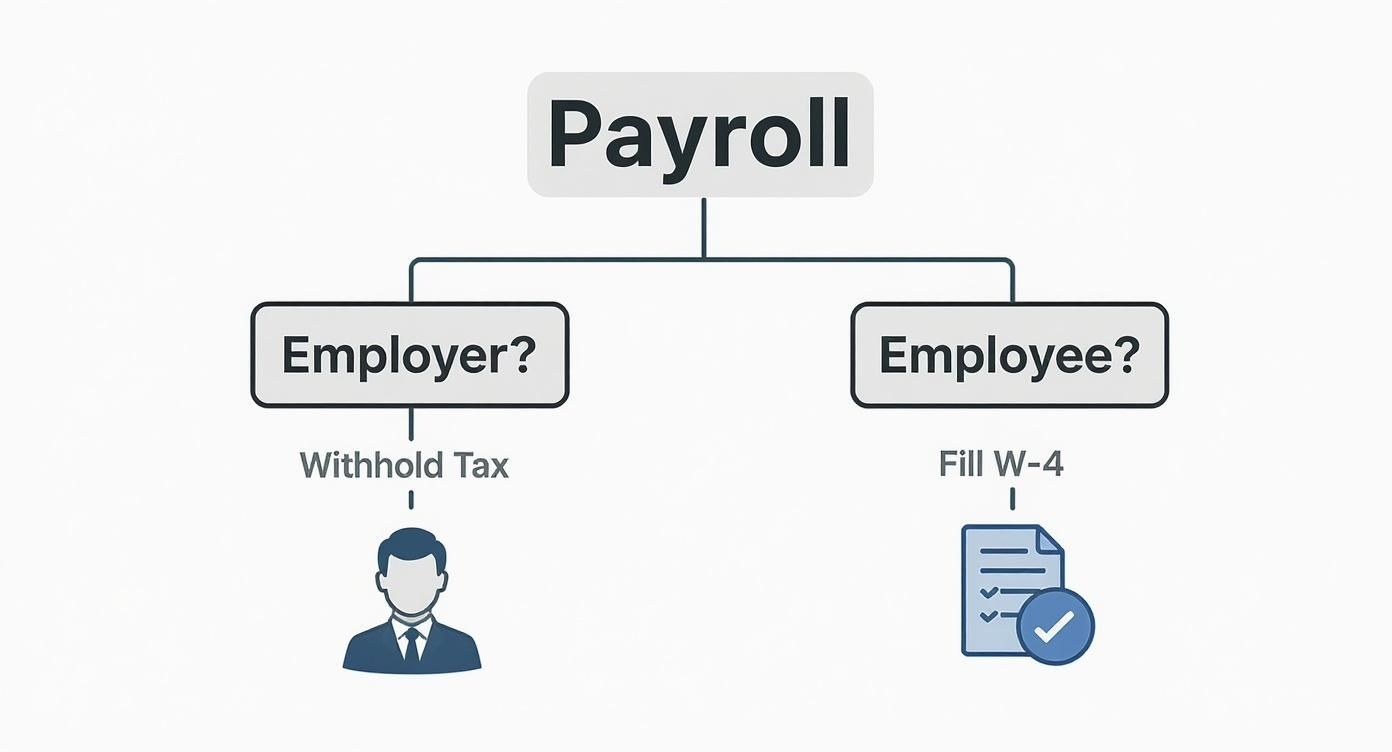
As you can see, you handle the complex side of things like withholding and remitting taxes, while your employees have a key role in providing accurate information upfront with their W-4.
Semi-Monthly vs. Monthly Schedules
A semi-monthly schedule is a little different. Instead of paying every two weeks, you pay on two specific dates each month, like the 15th and the 30th. This gives you a neat and tidy 24 pay periods a year, which can make your monthly accounting and budgeting feel much smoother. The hiccup? Paydays can land on a weekend or holiday, which requires adjustments. Overtime can also get tricky since the pay period dates don't always align perfectly with the standard workweek.
And then there's the monthly schedule. From an administrative standpoint, it’s the easiest path—just 12 payroll runs per year. This can be a major benefit for managing your cash flow. However, it can be a real financial strain for employees who have to make one paycheck stretch for a full month. Be careful here, as some states actually have laws that require you to pay employees more frequently, so a monthly schedule might not even be an option depending on where you operate.
Choosing the right pay frequency is a balancing act. You must weigh administrative efficiency, state compliance, your company's cash flow, and your employees' financial well-being to find the best fit for your business.
From Manual Ledgers to Automated Payroll Systems

To really get a handle on modern payroll, it helps to look at how far we've come. Not so long ago, payroll meant someone hunched over a paper ledger with a calculator and a stack of tax tables. It was a slow, agonizing process, and a single misplaced decimal could cause a world of headaches.
The move to computers was a massive turning point. When the first payroll software emerged late in the 20th century, it was a game-changer. Some big companies reported cutting their processing times by as much as 50%. You can find some fascinating details about this transition in ADP's global payroll survey.
But even that was just the beginning of the story.
The Rise of Modern Cloud-Based Payroll
Today's cloud-based systems are a whole different ballgame. So, what does payroll mean now? It means near-total automation that juggles complex calculations, files taxes on your behalf, and stays current with ever-changing compliance rules—all in the background.
These platforms can effortlessly handle payroll for a team scattered across different states, each with its own set of labor laws, without breaking a sweat.
This shift has transformed payroll from a back-office chore into a strategic business function. Relying on a modern, automated system is no longer a luxury—it's a necessity for accurate and efficient operations.
Modern solutions also talk to your other business tools, like accounting software, giving you a real-time picture of your labor costs. This makes financial planning so much easier. If you're weighing your options, our guide on payroll software for small business is a great place to start. Ultimately, this technology keeps you compliant and gives you back your most valuable resource: your time.
Deciding Your Payroll Strategy: DIY vs. Professional Help
Alright, you've got a handle on the moving parts of payroll. Now comes the big question: who’s going to run the machine? You really have two main options here—handling it yourself with software (the DIY approach) or handing it off to a professional service. Let's break down the trade-offs.
The DIY Payroll Path
Going the DIY route can look tempting, mostly because it seems cheaper upfront. Modern payroll software gives you a ton of control; you can see every number, tweak things on the fly, and feel like you're in the driver's seat.
But that control comes with a heavy dose of responsibility. You, and you alone, are on the hook for getting everything right. That means hitting every tax deadline, keeping up with constantly shifting regulations, and ensuring every single calculation is spot-on. One slip-up with withholdings or a late tax payment can bring on some painful IRS penalties.
Plus, you have to ask yourself: is spending hours buried in payroll paperwork the best use of your time? Probably not.
Weighing the Benefits of Outsourcing
The other path is to outsource your payroll to a company that lives and breathes this stuff. Yes, it costs more directly. There's no getting around that. But what you're buying is invaluable: peace of mind and your time back.
When you outsource payroll, you're not just buying a service; you're buying expertise and risk mitigation. This allows you to focus on core business activities instead of becoming a part-time tax expert.
These experts take care of all the headaches. They run the calculations, file your quarterly taxes, and stay on top of compliance for you. Many even offer guarantees, so if they make a mistake, they fix it.
Ultimately, this decision comes down to your company's size, the complexity of your payroll, and your own comfort level with financial rules. For a deeper dive, this guide on outsourcing finance and accounting can offer some great perspective. The best payroll strategy is the one that protects your business and lets you sleep at night.
Common Payroll Questions Answered
Even with a good handle on the basics, payroll can still feel a little murky when you get into the day-to-day details. Let's clear up a few of the questions that come up most often for business owners.
What’s the Difference Between Payroll and Salary?
Think of it this way: salary is what you pay, and payroll is how you pay it.
A salary is the fixed amount you agree to pay an employee over a year, say, $50,000. That number is just one component.
Payroll is the entire process. It’s the action of taking that $50,000 salary, breaking it down for the current pay period, calculating and subtracting all the necessary taxes, handling any other deductions, and finally, getting the correct net amount to your employee. Salary is an input; payroll is the whole operation.
Can I Just Run Payroll Myself for One Employee?
You certainly can. But it's important to know that the legal requirements are exactly the same whether you have one employee or one hundred. You’re still on the hook for handling all the withholdings, tax payments, and government filings correctly and on time.
Because the risk of a simple mistake turning into a costly penalty is so high, many small business owners opt for affordable payroll software even for a single employee. It’s often the easiest way to ensure everything is done by the book without having to become a tax expert overnight.
What Happens If I Make a Payroll Mistake?
Payroll errors can be a minor headache or a major problem, depending on what went wrong. A simple mistake, like miscalculating hours on a single paycheck, can usually be corrected on the next payroll run. It happens, and it’s a relatively easy fix.
Mistakes involving taxes, however, are a different story. If you mess up tax withholdings or file your payroll tax payments late, you can expect to hear from the IRS and state agencies. These errors often come with penalties and interest charges that can accumulate quickly. This is precisely why many businesses rely on professional services—they often come with accuracy guarantees and will handle any communications with tax authorities for you.
At Allied Tax Advisors, we simplify the complexities of payroll so you can focus on growing your business. Learn more about our payroll and advisory solutions today.