
When you look at your tax return, one of the most important numbers you’ll see is your Adjusted Gross Income, or AGI. So, what exactly is it?
Think of it this way: your gross income is every single dollar you earned throughout the year. But the government doesn’t tax you on that whole amount right away. First, you get to subtract a specific list of expenses, often called “above-the-line” deductions. What’s left over is your AGI. It’s the starting point for figuring out what you actually owe.
Your Income’s Journey on a Tax Return
To really get a handle on your taxes, it helps to see how your income flows from one stage to the next. Your total earnings are just the beginning. The AGI is a crucial middle step that determines your eligibility for many valuable credits and deductions later on.
It all starts with adding up your income—from your job, a side hustle, investments, you name it. Then, you subtract those special above-the-line deductions.
The number you get, your AGI, is the baseline for nearly everything else. From this figure, you’ll then subtract either the standard deduction or your itemized deductions to finally arrive at your taxable income.
To make this journey clearer, let’s break down how your income is processed on a typical tax return.
Your Income’s Journey on a Tax Return
| Stage | What It Means | Example Components |
|---|---|---|
| Gross Income | The total amount of money you earned from all sources before any deductions. | Wages, freelance income, investment gains, rental income. |
| Adjusted Gross Income (AGI) | Your gross income minus specific “above-the-line” deductions. | IRA contributions, student loan interest, health savings account (HSA) contributions. |
| Taxable Income | Your AGI minus either the standard deduction or itemized deductions. | This is the final amount of your income that is subject to federal income tax. |
This table shows how AGI acts as the critical bridge between what you earned and what you’re taxed on.
The AGI Calculation at a Glance
So, how does the math actually work? It’s simpler than you might think. The basic formula is just taking all your income and then subtracting a handful of specific, approved expenses.
This visual helps illustrate the flow from your total earnings down to your AGI.
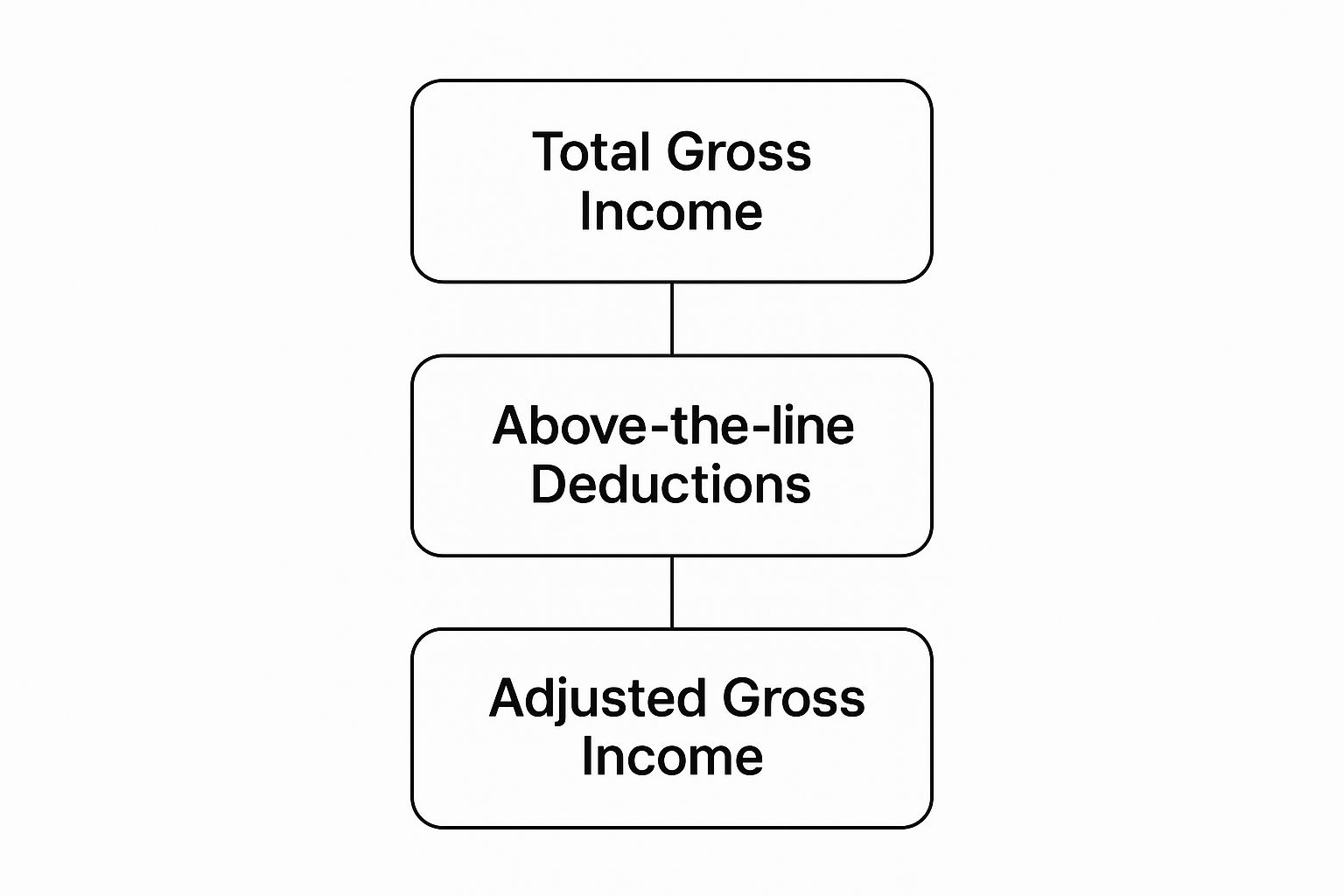
As you can see, AGI is that key middle number between your total gross income and your final taxable income, which is why it has such a big impact on your tax situation.
This figure is so central because it’s the official number the IRS uses for many calculations. For the 2025 tax year, you’ll find your AGI on line 11 of your Form 1040. Because it affects so many financial benefits, it’s worth understanding well. For a deeper dive, check out our guide on how AGI affects your tax refund.
How To Calculate Your AGI With Confidence

Figuring out your AGI doesn’t have to feel like wrestling with a tax beast. Think of it more like following a simple recipe. At its core, the entire process boils down to just two main steps: adding up all your income and then subtracting a specific list of deductions.
Let’s walk through it.
Step 1: Start With Your Gross Income
First things first, you need to tally up your gross income. This is the grand total of every dollar you earned throughout the year from all sources, before anything gets taken out. It’s your financial starting line.
Common sources of income include:
- Wages and salaries from your W-2 job
- Profits from your freelance business or side hustle
- Investment income, like dividends or capital gains
- Money you collected from rental properties
- Retirement income, such as pensions or distributions
The idea of an Adjusted Gross Income has been around for a long time. In fact, definitions from back in 2005 described AGI as gross income minus 22 specific deductions, covering a wide range of things like business expenses and retirement savings. This definition casts a wide net, though it’s important to remember that things like gifts and inheritances typically aren’t counted as income.
Step 2: Subtract Your “Above-the-Line” Deductions
Once you have your gross income total, you get to subtract certain expenses. These are officially called “adjustments to income,” but most people know them as “above-the-line” deductions. They are special expenses the IRS allows you to take right off the top of your income.
Let’s look at an example. Meet Alex, a freelance graphic designer who brought in $75,000 in gross income last year. During that time, Alex was smart about savings and contributed $4,000 to a traditional IRA. They also paid $2,500 in student loan interest.
Here’s how Alex would calculate their AGI:
$75,000 (Gross Income) – $4,000 (IRA Contribution) – $2,500 (Student Loan Interest) = $68,500 (AGI)
See? It’s just simple subtraction. This straightforward formula takes the mystery out of the process and makes it a much more manageable task. If you want a deeper dive, you can learn more about how the IRS calculates your AGI in our dedicated guide.
How to Lower Your AGI with “Above-the-Line” Deductions
Now that we know what AGI is, let’s get to the fun part: how to lower it. The most powerful tools for this job are what the IRS calls “adjustments to income,” but most people know them as above-the-line deductions.
Think of your gross income as the starting price. These deductions are like special coupons the IRS gives you for doing smart things like saving for retirement or paying for education. You get to apply these “coupons” before you decide between taking the standard deduction or itemizing.
The real magic of lowering your AGI is that it doesn’t just reduce your taxable income. A lower AGI can also make you eligible for other valuable tax credits and deductions that have income limits. It’s a win-win.
By getting a handle on these deductions, you can be much more strategic when tax season rolls around. Let’s look at the most common ones.
Common Deductions That Reduce Your AGI
While the full list is long, a handful of these deductions apply to millions of people every year. Getting to know them can make a real difference in how much tax you owe.
Here are a few of the big ones you should be aware of:
- Traditional IRA Contributions: Putting money into a traditional IRA isn’t just a great way to save for your future; it can also give you an immediate tax break.
- Health Savings Account (HSA) Contributions: If you’re covered by a high-deductible health plan, contributing to an HSA is one of the best deals in the tax code. You get a deduction now, the money grows tax-free, and withdrawals for medical expenses are also tax-free.
- Student Loan Interest: The IRS lets you deduct the interest you’ve paid on student loans, up to a maximum of $2,500 a year. It’s a small but welcome relief for anyone tackling education debt.
- Educator Expenses: For all the teachers out there, you can deduct up to $300 for the unreimbursed money you spent on classroom supplies.
- Self-Employment Tax: When you work for yourself, you’re responsible for both the employer and employee share of Social Security and Medicare taxes. The IRS lets you deduct one-half of what you pay, which helps level the playing field.
Each of these deductions shaves money directly off your gross income, pushing your AGI down. The more of these you can legitimately claim, the less you’ll ultimately pay in taxes.
A Closer Look at AGI-Lowering Deductions
To give you a clearer picture, here’s a quick comparison of some popular above-the-line deductions. This table breaks down who usually qualifies and the general rules to keep in mind.
| Deduction Type | Who Typically Qualifies | General Limit or Rule |
|---|---|---|
| Traditional IRA Contribution | Individuals with earned income. The deduction may be limited if you have a workplace retirement plan. | Up to $7,000 in 2024 ($8,000 if age 50+). |
| HSA Contribution | Individuals covered by a high-deductible health plan (HDHP). | For 2024, up to $4,150 for self-only coverage or $8,300 for family coverage. |
| Student Loan Interest | Anyone who paid interest on a qualified student loan. | You can deduct up to $2,500 of interest paid per year. |
| Educator Expenses | Eligible K-12 teachers, instructors, counselors, principals, or aides. | Up to $300 per year for unreimbursed classroom expenses. |
| Self-Employment Tax | Freelancers, independent contractors, and small business owners. | You can deduct 50% of the total self-employment tax you paid for the year. |
Remember, this is just a starting point. Always check the latest IRS guidelines or consult with a tax professional, as rules and limits can change from year to year. Knowing which of these apply to your situation is the key to effective tax planning.
Why Your AGI Is a Financial Superpower

It’s easy to dismiss your Adjusted Gross Income as just another number on your tax return, but that would be a huge mistake. Think of your AGI as a master key. This single figure determines your access to a whole host of valuable tax breaks and financial opportunities, and its influence goes far beyond calculating what you owe the IRS.
In fact, your AGI is the gatekeeper for some of the most powerful tax credits out there. We’re not talking about small change; these credits can put thousands of dollars back in your pocket. The catch? As your AGI goes up, your ability to claim these benefits can shrink—or vanish completely.
How AGI Shapes Your Financial Life
The impact of your AGI is incredibly broad, affecting everything from your tax bill to the financial tools you’re allowed to use. A lower AGI can open doors, while a higher one might slam them shut.
Here are a few critical areas where your AGI calls the shots:
- Tax Credit Eligibility: Many valuable credits, like the Child Tax Credit and educational breaks (think the American Opportunity Tax Credit), come with strict AGI limits. If you earn even a dollar over the threshold, you could lose out on significant savings.
- Retirement Savings: Your ability to deduct contributions to a traditional IRA—or even contribute to a Roth IRA at all—is tied directly to your AGI. A high AGI can severely limit or even block you from using these essential retirement-building tools.
- Student Loan Repayment: If you have federal student loans, some income-driven repayment plans use your AGI to figure out your monthly payment. A lower AGI could mean a much more affordable payment.
This reveals a powerful truth: managing your AGI is one of the most strategic moves you can make for your overall financial health. It’s not just about saving on taxes this year; it’s about unlocking your best financial future.
AGI in the Bigger Picture
While “Adjusted Gross Income” is a U.S.-specific term, the concept of using a modified income figure is pretty common around the world. Here in America, your AGI is a cornerstone of our graduated tax system.
For example, in 2024, the highest federal tax rate applies to single filers with an AGI over $578,125. This shows how AGI doesn’t just gatekeep credits—it also determines your fundamental tax bracket. Considering the median AGI for U.S. taxpayers is often around $50,000, you can see why actively managing this number is a smart strategy for the average person. You can find more details on how AGI impacts tax brackets on NerdWallet.com.
Actionable Strategies to Lower Your AGI

Knowing what AGI is is the first step, but learning how to manage it is where the real magic happens. Instead of waiting for tax season to sneak up on you, a few smart habits throughout the year can make a huge difference in your final tax bill. Taking control isn’t just about saving money in April—it’s about strengthening your entire financial picture.
The best strategies focus on using tax-advantaged accounts and deductions to your full advantage. Essentially, you’re looking for legal ways to shrink your taxable income. Let’s dig into some of the most effective ways to do just that.
Maximize Your Retirement Contributions
One of the simplest and most powerful tools for lowering your AGI is contributing to a tax-deferred retirement plan. Every single dollar you put into a traditional 401(k) or traditional IRA is an “above-the-line” deduction. This means it comes right off the top of your income before your AGI is even calculated.
Think of it as a win-win. You’re building a solid retirement fund for your future while getting an immediate tax break today. For instance, if you put $5,000 into your traditional IRA, you’ve just instantly lowered your gross income by $5,000. It’s a foundational move for smart financial planning.
Harness the Power of an HSA
If your health insurance is a high-deductible health plan (HDHP), you have access to what might be the single best savings account out there: a Health Savings Account (HSA). Its tax benefits are so good, they’re often called a “triple threat.”
Contributions to an HSA are tax-deductible, which directly lowers your AGI. The money in the account then grows tax-free. And when you need to use it for qualified medical expenses, those withdrawals are also completely tax-free. It’s an unbeatable combo.
Strategic Moves for Freelancers and Business Owners
Being your own boss comes with some unique financial perks, especially when it comes to managing your AGI. The secret here is keeping detailed records of every single legitimate business expense.
Here are some of the most common deductions you can take:
- Home Office Expenses: If you have a dedicated space in your home for work, you can deduct a portion of your rent or mortgage, utilities, and internet.
- Business Travel: The cost of flights, hotels, and even meals while you’re on the road for work can be deducted.
- Software and Supplies: Any tools, subscriptions, or materials essential for running your business are fair game.
- Half of Self-Employment Tax: You get to deduct 50% of what you pay in self-employment taxes—a significant break.
Diligently tracking these expenses reduces your net business income, which, in turn, brings down your AGI. This is especially crucial if you live in a state with high income taxes. You can dive deeper into this topic in our guide to California income tax brackets and deductions. Building these habits into your workflow can lead to some serious savings over time.
Answering Your Top Questions About AGI
Once you’ve got the basics down, you’ll find that Adjusted Gross Income still has a few tricky corners. It’s completely normal to have questions. Let’s clear up some of the most common points of confusion so you can feel more confident looking at your own financial picture.
Here are a few of the top questions we hear all the time.
What Is the Difference Between AGI and MAGI?
You’ve probably seen another acronym floating around: Modified Adjusted Gross Income (MAGI). The easiest way to think about it is that AGI is the main number, while MAGI is a slightly different version used for very specific calculations. For most taxpayers, their AGI and MAGI will be identical.
Where they differ is that MAGI takes your AGI and adds back certain deductions you may have taken. Things like student loan interest or tax-exempt interest income are common examples.
Why the extra step? The IRS uses MAGI, not AGI, to check your eligibility for certain tax breaks, like being able to contribute to a Roth IRA or qualifying for health insurance premium credits. It’s essentially the government’s way of getting a truer picture of your income before some of those popular deductions kick in.
Where Do 401(k) Contributions Fit In?
This is a fantastic question, and it really gets to the heart of why AGI-lowering strategies are so powerful. When you contribute to a traditional 401(k), those contributions are “pre-tax.” This means the money comes directly out of your paycheck before the income number is ever reported on your W-2.
Because of this, your 401(k) contributions don’t appear as a separate “above-the-line” deduction on your tax return. They’ve already done their work behind the scenes by lowering your starting gross income from the get-go. It’s one of the simplest and most effective ways to lower your AGI.
Where Can I Find My AGI on My Tax Return?
Need to look up your AGI from a prior year? Good news—you don’t have to redo all the math. The IRS requires this number to be clearly stated on your tax forms.
- Just grab your Form 1040 and look for line 11. Your Adjusted Gross Income will be right there.
Having this number handy is incredibly useful for all sorts of financial tasks, from applying for a mortgage to filling out a student’s financial aid application. It acts as the official record of your financial standing for that tax year.
Trying to make sense of AGI, tax credits, and deductions can feel like a puzzle. At Allied Tax Advisors, we specialize in providing personalized tax and accounting solutions to help you put all the pieces together and improve your financial outcome. To see how our experts can help, visit us at https://alliedtax.com.