
The biggest difference between an LLC and a sole proprietorship boils down to one critical concept: legal separation. Think of it this way: a sole proprietorship is the default business structure where you are the business. Your personal and business finances are legally one and the same. On the other hand, a Limited Liability Company (LLC) creates a separate legal entity, building a wall between your business and your personal life.
Understanding the Core Choice for Entrepreneurs
If you're a single owner just starting out, you're a sole proprietor by default. It's that simple. There's no paperwork to file with the state and no fees to get started, which makes it incredibly appealing for freelancers, consultants, and new small business owners. All your business income and losses just get reported on your personal tax return. Easy.
But that simplicity comes at a price: unlimited personal liability. If your business runs into debt or gets sued, there’s no legal distinction between your company’s assets and your personal ones. Your car, your house, your savings—it could all be on the line.
This is exactly why so many business owners choose to form an LLC. It establishes a formal business structure that is legally separate from you. This protective barrier is often called the "corporate veil," and it's the LLC's biggest superpower. It safeguards your personal assets, giving you essential peace of mind as your operations expand.
Key Takeaway: You’re essentially trading simplicity for security. A sole proprietorship is easy and free to start but offers zero asset protection. An LLC requires a bit more setup but provides a crucial liability shield.
To really get a handle on which path is right for you, it’s best to see them compared directly. The choice you make will affect everything from your legal exposure and tax filings to your day-to-day administrative tasks. For a complete look at all your options, you might find our guide on the different types of business structures helpful.
Quick Comparison LLC vs Sole Proprietorship at a Glance
Choosing the right structure is foundational to your business's success. This table gives you a quick, high-level overview of the key differences to help you see where you might fit.
| Feature | Sole Proprietorship | LLC (Limited Liability Company) |
|---|---|---|
| Liability Protection | None. The owner is personally liable for all business debts. | Strong. Personal assets are shielded from business debts. |
| Legal Status | The owner and the business are legally the same entity. | A separate legal entity, distinct from its owner(s). |
| Formation | Automatic and free. No state filing is required to start. | Requires filing Articles of Organization with the state. |
| Ongoing Compliance | Minimal; usually just local business licenses. | Requires annual reports and fees in most states. |
| Taxation | Profits pass through to the owner's personal tax return. | Flexible; can be taxed as a sole proprietorship, partnership, S Corp, or C Corp. |
While this table simplifies things, remember that the best choice depends entirely on your specific industry, risk tolerance, and long-term goals.
Understanding the Sole Proprietorship Model
If you've ever started a side hustle or began freelancing, you likely started as a sole proprietor without even realizing it. It’s the default business structure for anyone who starts working for themselves and doesn't register as a formal legal entity. Think of it as the path of least resistance—no paperwork, no state filings, just you and your business idea.
This simplicity is what makes it so appealing. You are the business, and the business is you. You call all the shots, and every dollar of profit flows directly into your personal bank account. Come tax time, things stay simple: you just report your business income and expenses on a Schedule C form attached to your personal 1040 tax return. No separate business tax returns needed.
Trading Simplicity for Risk
But here’s the catch. That seamless blend of your personal and business identity is also its biggest weakness: unlimited personal liability. From a legal standpoint, you and your business are one and the same. This means if the business gets into debt or is hit with a lawsuit, your personal assets are fair game. We're talking about your home, your car, and your life savings.
Let's say you’re a freelance web developer working as a sole proprietor. A client gets angry, claims your code cost them a fortune in lost sales, and decides to sue you.
- Your personal savings: A judgment could drain your personal bank accounts.
- Your home: It's possible a lien could be placed on your property to satisfy the debt.
- Your reputation: The lawsuit is against you, personally, not an anonymous business entity.
This kind of exposure is a huge gamble, and it’s why so many entrepreneurs eventually graduate to a more protective structure.
The core problem with a sole proprietorship is that there's no protective wall. Every business risk is a personal financial risk, and that danger multiplies as your business grows and your client list expands.
Taxation and Financial Obligations
As a sole proprietor, the IRS considers you self-employed. That means you're on the hook for the entire self-employment tax, which covers both the employee and employer portions of Social Security and Medicare. Our guide offers a detailed breakdown on how to calculate self-employment tax so you know exactly what to expect.
All your net business profit is taxed at your personal income tax rate. While this keeps filing easy, it also means a successful year could push you into a much higher tax bracket, often without the strategic tax-planning opportunities available to other business structures.
The gig economy has turned the sole proprietorship into the go-to model for millions. While they make up about 7.36% of all business establishments, SBA data reveals that a staggering 86.3% of the 28.5 million nonemployer firms in the U.S. are sole proprietorships. This is a massive jump since the late 1990s, driven by the explosion in freelancing and remote work. You can dig into more sole proprietorship statistics on Business Initiative.
Ultimately, a sole proprietorship is a fantastic launchpad. It’s perfect for testing a business idea or for those operating in very low-risk fields. It gets you up and running fast with almost no cost or administrative headaches. However, the moment your business starts to gain real traction and take on meaningful risk, the question of what is an LLC vs sole proprietorship becomes one you can't afford to ignore.
How an LLC Creates a Protective Shield for Your Business
When you're ready to move beyond the high-risk world of a sole proprietorship but aren't quite prepared for the rigid structure of a corporation, the Limited Liability Company (LLC) is often the perfect fit. Think of it as a hybrid—it's designed to give you the best of both worlds: the robust liability protection of a corporation and the straightforward operational style of a partnership.

The single most important feature of an LLC is that it establishes a separate legal entity, completely distinct from you, the owner. This separation creates what we call the "corporate veil"—a legal barrier that protects your personal assets. Your home, car, and personal savings are shielded from business debts and lawsuits.
If your business ever gets into financial hot water or faces legal action, creditors generally can't come after your personal property. This protection is, without a doubt, the number one reason entrepreneurs upgrade from a sole proprietorship to an LLC.
The Formal Creation Process
Unlike a sole proprietorship, which just is once you start doing business, an LLC has to be formally registered with the state. This isn't just paperwork; these steps are what give your LLC its legal power and protective benefits.
- Filing Articles of Organization: This is the birth certificate of your LLC. You file it with your state’s Secretary of State, and it typically includes basic information like your business name, address, and the names of its members.
- Creating an Operating Agreement: While not every state legally requires one, I can't stress this enough: you need one. For an LLC, it's essential to define the internal rulebook. A business operating agreement spells out things like ownership percentages, member duties, and how profits and losses are managed.
Taking these formal steps also adds a layer of credibility that a sole proprietorship just doesn't have. It makes it far easier to open a business bank account, get approved for a loan, or land contracts with bigger clients.
The corporate veil isn't invincible. You absolutely must maintain a clean separation between your business and personal finances. If you start commingling funds, a court can "pierce the veil," and your personal assets will be right back on the line.
A Major Advantage in Tax Flexibility
One of the most powerful features of an LLC is its incredible tax flexibility. By default, the IRS treats a single-member LLC as a "disregarded entity," which is a fancy way of saying it’s taxed just like a sole proprietorship. All your business profits and losses simply pass through to your personal tax return on Schedule C.
But here’s the strategic advantage: an LLC can elect to be taxed differently. This is where the what is an LLC vs sole proprietorship debate gets really interesting for your bottom line. An LLC can choose to be taxed as an S Corporation, which can unlock some serious tax savings, especially as your business becomes more profitable. You can dive deeper into these strategies in our article covering the tax advantages of an LLC.
This combination of liability protection and tax choice is exactly why LLCs have become so popular since the 1990s. While a single-member LLC defaults to sole prop taxation, making the S Corp election can dramatically reduce your 15.3% self-employment tax bill. You do this by paying yourself a reasonable salary and taking the rest of your profits as distributions, which aren't subject to self-employment tax. This powerful tax move is a key reason why many entrepreneurs are moving to the LLC structure for greater security and growth potential.
Comparing Key Differences That Matter for Your Business
Choosing between an LLC and a sole proprietorship isn't just about the paperwork—it fundamentally changes your relationship with your business. This decision directly impacts your personal risk, how you're taxed, and your ability to grow. Let's dig into the distinctions that will really shape your journey as a business owner.
Liability Protection: Your Personal Safety Net
The biggest, most critical difference between these two is how they handle your personal assets. A sole proprietorship offers absolutely no separation between you and your business. If the business racks up debt or gets sued, your personal savings, your home, and even your car are on the table.
An LLC, however, creates a legal shield. By forming a Limited Liability Company, you establish a distinct business entity. This means your personal assets are generally protected from business debts and lawsuits. For anyone operating in a field with even a moderate amount of risk—from construction to consulting—this protection is non-negotiable.
Key Insight: Think of an LLC as a type of business insurance you can't buy from a policy. It’s a structural safeguard that insulates your personal financial life from the inevitable ups and downs of running a business. Without it, you are the business, and you’re personally guaranteeing every single obligation it has.
For instance, imagine a freelance graphic designer operating as a sole proprietor. If a client claims a logo design infringed on a copyright, the designer could be personally sued. An LLC would force the lawsuit to be against the business entity, keeping the designer's personal bank account out of it.
Taxation: The Power of Flexibility
At first glance, the tax situation for both structures seems pretty similar. By default, both are considered pass-through entities. This just means the business profits "pass through" to the owner's personal tax return, which is great because it avoids the double taxation corporations face. A sole proprietor reports this income on a Schedule C with their 1040, and a single-member LLC does the exact same thing.
But this is where the LLC reveals its secret weapon: tax flexibility. A sole proprietorship is stuck with that one method. An LLC, on the other hand, can choose to be taxed as an S Corporation, and this strategic move can unlock some serious tax savings.
Why does that matter? When you elect S Corp taxation, you can pay yourself a "reasonable salary," which is subject to self-employment taxes. Any additional profits can be taken as distributions, which are not subject to the 15.3% self-employment tax. For a business that's turning a healthy profit, this can literally save you thousands of dollars every year.
Formation and Costs: Getting Off the Ground
This is one area where the sole proprietorship clearly wins on simplicity and cost. To become a sole proprietor, you just… start doing business. That's it. There are no state filing fees or formal setup requirements, making it a completely frictionless way for new entrepreneurs to get started.
Forming an LLC is a more formal process and comes with some real costs.
- State Filing Fees: You have to file "Articles of Organization" with your state, and that comes with a fee that can range from $50 to $500, depending on where you live.
- Annual Fees and Reports: Most states require LLCs to file an annual report and pay a yearly fee to stay in good standing. In California, for example, this includes a hefty $800 annual franchise tax.
- Registered Agent Fees: You'll also need to name a registered agent to accept legal documents for your business, which might mean hiring a service for an additional annual fee.
While the upfront and ongoing costs for an LLC are higher, think of them as the price you pay for liability protection and legitimacy.
Raising Capital and Building Credibility
Your business structure sends a clear message to the outside world. A sole proprietorship often comes across as less formal to lenders, investors, and potential partners. Trying to get a business loan or attract investment can be tough because the business's identity is completely tied to you as an individual.
An LLC, with its official state registration and that "LLC" at the end of its name, projects a more serious and stable image. This added credibility makes it much easier to:
- Open a business bank account, which is absolutely crucial for keeping your finances separate.
- Apply for and secure business loans and lines of credit.
- Attract investors or bring on partners, because the LLC structure is designed to accommodate multiple members.
The data shows a clear trend when you look at what is an LLC vs sole proprietorship. While sole proprietorships still make up the majority of new business starts (86.3% of the 24.6 million nonemployer businesses), LLCs are the go-to structure for anyone planning for sustainable growth. This helps explain why the number of sole proprietorships actually saw a decline between 2021 and 2022—many owners upgraded their structure to get better protection and financial options. To really grasp the benefits of making that switch, you can find more insights on the advantages of an LLC.
Deciding Which Business Structure Fits Your Goals
Theory is great, but the real test is how these structures hold up in the wild. The best choice between an LLC and a sole proprietorship really comes down to your industry, your tolerance for risk, and where you see your business going. Let's step away from the definitions and walk through a few common scenarios to see how this plays out for different entrepreneurs.
Honestly, the decision often boils down to one simple question: how much risk are you taking on? This visual gives you a great starting point for that analysis.
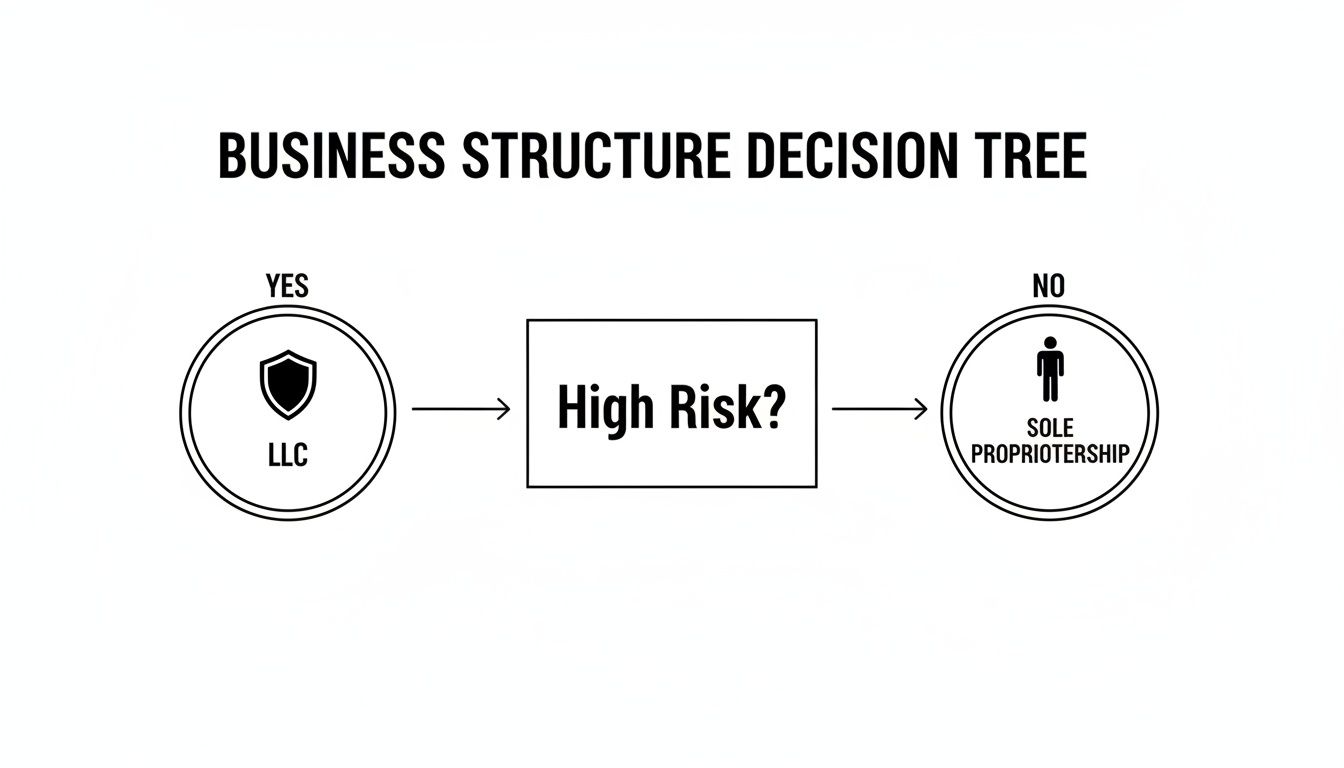
As the flowchart suggests, high-risk ventures almost always call for an LLC, while lower-risk businesses can get by just fine as a sole proprietorship, at least at first. That's the core trade-off we're looking at.
The Freelance Consultant Scenario
Picture a freelance writer or designer just getting started. They're working from a home office with a couple of small, local clients. In this case, a sole proprietorship is the perfect fit. It's the default, costs nothing to set up, and lets them dive right into the work without getting bogged down in paperwork. Their risk is pretty low—the worst-case scenario might be a client who's unhappy with the final product.
But things change. Let's say that freelancer lands a huge contract with a national brand. Suddenly, they’re signing complex MSAs and working on projects with massive budgets and visibility. The potential for a serious lawsuit just shot through the roof. This is the exact moment when upgrading to an LLC becomes a no-brainer. It protects their personal assets from that new level of professional risk and frankly, it just looks more professional to bigger clients.
The Real Estate Investor Scenario
Now, let's look at someone buying rental properties. For a real estate investor, liability lurks around every corner. A tenant could get hurt, a pipe could burst and cause damage, or a deal could go south. Operating this kind of business as a sole proprietorship would be incredibly reckless, as it puts the investor’s personal home, car, and savings account on the line for any business-related lawsuit.
For anyone in real estate, an LLC isn't just a smart move; it's standard practice. Many savvy investors even create a separate LLC for each property they own. Why? It isolates the risk. If something goes wrong at Property A, the lawsuit is contained within that specific LLC, shielding the investor's personal wealth and their other properties from the fallout. You can't safely scale a real estate portfolio without this kind of protection.
Expert Insight: Any time your business deals with physical products, customer-facing services, employees, or binding contracts, personal liability is a real threat. An LLC turns that threat from a potential personal catastrophe into a contained business issue.
The E-commerce Seller Scenario
Finally, consider a crafter who starts an online shop selling handmade baby toys. As a sole proprietor, the simplicity is appealing while they get their brand off the ground. But what if a toy is later discovered to have a small defect that poses a choking hazard? A product liability lawsuit could be financially ruinous, and without that legal separation, the owner's personal finances are completely exposed.
This is a textbook example of when an LLC is the only responsible choice. By forming an LLC, the business owner establishes a legal entity that would be the target of any lawsuit, not their family's savings account. This is absolutely critical for anyone selling physical goods, where product liability is a serious and unpredictable risk. An LLC offers the peace of mind to grow without the constant fear that one mistake could cost you everything.
How to Form an LLC or Convert From a Sole Proprietorship

Making the move to an LLC is a major milestone for any business owner. It’s the moment you formalize your operation and build a wall between your business and personal life. Whether you're launching a brand-new venture or leveling up from a sole proprietorship, the process involves a few critical steps to get it right.
First things first: you need a name. It has to be unique in your state, so you'll want to run a quick search on your state's business database. Remember, state rules usually require you to include a signifier like “Limited Liability Company” or “LLC” in the official name.
The Core Steps to LLC Formation
Once you’ve locked down a great name, it's time to make it official with the state. This registration is what creates that all-important liability shield, so attention to detail is key.
Appoint a Registered Agent: Every LLC needs a designated point of contact for official mail—think legal notices or state correspondence. This can be a person or a service, but they must have a physical street address in the state where you’re forming the LLC.
File the Articles of Organization: This is the document that officially creates your LLC. You’ll file it with your Secretary of State (or equivalent agency), providing basic details like the business name, address, and your registered agent. When pulling together the required legal paperwork, using tools like AI legal software can be a real help.
Draft an Operating Agreement: This one is a biggie. While not every state legally requires it, an operating agreement is your business's internal playbook. It spells out who owns what, how decisions are made, and how profits are split. A solid agreement can save you from major headaches and disagreements down the road.
Converting From a Sole Proprietorship
Already running your business as a sole proprietor? Good news. Shifting to an LLC is usually quite simple. There’s typically no complex "conversion" paperwork; you just follow the standard steps for forming a new LLC.
After the state gives your LLC the green light, a few housekeeping items are in order. You’ll need a new Employer Identification Number (EIN) from the IRS, a separate business bank account under the LLC's name, and you'll have to update all your licenses, permits, and contracts to reflect the new legal entity.
Crucial Tip: Converting isn't just a legal change; it’s a mindset shift. You have to start treating the business as its own person. That means strict separation of finances—no mixing personal and business funds. This discipline is what keeps your liability protection intact.
Navigating these steps can get tricky, especially when you factor in state-specific rules or advanced tax strategies like an S Corp election. This is where working with a professional can make all the difference, ensuring your LLC is set up for both legal protection and financial success from day one.
Common Questions We Hear About Business Structures
Once you get past the high-level definitions, the real questions start to pop up. How do these structures actually work day-to-day? Let's dive into some of the most frequent questions business owners ask when they're on the fence.
How Do I Pay Myself?
This is easily one of the most confusing parts for new entrepreneurs. As a sole proprietor, you aren't an employee of your business. You pay yourself by taking what’s called an owner’s draw—literally just transferring money from your business account to your personal account.
An LLC owner (called a member) does the same thing, taking owner's draws. But there's a big "what if." If you've set up your LLC to be taxed as an S Corporation, the rules change. You are then required to pay yourself a "reasonable salary" as a W-2 employee before you can take any extra profits as a distribution. This is a critical distinction and a non-negotiable part of the S Corp tax election.
Do I Really Need a Separate Business Bank Account?
For a sole proprietorship, the law doesn't force you to have one, but I can't recommend it enough. Trying to untangle business and personal spending from a single account at tax time is an absolute mess. It also makes it nearly impossible to see if your business is actually profitable.
For an LLC, a separate business bank account isn't a suggestion—it's mandatory. This is a cornerstone of maintaining your liability protection.
Crucial Insight: Mixing funds, or "commingling," is the quickest way to lose the personal liability protection your LLC provides. If you're paying your mortgage out of your business account, a court could decide there’s no real separation between you and the company, effectively "piercing the corporate veil" and putting your personal assets at risk.
What If My Business Operates in More Than One State?
If you're a sole proprietor, you simply need to make sure you're following the local tax and licensing rules wherever you're doing business. It's relatively straightforward.
An LLC, on the other hand, has more formal requirements. Your LLC is formed in its "domestic" state. To operate legally in any other state, you have to register it as a foreign entity there. This process, often called "foreign qualification," means more paperwork and additional fees to keep your business compliant across state lines.
Can I Add a Partner Later On?
This is where the LLC really shows its strength. A sole proprietorship is, by its very nature, a one-person operation. The moment you bring in a partner, the sole proprietorship dissolves, and you've automatically created a general partnership.
A single-member LLC, however, is built for growth. You can add new members by simply updating your business operating agreement to reflect the new ownership percentages, roles, and responsibilities. This built-in flexibility makes an LLC the smarter choice if you think you might want to bring on partners or investors down the road.
Choosing between an LLC and a sole proprietorship is a foundational decision that will impact your finances for years to come. For clear, expert guidance on structuring your business for maximum protection and tax efficiency, contact Allied Tax Advisors. We're here to help you build a solid financial future. Learn more at https://alliedtax.com.