
If you run an S corporation, Form 1120-S is the tax return you'll get to know very well. It's the master report your business sends to the IRS each year, detailing all your company's income, gains, losses, deductions, and credits.
But here’s the key difference: unlike a traditional C corp, your S corp generally pays no federal income tax itself. Instead, everything reported on this form passes through to the shareholders, which is the main reason businesses choose this structure—it avoids the dreaded double taxation.
Decoding Form 1120-S: The S Corporation Tax Return
Think of Form 1120-S as the playbook for your S corp's annual financial performance. A regular C corporation files Form 1120 and pays taxes directly on its profits. An S corp, on the other hand, uses Form 1120-S primarily as an information return. It calculates the business's total profit or loss, but the tax bill itself isn't settled at the company level.
This is where pass-through taxation comes into play. All the financial results—profits, losses, deductions, and credits—flow directly to the individual shareholders. They then take their portion of these items and report them on their personal tax returns (Form 1040). The information they need to do this comes from a separate document called a Schedule K-1, which is generated directly from the master Form 1120-S.
For a quick overview, here's a breakdown of what Form 1120-S is all about.
Form 1120S At a Glance
| Attribute | Description |
|---|---|
| Official Title | U.S. Income Tax Return for an S Corporation |
| Filing Entity | Domestic corporations that have elected to be treated as an S corporation. |
| Primary Function | Reports the S corp's income, gains, losses, deductions, and credits. |
| Taxation Principle | Pass-through taxation. Profits and losses are passed to shareholders. |
| Key Output | Generates Schedule K-1 for each shareholder to use on their personal return. |
| Main Advantage | Avoids double taxation at the federal level (corporate + individual). |
This structure ensures that business income is taxed only once, at the individual shareholder's level.
Why Mastering This Form Is Crucial
As an S corp owner, getting this form right is non-negotiable. Proper and accurate filing is fundamental to keeping your S corp status in good standing and ensuring both the business and its shareholders stay compliant with tax law.
Simple mistakes can snowball into big problems. Misclassifying an expense or incorrectly allocating profits can trigger an IRS audit, leading to penalties and a lot of unnecessary stress. For business owners looking for additional insights on business tax forms, several reputable financial blogs can offer further guidance.
Ultimately, mastering Form 1120-S is the key to unlocking the significant tax advantages that make the S corp structure so appealing in the first place.
Who Needs to File Form 1120-S?

So, who exactly has to file Form 1120-S? It's not a choice—it's a must-do for any domestic corporation that has officially elected to be treated as an S corporation by the IRS. This special tax status is the trigger.
The path to becoming an S corp always starts with one specific document: Form 2553, Election by a Small Business Corporation. Once you file this form and the IRS gives you the green light, your business operates under Subchapter S of the tax code. From that point on, filing Form 1120-S annually is part of the deal. You can get the full rundown on that initial step in our guide on what is Form 2553 and how it works.
The Ground Rules for S Corp Status
Before you can even think about Form 1120-S, your business has to play by the S corp rules. Sticking to these requirements is non-negotiable if you want to keep your S corp status.
Here are the big ones:
- Shareholder Limit: You can't have more than 100 shareholders. This structure is designed for closely-held businesses, not massive public companies.
- Shareholder Type: Your shareholders must be individuals, certain trusts, or estates. You can't have partnerships, other corporations, or non-resident aliens as shareholders.
- One Class of Stock: The company can only have a single class of stock. This ensures all shareholders have the same rights to company profits and assets, though it's okay to have differences in voting rights.
Remember, these aren't just one-time hurdles you clear at the beginning. Your company has to meet these criteria for the entire tax year to stay in good standing.
Filing Is Not Optional
Once your business is officially an S corp, filing Form 1120-S becomes a fundamental yearly task. It’s how your company reports its financial results to the IRS and tells the government how income, deductions, and credits get "passed through" to the owners.
It doesn’t matter if your business made a profit, broke even, or ended the year with a loss—you still have to file.
Think of Form 1120-S as the official financial story your S corp tells the IRS each year. Skipping it is like a star player refusing to show up for the championship game—it guarantees a loss and comes with some serious penalties.
Ignoring this filing duty can get you into hot water fast. The IRS imposes hefty late-filing penalties, which usually add up based on the number of shareholders and how many months the return is overdue.
Worse than fines, repeated failure to file can jeopardize your S corp status altogether. The IRS can actually revoke your election, which would automatically revert your business to being taxed as a C corporation. That brings back the very double taxation most businesses choose the S corp structure to avoid. It’s a costly mistake that impacts both the company’s bottom line and the shareholders’ personal finances, making on-time filing an absolute must.
A Guided Tour Through Form 1120-S
At first glance, Form 1120-S can look pretty daunting. But once you get the hang of it, you’ll see it has a logical flow. The best way to think about it is like a financial storybook for your S corporation. Page 1 sets the scene with your core business numbers, while the schedules dive into the details, showing how the plot affects each shareholder.
Let's break down the main parts so you know exactly what you're looking at. Getting this right is the key to accurate reporting and keeping your S corp compliant.
Page One: The High-Level Business Snapshot
The first page of the 1120-S is your command center. It gives the IRS a bird's-eye view of your company's financial performance for the year. This is where you calculate your ordinary business income or loss—the main profit or loss figure before any special items are passed on to shareholders.
You’ll start with the basics: your business name, address, and Employer Identification Number (EIN). From there, you get into the real meat of the return.
Key areas on Page 1 include:
- Income: This section kicks off with Gross Receipts or Sales, which is every dollar your business brought in before factoring in things like returns or allowances.
- Cost of Goods Sold (COGS): If you sell physical products, you'll subtract the direct costs of making or acquiring those goods right here. This gives you your gross profit.
- Deductions: This is where you'll spend most of your time on page one. It’s an itemized list of all your ordinary and necessary business expenses. You’ll see lines for everything from officer compensation and employee salaries to rent, repairs, taxes, interest, and advertising.
Each deduction is a lever you can pull to lower your taxable income. For instance, that online marketing campaign you ran? That goes under "Advertising." Your monthly office lease payment fits neatly under "Rents." Once you total all your deductions and subtract them from your gross profit, you’ll have your ordinary business income or loss for the year.
Schedule K: The Total Pie of Profits and Losses
After you’ve nailed down page one, you’ll move on to the schedules, starting with Schedule K. If page one is the company's main financial statement, Schedule K is the master list of every single item that has to be passed through to the shareholders. It pulls together the company's total financial activity for the year.
Think of Schedule K as the entire pie. It starts with the ordinary income you just calculated on page one, but it also adds other financial items that have special tax treatment. These have to be reported separately so shareholders can handle them correctly on their personal returns.
Schedule K doesn't just show the final profit number. It breaks down the S corporation's full financial picture into distinct categories that each shareholder needs to report, ensuring every dollar is accounted for in the pass-through process.
This includes things like:
- Net income or loss from rental real estate.
- Interest and dividend income.
- Capital gains and losses.
- Charitable contributions made by the corporation.
- Section 179 deductions for equipment purchases.
All of these items are totaled up on Schedule K, creating a complete inventory of every financial piece that will eventually be divided among the owners.
Schedule K-1: The Individual Slice for Each Shareholder
And that brings us to Schedule K-1, which is arguably the most important document to come out of this whole process. While Schedule K represents the "total pie" of your S corp's financial results, each Schedule K-1 is the "individual slice" that belongs to a single shareholder.
A separate Schedule K-1 is created for every single person who owns stock in the company. This form reports their pro-rata share—their specific ownership percentage—of every income, deduction, credit, and loss item that was listed on Schedule K. This is the nuts and bolts of pass-through taxation.
For example, say an S corp has two shareholders, each owning 50% of the company. If Schedule K shows $100,000 in ordinary income and $10,000 in charitable contributions, each shareholder gets a Schedule K-1 showing:
- $50,000 in ordinary business income.
- $5,000 in charitable contributions.
Shareholders then take the numbers from their Schedule K-1 and plug them into their personal tax return, Form 1040. This document is the critical bridge connecting the S corp's return to each owner's personal tax situation. It ensures the business profits and losses are taxed at the individual level, which is the whole point of an S corp. This is also where understanding the difference between a salary and a distribution is non-negotiable. Knowing the tax rate on S corp distributions is absolutely vital for proper personal tax planning.
Once you see how Page 1, Schedule K, and Schedule K-1 all work together, the flow of financial information from your business to its owners becomes crystal clear.
How Form 1120-S Stacks Up Against Other Business Tax Forms
To really get a handle on what Form 1120-S does, it helps to see it next to the other major business tax returns. The tax world has a few key forms, and knowing which one to use isn't just about compliance—it's a core part of your business strategy. This quick comparison will show you exactly where the S corp return fits into the bigger picture.
We’ll focus on the two other big players: Form 1120 for C corporations and Form 1065 for partnerships. Each is designed for a different type of business and, crucially, operates under a completely different tax philosophy.
Form 1120-S vs. Form 1120: The Double Taxation Difference
The single biggest distinction between an S corp (filing Form 1120-S) and a C corp (filing Form 1120) comes down to one critical concept: double taxation.
A C corporation is its own taxpayer. The business files Form 1120 and pays corporate income tax directly on its profits. But the story doesn't end there. If the C corp then pays out those after-tax profits to its shareholders as dividends, the shareholders get taxed on that income again on their personal returns. It's a classic two-layer tax system that many entrepreneurs try to avoid.
Form 1120-S, on the other hand, is the vehicle for a much friendlier "pass-through" system. The S corp itself generally pays no federal income tax. Instead, all profits and losses flow directly through to the shareholders' personal tax returns. They report the income and pay tax on it just once. Simple as that.
The popularity of this structure speaks for itself. For the 2022 tax year, business owners filed roughly 5,583,837 S corporation returns, marking a 4.3% increase from the year before. It's clear that the pass-through model is a powerful draw for small businesses.
This flow is what makes the S corp so efficient.
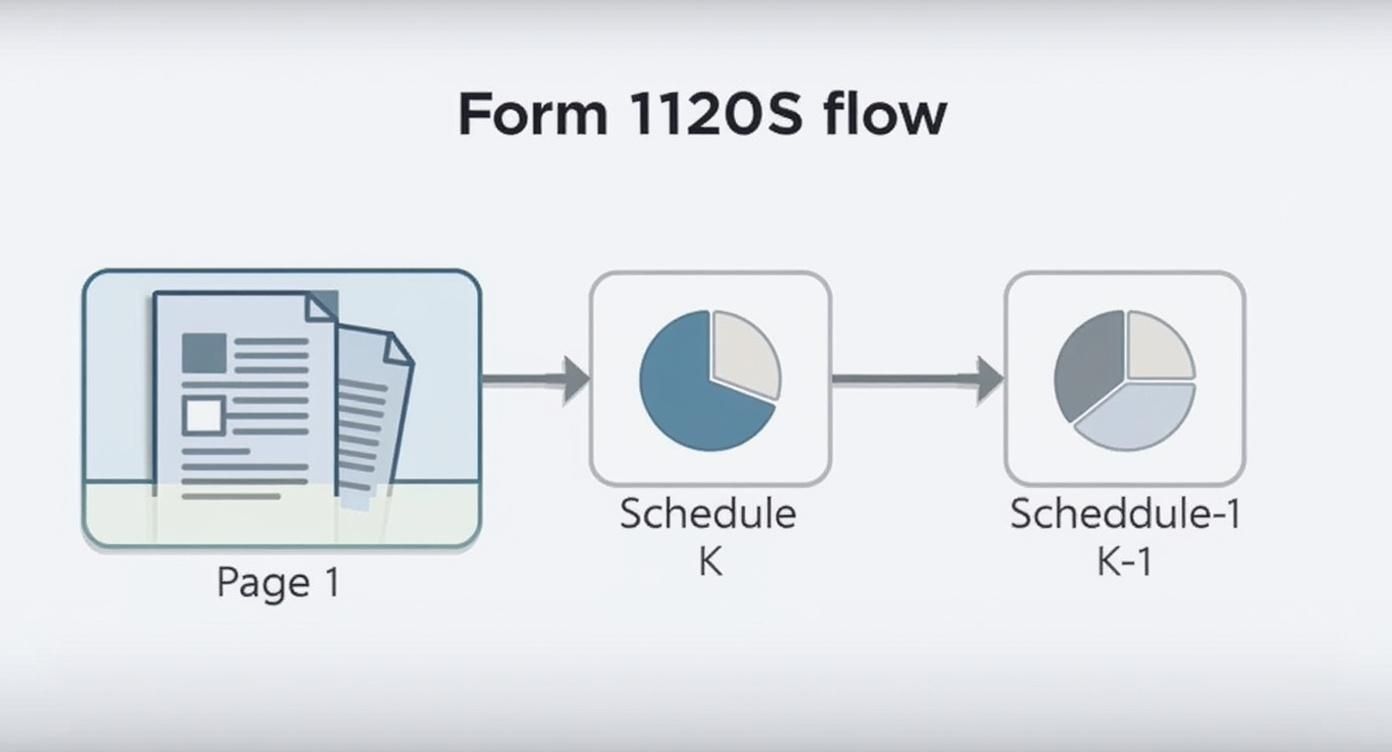
As you can see, Form 1120-S acts as the main hub, gathering all the company's financial information before neatly divvying it up among the owners on their Schedule K-1s.
Form 1120-S vs. Form 1065: Similar System, Different Structures
Now, let's look at Form 1120-S next to Form 1065, which is filed by partnerships. On the surface, they look like twins. Both are informational returns for pass-through businesses. In both cases, the entity itself doesn't pay federal income tax—the owners do.
But peel back that layer, and you’ll find significant legal and structural differences. An S corporation is a formal corporate structure that gives its shareholders a strong liability shield. A partnership can be much less formal, but that flexibility comes with a trade-off: general partners often have unlimited personal liability for the business's debts. For anyone weighing their options, understanding the details of an S corp vs LLC for small business is a non-negotiable first step.
While both Form 1120-S and Form 1065 facilitate pass-through taxation, they are built for fundamentally different legal structures. The S corp offers a corporate liability shield, while partnerships have more flexibility but potentially greater personal risk for owners.
The differences don't stop there. S corps come with strict rules that partnerships don't have to worry about, like a cap of 100 shareholders and tight restrictions on who can even be a shareholder (no corporations or non-resident aliens, for instance). Partnerships, however, offer much more flexibility in how they allocate profits and losses among partners. S corps have no such wiggle room; allocations must strictly follow ownership percentages.
Here’s a table to help you see the core distinctions at a glance.
Comparison of Key Business Tax Forms
| Feature | Form 1120-S (S Corp) | Form 1120 (C Corp) | Form 1065 (Partnership) |
|---|---|---|---|
| Taxation Method | Pass-through taxation | Corporate-level tax (double taxation) | Pass-through taxation |
| Filing Entity | S Corporation | C Corporation | Partnership, Multi-member LLC |
| Owner Reporting | Schedule K-1 | Dividends reported on Form 1099-DIV | Schedule K-1 |
| Liability Shield | Corporate liability protection for all shareholders | Corporate liability protection for all shareholders | Varies; general partners may have unlimited liability |
| Ownership Rules | Max 100 shareholders, specific eligibility | No restrictions on number or type of shareholders | Flexible ownership, no shareholder limits |
Ultimately, while the forms might seem similar, the legal and financial reality behind each one is worlds apart. Choosing the right entity—and the right tax form—is one of the most important decisions a business owner will make.
Hitting Your Deadlines (and What to Do if You Can't)
Getting your numbers right on Form 1120-S is only half the battle. You also have to hit the IRS deadlines. Missing them can lead to some painful penalties right out of the gate, so let's mark our calendars.
For the vast majority of S corporations, the tax year follows the standard calendar year. This makes the deadline pretty easy to remember.
Your Form 1120-S must be filed by the 15th day of the third month after your tax year ends. For most businesses, that means the big day is March 15.
If your S corp operates on a different fiscal year, the logic is the same. Just find the date your fiscal year closes, count forward three months, and your return is due on the 15th of that month.
How to Get an Extension if You're Running Behind
Life happens. Sometimes you're waiting on a final K-1 from another partnership, or your books just aren't quite ready. The good news is that the IRS offers a straightforward, no-questions-asked six-month extension.
All you need to do is file Form 7004, Application for Automatic Extension of Time to File. You have to get this form in by the original March 15 deadline. Once you do, your new filing deadline is pushed back to September 15.
Now, here’s a critical point that trips up a lot of business owners: an extension to file is not an extension to pay.
- An Extension to File: This gives you six extra months to submit your Form 1120-S and avoid the late-filing penalty.
- An Extension to Pay: This doesn't exist. You still have to pay any taxes you owe by the original March 15 deadline.
Paying What You Owe, Even With an Extension
"Wait," you might be thinking, "I thought S corps didn't pay federal income tax." And you're mostly right! The profits pass through to the shareholders.
However, there are a few specific scenarios where the S corp itself owes tax directly. This usually involves things like built-in gains tax (for companies that used to be C corps) or taxes on excess passive income.
If your S corp falls into one of these categories, you have to estimate the tax liability and pay it by March 15. If you don't, you'll start racking up interest and late-payment penalties, even with a valid filing extension in place. Getting this right is crucial for keeping your S corp compliant and penalty-free.
Common Filing Mistakes and How to Avoid Them
Filing Form 1120-S is a crucial part of keeping your S corp compliant, but a few common errors can easily trip up even the most careful business owners. Knowing where the pitfalls are is the best way to steer clear of IRS headaches, penalties, and a lot of unnecessary stress. Let’s walk through the most frequent mistakes so you can get ahead of them.
The S corp itself has been around for a long time, created by the Revenue Act of 1958 to give small businesses a way around double taxation. Its popularity has only grown. By 2012, millions of businesses were filing as S corps in just about every industry imaginable. If you're curious, the IRS even publishes reports breaking down this historical S corp data by sector.
Miscalculating Shareholder Basis
One of the trickiest and most common mistakes we see is getting shareholder basis wrong. Think of "basis" as a shareholder's total financial stake in the business. It’s the key to figuring out if distributions are taxable and if losses can be deducted. The problem is, it’s not a set-it-and-forget-it number; it changes every single year with profits, losses, and distributions.
A classic error is assuming all distributions are tax-free. They’re only tax-free up to the amount of your basis. If you take out more than you have in basis, that excess is generally taxed as a capital gain.
Key Takeaway: Shareholder basis is a moving target that you have to recalculate annually. If you don't keep track, you could end up paying taxes you didn't expect on a distribution or having the IRS deny a loss deduction on your personal return.
Confusing Salary and Distributions
This is a big one. Some S corp owners try to shrink their payroll tax bill by paying themselves a tiny salary and taking the rest of the company’s profit as distributions. The IRS is on high alert for this maneuver.
The rule is simple: if you’re a shareholder who actually works in the business, you have to be paid a reasonable salary before you take any distributions. That salary is subject to Social Security and Medicare taxes, which distributions are not.
To stay on the right side of this rule:
- Research what similar positions pay in your industry. What’s the market rate?
- Write down the shareholder-employee's job duties and responsibilities.
- Make sure the salary you pay reflects the genuine value of those services.
Mishandling Shareholder Health Insurance
The rules for handling health insurance for shareholders who own more than 2% of an S corp are very specific and often get botched. The good news is the company can deduct the premiums it pays. The catch? The cost of those premiums has to be included as wages on the shareholder's Form W-2.
From there, the shareholder can usually deduct the premium cost on their personal Form 1040. If you just pay the premiums directly without running them through payroll this way, both the corporation and the shareholder could lose the deduction entirely.
Finally, managing all this sensitive tax information brings up another critical point where mistakes can be costly: maintaining proper data security compliance. Whether it’s basis, benefits, or security, these common tripwires show just how valuable professional guidance can be to get it right.
Your Top Questions About Form 1120-S, Answered
Let's face it, tax forms come with a lot of questions. When you're running an S corp, you need clear, straightforward answers. We've gathered some of the most common questions we hear from business owners about Form 1120-S to help you get unstuck.
When Is Form 1120-S Actually Due?
For the vast majority of S corporations, the ones that operate on a standard calendar year, the deadline is simple to remember. Your return is due by the 15th day of the third month after your tax year closes.
That puts the big day at March 15. If March 15 happens to land on a weekend or a holiday, don't worry—the deadline automatically bumps to the next business day.
What if I Can't Make the Deadline? Can I Get an Extension?
Yes, you can. The IRS understands that life happens, and they offer an automatic six-month extension for filing Form 1120-S. To get it, you just need to file Form 7004, Application for Automatic Extension of Time to File, before the original March 15 deadline.
Filing Form 7004 pushes your new deadline out to September 15. But there's a catch. This is only an extension to file the paperwork, not an extension to pay what you owe.
Crucial Point: An extension gives you more time to get your documents in order, but it does not delay your tax payment. If your S corp owes any taxes (like the built-in gains tax), that money is still due by March 15 to steer clear of interest and penalties.
Can I Just File My S Corp Return Online?
Absolutely. In fact, the IRS prefers it. Electronic filing is available for Form 1120-S and is the standard for most business returns these days. It’s faster, more secure, and significantly cuts down on the simple math or transcription errors that can happen with paper returns.
Most professional tax software makes e-filing a breeze, and your tax preparer will almost certainly file this way. A huge plus is that you get an instant electronic confirmation that the IRS has your return in hand.
What’s the Damage if I File Form 1120-S Late?
Filing late without an approved extension can get expensive, and the penalty is designed to grow quickly. The IRS calculates the penalty based on the number of shareholders you have and how many months (or even partial months) the return is overdue.
For an S corp with several shareholders, this penalty can stack up fast. The best strategy is always to file on time. If you can't, make sure you submit Form 7004 to get that extension and avoid the penalties altogether.
Getting your S corp return filed correctly and on time is non-negotiable for keeping your business in good standing. If you're wrestling with anything from calculating a shareholder's basis to determining reasonable compensation, getting expert advice is one of the smartest investments you can make. The team at Allied Tax Advisors is here to help you handle every detail with confidence. Visit us at https://alliedtax.com to make sure your S corp tax strategy is built to last.