
When you're staring down a mountain of tax debt that seems impossible to climb, the IRS actually has a program that can feel like a lifeline. It’s called an Offer in Compromise (OIC), and it's a formal agreement that lets you settle your tax bill with the government for less than the full amount you owe.
This isn't some secret loophole or a way to get out of paying taxes. Think of it more as a financial reset button, designed for people and businesses who are in a genuinely tough spot.
Unpacking the Offer in Compromise

Let's be real—the IRS would rather collect something than nothing at all. That's the practical reality behind the OIC program. It’s for situations where forcing someone to pay their entire tax debt would create an extreme financial hardship, making it impossible for them to cover basic living expenses.
When you apply, you're essentially opening up your financial books to the IRS. They'll take a hard look at your income, regular expenses, assets, and what you could reasonably earn in the future to decide if you're a good candidate. It's a negotiation, but one based entirely on the facts of your financial situation.
So, What's the Real Purpose Here?
At its core, the OIC program is about giving taxpayers who are truly underwater a fresh start. It’s not a simple handout; it’s a structured resolution where the amount you offer is the absolute most the IRS believes it can ever expect to collect from you.
Here’s a breakdown of what that means in practice:
- It’s Based on Hardship: The program is built for people who would face legitimate economic distress if forced to pay in full.
- It’s a Formal Deal: If your offer is accepted, it becomes a legally binding contract. You have to make the agreed-upon payments on time and stay current on all your future taxes.
- It’s Often a Last Resort: The IRS usually wants to see that other options, like an installment agreement, just won’t work for your situation before they'll consider an OIC.
To give you a quick snapshot, here are the essential components of an Offer in Compromise.
Offer in Compromise At a Glance
This table breaks down the key elements of an OIC into simple terms.
| Component | Description |
|---|---|
| Definition | A formal agreement with the IRS to resolve your tax liability for less than the full amount owed. |
| Primary Eligibility | Based on your ability to pay, income, expenses, and asset equity. Proving financial hardship is key. |
| Grounds for Acceptance | Doubt as to Collectibility, Doubt as to Liability, or Effective Tax Administration. |
| Key Requirement | You must have filed all required tax returns and be current with estimated tax payments. |
| Outcome | If accepted, it resolves the debt. You must comply with all tax laws for five years after acceptance. |
Understanding these fundamentals is the first step in determining if an OIC is the right path for you.
A Look at the Real-World Numbers
Getting an OIC accepted is no walk in the park. The process is strict, and the IRS scrutinizes every detail. In fact, during fiscal year 2023, the IRS received 3,163 OIC applications and only accepted around 42% of them. That’s just 1,327 approved offers, which really underscores how critical it is to submit a perfect, well-supported application from the get-go.
Ultimately, an Offer in Compromise is a serious financial tool for a serious financial problem. For those who truly qualify, it can be a powerful way to put overwhelming tax debt in the rearview mirror and get back on solid ground.
To dive deeper into the process, you can explore our complete guide on understanding the IRS Offer in Compromise.
Do You Qualify for an Offer in Compromise?

Before you dive into the paperwork, the first and most critical step is figuring out if an Offer in Compromise is even a possibility for you. The IRS has a strict set of rules, and if you don't tick the right boxes from the start, your application will be rejected before it's even seriously considered. It’s best to know where you stand before investing your time and energy.
First off, there are a few absolute, non-negotiable requirements you have to meet just to get your foot in the door. Think of these as the gatekeepers to the OIC process.
- You must have filed all required tax returns. The IRS won't even look at an offer if you have outstanding filings.
- You must be up-to-date on your current year's estimated tax payments.
- You cannot be in an open bankruptcy proceeding. If you are, the process has to be completed or paused by the court before the IRS will engage with you on an OIC.
Missing any of these is an automatic deal-breaker. But if you clear these initial hurdles, you can move on to the next step: proving your situation fits one of the three official grounds for an OIC.
The Three Official Grounds for an OIC
The IRS doesn’t just settle a tax debt because it feels overwhelming. Your case has to fall squarely into one of three specific categories.
-
Doubt as to Collectibility: This is, by far, the most common reason an OIC gets approved. This is your argument when you agree you owe the money, but you simply don't have the assets or income to pay it all back. You're essentially making a case that the IRS will never be able to collect the full amount, so accepting a smaller, realistic sum is their best option.
-
Doubt as to Liability: This path is much less traveled. You’d use this if you genuinely believe you don't legally owe the tax in the first place. To succeed here, you need solid evidence to prove the IRS’s assessment was wrong from the beginning.
-
Effective Tax Administration (ETA): This is for rare and compelling situations. You might qualify under ETA if paying the full tax debt, while technically possible, would create an extreme economic hardship. This isn't about inconvenience; it's about situations like a severe long-term illness or being forced to liquidate assets needed for basic living expenses.
For the vast majority of people exploring this option, Doubt as to Collectibility is the lane they'll be in. The entire decision comes down to a cold, hard look at your finances, which is why your financial disclosures have to be absolutely spot-on.
Getting Real About Your Financial Situation
When the IRS evaluates an offer based on "Doubt as to Collectibility," they conduct a thorough financial investigation. They aren't just taking your word for it. Their goal is to calculate what they call your Reasonable Collection Potential (RCP).
This isn't a quick peek at your bank account. It's a deep dive into your entire financial life—the equity in your home and cars, the value of retirement accounts, and any other assets you hold. They also look at your income, subtract a set amount for allowable living expenses (based on their own national and local standards), and determine your future ability to pay.
If their math shows that your RCP is less than what you owe, you're likely a good candidate. Understanding how the IRS calculates this number is the secret to crafting a realistic offer that has a fighting chance of being accepted.
How the IRS Calculates Your Offer Amount
When you submit an Offer in Compromise, the IRS doesn't just pull a number out of a hat. They have a very specific formula they use to figure out the absolute rock-bottom amount they'll accept to clear your tax debt. This magic number is called your Reasonable Collection Potential, or RCP.
Think of the RCP as a complete financial x-ray. It’s the IRS's way of calculating the most they believe they could squeeze out of you if they used every collection tool at their disposal. The success or failure of your entire offer really hinges on this one calculation, making it the most critical piece of the puzzle.
Breaking Down the Reasonable Collection Potential Formula
The RCP formula isn't some secret code; it's a cold, hard look at your financial reality. The IRS determines your ability to pay by digging deep into your financial records. A huge part of this involves how you calculate disposable income, which directly feeds into their final RCP number.
Here's what they're looking at:
- Net Equity in Assets: This is what your stuff is worth after you subtract any loans against it. The IRS is looking at everything—your house, your car, your bank accounts, even retirement funds and investments.
- Future Income Potential: This isn't just about your current paycheck. The IRS projects your disposable income into the future to estimate how much you could reasonably pay toward your tax debt over time.
The final RCP is simply your asset equity plus your future income potential. If that number comes out to be less than what you owe in taxes, you’ve got a good foundation for a successful OIC.
A Hard Look at Allowable Living Expenses
A huge part of figuring out your future income potential is subtracting your monthly expenses from your monthly income. But here's the catch: the IRS doesn't care about your actual expenses. They use a strict set of "allowable living expenses" based on national and local standards.
This is a major tripwire for many taxpayers. What you might consider a necessary expense, the IRS could see as a luxury or cap it at a much lower amount than what you actually spend.
Key Insight: Your offer must be equal to or greater than your calculated Reasonable Collection Potential. If you submit an offer for less than what the IRS thinks you can pay, you're almost guaranteed a rejection letter.
The entire process, from filling out the first form to getting a final decision, is a journey.
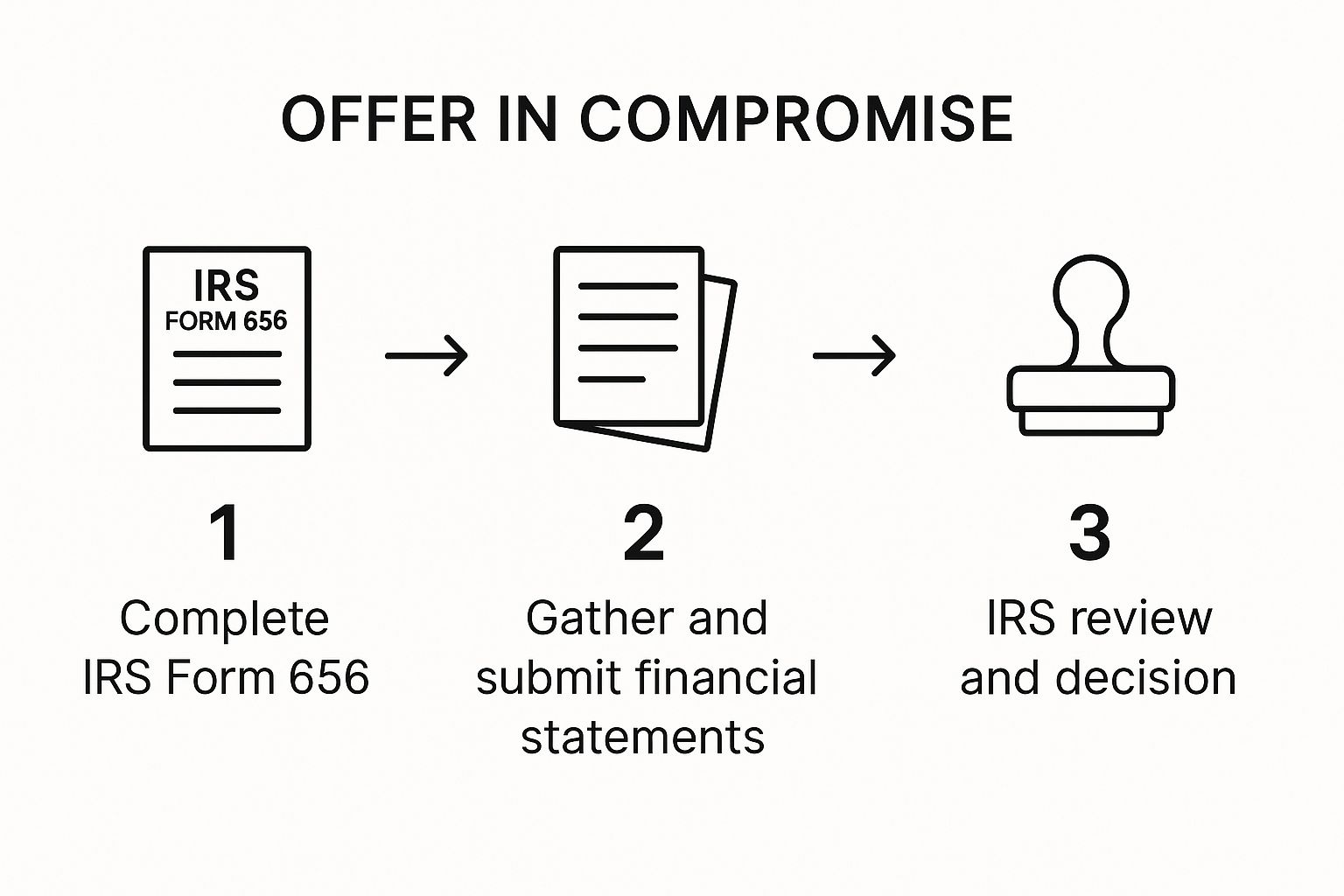
This visual really clarifies the path. You submit your Form 656 and all the financial backup, and the IRS puts it all under a microscope to run their calculations. Your success depends entirely on giving them a full and honest financial picture that lines up with their strict standards.
The table below breaks down the kind of expenses the IRS typically allows versus those they often question or flat-out disallow.
Common Allowable vs Disallowed IRS Expenses
| Expense Category | Generally Allowable (Within National/Local Standards) | Often Disallowed or Limited |
|---|---|---|
| Housing & Utilities | Rent or mortgage payments, property taxes, homeowners' insurance, and basic utilities (gas, electricity, water). Capped at local standards. | Cable TV, internet, home security systems, or excessive utility costs. |
| Transportation | Car loan/lease payments, fuel, insurance, maintenance, and public transit costs. Capped at national/local standards. | Payments for luxury vehicles, multiple cars for one driver, or ride-sharing services for convenience. |
| Food & Clothing | Costs for groceries and basic clothing, based on national standards for your family size. | Restaurant meals, expensive brand-name clothing, or entertainment expenses. |
| Healthcare | Health insurance premiums, out-of-pocket costs like co-pays, and prescription drugs. | Elective cosmetic procedures or non-essential health supplements. |
| Other Expenses | Court-ordered payments (e.g., child support) and student loan payments. | Voluntary retirement contributions (401k), college tuition for dependents, private school tuition, or charitable donations. |
Getting a handle on these distinctions is crucial. The IRS is focused on what you need to live and work—not what you prefer to spend your money on.
A Real-World Example: John’s Offer Calculation
Let's walk through a quick, fictional example to see how this all plays out. Meet John, a freelance graphic designer who owes the IRS $65,000.
1. Tallying Up Asset Equity:
First, the IRS looks at John's assets.
- Checking & Savings: $1,500
- Car Value: $8,000
- Car Loan: -$5,000
- Car Equity: $3,000
- Total Asset Equity: $1,500 (cash) + $3,000 (car equity) = $4,500
Keep in mind, the IRS often uses a "quick sale value" for assets, which is typically around 80% of the fair market value. For simplicity, we'll stick with the numbers above.
2. Calculating Future Income:
Next, they move on to John's monthly income and expenses.
- Monthly Income: $4,000
- Allowable Living Expenses: -$3,500 (This is the IRS number for his situation, not what he actually spends on rent, food, etc.)
- Monthly Disposable Income: $500
The IRS then multiplies this disposable income by a future timeframe—either 12 or 24 months, depending on which payment plan John picks.
- Lump Sum Offer (paid in 5 months or less): $500 x 12 = $6,000
- Periodic Payment Offer (paid in 6-24 months): $500 x 24 = $12,000
3. Arriving at the Minimum Offer Amount:
Finally, they add the asset equity to the future income potential.
- Minimum Lump Sum Offer: $4,500 (Assets) + $6,000 (Future Income) = $10,500
- Minimum Periodic Payment Offer: $4,500 (Assets) + $12,000 (Future Income) = $16,500
Based on this math, if John offers anything less than $10,500, the IRS will likely reject it out of hand. Understanding how they get to this number is the absolute key to putting together a realistic offer that has a fighting chance.
Navigating the Offer in Compromise Application

Getting an Offer in Compromise approved is less about filling out forms and more about telling a clear, compelling financial story to the IRS. They demand meticulous documentation, and even a small misstep can get your application tossed out. Let's walk through how to build a strong application package that actually meets the IRS's tough standards.
Think of the application as a formal negotiation, where your paperwork is your opening statement. It has to be precise. In a way, using a detailed contract review checklist is a good analogy here—you need to understand every single detail before you submit. Incomplete or inaccurate information is one of the fastest tickets to a rejection letter.
Assembling Your Core Application Package
The entire foundation of your OIC submission is built on two key forms. These documents give the IRS a complete, detailed snapshot of your financial life, and their decision will hang on what you put in them.
Your complete application package has to include:
- Form 656, Offer in Compromise: This is the main event. It's where you officially state the amount you're offering to pay and how you'll pay it (either a lump sum or in monthly installments).
- Form 433-A (OIC) for individuals or Form 433-B (OIC) for businesses: This is the Collection Information Statement. It's an exhaustive breakdown of your income, expenses, and assets. The IRS uses this form to calculate your Reasonable Collection Potential (RCP).
A simple way to look at it is that Form 656 is the "what" (what you're offering), and Form 433 is the "why" (why that's all you can afford). You absolutely must back up every number on your Form 433 with hard proof, like recent pay stubs, bank statements, and property valuations.
Understanding Fees and Initial Payments
Submitting an OIC isn't free. The IRS requires both an application fee and an initial payment right up front to show you're serious. Be warned: these payments are non-refundable, even if your offer is ultimately denied.
When you send in Form 656, it must be accompanied by Form 433-A (OIC) or 433-B (OIC). The amount you propose must be at least what the IRS calculates you can pay based on your assets and income. Your application must also include a $205 application fee and an initial payment—either 20% of your total offer for a lump-sum deal or the first monthly payment if you choose an installment plan.
There are exceptions. You might be able to get the fee and initial payment waived if you meet the Low-Income Certification guidelines, which are based on your household income and size.
Important Takeaway: The OIC process can take several months, sometimes dragging on for more than a year. This long waiting period can impact other financial decisions, so you need to be prepared for the delay.
Avoiding Common Application Pitfalls
A surprising number of OIC applications are rejected for simple, avoidable mistakes. Knowing what these common errors are can dramatically increase your chances of having the IRS take your offer seriously.
Here are the most frequent pitfalls to watch out for:
- Incomplete Forms: Leaving fields blank on Form 656 or 433-A/B is a major red flag. If a section doesn't apply to you, write "N/A"—don't just leave it empty.
- Missing Documentation: Every single asset, income source, and expense you list must be proven with supporting documents. If you don't provide the proof, your application will grind to a halt.
- Calculation Errors: Double- and triple-check your math. Simple arithmetic mistakes can make the IRS question the credibility of your entire financial story.
- Unrealistic Offer Amount: This is an instant deal-breaker. If you submit an offer that's way below your calculated RCP, you're guaranteeing a rejection. Your offer has to be based on their formula.
Trying to master IRS forms and calculations can be completely overwhelming. For anyone feeling lost in the process, learning how to resolve IRS issues with the help of a professional tax accountant can be a game-changer. An expert can make sure your application is accurate, complete, and positioned for the best possible outcome.
What Happens After Your Offer Is Accepted
Getting that acceptance letter from the IRS for your Offer in Compromise is a huge moment. It feels like you can finally breathe again after a long, stressful financial battle. But it's important to understand that this isn't the finish line—it's the start of a new, crucial phase with its own set of rules.
Think of it like being approved for a mortgage. You got the green light to buy the house, but now you have to make the payments and keep the property in good shape for years. An accepted OIC is a binding contract, and sticking to your end of the deal is just as important as getting it approved in the first place.
Your Post-Acceptance Obligations
Once your offer is accepted, the IRS gives you a clear roadmap to follow. It’s not just about paying the settlement amount you agreed on; it's about proving you’re committed to staying on the right side of the tax system moving forward.
Here’s what you absolutely must do:
- Pay the Offer Amount: You need to pay the settled amount based on the terms you chose. This could be a single lump-sum payment within five months or a payment plan spread out over as long as 24 months.
- Stay Current on All Future Taxes: For the next five years, you have to file all your tax returns on time and pay any taxes you owe, in full. This five-year clock starts the day your offer is officially accepted.
- Avoid New Tax Debt: Racking up any new tax debt during this probationary period is a deal-breaker and can completely unravel your agreement.
The five-year compliance period is a non-negotiable part of the deal. The IRS views this as a probationary term to ensure you remain a taxpayer in good standing. One misstep can undo all the hard work that led to your OIC acceptance.
The Serious Consequences of Defaulting
What happens if you don't hold up your end of the bargain? The IRS calls this a "default," and the consequences are severe. A default can put you right back where you started, or even in a worse position.
If you default on your OIC, the IRS has the right to reinstate your original tax debt in full, subtracting only the payments you’ve already made.
That means the entire forgiven amount—plus all the penalties and interest that were paused—comes roaring back to life. The IRS can immediately fire up its collection machine again, hitting you with property liens, bank account levies, and wage garnishments.
If you run into unexpected trouble during this five-year window, you have to act fast. You may be able to find help through the IRS Taxpayer Advocate Service for unresolved tax issues to see what options might be available.
The Benefits of Successful Completion
While the obligations are serious, the payoff for successfully completing your OIC is life-changing. Making that final payment and staying compliant for five years gives you the genuine financial fresh start you’ve been fighting for.
One of the biggest wins is the release of any federal tax liens the IRS had filed against you. Once you make the final payment on your OIC, the IRS will release those liens. This is a massive step toward clearing your public record and rebuilding your credit. You can learn more about the specifics of OIC compliance from the IRS.
Completing the process successfully clears the way to restored financial health, finally allowing you to move forward without the crushing weight of old tax debt holding you back.
Common Questions About an Offer in Compromise
When you start digging into the details of an Offer in Compromise, a lot of practical questions naturally pop up. Getting a handle on the timeline, what happens if things don't go as planned, and how it all affects your finances can give you the clarity and confidence you need. Let's tackle some of the biggest concerns taxpayers have.
How Long Does the OIC Process Take?
Patience is a virtue, especially when it comes to the OIC process. You should plan for the IRS to take anywhere from 6 to 12 months to fully review your application and give you a final answer.
If your financial situation is particularly tangled, maybe involving a business or complex assets, expect that timeline to stretch out even longer. The silver lining here is that while your offer is under review, the IRS usually puts a hold on most collection actions, like wage garnishments or bank levies.
What Happens If My OIC Is Rejected?
Getting a rejection notice is tough, but it's definitely not the end of the line. When the IRS denies your offer, they have to send you a letter explaining exactly why.
You have 30 days from the date on that letter to file an appeal. This is your chance to provide new information, clarify misunderstandings, or argue why their decision was off the mark. A rejection can also be a valuable signal that it's time to look at other options, like a formal installment agreement or getting classified as currently not collectible.
If your case is complex or you just want an expert in your corner, consulting with a CPA firm can be a smart move to navigate the OIC process and any potential appeals.
Key Insight: Think of a rejection as feedback. The IRS is pointing out the exact weak spots in your application, whether it's your financial disclosures or the offer amount itself. This gives you a clear roadmap for what to fix in an appeal or a future OIC.
Will an OIC Affect My Credit Score?
This is a huge point of confusion for many people, but the answer is pretty simple: an Offer in Compromise itself is not reported to credit bureaus like Experian, Equifax, or TransUnion. So, no, the OIC agreement won't directly drag down your credit score.
However, the reason you need an OIC in the first place—the tax debt—is what can cause the real damage. Long before you apply for an OIC, the IRS may have filed a Notice of Federal Tax Lien. That lien is a public record, and it can absolutely wreck your credit.
The good news? Once you’ve paid off your OIC in full as agreed, the IRS will release the tax lien. While the record of the lien might hang around on your credit report for a while, its release is a major step toward rebuilding your financial health.
At Allied Tax Advisors, we demystify the tax resolution process and provide clear, actionable guidance. If you're facing overwhelming tax debt, let our experienced team help you find the best path forward. Visit us at https://alliedtax.com to schedule a consultation.