
When you form an LLC, one of the most important decisions you'll make is how you want it to be taxed. This is your LLC's tax classification, and it directly dictates how the IRS will handle your business's profits. Think of your LLC as a legal container for your business operations; its tax classification is the tax label you put on that container. The best part? You can change that label to better fit your financial strategy.
The Chameleons of the Business World

The incredible flexibility of the Limited Liability Company (LLC) is truly its superpower. Unlike a corporation, which comes with a rigid, built-in tax structure, an LLC is a bit of a chameleon. It has the unique ability to change its tax "color" to whatever best suits its financial environment, giving you a serious strategic advantage.
This adaptability comes from a simple but crucial fact: while your LLC is a legal business structure created under state law, the IRS doesn't actually have a dedicated tax category for it. So, what happens? The IRS assigns a default tax status but then—and this is the key—gives you the power to choose a different one if it makes more sense for you.
Your Default Status and Available Choices
Out of the box, the IRS classifies your LLC based on a single factor: the number of owners, who are called members.
If you're the only owner, you have a single-member LLC. The IRS automatically treats it as a "disregarded entity," which is a fancy way of saying they ignore the LLC for tax purposes. All your business income and expenses flow directly onto your personal tax return, just as they would for a sole proprietorship.
If your LLC has two or more members, it’s a multi-member LLC. The default tax treatment here is a partnership. The LLC itself doesn't pay taxes; instead, profits and losses "pass through" to the individual members, who then report them on their own tax returns. For a closer look at these classifications, you can find a solid breakdown of their tax implications from Business Anywhere.
But here’s where the strategy comes in. You aren't stuck with these defaults. Any LLC, whether it has one member or twenty, can elect to be taxed as either an S Corporation or a C Corporation by filing the right paperwork with the IRS. Making this choice is the heart of what tax classification for an LLC truly means. It’s an active financial decision, not a permanent, unchangeable rule.
To make this clearer, let's break down the paths your LLC can take.
LLC Tax Classification Options at a Glance
This table sums up the default tax treatments the IRS applies to LLCs and the alternative elections you can make.
| LLC Structure | Default IRS Tax Classification | Alternative Tax Elections Available |
|---|---|---|
| Single-Member LLC | Disregarded Entity (Sole Prop) | S Corporation or C Corporation |
| Multi-Member LLC | Partnership | S Corporation or C Corporation |
As you can see, regardless of how your LLC starts out, you have the option to pivot to a corporate tax structure. This decision can have huge effects on your tax bill, how you pay yourself, and your long-term financial planning.
How the IRS Sees Your LLC by Default
The moment you form an LLC, the IRS doesn't just wait around to see what you'll do. It automatically assigns a default tax status based on one simple factor: how many owners (or "members") your business has. This initial setup is your starting point for building a smart tax strategy.
Think of it like getting the keys to a new car. It comes with standard factory settings that are designed to work well right off the lot. For an LLC, these "factory settings" are all about simplicity, making sure your profits are taxed in the most direct way possible.
If You're a Solo Owner: The Single-Member LLC
When you're the only person running the show, the IRS classifies your LLC as a disregarded entity. It's a bit of a strange term, but it just means that for federal income tax purposes, the IRS sees you and your business as a single taxpayer. They essentially look right past the "LLC" and treat your business as a sole proprietorship.
This makes tax time much simpler. You won't file a separate tax return for the LLC. Instead, you'll report all your business income and expenses on a Schedule C (Profit or Loss from Business), which you attach directly to your personal Form 1040 tax return.
Here’s a quick example:
Sarah is a freelance graphic designer who formed a single-member LLC. At year-end, she totals up her client payments and subtracts her business costs, like software subscriptions and marketing expenses. She puts these numbers on her Schedule C, and the final net profit gets added to her other income on her Form 1040. Easy.
When It's a Team Effort: The Multi-Member LLC
If your LLC has two or more members, the default classification automatically shifts to a partnership. This is also a pass-through entity, meaning the business itself doesn't pay income tax, but the process has a few more moving parts.
The LLC files an informational return with the IRS called Form 1065 (U.S. Return of Partnership Income). This form tells the government about the partnership's total income, deductions, and profits for the year.
From there, the LLC issues a Schedule K-1 to each member. This crucial document breaks down each owner's individual share of the company's profits or losses, which they then have to report on their personal tax returns.
One thing that catches many new partners by surprise is that you are taxed on your share of the profits, whether you actually received the cash or not. If your K-1 shows your share of the profit was $50,000, you owe tax on that entire amount—even if the partnership kept every penny in the business bank account to fund future growth.
Since profits "pass through" to the owners, they are taxed at each member's personal income tax rate, which can range anywhere from 10% to 37%. On top of that, owners typically have to pay a 15.3% self-employment tax on their earnings. You can get a deeper look into these business tax rates for LLCs on Ramp.com. While this system works well for many, as your business grows, it often makes sense to consider other tax elections. To learn more, take a look at our complete guide on the S Corporation tax structure.
Choosing a Different Path with S Corp or C Corp
While an LLC’s default tax status is wonderfully simple, it isn't always the most strategic choice for your bottom line. As your business scales and becomes more profitable, sticking with those "factory settings" could mean you're overpaying in taxes. This is where you can take control by making a deliberate choice—an election—to have your LLC taxed as either an S Corporation or a C Corporation.
This is a big decision, and understanding the core differences is the first step.
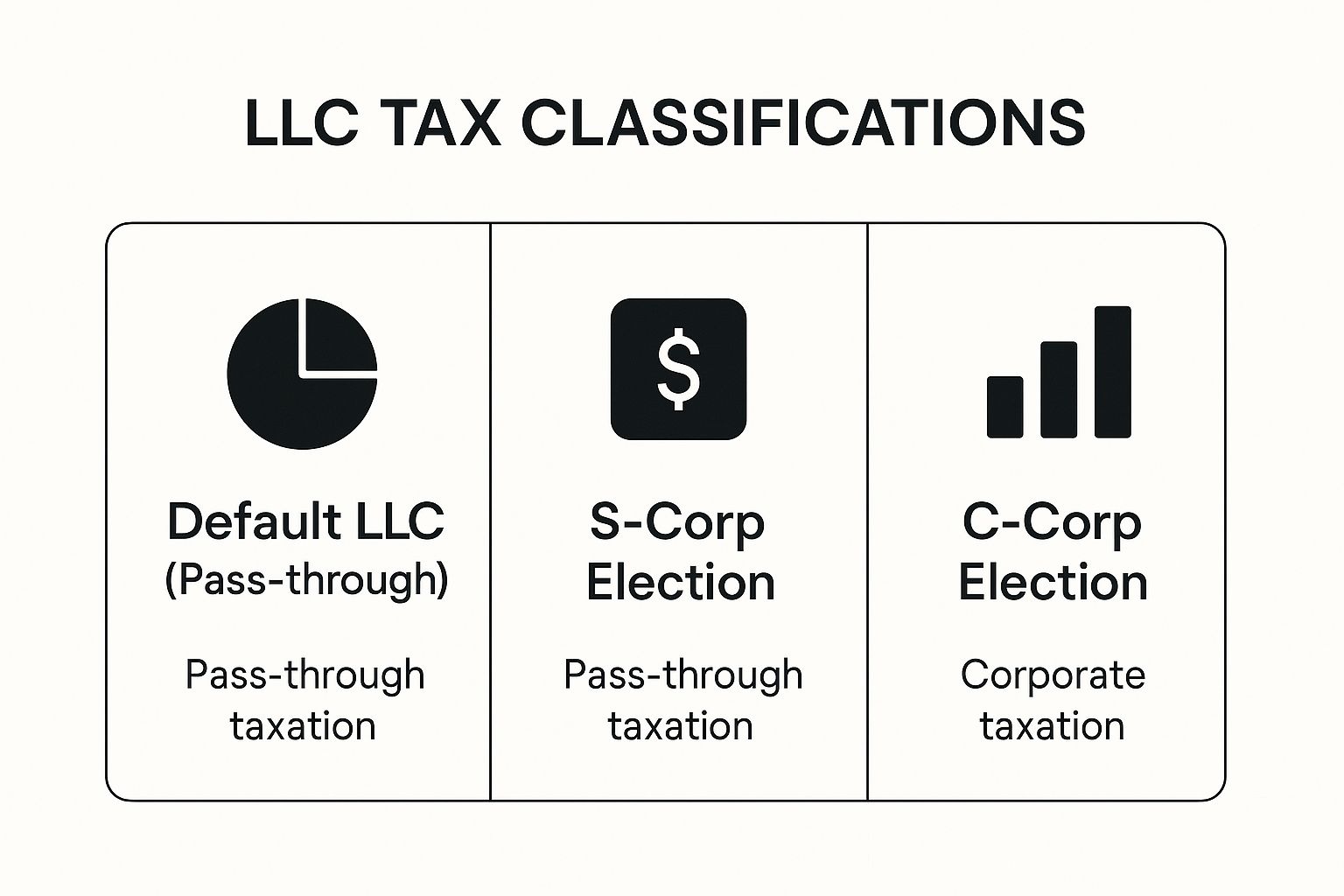
As you can see, electing a corporate tax status fundamentally changes how money flows through your business and onto your personal tax return.
The S Corp Election for Tax Savings
For many successful LLC owners, making the S Corp election is a lightbulb moment. Its main draw? A powerful strategy to significantly lower your self-employment tax bill.
Remember, with the default setup, every single dollar of net profit gets hit with that 15.3% self-employment tax. An S Corp election completely changes the game. It allows you to divide your company's earnings into two different pots:
- A Reasonable Salary: As an owner-employee, you must pay yourself a fair wage for the work you actually perform. This salary is treated just like any other employee's, meaning it's subject to payroll taxes (Social Security and Medicare).
- Profit Distributions: The rest of the profit can be paid out to you as distributions. Here’s the magic: these distributions are not subject to self-employment taxes.
That separation is precisely where the savings come from. You still pay personal income tax on everything, but you only pay the hefty self-employment tax on the salary portion. For a business bringing in solid profits, this can easily add up to thousands of dollars saved each year. Digging into the specific LLC vs S Corp tax benefits can help you run the numbers for your own situation.
When the C Corp Election Makes Sense
The C Corp election is a less-traveled road for most small businesses, mainly because of something called "double taxation." This is a real concern: the corporation pays income tax on its profits, and then you, the shareholder, pay income tax again when you receive those profits as dividends.
So, why on earth would an LLC choose this?
The C Corp structure becomes a strategic tool when your primary goal is aggressive growth and reinvestment. It's built for businesses that plan to keep profits inside the company to scale operations or attract outside investors.
Venture capitalists and angel investors love C Corps because they understand the familiar stock structure. It makes investment rounds much cleaner. C Corps also have access to a broader array of tax-deductible employee fringe benefits, like robust health insurance plans, which can be a great way to attract top talent.
To get a clearer picture of how these two elections stack up, let's compare them side-by-side.
Comparing S Corp vs. C Corp Election for an LLC
This table breaks down the key differences to help you see which structure might align better with your business goals.
| Feature | S Corporation Election | C Corporation Election |
|---|---|---|
| Taxation of Profits | Profits "pass-through" to owners' personal returns. | Corporation pays its own tax at the corporate level. |
| Double Taxation | Avoided. Income is only taxed once at the personal level. | A real risk. Profits are taxed at the corporate level, then again as dividends on personal returns. |
| Self-Employment Tax | Only paid on the owner's "reasonable salary," not on profit distributions. | No self-employment tax; owners receive salaries (with payroll taxes) and/or dividends. |
| Ownership Restrictions | Limited to 100 shareholders; shareholders must be U.S. citizens/residents. | No restrictions on number or type of shareholders; ideal for outside investment. |
| Investor Appeal | Less attractive to venture capitalists due to ownership limits. | Highly attractive to VCs and other institutional investors due to its traditional stock structure. |
| Fringe Benefits | Limited tax-deductible benefits for owners holding >2% stock. | Can offer a full range of tax-deductible benefits to all employees, including owners. |
Ultimately, the S Corp is often about saving the owner money on taxes today, while the C Corp is about positioning the company for massive growth and external funding tomorrow.
Whichever corporate path you consider, remember to keep your business and personal finances strictly separate. If you blur those lines, you could face a legal challenge known as piercing the corporate veil, which could destroy your liability protection and put your personal assets on the line.
So, you’ve decided to change how your LLC is taxed. That’s a big move, but telling the IRS what you want to do is actually pretty simple once you know the right forms and deadlines. Think of it as giving your business a new "tax name tag" for the government to see.

This isn’t a choice to make lightly. Once you make an election, you’re generally locked into that tax structure for a while. The key is to be intentional and, most importantly, on time with your paperwork to make sure everything goes off without a hitch.
Electing S Corp Status with Form 2553
If you’ve run the numbers and decided the S Corp tax structure is the right fit for you, your next step is filing IRS Form 2553, Election by a Small Business Corporation. The good news is that this one form does all the work—you don't have to file a separate form to be treated as a corporation first.
Now, here’s where you need to pay close attention: timing is everything. You have to file Form 2553 either:
- No more than two months and 15 days after the start of the tax year when you want the election to kick in.
- Anytime during the tax year before the tax year it’s supposed to take effect.
For a brand-new business, that gives you a tight 75-day window from your official formation date to get it done for the current year. If you're an existing business on a calendar year, your deadline is March 15th.
Key Takeaway: Missing the deadline for Form 2553 isn't just a small hiccup; it can push your tax savings back by an entire year. The IRS is notoriously strict about these dates, so circle them on your calendar.
Choosing C Corp Status with Form 8832
If your long-term vision—maybe you’re looking for venture capital or planning complex stock options—points toward a C Corp, then your go-to is IRS Form 8832, Entity Classification Election. This is the official form an LLC uses to tell the IRS, "Hey, please tax us like a corporation."
We have a complete walkthrough on this process in our guide on what you need to know about Form 8832.
Once that election is accepted, you’re officially in the C Corp world and will follow all its tax rules. The deadlines for Form 8832 are a bit more forgiving. The main rule is that your election can't start more than 75 days before you file the form or more than 12 months after you file it.
What If You Miss the Deadline?
It happens. A deadline gets missed, and panic sets in. Take a deep breath, because the IRS does provide a potential fix. If you miss the filing window for your S Corp or C Corp election, you might qualify for late election relief.
To get this relief, you generally have to prove you had a good reason for being late and that your business has consistently acted as if the election was already in place. This isn't an automatic approval, though. You'll likely need to attach a detailed statement explaining what happened. This is one of those times where getting a tax professional involved is a smart move; they can help you build the strongest case for relief.
A Look at Tax Rules for International LLC Owners
Running a US-based LLC from another country throws a few unique tax wrinkles into the mix. If you’re not a US resident, you’ll need to get familiar with a couple of key concepts the IRS uses to figure out how—and where—your profits get taxed. They essentially split your income into a few different buckets, and each one gets handled differently.
The biggest distinction you need to understand is the one between money you actively earn in the US versus income that’s more or less passive.
Are You Actively Doing Business in the US?
This question brings us to a critical term: Effectively Connected Income (ECI). Think of ECI as any profit you generate from actively running your business in the United States. If your LLC is providing services to American clients or selling products to customers in the US, the money you make from that is almost always considered ECI.
On the flip side, you have passive income sources, which often fall into a category the IRS calls Fixed, Determinable, Annual, or Periodic (FDAP) income. This is a mouthful, but it generally covers things like dividends from stocks, interest from investments, or royalties. The tax rules for ECI and FDAP are night-and-day different.
For entrepreneurs weighing their global options, getting a handle on the setup process in different locations, like when starting an LLC in the UAE, is a great starting point for seeing how structures compare.
If you’re a nonresident alien, any US-sourced ECI from your LLC gets reported on Form 1040-NR and is taxed at the same progressive rates a US citizen would pay. But that passive FDAP income? It typically gets hit with a flat 30% withholding tax right off the top, and you don't get to take any deductions against it.
Your Filing To-Do List
To keep everything above board, an international LLC owner with ECI has a few must-do filing requirements.
First up is Form 1040-NR (U.S. Nonresident Alien Income Tax Return). This is the primary form you’ll use to report your slice of the LLC’s profits to the IRS.
Beyond that, depending on your LLC's tax election, you might also be on the hook for other forms like 1120 and 5472. It’s also incredibly important to check if there’s a tax treaty between the United States and your home country. These agreements can sometimes lower—or even completely wipe out—certain US tax obligations, saving you a significant amount of money.
Frequently Asked Questions About LLC Taxes

Once you get the hang of the basics, the real-world questions about LLC taxes start popping up. It's one thing to understand the options, but it's another to know how those choices play out over the long run. Let's dig into some of the most common questions business owners have, so you can feel confident in your decisions.
Can I Change My LLC Tax Classification More Than Once?
This is a big one, because your initial choice isn't something you can easily undo. If you decide to elect S Corp status and then have second thoughts a year later, you can't just flip a switch and go back.
The IRS put a rule in place to keep businesses from hopping between classifications to chase short-term tax perks.
The IRS "60-month rule" is the key here. It generally makes an LLC wait five years (60 months) after revoking a tax election before it can make another one. This makes your first choice a pretty significant strategic move.
Now, there are some rare exceptions. If your LLC has a massive ownership shake-up—we're talking more than 50% changing hands—the IRS might let you elect a new status before that five-year clock runs out. This is exactly why getting professional advice before you file anything is so critical.
Does My State Recognize Federal LLC Tax Elections?
Here’s a detail that trips up a lot of business owners and can lead to some nasty surprises come tax time. Just because you've told the IRS how you want to be taxed doesn't mean your state automatically gets the memo or even agrees.
While most states do follow the federal government's lead, a handful play by their own rules. For instance, your state might ignore your S Corp election entirely and continue to tax your business as a partnership. Some even have their own separate entity-level taxes.
A few things to watch out for:
- State-Specific Elections: Some states require you to file a separate S Corp election at the state level.
- Franchise Taxes: States like California and Texas will hit your LLC with franchise or entity-level taxes, no matter how the feds see you.
- Annual Filings: Just about every state demands an annual report and a fee to keep your LLC in good standing.
The bottom line? Never assume. Always check directly with your state's department of revenue to know exactly where you stand. It's a simple step that can save you a world of financial pain.
When Is the Best Time to Elect S Corp Status?
Timing is everything with the S Corp election. Pull the trigger too early, and you could be drowning in administrative costs for no reason. Wait too long, and you're leaving money on the table.
The sweet spot is when your business is profitable enough that the savings on self-employment tax are greater than the added costs and hassles. Switching to an S Corp means running payroll and filing a separate business tax return (Form 1120-S), which all costs time and money.
That tipping point usually arrives when you can pay yourself a "reasonable salary" (an IRS requirement) and still have a healthy chunk of profit left over to take as distributions. If you're just starting out with unpredictable income, sticking with the default tax status is often the smarter, simpler path. A good tax advisor can help you run the numbers and pinpoint the exact moment when making the S Corp election makes solid financial sense.
What Happens If I Choose the Wrong Tax Classification?
Making the wrong call on your tax classification can be a costly mistake. For example, jumping into a C Corp election too soon could trap you in a cycle of double taxation without delivering the investor appeal you were hoping for.
If you realize you've made a misstep, you might be able to ask the IRS for late election relief, but there are no guarantees. If they say no, you could be stuck with that tax structure for up to five years. This is precisely why a small investment in professional tax advice before you file is one of the wisest moves a new business owner can make.
Getting your LLC tax classification right is a foundational piece of your financial puzzle. At Allied Tax Advisors, we help business owners like you structure their companies for maximum tax efficiency and long-term growth. Contact us today for a consultation and take control of your financial future.