
Let's face it, most of us think about income as the paycheck we get for showing up to work every day. That's what the IRS calls earned income—money you get for trading your time, skills, and labor. But there's a whole other side to the coin: unearned income.
This is the money your money makes. Think of it as income that flows from your assets, not your direct effort. It's the cash generated by things you own, whether that's stocks, real estate, or even a savings account.
Understanding Unearned Income vs Earned Income

To really get the difference, picture a small apple orchard you planted years ago. All the hard work of tilling the soil, planting the saplings, and setting up an irrigation system—that was your "earned" effort. Now, years later, the apples just grow. You still have to harvest and sell them, but the trees produce fruit without you having to re-plant them every single day. That recurring harvest is a lot like unearned income.
In the tax world, the distinction is critical. Earned income comes from a job, whether it's your salary, tips, bonuses, or the net earnings from a business you're actively running.
Unearned income, on the other hand, is passive. It's the byproduct of your capital working for you. Now, the term "unearned" can feel a little misleading. It doesn't mean the income isn't deserved or that you did nothing to get it—it simply describes how the money was generated for tax purposes. This classification has some pretty big implications for how much you'll owe.
One of the biggest perks? Unearned income is generally not subject to Social Security and Medicare (FICA) taxes. That alone can mean a huge tax savings compared to the same amount of money earned as wages.
Earned vs Unearned Income at a Glance
This distinction between active work and passive returns is the bedrock of a lot of tax planning. For instance, rental income is almost always classified as unearned. However, the lines can get blurry, especially with short-term rentals where your involvement might be more hands-on. Digging into rules like Material Participation for Airbnb Rentals: STR Loophole Demystified can help you figure out if your rental activities cross over into "active" territory. For a deeper dive, our guide on whether https://alliedtax.com/is-rental-income-earned-income/ breaks down these specific scenarios.
To make things simple, here’s a quick side-by-side look at the key differences.
| Characteristic | Earned Income | Unearned Income |
|---|---|---|
| Source | Active participation (wages, salary, self-employment) | Passive ownership (investments, assets, benefits) |
| Effort Required | Direct exchange of labor, time, or services | Minimal to no active effort to generate |
| FICA Taxes | Subject to Social Security & Medicare taxes | Generally not subject to FICA taxes |
| Common Examples | Paycheck, bonuses, freelance payments | Dividends, interest, capital gains, rent |
Understanding which bucket your income falls into is the first step toward building a smarter tax strategy and making sure you're not paying a penny more than you have to.
The Most Common Types of Unearned Income
You might have unearned income and not even know it. The term can sound a bit academic, but chances are, some of its sources are sitting right in your financial accounts. Figuring out what counts is the first step to getting a handle on it.
Unearned income comes in all shapes and sizes, from old-school investment returns to rewards from digital assets. The IRS lumps them together because the money flows from something you own, not from the work you do.
Let's break down the most common examples you're likely to see.
Income From Investments and Savings
This is the classic category of unearned income, where your money is doing the work for you.
- Interest Income: This is probably the most straightforward example. It's the cash your bank pays you just for letting your money sit in a savings account, money market, or certificate of deposit (CD).
- Dividends: When you own stock, you own a tiny piece of a company. If that company decides to share its profits with its owners, that payment is a dividend. It’s a direct return on your investment.
- Capital Gains: This happens when you sell an asset—like stocks, a piece of real estate, or even a collectible—for more than you paid. That profit is considered a capital gain, a very common form of unearned income for investors.
These are the sources most people picture when they hear "investment income." No active work is required; the return is generated directly by the assets you hold.
Income From Property and Assets
Your money doesn't just have to be in the market to generate unearned income. Physical and intellectual property are huge sources for many people.
Rental income is a perfect example. If you own a house and collect rent from tenants, the IRS considers that money unearned income. Even if you're actively managing the property, the income is seen as a return on your asset, not a wage for your landlord duties.
Another source is royalties. If you wrote a book, recorded a song, or patented an invention, the ongoing payments you receive when people use your work are unearned income.
The Big Idea: The common thread here is ownership. Whether you own a rental property, a stock portfolio, or the rights to a song, the asset itself is the engine producing the cash.
Government Benefits and Other Sources
Not all unearned income is from a traditional investment. A surprising amount comes from government programs or other miscellaneous streams.
- Social Security Benefits: Depending on your other income, a slice of your Social Security payments might be taxable as unearned income.
- Unemployment Compensation: That check you get when you're between jobs? It’s fully taxable and counts as unearned income.
- Pensions and Annuities: Payments you receive in retirement from a pension plan or an annuity fall squarely in this category.
- Cryptocurrency Rewards: The digital world has its own version. Income from things like crypto staking (where you "lock up" your coins to help run the network) or lending is treated as unearned income by the IRS.
Knowing these sources is about more than just tax prep; it helps you see the bigger economic picture. On a global scale, a huge chunk of unearned income flows to the wealthy—the top 1% of earners capture about 20% of all global income through these kinds of passive streams.
This concentration of wealth stands in stark contrast to the reality for many, as over a third of the world's population lives on less than $6.85 per day. For a deeper dive into these global economic trends, the UN's World Social Report offers some eye-opening insights. By spotting these income streams in your own life, you're better equipped to plan your financial future.
Alright, you've got the basics of what unearned income is. But knowing what it is and knowing how the IRS treats it are two very different things. This is where a solid financial strategy really begins to take shape.
Unlike the predictable taxes taken out of your regular paycheck, unearned income plays by its own set of rules. Getting a handle on these differences is crucial if you want to avoid a surprise tax bill come April and manage your money wisely.
The biggest difference right off the bat? Most unearned income is not subject to FICA taxes. That's the 7.65% chunk for Social Security and Medicare that’s automatically pulled from your wages. This is a huge plus, but don't get too excited—it doesn't mean the income is tax-free. It just means it's taxed in a different way.
This chart helps visualize where these various income streams come from, branching out from your investments, assets, or certain benefits you might receive.
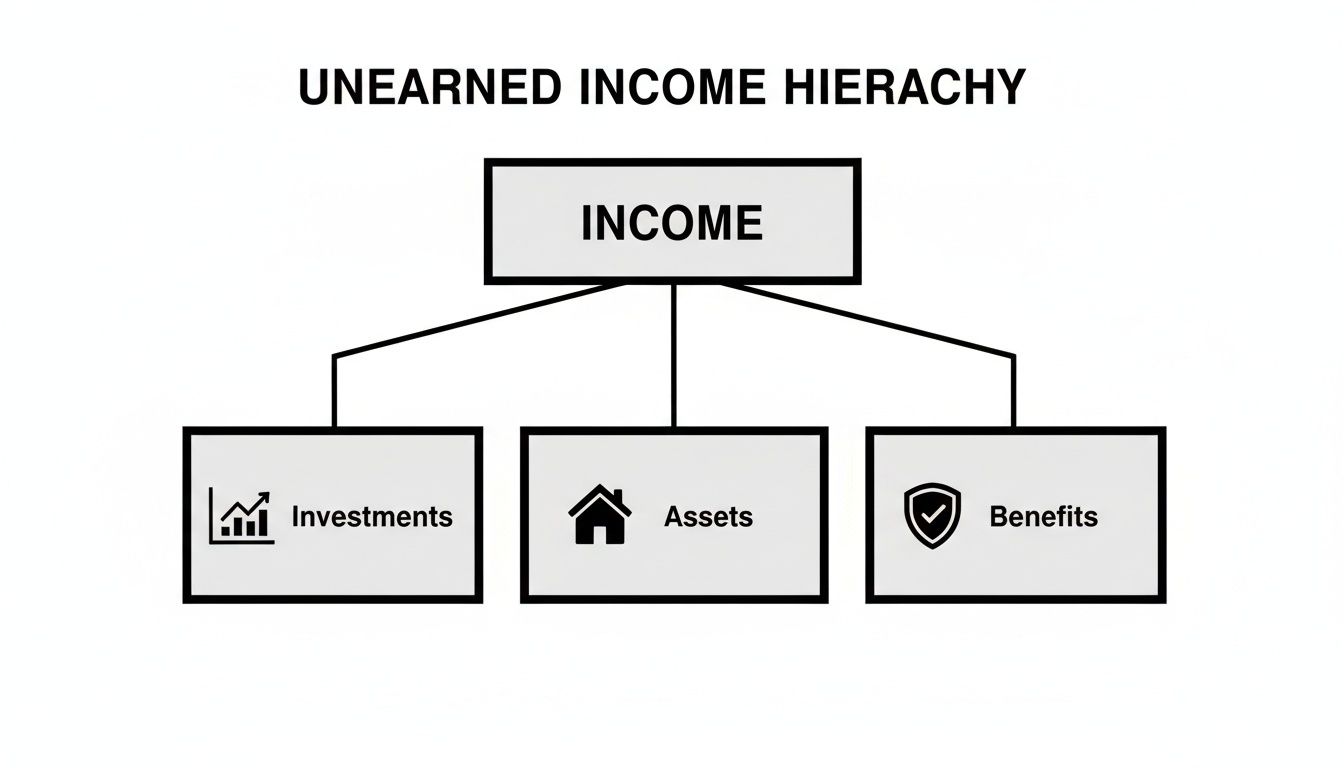
As you can see, money can flow from a lot of different places. And for each one, the IRS has a specific approach for how it shows up on your tax return.
Ordinary Income vs. Capital Gains Rates
The tax rate slapped on your unearned income hinges entirely on what kind of income it is. For investments, it also depends on how long you owned the asset that produced the gain.
- Ordinary Income: This is the most straightforward category. Things like interest from your savings account, most rental income, and short-term capital gains (from selling an asset you held for a year or less) are taxed at your regular income tax rate. Essentially, the IRS treats this money just like your salary.
- Capital Gains: This is where things get interesting. Profits from selling assets you've held for more than one year get special treatment. These long-term capital gains, along with certain types of dividends ("qualified dividends"), are taxed at much friendlier rates: 0%, 15%, or 20%, depending on your overall taxable income.
Understanding this split is a cornerstone of smart tax planning. Sometimes, holding onto an investment for just one more day can literally flip a switch, moving your profit from the high ordinary income tax bracket to a much lower long-term capital gains rate. To really dig into this, check out our guide on how capital gains tax explained.
Special Rules And Extra Taxes To Watch For
Beyond the basic rates, the tax code has a few curveballs, especially for higher earners or families with kids who have their own investment accounts.
First up is the Net Investment Income Tax (NIIT). If your income crosses a certain threshold, you could be hit with an extra 3.8% tax on top of your regular tax. This applies to most types of unearned income, including interest, dividends, capital gains, and rental income. It's an important one to plan for if you have a significant investment portfolio.
Then there’s the "Kiddie Tax." This rule was created to stop parents from dodging taxes by simply shifting their investments into their kids' names to take advantage of their lower tax brackets. If a child under 19 (or a full-time student under 24) has unearned income over $2,600 (for 2024), that income gets taxed at their parents' higher rate, not their own.
These tax rules have a massive real-world impact. Consider that the top 10% of global earners take home 53% of all income, while the bottom 50% get just 8%. A big reason for that gap is that unearned income, which flows from owning assets, tends to concentrate wealth at the top. This data on global economic inequity paints a pretty clear picture of how these financial systems work on a larger scale.
How to Report Unearned Income Correctly
Knowing you have unearned income is one thing, but getting it reported correctly to the IRS is where it really counts. Don’t worry, the process isn’t nearly as scary as it sounds. The key is understanding that different types of income have their own specific tax forms.
Think of these forms as a reporting system. The bank that paid you interest or the brokerage that sent you dividends sends a copy to you and another directly to the IRS. This creates a clear paper trail, so the IRS already has a good idea of your unearned income before you even sit down to do your taxes. Your job is simply to make sure the numbers on your return match the ones they already have. If they don't, their automated system will likely flag it, and that's when you get those dreaded letters in the mail.
Decoding the Tax Form "Alphabet Soup"
At first glance, IRS forms can look like a confusing jumble of letters and numbers. But once you know what to look for, it all starts to make sense. By January 31st, you should have received all the documents you need to get started.
Here are the most common forms you’ll encounter for unearned income:
- Form 1099-INT: This one is for interest income. If you earned more than $10 in interest from a savings account or CD at a single bank, they’ll send you this form.
- Form 1099-DIV: This form reports the dividends and capital gain distributions you earned from stocks and mutual funds. Knowing the 1099-DIV due date is handy so you know when to expect it in your mailbox.
- Form 1099-B: Did you sell stocks, bonds, or other investments? This form shows the proceeds from those sales, giving you the raw data needed to calculate your capital gains or losses.
- Schedule E (Form 1040): This isn't a form you receive, but one you fill out. It’s the designated spot for reporting income or losses from rental properties, royalties, and income from partnerships or S corporations.
Once you’ve gathered all your 1099s, the information usually transfers pretty straightforwardly onto your main Form 1040 and its related schedules.
Staying Ahead of Penalties with Estimated Taxes
One of the easiest traps to fall into with unearned income is the underpayment penalty. With a W-2 job, your employer withholds taxes from every paycheck. But with most unearned income, the money comes to you in full, with zero taxes taken out. It's up to you to set that money aside.
If you anticipate owing $1,000 or more in tax for the year from this income, the IRS expects you to pay your taxes as you earn them, not all at once in April.
This is done through quarterly estimated tax payments. You essentially pay your tax bill in four chunks throughout the year, which helps you avoid a massive surprise bill and, more importantly, a penalty.
If you skip these payments, you can be hit with a penalty—even if you pay the full amount you owe by the tax deadline. The government runs on a steady stream of revenue, and estimated payments are how they ensure that happens. For anyone with significant unearned income, planning for these quarterly payments is absolutely essential.
Tax Planning Strategies for Unearned Income

Knowing you have to report your unearned income is one thing. Actually managing it to your advantage is where the real power lies. Smart, proactive tax planning can make a massive difference in how much you owe, shifting your entire financial mindset from just following the rules to actively building wealth.
With the right moves, you can legally hold onto more of the money your assets are generating for you.
This kind of strategic thinking is more important than ever. We're living in a time of incredible wealth concentration—one analysis showed billionaire wealth recently shot up $2 trillion, growing three times faster than the previous year. This boom is a perfect example of unearned income, driven by appreciating assets and inheritance, with some projecting we could see our first trillionaires within a decade.
For most of us, though, effective planning isn't about that kind of scale. It’s about understanding and using the tools available to everyone.
Strategies for Investors
If you’re generating unearned income from stocks, bonds, or mutual funds, your two best friends are timing and strategic sales.
-
Time Your Asset Sales: This is a big one. The difference between short-term and long-term capital gains tax rates is huge. If you can hold onto a profitable asset for at least one year and one day before selling, your tax rate can plummet from as high as 37% (your ordinary income rate) to the much friendlier long-term rates of 0%, 15%, or 20%. Patience literally pays off.
-
Tax-Loss Harvesting: Don't let your investment losses go to waste. With tax-loss harvesting, you sell underperforming investments to realize a loss, which you can then use to cancel out your capital gains. If you have more losses than gains, you can deduct up to $3,000 of those losses from your regular income each year. Any leftover loss can be carried forward to future years.
Strategies for Property Owners
For those in the real estate game, collecting rent is only half the picture. The tax code gives landlords some powerful tools to lower their taxable unearned income.
The most important of these is depreciation. This allows you to deduct a portion of your property's value each year to account for wear and tear. The beautiful part? It’s a "paper" deduction—you get the tax break without actually spending any cash. This can be powerful enough to make a cash-flow-positive property show a loss on your tax return.
Key Takeaway: Smart tax planning isn’t about finding sketchy loopholes. It's about deeply understanding the rules and using them as they were intended—to your advantage.
Strategies for Retirees
Retirement often means juggling multiple streams of unearned income, from pensions and Social Security to 401(k) withdrawals. Careful planning is what makes those savings last. For federal employees, for example, figuring out how to reduce taxes on retirement income is a critical piece of the puzzle.
When you start combining these strategies—timing your investment sales, maximizing deductions like depreciation, and structuring your retirement withdrawals thoughtfully—you build a much stronger financial foundation. It’s how you legally minimize the tax bite on your unearned income and get closer to your wealth-building goals.
Common Questions About Unearned Income
As we've worked through the ins and outs of unearned income, from identifying where it comes from to crafting smart tax strategies, a few common questions always seem to pop up. Let's tackle some of the most frequent points of confusion to help you put these concepts into practice.
Is My Inheritance Considered Taxable Unearned Income?
The short answer is no. Generally, the inheritance you receive directly isn't considered taxable income on your federal return. The estate itself might have paid an estate tax before you ever saw the money, but that’s a separate issue handled by the estate.
The real key, though, is what happens after you receive it. Once that inherited asset is in your name—whether it’s a stock portfolio or a rental property—any new income it generates is all yours. And yes, it’s absolutely taxable unearned income. So, any dividends that start rolling in or rent checks you collect from tenants have to be reported to the IRS.
Can Unearned Income Make Me Ineligible for Tax Credits?
Yes, and this is a critical point that trips a lot of people up. Many valuable tax credits are specifically designed to help low-to-moderate-income families, and they have strict limits on how much investment income you can have before you're disqualified.
The best example is the Earned Income Tax Credit (EITC). If your investment income—a classic form of unearned income—goes over the annual limit (which was $11,600 for the 2024 tax year), you're automatically out. It doesn't matter how low your actual wages are; you simply won't qualify.
It’s not just tax credits, either. Supplemental Security Income (SSI) benefits are also affected. Any unearned income you receive reduces your SSI benefit dollar-for-dollar after a small $20 exclusion. It shows how even a little bit of unearned income can have a huge impact on your eligibility for these vital support programs.
What Happens If I Forget to Report Unearned Income?
This is one mistake the IRS will almost certainly catch. It’s not a matter of if, but when. The reason is simple: every bank, brokerage, and financial institution that pays you unearned income is required to send the same 1099 forms to the IRS that they send to you.
The IRS has powerful automated systems designed to play a matching game. When the income a company reports paying you doesn't show up on your tax return, it immediately throws up a red flag.
The most likely outcome is a CP2000 notice in your mailbox. This isn't a full-blown audit, but it's an official letter from the IRS proposing additional tax they believe you owe based on the information they have. On top of the back taxes, that bill will include penalties for underpayment and interest that's been racking up. It's crucial to deal with that notice right away to keep a small mistake from turning into a much bigger problem.
Navigating the world of unearned income, from capital gains to rental property rules, takes careful planning. At Allied Tax Advisors, our team of CPAs and enrolled agents builds personalized tax strategies to keep you compliant and financially optimized. Find out more about how we can help with your financial journey at https://alliedtax.com.