
When you’re thinking about deducting business meals, the first number that should pop into your head is 50%. For most food and beverage expenses you incur for your business, this is the magic number—you can only deduct half the cost.
This is the bedrock principle for this type of deduction, and getting it right is non-negotiable.
The 50 Percent Rule for Business Meals

So, why the 50% cap? The IRS knows you have to eat anyway, whether it’s for business or not. This rule is their way of splitting the difference. It acknowledges that the meal is a legitimate business expense while also accounting for the personal benefit you receive.
This isn’t some new, tricky regulation; it’s a long-standing part of the tax code. And it applies to the entire cost of the meal. That includes:
- The price of the food and drinks
- Sales tax
- The tip you give your server
Let’s walk through a real-world example. Say you take a potential client out for lunch. The bill comes to $120, you add a $25 tip, and the tax is $10. Your total out-of-pocket cost is $155. When you apply the 50% rule, your actual deduction is $77.50.
What Qualifies as a Business Meal
Before you can even think about the 50% rule, you have to be certain the meal actually qualifies as a business expense in the first place. The IRS has a few boxes you absolutely must check.
First, the meal has to be ordinary and necessary. “Ordinary” just means it’s a common and accepted expense in your line of work. “Necessary” means it was helpful and appropriate for your business. You don’t have to prove it was indispensable, just that it served a clear business purpose.
Second, the cost can’t be lavish or extravagant. This is a bit subjective, but it’s a “smell test.” A five-star Michelin dinner to close a small-time deal might raise eyebrows. The expense should feel reasonable for the business being conducted.
Key Takeaway: The entire deduction hinges on one thing: a clear business purpose. You have to show that you talked business before, during, or right after the meal. Just grabbing a bite with a colleague doesn’t cut it. There needs to be a substantial business conversation.
To give you a clearer picture, let’s break down the core requirements for the standard 50% deduction.
Standard 50 Percent Business Meal Deduction at a Glance
This table sums up the essential rules you need to follow for the standard 50% business meal deduction.
| Requirement | Description | Deductible Amount |
|---|---|---|
| Business Purpose | The meal’s primary purpose must be for a substantial business discussion. This must occur before, during, or immediately after the meal. | 50% of the total cost |
| Ordinary & Necessary | The expense must be common and helpful for your specific trade or business. | 50% of the total cost |
| Not Lavish or Extravagant | The cost must be reasonable under the circumstances. An unusually expensive meal could be disqualified. | 50% of the total cost |
| Taxpayer Presence | You or an employee must be present at the meal. | 50% of the total cost |
| Substantiation | You need detailed records: cost, date, place, business purpose, and business relationship of the people involved. | 50% of the total cost |
Think of these rules as your guideposts. As long as your meal expense fits within these parameters, you can confidently claim your 50% deduction.
It’s also worth noting that related rules can change. For instance, the IRS adjusts per diem rates for travel to keep up with inflation. The Meals & Incidental Expenses (M&IE) rate for 2025 rose to $68 from $59, as detailed in this guide to 2025 per diem rates from Engine. While this allows for more generous expense accounting on the road, the 50% limit on the deduction itself still applies to most standard business meals.
Mastering this core rule is a critical first step, as it unlocks a better understanding of the many other tax deductions and credits you might be missing.
The Ground Rules: What Makes a Meal Deductible?
Just because you’re talking business over a plate of food doesn’t mean the IRS will automatically let you write it off. Before you can even think about the 50% deduction, the meal itself has to pass a few key tests. Getting these right is the difference between a legitimate deduction and a red flag during an audit.
Think of these rules less as bureaucratic hoops and more as a way to prove the meal was truly for business. They work together to paint a clear picture of why the expense was a valid part of your operations.
Was the Meal “Ordinary and Necessary”?
First things first, any meal expense you claim has to be both ordinary and necessary. This is a classic IRS term, but what does it actually mean in the real world?
- An ordinary expense is one that’s common and accepted in your line of work. If you’re a marketing consultant, taking a new client out to a nice lunch to kick off a project is perfectly ordinary. For a general contractor, buying pizza for the crew on-site during a long day is also completely ordinary.
- A necessary expense is one that is helpful and appropriate for your business. It doesn’t mean it has to be absolutely indispensable. That lunch with the marketing client helped build rapport and clarify the project scope, making it a necessary part of the business relationship.
Context is everything here. What’s considered standard practice for a law firm closing a major case will be very different from a freelance photographer meeting a client at a coffee shop.
You (or an Employee) Had to Be There
This one is simple but non-negotiable: You or one of your employees must be present at the meal. You can’t just pick up the tab for a client’s dinner or send them a restaurant gift card and claim it as a meal deduction.
The entire point of this deduction is to cover the cost of conducting business during the meal. If no one from your company is there to actually discuss business, the expense is just a gift, which falls under different, more restrictive rules.
Key Takeaway: Your presence is what turns a meal into a legitimate business event. Someone from your company needs to be there to steer the conversation toward business matters.
Don’t Get “Lavish or Extravagant”
The IRS doesn’t expect you to pinch pennies, but it also won’t subsidize a wildly luxurious outing that’s out of sync with the business at hand. This “lavish or extravagant” rule is intentionally subjective because it all comes down to what’s reasonable for the situation.
There’s no magic dollar amount that makes a meal extravagant. It’s all about context.
For instance, celebrating the close of a $500,000 deal with a high-end steak dinner for a major client? That will likely be seen as perfectly reasonable. Spending that same amount on a weekly check-in lunch with a long-time supplier? That’s probably pushing it.
Ask yourself: would a reasonable person consider this expense appropriate given the facts and circumstances?
Business Had to Be the Main Event
Here’s the heart of the matter. To qualify for the deduction, you must conduct a substantial business discussion before, during, or immediately after the meal. Simply sharing a meal with a business contact and catching up doesn’t cut it.
- Weak Case: You run into an old colleague, grab lunch, and vaguely mention that you’re both “keeping busy.” That’s a personal lunch.
- Strong Case: You meet a potential customer for lunch specifically to walk them through your service proposal, map out a project timeline, and negotiate terms. That’s a deductible business meal.
You have to be able to show that the primary purpose of the meal was to advance your business interests. This is why taking good notes is so critical—it’s your proof.
When Meals Are 100 Percent Deductible

While the 50% rule is your day-to-day standard for business meals, don’t assume it applies to everything. The IRS has carved out a few important exceptions that allow you to deduct the entire cost—a full 100%.
Getting familiar with these situations is more than just good practice; it can seriously impact your bottom line. These aren’t sneaky loopholes. They’re specific scenarios the IRS considers fully deductible because they serve a distinct company-wide purpose, often by benefiting your employees or even the public.
Company-Wide Social Events
This is probably the most common—and most enjoyable—exception. Think about that annual holiday party or the summer picnic you host for your team. The food, drinks, and other related costs for these events are 100% deductible.
There’s one major condition, though. The event must be primarily for the benefit of your rank-and-file employees, not just the top brass. A party exclusively for the executive team won’t cut it. The gathering needs to be open to everyone on a non-discriminatory basis to qualify for the full write-off.
Key Takeaway: The whole point of this rule is to encourage morale-boosting activities. So go ahead and plan that employee appreciation dinner or retirement celebration. You get to reward your hardworking team and claim a full deduction for it.
Meals Provided for the Employer’s Convenience
Ever had to provide lunch just to keep everyone on-site and focused? That’s what the IRS calls a meal provided for the “convenience of the employer,” and it’s another ticket to a 100% deduction.
A perfect example is catering lunch during a mandatory, all-day training session. You’re providing the meal so the schedule stays on track, which is a clear business reason. The same logic applies when you buy dinner for employees who have to work late to hit a tight deadline. This is one of the more powerful yet often overlooked tax-saving strategies for freelancers and small business owners who have a team.
A Look Back at the Temporary 100% Deduction
Tax laws can and do change, sometimes in response to major economic events. We saw this play out recently with a temporary rule that allowed a 100% deduction on most business meals.
As part of an effort to boost the struggling restaurant industry during the pandemic, the Consolidated Appropriations Act of 2021 made a big change. For all of 2021 and 2022, businesses could fully deduct food and beverages purchased from restaurants. But this provision had a sunset date, and on January 1, 2023, the deduction reverted to the standard 50%. You can still find information about this temporary rule on the IRS website if you’re curious about the specifics.
While that particular perk is gone, it’s a great reminder of just how important it is to stay on top of tax law changes. What worked for your deductions last year might not apply this year. Vigilant financial management isn’t just about crunching the numbers—it’s about staying informed.
Keeping Flawless Records for Every Meal
Let’s be honest: a deduction without solid proof is just a gamble. If you can’t show the IRS the who, what, where, when, and why of a business meal, they have every right to throw it out during an audit. Creating an audit-proof system is about more than just keeping receipts in a shoebox—it’s about building a simple, bulletproof habit.
The best part? This doesn’t have to be complicated. All the information you need is right there when you pay the bill. The trick is to capture it on the spot before the details get fuzzy.
What Your Records Must Show
For every single business meal you claim, your records need to tell a complete story. A lone credit card statement with a restaurant name on it just won’t cut it with the IRS. You need to be more specific.
Whether you go digital or stick to paper, your documentation must clearly include:
- The Cost: The final bill, including the meal, tax, and tip.
- The Date: The exact day you had the meal.
- The Location: The name of the restaurant and the city it’s in.
- The Attendees: Who you met with and their business relationship. For example, “Jane Doe, potential client” or “John Smith, lead project supplier.”
- The Business Purpose: What did you actually talk about? “Discussed Q3 marketing strategy” is strong. “Business meeting” is weak and invites questions.
Once you have those details documented, calculating the actual deductible amount is straightforward. This infographic shows you how the 50% limit is applied.
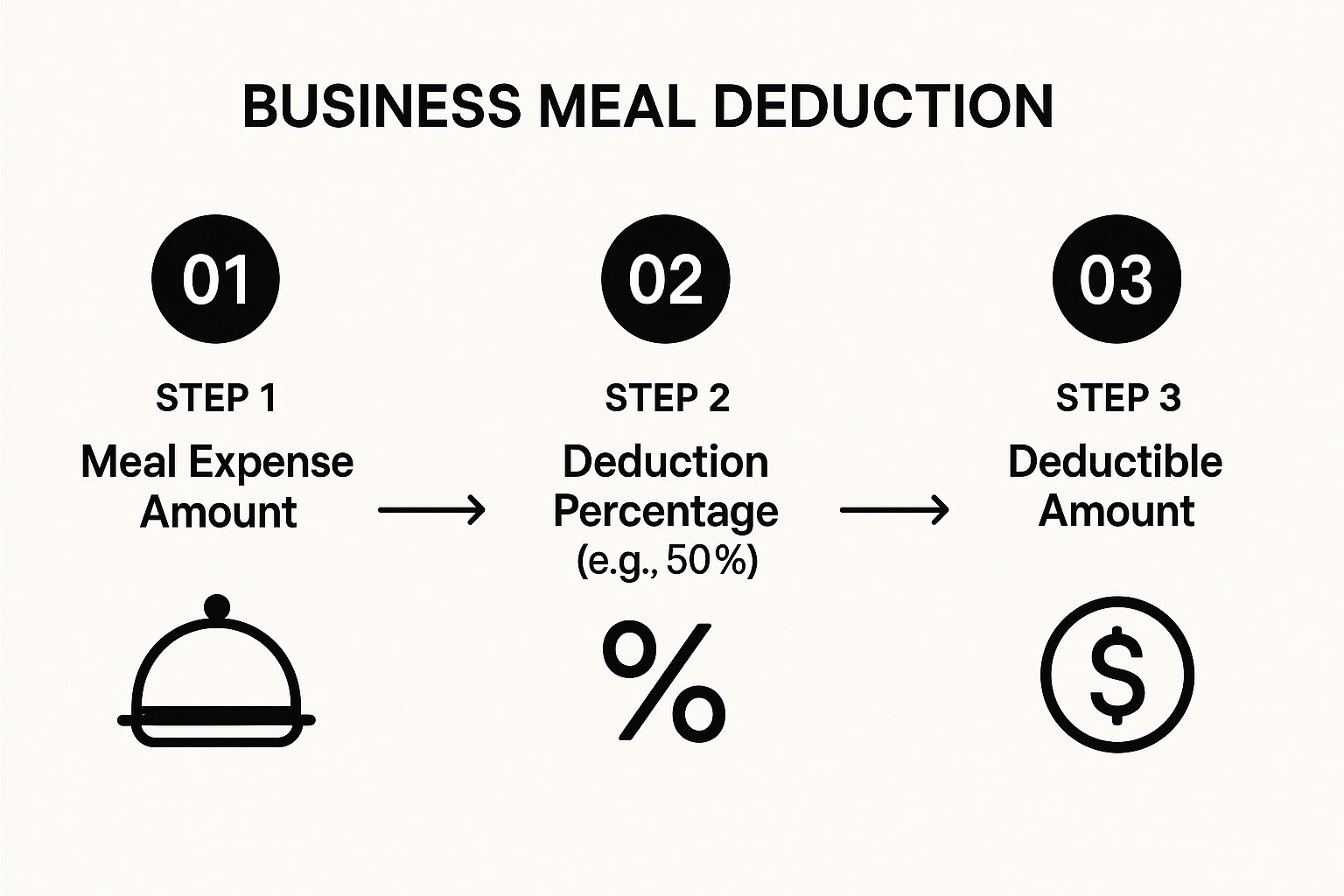
As you can see, the math is simple. The real work is in capturing the details that prove the meal was a legitimate business expense in the first place.
Let Technology Do the Heavy Lifting
Manually jotting down every detail gets old fast. This is where a good expense-tracking app becomes your secret weapon. Tools like QuickBooks or Expensify can make this process nearly automatic. Even the notes app on your phone works in a pinch.
My Go-To Method: The second the waiter brings the bill, I snap a photo of the itemized receipt. Most modern apps can scan it and instantly pull the date, location, and amount. I then spend literally 30 seconds adding a quick note: “Met with Sarah Jones (Acme Inc.) to finalize the new project scope.” Done.
Building this simple, real-time habit is the single most effective way to create an ironclad record of your business meal expenses. Meticulous records are your best defense against some of the most common tax filing mistakes to avoid and will give you complete peace of mind when you claim your deductions.
Drawing the Line Between Meals and Entertainment
Navigating the rules for business meal deductions can feel like walking a tightrope, especially when it comes to entertainment. A few years ago, a major tax law overhaul completely did away with deductions for entertainment, amusement, and recreation. That means those tickets to the football game, that round of golf, or the front-row seats at a concert are now 0% deductible, even if you’re wooing a major client.
This change puts the pressure squarely on business owners to be meticulous with their record-keeping. Let’s say you take a client to a sporting event. The price of the tickets is a business expense, but you can’t deduct a single dollar of it. However, the hot dogs and sodas you buy at the stadium? Those might still be deductible, but only if you play your cards right.
The whole thing hinges on what the IRS calls the “separate statement” rule. For the food and drinks part of an entertainment outing to be deductible, the cost has to be broken out separately from the entertainment cost on the receipt or invoice.
Why You Must Insist on a Separate Invoice
Imagine you’re treating a prospective client to a day at the ballpark. You spring for a private suite that comes with a food and beverage package. If the invoice you get just has one line item for “Suite Package,” you’re out of luck. The entire amount is considered non-deductible entertainment, and you can’t claim any of it.
But what if the invoice breaks it down? Let’s look at that scenario:
- Suite Tickets: $500 (This is 100% non-deductible entertainment)
- Food & Beverage Package: $200 (This is potentially 50% deductible)
Suddenly, the situation looks very different. With this itemized invoice, you can now claim a deduction on that $200 meal portion. Factoring in the standard 50% limit, that’s a $100 deduction you would have otherwise lost. A small detail on a piece of paper can have a real impact on your bottom line.
My Two Cents: Whenever you book an event that mixes fun with food, make it a habit to ask for an itemized bill upfront. Just explain you need it for your expense records. Venues deal with this all the time and are usually happy to oblige.
This distinction is absolutely critical. Remember, U.S. taxpayers are already limited to deducting just 50% of their business meal costs under Internal Revenue Code Section 274. For many businesses, food and drinks are a huge chunk of the budget for travel and client relations—sometimes as high as 40%. If you don’t separate those costs from entertainment, you’re forfeiting a deduction that’s already limited but still incredibly valuable. You can find more details on current meal deduction rules at pkfod.com.
At the end of the day, the IRS puts the burden of proof on you. The best way to protect your business is to be proactive. Always insist on clear, itemized receipts for any expense that combines business meals with what the tax code now considers pure, non-deductible fun.
Tackling Tricky Meal Deduction Scenarios
Once you get the basics down, you’ll inevitably run into those gray areas. Business doesn’t always happen in a textbook-perfect way, so knowing how to handle real-world situations is key. Let’s walk through some of the questions I hear most often from business owners.
What if I Cook for a Client at Home? Can I Deduct Groceries?
Absolutely. If you host a client for a home-cooked meal, the groceries you buy for that specific meal are deductible. Think of the grocery receipt as your restaurant bill.
The same rules we’ve been discussing still apply. You’ll need to keep that receipt and document who was there, their business relationship to you, and what specific business matters you discussed. And just like a meal at a restaurant, this expense is subject to the 50% limitation.
What About Coffee and Donuts for the Team?
This is a classic one. The answer hinges entirely on who is in the room.
- Just your employees? This can often be 100% deductible. The IRS generally sees this as a “de minimis” (or minimal) fringe benefit—a small, occasional perk that’s just not practical to track on an individual employee level.
- Clients or partners present? If you bring in anyone from outside the company, the expense almost always falls back to the standard 50% rule.
The bottom line, as always, is documenting that a real business meeting happened.
Expert Tip: Don’t forget that the “total cost” of a meal includes everything. That means the food, sales tax, delivery fees, and even the tip. You add all of that up before you apply the 50% cut. So, a $100 all-in bill gives you a $50 deduction.
Can I Write Off Lunch with My Business Partner?
Tread very carefully here. This is one of the first things an auditor will question, so your justification needs to be rock-solid.
Simply grabbing a “catch-up” lunch together almost never qualifies. The IRS’s perspective is that you have ample opportunity to talk business at the office. To make this deduction stick, you have to prove that the meeting was for a specific, pre-planned purpose that couldn’t have been handled during a typical workday.
For example, a lunch meeting to privately discuss a sensitive year-end partner bonus structure or to hammer out the final details of a confidential acquisition might hold up. You need a formal agenda and detailed notes. A simple “business discussion” scribble on the receipt just won’t cut it.
Figuring out these details is where having a professional in your corner really pays off. At Allied Tax Advisors, we go beyond the black-and-white rules to help you apply them strategically to your actual business. Book a consultation with our team and let’s make sure you’re confidently claiming every single deduction you deserve.