
If you’re a real estate investor, you’ve probably heard about depreciation. It’s one of the most powerful tax deductions out there, but many people don’t fully grasp what it is or how it works. Let’s clear that up.
At its core, depreciation is a way for the IRS to let you write off the cost of your rental property over time. It’s not about the property’s actual market value going down. In fact, your property could be gaining value every year, and you’d still get to claim this deduction. It’s a non-cash expense, meaning you deduct it on paper without actually spending any money that year, which is a huge win for lowering your taxable income.
What Is Depreciation on a Rental Property, Really?
The best way to think about it is to compare your rental building to a piece of business equipment, like a delivery truck. Over years of use, that truck will experience wear and tear, and its value will decrease. The IRS understands that your rental building—the structure itself, not the land it sits on—also wears out from tenants, weather, and general aging. Depreciation is how you account for that gradual decline on your tax return.
This is a critical distinction: depreciation is a tax concept, not a market valuation. You’re simply recovering the cost of the asset you bought to produce income.
The real magic of depreciation is that it creates a “paper loss.” This loss can offset your real rental profits, often reducing your tax bill to zero or even creating a loss you can use to offset other income. It’s a game-changer for your cash flow.
The Three Pillars of Depreciation
To really get a handle on this, you need to understand the three components that go into the calculation. Everything flows from these core concepts. We’ll dive deeper into each one later, but for now, here’s a quick look.
To make these concepts easier to digest, here’s a quick summary table.
Key Depreciation Concepts at a Glance
| Concept | Brief Explanation | Why It Matters |
|---|---|---|
| Property’s Basis | Your starting point for the calculation. It’s what you paid for the property, plus certain closing costs, minus the value of the land. | Getting this wrong is a common mistake. If your basis is off, every year’s depreciation deduction will be incorrect. |
| Useful Life | The set period over which the IRS says you can depreciate the property. For residential rentals, it’s always 27.5 years. | This is a non-negotiable number set by the IRS. It determines how your total deduction is spread out over time. |
| Depreciation Method | The formula used for the calculation. For residential rentals, you’ll almost always use the Modified Accelerated Cost Recovery System (MACRS). | This method dictates a straight-line calculation, ensuring you deduct an equal amount of depreciation each full year you own the property. |
These three pillars are the foundation of your entire depreciation strategy.
Think of them as the legs of a stool—if one is wobbly, the whole thing is unstable. For example, a common mistake is failing to properly separate the land value from the building’s value when calculating your basis. Since land doesn’t depreciate, getting that allocation wrong can lead to serious calculation errors and potential red flags with the IRS.
By mastering these fundamentals, you’re not just learning a tax rule; you’re unlocking one of the greatest financial benefits of being a real estate investor.
Establishing Your Property’s Depreciable Basis
Before you can even think about calculating your annual depreciation deduction, you need to lock in your starting number. This figure is called your basis, and getting it right is the bedrock of all your future depreciation claims. Think of it as the official “cost” of your property from the IRS’s perspective.
Your journey to finding the basis starts with the purchase price, but it definitely doesn’t stop there. It also includes many of the settlement and closing costs you paid to acquire the property. These are the expenses that were necessary to get the property into your hands and ready to rent.
Calculating Your Initial Cost Basis
To figure out your initial cost basis, you’ll begin with the contract price and then tack on certain other expenses from the closing table. Adding these costs gives you a truer picture of your total investment.
Common costs you can roll into your basis include:
- Legal and recording fees: Payments to attorneys, for document prep, and for recording the new deed.
- Abstract fees and title insurance: The costs of making sure the property’s title is clean and undisputed.
- Surveys: The fee for having the property lines professionally mapped out.
- Transfer or stamp taxes: Any state or local taxes you had to pay to transfer the property title.
- Owner’s title insurance: The policy you bought to protect your ownership rights.
- Certain seller debts: Any of the seller’s outstanding debts, like back taxes, that you agreed to pay as part of the deal.
Basically, if a fee was essential to the purchase itself, it can usually be added to your basis. For a deeper dive into how all these costs fit into your overall tax strategy, check out our guide on the taxation of rental properties.
A word of caution: It’s a common mistake to assume all closing costs get added to your basis. Expenses like lender’s title insurance, points you paid to secure your mortgage, or property insurance premiums are generally not included. The IRS views these as costs of financing your loan, not costs of acquiring the actual property.
The Crucial Step: Separating Land from Building
Here’s probably the most important rule you need to know when figuring out your basis for depreciation: you can only depreciate the building, not the land it sits on. The reasoning is simple—land doesn’t wear out, get used up, or become obsolete. Because of this, you have to subtract the value of the land from your total cost basis. What’s left is your depreciable basis.
Getting this wrong is one of the most frequent and expensive errors I see investors make. So, how do you put a reasonable value on the land? You have a couple of accepted methods.
1. Use the Tax Assessor’s Valuation: Your local property tax bill is a great place to start. It often provides separate assessed values for the land and the building. You can use that ratio to allocate your total cost. For instance, if the county assessor values the building at 80% of the total property value, you would apply that same percentage to your total cost basis.
2. Get a Professional Appraisal: A formal appraisal gives you a highly defensible valuation for both the land and the structure. Yes, it costs money, but it provides a strong, accurate number that is far less likely to be questioned by the IRS.
Let’s walk through a quick example.
Suppose you bought a rental house for $350,000. Your allowable closing costs (like legal fees and transfer taxes) came to $10,000. That brings your total cost basis to $360,000.
You pull out your property tax assessment, which values the land at $72,000 and the building at $288,000. A little math shows the building represents 80% of the total assessed value ($288,000 ÷ $360,000).
To find your depreciable basis, you just apply that percentage to your total cost basis:
$360,000 x 80% = $288,000
In this case, $288,000 is your depreciable basis. That’s the magic number you’ll use to calculate your annual depreciation deduction over the next 27.5 years.
Alright, you’ve figured out your property’s depreciable basis. Now for the fun part: turning that number into an actual tax deduction. This is where we translate the idea of “wear and tear” into cold, hard cash savings on your tax return.
For any residential rental property put into use after 1986, the IRS has a specific formula you must follow. It’s called the Modified Accelerated Cost Recovery System (MACRS). Don’t let the complicated name fool you; for real estate investors, it’s actually quite straightforward.
This infographic lays out the whole process visually, showing you how to pull everything together.
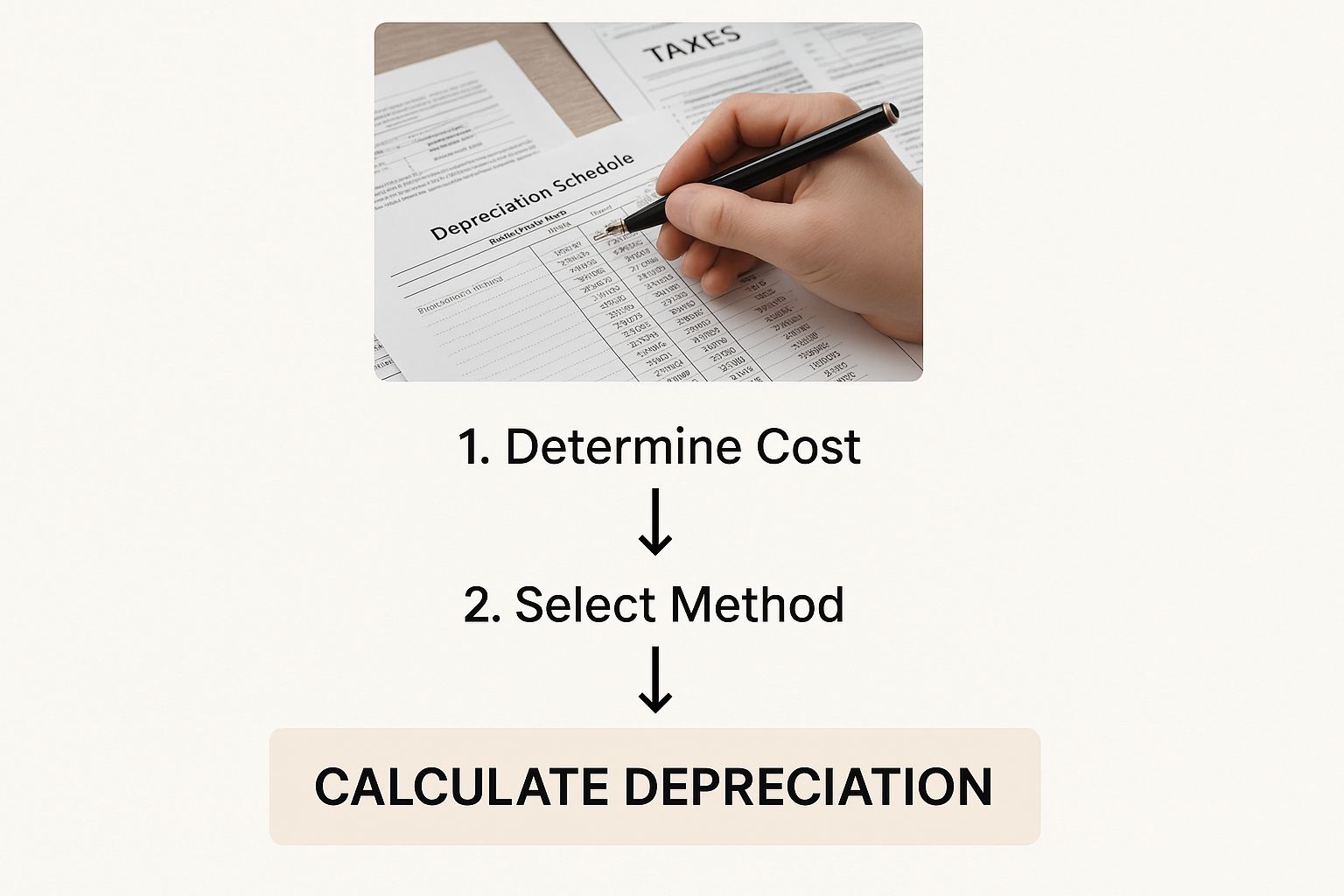
As you can see, it’s a matter of gathering the right financial documents to land on your final deduction.
The 27.5-Year Rule with GDS
Under the MACRS umbrella, you’ll use the General Depreciation System (GDS). The most critical piece of information here is the recovery period GDS sets for all U.S. residential rental properties: 27.5 years. This isn’t a suggestion—it’s the fixed timeline.
This means you get to deduct the value of your building in equal pieces over that 27.5-year span. Because MACRS for residential properties uses a straight-line method, you’ll write off the same amount every full year you have the property in service.
The math is simple division:
Depreciable Basis / 27.5 Years = Annual Depreciation Deduction
Let’s stick with our earlier example, where your depreciable basis was $288,000.
$288,000 / 27.5 = $10,473
That’s a $10,473 deduction you can take against your rental income every single year. It’s a powerful “phantom” deduction because it doesn’t require you to spend any actual cash, yet it directly lowers your tax bill and boosts your cash flow. Of course, this is just one piece of the puzzle; for a complete picture, check out our guide on how to maximize your mortgage interest deduction.
Quick heads-up: For the first and last years you own the property, the deduction is prorated. The IRS provides specific percentage tables to figure this out based on the month you put the property into service.
A Smarter Strategy: Cost Segregation
The standard straight-line method is reliable, but it’s not always the best way to get the biggest tax savings now. For that, savvy investors use a more advanced approach called cost segregation.
Think of your property less like a single, solid block and more like a bundle of different components. The building’s structure is built to last, but things like carpets, appliances, and fences wear out much faster. Cost segregation is the process of identifying those individual components and depreciating them on their own, much shorter IRS-approved schedules.
This strategy can dramatically boost your deductions in the early years of ownership, freeing up a significant amount of cash.
Identifying Faster Depreciation Schedules
So, what parts of your property can you write off more quickly? A cost segregation study, usually done by a specialized engineer, pinpoints these assets for you.
Here are some common examples of property components and their shorter recovery periods:
- 5-Year Property: This includes assets like carpeting, appliances (stoves, refrigerators, etc.), and some light fixtures.
- 15-Year Property: This covers land improvements that aren’t part of the building itself, like adding a fence, sidewalk, or driveway.
- 27.5-Year Property: This is the main structure—the foundation, walls, roof, plumbing, and electrical systems.
By separating a $5,000 carpet from the building’s main cost basis, you could get a $1,000 annual deduction for five years, instead of the tiny $182 per year you’d get by lumping it into the 27.5-year schedule. It’s a massive difference.
While a full-blown cost segregation study requires hiring a professional, the tax savings can be enormous, especially on larger properties. It takes the standard depreciation on rental property from a simple annual chore to a powerful tool for strategic financial planning.
How to Report Depreciation on Form 4562
You’ve done the heavy lifting and calculated your annual depreciation. That’s a huge step, but the job isn’t quite done. Now, you have to report that deduction correctly to the IRS to actually realize the tax savings. This is where IRS Form 4562, Depreciation and Amortization, comes into play.
Think of Form 4562 as the official scorecard for all your depreciable assets for the year. It’s not just for the rental house itself; you’ll also list things like new appliances, a fence, or any other major improvements you’ve “placed in service.” Getting this form right is absolutely critical for filing an accurate, audit-proof tax return.
Navigating the Key Sections of the Form
Form 4562 can look a bit daunting at first glance, but don’t worry. As a residential landlord, you’ll likely spend most of your time in one specific area: Part III, MACRS Depreciation.
This is where you’ll lay out all the essential details for your rental property. The IRS needs to see a clear breakdown, so be prepared with this information:
- The depreciable basis of the property (remember, this is the building’s value, not the land).
- The date the property was placed in service (the day it was officially ready for tenants).
- The recovery period, which is a standard 27.5 years for residential rentals.
- The depreciation method, which you’ll note as “S/L” for straight-line.
- Your calculated depreciation deduction for the tax year.
Here’s a snapshot of the form itself, straight from the source.
This image shows the top of Form 4562. It’s the central hub for reporting all depreciation and amortization related to your business activities, including your rental properties.
From Form 4562 to Schedule E
Once you’ve completed Form 4562 and have your total depreciation figure for the year, there’s one last move to make. You’ll carry that number over to another key document: Schedule E (Supplemental Income and Loss). This is the main form where you report your rental income and all your expenses.
Your total depreciation deduction from Form 4562 gets entered on line 18 of Schedule E.
This is where the magic really happens. That depreciation figure reduces your total rental income, directly lowering your taxable profit for the year—all without you spending another dime out-of-pocket. A smaller profit means a smaller tax bill. Simple as that.
I can’t stress this enough: meticulous record-keeping underpins this entire process. You need a clear depreciation schedule for every single asset, tracking its basis, when it was placed in service, and the total depreciation you’ve claimed over time. This isn’t just about being organized; it’s your primary defense if the IRS ever comes knocking. Solid records ensure your depreciation on rental property is both maximized and completely defensible.
The Hidden Tax of Depreciation Recapture
For years, depreciation feels like a landlord’s best-kept secret. It’s a fantastic paper deduction that lowers your tax bill every year without you having to spend a dime. But there’s a catch, and it’s a big one. The IRS has a long memory, and when you decide to sell your rental property, they come to collect what’s owed. This is called depreciation recapture.
Ignoring this can lead to a nasty shock when you see the final numbers at closing. Think of it this way: the IRS let you deduct the property’s “wear and tear” all those years. When you sell it, especially for a profit, the government essentially says, “Okay, you got a tax break on that value, but now you have to pay it back.”
How Recapture Is Taxed
Here’s where many investors get tripped up. The money you “pay back” through recapture is not taxed at the friendly long-term capital gains rates (0%, 15%, or 20%). The IRS has a special rate just for this.
Your recaptured depreciation is taxed at your ordinary income tax rate, but it’s capped at a maximum of 25%. For most investors, that’s a significantly higher tax bite than they were expecting on their profit.
This isn’t a minor detail—it can dramatically shrink your net proceeds from the sale. That higher tax rate carves directly into the equity you’ve worked so hard to build. Knowing about this potential tax bill ahead of time is absolutely critical for smart financial planning. It’s always wise to explore every possible tax break, and you can learn about more strategies in our guide on the top deductions and credits you might be missing.
Depreciation Recapture in Action
Let’s put this into a real-world context to see the financial impact.
Suppose you bought a rental property 10 years ago. The depreciable basis (the part of the property you can write off) was $300,000. Over that decade, you claimed $100,000 in depreciation, which reduced your adjusted basis to $200,000. Today, you sell the property for $450,000.
Here’s how the IRS breaks down your gain:
- Calculate Your Total Gain:
- Sale Price: $450,000
- Adjusted Basis: $200,000
- Total Gain: $250,000
- Split the Gain into Two Parts:
- Depreciation Recapture: The first $100,000 of your gain is considered recaptured depreciation. This amount gets taxed at your ordinary income rate, up to that 25% cap.
- Capital Gain: The rest of the profit, $150,000 ($250,000 total gain – $100,000 recapture), is a true long-term capital gain. This portion is taxed at the lower 0%, 15%, or 20% rate.
That $100,000 slice of recaptured depreciation could trigger a tax bill as high as $25,000 all on its own. That’s a check no one wants to write unexpectedly.
A Powerful Strategy to Defer Taxes
Luckily, you don’t just have to sit back and take the hit. A 1031 exchange is a game-changing tool for real estate investors. Named after Section 1031 of the U.S. tax code, this strategy allows you to sell an investment property and roll the entire sale proceeds into a new “like-kind” property.
When done correctly, you defer both the capital gains tax and the depreciation recapture tax. You’re not avoiding taxes forever, but you are kicking the can down the road, allowing your full investment to keep working and growing for you. It’s a cornerstone strategy for building serious long-term wealth in real estate.
How Economic Shifts Affect Your Depreciation Strategy

Your rental property doesn’t exist in a vacuum. It’s deeply connected to the wider economy, and big shifts like changing interest rates or real estate market cycles can dramatically alter your investment’s performance. More importantly, they can change how you should think about your tax strategy.
Grasping this connection is what sets a savvy, strategic investor apart from a passive landlord. When the economic winds change, your depreciation deduction can transform from a simple tax perk into a vital tool for financial survival and growth.
Rising Interest Rates and Cash Flow Pressure
Let’s start with one of the biggest economic movers: interest rates. When rates climb, so does the cost of borrowing money to buy or refinance a property. This increase slices directly into your profits.
For investors, this can create intense pressure. The commercial real estate world, for example, often reels when rising rates cause debt servicing costs to skyrocket—sometimes by as much as 75% to 100% compared to what they were in a low-rate environment. This puts a serious squeeze on investors who depend on rental income to cover their costs. You can find more great insights into the risks facing real estate investors on alliancecgc.com.
In these tight-margin situations, your depreciation deduction becomes more valuable than ever. It’s like a financial shield, lowering your taxable income and freeing up cash that would otherwise be destined for the IRS. This can easily be the difference between a profitable year and a painful loss.
When rising interest rates shrink your cash flow, depreciation isn’t just a nice-to-have deduction. It becomes a vital lifeline that helps protect your income and preserve the financial health of your investment.
Market Cycles and Property Valuation
Real estate markets have a natural rhythm. They move through cycles of growth, stability, and decline, and these phases directly impact your property’s value. This, in turn, should influence your investment strategy and how you view your depreciation claims.
- In a Booming Market: When property values are shooting up, your focus might naturally shift to building equity and chasing long-term capital gains. Depreciation is still a fantastic annual benefit, but the massive growth in your property’s worth often steals the show.
- In a Stagnant or Declining Market: When values flatten out or even drop, cash flow becomes king. During these times, maximizing your annual depreciation on rental property is absolutely critical. The tax savings it generates can prop up your overall returns when market appreciation has gone missing in action.
On top of this, higher borrowing costs often lead to higher capitalization rates (cap rates), which can push property values down. A lower property value could mean a smaller depreciable basis on your next purchase, making it even more important to wring every last dollar out of your available deductions.
How Economic Factors Influence Your Rental Investment
The table below breaks down how different economic climates can affect your rental property’s key metrics, highlighting why depreciation is such a versatile tool.
| Economic Factor | Impact on Property Value | Impact on Cash Flow | Importance of Depreciation |
|---|---|---|---|
| Low Interest Rates | Tends to increase values as borrowing is cheap and demand rises. | Higher, as financing costs are low. | Important for tax efficiency and boosting already good returns. |
| High Interest Rates | Can decrease values as borrowing is expensive, cooling demand. | Lower, as debt service costs increase significantly. | Critical for protecting thin margins and preserving cash flow. |
| Strong Economy | Property values and rents typically increase. | Generally strong, with high occupancy and rising rents. | A key tool for sheltering higher rental income from taxes. |
| Weak Economy | Values may stagnate or fall; rent growth slows. | May weaken due to vacancies or inability to raise rents. | Essential for generating returns and offsetting weak performance. |
By learning to spot these patterns, you can become more agile. You’ll be able to adjust your strategy on the fly, using depreciation as a flexible financial lever to navigate whatever economic weather comes your way.
Common Questions About Rental Property Depreciation
Even after you’ve got the basics down, real-world investing always throws a few curveballs. When it comes to depreciation on rental property, knowing how to handle these unique situations is what separates a good investor from a great one. Let’s tackle some of the most common questions I hear from property owners.
Can I Depreciate a Property I Just Started Renting?
Yes, you can. The clock on depreciation starts ticking the moment your property is “placed in service.” That’s just the official IRS term for when it’s ready and available for a tenant to move in. It doesn’t matter if you lived in it yourself for a decade before that.
The key difference is how you figure out your starting point for depreciation, or your basis. When you convert a personal home into a rental, your depreciable basis is the lesser of these two figures:
- The property’s Fair Market Value (FMV) on the day you make it available for rent.
- Your adjusted cost basis (what you originally paid, plus the cost of any capital improvements you made along the way).
This rule is in place for a simple reason: it stops you from depreciating a loss in value that happened while the property was your personal residence, not a business asset.
How Do I Handle Major Improvements?
So, what about that brand-new roof you just installed or the kitchen you completely gutted and remodeled? Those aren’t everyday repairs. They’re significant upgrades that either add real value to your property or extend its useful life.
The IRS treats each of these major improvements as its own separate asset. That new roof gets its own, brand-new 27.5-year depreciation schedule, starting from the date it was completed and ready for use.
This means you’ll end up with multiple depreciation schedules running at the same time—one for the original building and another for each major project. Keeping detailed, organized records for every single improvement isn’t just a good idea; it’s absolutely essential.
What If I Forgot to Claim Depreciation?
This happens more often than you’d think, and unfortunately, it can be a costly mistake. If you realize you haven’t claimed depreciation for a few years, you can’t simply go back and amend your old tax returns. The IRS has a specific process you have to follow.
To get back on track and claim those missed deductions, you’ll need to file Form 3115, Application for Change in Accounting Method. This form lets you take a one-time “catch-up” deduction for all the depreciation you should have claimed in prior years.
Dealing with this is critical because of the IRS’s “allowed or allowable” rule. When you sell the property, they will tax you on the depreciation you were allowed to take, whether you actually took it or not. If you forgot to claim it, you get none of the yearly tax savings but still get hit with the full recapture tax bill at the end. It’s truly the worst of both worlds.
Navigating the complexities of rental property taxes requires more than just filling out forms; it requires a strategic partner. Allied Tax Advisors specializes in helping real estate investors optimize their tax position, from depreciation planning to audit support. Discover how our expertise can secure your financial success.