
That moment you open an envelope from the IRS and see a number with way too many zeros is enough to make your heart sink. It’s a jarring experience, but the absolute worst thing you can do is shove it in a drawer and hope it goes away. Trust me, it won’t.
Instead, take a breath. That notice is your starting point, not the final verdict. Let’s walk through how to methodically break it down, check its accuracy, and figure out your next move.
First Steps for Tackling a Large Tax Bill

That piece of paper might feel like an accusation, but it’s really just a conversation starter. The IRS thinks you owe more money, and now it’s your turn to understand why and verify if they’re right. More often than not, a big tax bill isn’t from one single error but a perfect storm of financial events from the past year.
Common Causes for a Sudden Tax Increase
- Freelance or Gig Work: If you earned income reported on a 1099-NEC or 1099-K, no taxes were withheld. This leaves you on the hook for the entire bill, which includes the often-surprising 15.3% self-employment tax on top of regular income tax.
- Investment Gains: Cashing in on stocks, crypto, or real estate feels great until the tax bill arrives. If you didn’t proactively set aside money for capital gains, that profit can lead to a hefty tax liability.
- Under-Withholding: Did you get a big raise or a bonus? Your W-4 withholding at your day job might not have kept up, meaning you paid too little in taxes throughout the year.
- Changes in Filing Status: Life events have major tax consequences. A divorce, for instance, can bump you into a less favorable tax bracket and slash your standard deduction, resulting in a higher bill than you’re used to.
On a broader scale, it’s also smart to be aware of major legislative shifts. The “One Big Beautiful Bill Act,” for example, is one of the most significant pieces of federal tax legislation since 2017. Analysis shows its main provisions could reduce federal revenues by a massive $5.0 trillion over the next 10 years. Understanding the impact of a deeper analysis of this tax plan helps you see the bigger picture and how it might shape tax strategies down the road.
Key Takeaway: Your tax notice isn’t a dead end. It’s a road map showing where the IRS thinks a discrepancy is. Your job is to double-check that map before you start driving.
To get started right away, here’s a quick-reference table that outlines the first critical steps you should take.
Immediate Action Plan for Your Tax Bill
| Step | Action Required | Why It’s Important |
|---|---|---|
| 1. Don’t Ignore It | Read the entire notice carefully. Note the due dates and contact information immediately. | Deadlines are real. Ignoring them adds penalties and interest, making the problem bigger. |
| 2. Verify the Basics | Check your Name, SSN, and Address. Confirm the tax year mentioned in the notice. | Simple clerical errors happen. You don’t want to deal with a bill that isn’t even yours or is for the wrong year. |
| 3. Identify the Notice Type | Look for the notice number (e.g., CP2000, CP504) in the top right corner. | This tells you if it’s a proposal (CP2000) or a final demand (CP504), which dictates how urgently you need to respond. |
| 4. Cross-Reference Your Records | Pull out your tax return for that year and compare it to the changes the IRS is proposing. | The IRS might have received a 1099 you forgot about. This step helps you find the exact source of the disagreement. |
Following these initial steps gives you a solid foundation to build your response and regain control of the situation.
How to Decode Your IRS Notice
Before you can form a plan, you have to be sure the bill is even legitimate and accurate. Start with the simple stuff: Is your name spelled correctly? Is the Social Security number right? Then, look at the tax year. It’s a common mistake to think a notice that arrives in April is for last year’s taxes when it could easily be for an audit from two or three years ago.
Next, you need to understand what kind of notice you’re holding. This is crucial. A CP2000 notice, for example, is just a proposal. It means the IRS’s computers found a mismatch between the income you reported and the information they got from employers or banks. It’s an invitation to either agree or explain the difference.
On the other hand, a notice like a CP504 is far more serious. This is a final demand for payment and a warning that the IRS is about to start collection actions, like levying your bank account. Knowing the difference tells you exactly how much time you have to get your ducks in a row.
Uncovering Savings Before You Pay

Before you throw in the towel and write that huge check to the IRS, take a breath. It’s crucial to pause and treat your tax return like a detective with a fresh case file. I’ve seen it time and time again—tax bills get inflated by simple oversights and missed opportunities during the original filing. This is your moment to do a thorough review and claw back some savings.
Think of it as getting a financial second opinion on your own return. Were you a student? It’s easy to overlook education credits like the American Opportunity Tax Credit. Did you start a business or side hustle from home? The home office deduction rules can be tricky, but many eligible self-employed people leave this valuable deduction on the table every year.
Taking the time for this proactive review can turn what feels like a tax crisis into a much more manageable situation. The goal is to make sure you’re paying what you actually owe, and not a penny more.
Finding Common Errors and Omissions
First things first: gather all your financial documents for that tax year. I mean everything. Then, meticulously compare them against what you reported on your Form 1040. It’s surprisingly easy to miss a small 1099-INT from a savings account you barely use, or to forget about those automatic charitable donations from your paycheck.
Here are a few common areas I always tell my clients to double-check:
- Medical Expenses: If you had significant medical or dental bills, this is a big one. You can deduct the portion of your medical expenses that is more than 7.5% of your adjusted gross income (AGI), but only if you itemize.
- Student Loan Interest: This is a gem because you might be able to deduct the interest you paid on student loans even if you don’t itemize.
- State and Local Taxes (SALT): The SALT deduction is capped, but many people still don’t maximize it. Did you forget to include state estimated tax payments you made? Or the sales tax on a major purchase, like a new car?
These details might seem small on their own, but they can add up to significant savings. For a more exhaustive checklist, our guide on how to reduce your tax bill with top deductions and credits is a fantastic resource.
Correcting Mistakes with an Amended Return
So, what happens if you find a mistake or a juicy deduction you missed? Don’t panic. This is exactly what the IRS has a process for. You can correct your return after it’s been filed using Form 1040-X, Amended U.S. Individual Income Tax Return.
Pro Tip: You typically have three years from the date you filed the original return (or two years from the date you paid the tax, whichever is later) to file Form 1040-X and claim a refund.
Filing an amended return isn’t an admission of wrongdoing, and it’s not an automatic red flag for an audit. It’s a standard, routine procedure. On the form, you’ll simply explain the changes and calculate your new, correct tax amount. If the changes mean you owe less, the IRS will adjust your account, which could shrink or even completely wipe out that daunting tax bill. This one step might be the most powerful move you can make.
So, you’ve double-checked the numbers, and that big tax bill isn’t going anywhere. Now what? The most pressing question is how you’re going to pay it. If writing a check for the full amount isn’t an option, don’t panic. The IRS actually has several structured payment solutions to help you get things sorted out without the threat of aggressive collections looming over you.
The trick is to be proactive. You need to get ahead of the problem by choosing the right plan for your specific financial circumstances. It’s more than just picking an option from a list; it’s about finding a strategy that stops penalties and interest from piling up, letting you clear the debt without breaking the bank.
IRS Payment Plan Comparison
To help you figure out the best path forward, let’s break down the most common IRS payment solutions. Each one is designed for a different scenario, so matching your situation to the right plan is crucial.
| Payment Option | Best For | Key Considerations |
|---|---|---|
| Short-Term Payment Plan | Taxpayers who need a little extra time (up to 180 days) and expect a cash infusion soon (like a bonus or commission check). | Interest and penalties continue to accrue. No setup fee for online applications, making it a simple, low-cost extension. |
| Installment Agreement | Larger tax debts that will take more than six months to pay off (up to 72 months). | You must have filed all tax returns. Best for combined balances under $50,000. Setup fees apply, but it prevents aggressive collection actions. |
| Offer in Compromise (OIC) | Individuals facing severe financial hardship who can prove they will likely never be able to pay the full amount owed. | This is a last resort, not a negotiation tool. Requires extensive financial documentation and is subject to strict IRS formulas. |
Ultimately, the goal is to get into compliance with the IRS in a way that’s manageable for you. The Short-Term Plan and Installment Agreement are the go-to choices for the vast majority of people.
Need a Little Extra Time? Consider a Short-Term Payment Plan
A Short-Term Payment Plan is often the perfect first move if you just need a bit more breathing room. This gives you up to 180 additional days to pay your entire tax bill. I often recommend this for clients who are just waiting on a commission check, a bonus, or some other expected cash flow that simply won’t arrive before the tax deadline.
Of course, interest and late-payment penalties will keep ticking until the balance is zero. But the huge benefit here is that there’s no setup fee when you apply online. It’s a straightforward extension that keeps you on the IRS’s good side.
For Bigger Balances, Look at a Long-Term Installment Agreement
When you know that 180 days just isn’t going to cut it, an Installment Agreement is the next logical step. This is a formal deal with the IRS where you agree to make monthly payments for up to 72 months. It’s built for those larger tax liabilities that require a much longer runway to resolve.
To qualify, the general rule is you must have filed all your past tax returns and owe a combined total of less than $50,000 (that includes the original tax, plus any penalties and interest). While you will have to pay a setup fee, locking in an installment agreement officially halts more serious collection efforts, like liens or levies.
This image really drives home how shifts in tax policy can ripple through the economy, directly affecting federal revenue and the tax environment we all navigate.
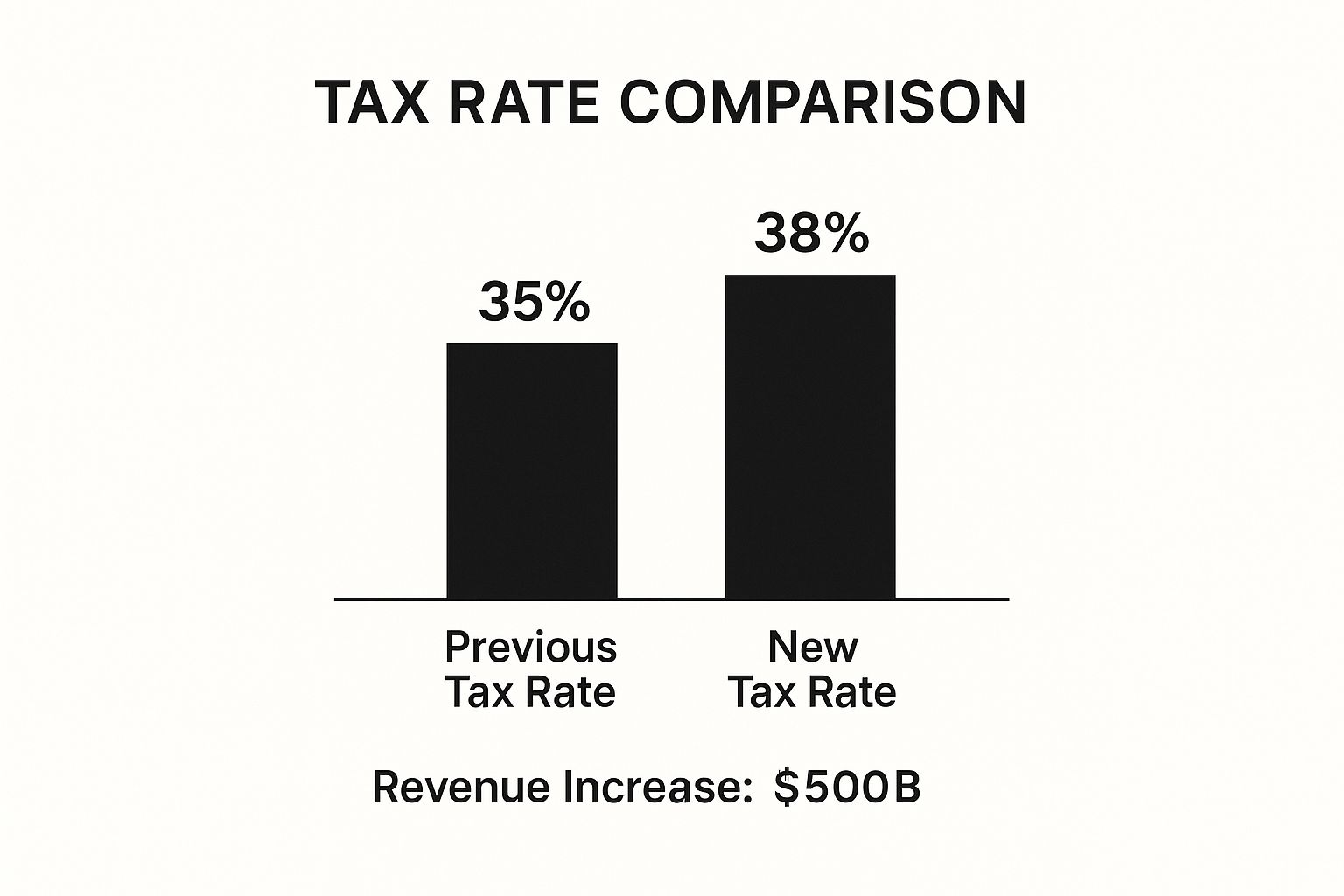
It’s a great visualization of how even small tweaks to tax law can lead to major changes in the government’s ability to collect revenue.
The Last Resort: An Offer in Compromise
Finally, we have the Offer in Compromise (OIC). This program allows some taxpayers to settle their tax debt with the IRS for less than the full amount they owe. But let’s be clear: this option is much rarer than most people think. It’s reserved for taxpayers in genuine, demonstrable financial distress.
The IRS will only even entertain an OIC if you can prove what they call “doubt as to collectibility.” Essentially, you have to open up your books and show them that based on your income, expenses, and assets, there’s virtually no chance you could ever pay back the full debt.
An Offer in Compromise isn’t a negotiation tactic. The IRS uses rigid formulas to calculate your “reasonable collection potential.” It’s an invasive process that requires a mountain of paperwork and is only granted when a taxpayer’s financial situation is truly dire.
For most people facing a large but ultimately payable tax bill, a payment plan is the far more realistic route. An OIC is a powerful tool, but it should only be considered a true last resort when all other options are off the table.
How to Negotiate with the IRS

The very idea of negotiating with the IRS can feel daunting. Most people picture a high-stakes argument, but the reality is much more structured—and often, quite successful. Success here isn’t about being combative; it’s about understanding the specific channels the IRS provides for relief and building a strong, documented case for yourself.
The most common path forward is through penalty abatement. This is where you formally ask the IRS to forgive the penalties they’ve tacked onto your tax bill. It’s not a long shot. The IRS has established programs for this, but you have to play by their rules. A vague excuse like “I couldn’t pay” is a non-starter. You need to prove why you couldn’t comply and have the evidence to back it up.
Your First Shot: The First-Time Penalty Abatement
Your best and easiest chance for relief might be the First-Time Abate (FTA) policy. Think of it as a one-time “get out of jail free” card for taxpayers who usually do everything right. If you have a clean compliance record for the past three years—meaning all returns filed and no penalties assessed—you can often get the failure-to-file and failure-to-pay penalties waived.
Consider it a reward for being a responsible taxpayer who just hit a rough patch. If you meet the criteria, this should absolutely be the first thing you ask for. It’s the most straightforward path to reducing your bill.
Key Insight: The First-Time Abate policy is what’s known as an administrative waiver. This means you don’t need a dramatic, sob-story reason for your slip-up. A clean history is all the justification you need.
Making a Case for Reasonable Cause
What if you don’t qualify for the FTA? Your next move is to build a case for abatement based on Reasonable Cause. This is a higher bar to clear. You must prove that you exercised “ordinary business care and prudence” but were still unable to file or pay on time because of circumstances genuinely outside your control.
The IRS has a list of what it generally considers a valid reason. These include situations like:
- Serious Illness or Death: A significant health crisis impacting you or a member of your immediate family.
- Natural Disaster: Events like a fire or flood that destroyed your home, business, or essential records.
- Incorrect Advice: Relying on bad advice from a tax professional, provided you gave them all the necessary information to begin with.
- Inability to Obtain Records: Being unable to get the documents you needed for reasons you couldn’t control.
For any of these claims, documentation is king. You’ll need things like doctor’s notes, insurance claims, or even a sworn letter from your tax advisor explaining their error.
If your tax debt is particularly large and complicated, you might also look into more advanced solutions like an Offer in Compromise (OIC). You can explore how to settle your tax debt in our detailed guide on the topic. For many people, however, penalty abatement is the most direct and achievable goal.
When you’re facing a significant tax problem that feels overwhelming, bringing in a professional is a smart investment. An Enrolled Agent or CPA knows the system inside and out. They can speak directly to the IRS on your behalf, navigating the complex rules and dramatically improving your odds of a successful outcome.
How Global Tax Policy Affects Your Bill
If you earn income or hold assets outside the United States, your tax situation isn’t just a domestic affair. It’s a global one. High-level policy shifts in Washington can have a direct, and sometimes surprising, impact on your bottom line by reshaping the rules for U.S. expats and businesses with foreign operations. A major piece of legislation can alter the international tax landscape almost overnight.
When big, sweeping laws like the “One Big Beautiful Bill” are debated, they often contain provisions that ripple across borders. These aren’t just tweaks for massive corporations. The changes trickle down and affect individual taxpayers by modifying the rules around foreign tax credits and how you report income. Suddenly, the way you’ve always accounted for overseas income or assets might be completely wrong.
This makes staying on top of both U.S. and global tax trends more important than ever. What happens in Washington doesn’t happen in a vacuum—it’s often a reaction to, or a divergence from, international standards.
The Impact of Evolving International Tax Rules
The U.S. has an incredibly complex framework for taxing international income, largely designed to prevent companies from stashing profits in low-tax countries. Key parts of this framework, like the Base Erosion and Anti-abuse Tax (BEAT), are frequently adjusted through new legislation.
The “One Big Beautiful Bill,” for example, makes significant changes here. It permanently sets the BEAT rate at 10.5% and keeps certain taxpayer-friendly rules in place for multinational companies. These adjustments bring the U.S. a bit closer to some global standards while still maintaining uniquely American policies. If you’re curious about the bigger picture, you can explore a detailed comparison of these policies against worldwide trends in Deloitte’s 2025 Global Tax Policy Survey.
Understanding these shifts is the first step in anticipating changes to your own filing obligations before they become a problem.
How Policy Changes Affect You Personally
It’s easy to tune out these high-level policy discussions, assuming they only matter to multinational giants. But the downstream effects can hit very close to home, especially for individuals with any kind of global financial footprint.
Here’s how these abstract policy changes can show up on your tax return:
- Foreign Tax Credits: Alterations to international tax treaties or U.S. law can change how much credit you can claim for taxes you’ve already paid to a foreign government. This is a big deal, as it directly impacts whether you get hit with double taxation.
- Income Reporting: New rules could demand more detailed reporting of your foreign assets or income streams, adding to your compliance burden and the potential for costly mistakes.
- Expat Exclusions: The Foreign Earned Income Exclusion (FEIE) is a critical tax break for Americans living abroad. Major tax bills often float proposals that could slash its value or change who qualifies.
A change in a single provision, like the GILTI (Global Intangible Low-Taxed Income) rules, can reclassify how your foreign business profits are taxed, potentially leading to an unexpected and big beautiful tax bill.
These global policies also have domestic implications, intersecting with state-level tax laws. If you’re managing complex financial affairs, you have to see how federal changes interact with local ones. For example, our article on how the 2024 California tax brackets affect San Diego residents offers insight into how these different layers of tax law come together. Being aware of the complete picture makes you a much more informed and empowered taxpayer.
Answering Your Top Questions About Large Tax Bills
Even when you’ve done everything right, that official IRS envelope can stir up a lot of “what-ifs.” Getting hit with a large tax bill is stressful, but having clear, direct answers to your most pressing questions is the best way to get that anxiety under control.
Knowledge is power here. When you understand the process and know your rights, you can face the situation with a much clearer head.
What Happens If I Just Ignore the Tax Bill?
Let’s be blunt: this is the single worst thing you can do. Choosing to ignore an IRS notice sets off a predictable, and increasingly aggressive, chain of collection actions. It always starts with more letters, but it doesn’t end there.
The IRS has serious tools at its disposal, including:
- Wage Garnishment: They can legally order your employer to send a chunk of every paycheck directly to them.
- Bank Account Levies: They can freeze and seize funds straight from your bank accounts, often without any further warning.
- Federal Tax Liens: A lien is a public, legal claim against your property (your house, your car, etc.). It wrecks your credit and makes it nearly impossible to sell the asset until the debt is paid.
All the while, penalties and interest are piling up, causing the original debt to swell into a much more intimidating figure. Communication is your best defense—never silence.
Can I Get Penalties Removed from My Tax Bill?
Yes, absolutely. The IRS has a formal process for this called penalty abatement, but you have to ask for it and have a legitimate reason. The most straightforward route is the “First-Time Abate” policy. Think of it as a one-time free pass for taxpayers who have a clean record for the past three years.
If you don’t qualify for that, you can argue for abatement based on “Reasonable Cause.” This means you have to prove that you couldn’t file or pay on time because of circumstances you couldn’t control. This could be a serious illness, a death in the family, a natural disaster, or even getting bad advice from a tax professional. Strong documentation is everything when making this case.
A lot of people think penalties are set in stone. The truth is, the IRS waives millions in penalties every year for people who can provide a solid reason and back it up with evidence.
How Long Do I Have to Set Up a Payment Plan?
You need to act the moment you get that notice. While there’s a small grace period before the heavy-handed collection actions start, penalties and interest begin ticking from the original tax deadline. The longer you wait, the more you’ll end up paying.
The good news is that applying for a plan is easier than ever. You can typically set up a short-term plan (giving you up to 180 days) or a long-term installment agreement right on the IRS website. This is often the quickest way to get a formal agreement in place and make the threatening letters stop.
Should I Hire a Professional to Help Me?
That really depends on how deep the water is. If you just need a simple extension or a standard payment plan for a manageable amount, you can probably handle it yourself online.
But, you should seriously consider calling in a pro—like a CPA or an Enrolled Agent—if:
- The tax debt is substantial.
- You think you might qualify for an Offer in Compromise.
- Your case for penalty abatement is complex and needs a compelling argument.
- You’re behind on multiple years of tax filings.
A good expert can save you a surprising amount of money, not to mention the time and stress. It’s also important to see your situation in a wider context. For instance, when we look at how different countries handle taxes, the OECD notes its member countries get 31.1% of revenue from consumption taxes and only 23.7% from individual income taxes—a very different model from what we have in the U.S. You can learn more about how the U.S. stacks up in this analysis of the 2025 tax bill.
Dealing with a large tax bill is a heavy burden, but you don’t have to carry it alone. The team at Allied Tax Advisors has spent decades in the trenches, helping San Diego individuals and businesses resolve tough tax issues, get compliant, and find savings. Whether you need a hand with an amended return, an IRS payment plan, or long-term tax strategy, our experts are here to give you personalized support. Take the first step toward financial peace of mind with Allied Tax Advisors.