
When we talk about “year-end tax planning,” what we’re really talking about is a set of strategic moves you can make before December 31st to lower your tax bill for the year. It’s about timing your income and expenses, finding every deduction you’re entitled to, and making smart adjustments to your investments—all within the rules of the current tax code.
Why Your Tax Planning Matters More Than Ever

Let’s be real—most people push tax planning to the bottom of their to-do list. But this year, treating it as an afterthought could be a costly mistake. Being proactive with your taxes right now isn’t just about saving a few bucks; it’s a critical defense for your financial future.
So, what’s the big rush? The urgency comes from a massive shift looming on the horizon. A huge part of today’s planning involves preparing for the scheduled expiration of key provisions from the Tax Cuts and Jobs Act (TCJA) of 2017. Many of these rules, which have defined how we handle taxes for years, are set to disappear after 2025. For most people, this will likely mean higher tax bills. You can get a professional breakdown of these upcoming TCJA changes at CohnReznick.com.
This situation creates a unique and valuable window of opportunity—but it’s closing fast.
Your Strategic Roadmap for a Crucial Year
Forget the generic checklists you’ve seen a hundred times. This guide is different. We’ve built it as a strategic roadmap for what has become a truly pivotal moment for taxpayers. My goal is to get past the basics and give you concrete, actionable advice you can use before the ball drops on New Year’s Eve.
We’ll dig into practical strategies that make sense for today’s economy and the upcoming tax law changes, including:
- Maximizing Deductions: We’ll uncover every available write-off to bring down your taxable income.
- Optimizing Investment Outcomes: It’s time to make smart moves in your portfolio to manage capital gains effectively.
- Smarter Retirement Contributions: Let’s turn your retirement accounts into the powerful tax-reduction tools they’re meant to be.
Thoughtful planning in the final quarter can lead to substantial savings. Just as important, it helps you sidestep those costly and stressful surprises when it’s time to actually file your return.
This isn’t just about checking a box for compliance; it’s about seizing an opportunity. The steps you take over the next few weeks can directly impact your financial health for years. By understanding the playing field and acting decisively, you can turn a routine chore into a powerful wealth-building exercise. Let’s dive into the specific moves that will secure a better financial outcome.
Tax-Saving Moves for Individuals and Families

Theory is one thing, but what really counts are the practical moves you can make to actually save money. Let’s get into the specific strategies that can genuinely lower your tax bill. These are the actions individuals and families should consider before December 31st to put themselves in a better financial spot come April.
A great starting point for any effective end of year tax planning is asking a simple question: should you itemize your deductions or just take the standard deduction? With the standard deduction being so high these days, many people assume itemizing is out of reach. That’s where a smart strategy called bunching can make all the difference.
Essentially, bunching means you consolidate, or “bunch,” several years’ worth of deductible expenses into a single tax year. The goal is to push your total deductions over the standard deduction threshold for that one year, allowing you to itemize. In the other years, you simply fall back on taking the standard deduction.
Bunching Deductions for Maximum Impact
Let’s walk through a common scenario. Imagine you typically donate $5,000 to your favorite charity each year and have another $5,000 in state and local taxes (SALT). Your $10,000 in total deductions is well below the standard deduction for a married couple, so you wouldn’t bother itemizing.
But what if, instead of that steady annual donation, you “bunched” them? By contributing $10,000 before the end of this year, your itemized deductions would jump to $15,000. That’s enough to surpass the standard deduction, giving you a much larger tax break for the current year. Next year, you’d make no donation and take the easy standard deduction.
You can apply this same logic to medical costs. If you know you have some non-urgent medical or dental procedures on the horizon, try to schedule and pay for them in the same year you’re bunching other expenses. This can help you get over the 7.5% adjusted gross income (AGI) hurdle you need to clear before you can deduct those costs.
Pro Tip: For charitable bunching, I often recommend clients look into a Donor-Advised Fund (DAF). You can make one large, tax-deductible contribution to the DAF this year to get the immediate tax benefit, then recommend grants from the fund to your favorite charities over the next several years.
Supercharge Your Retirement and Health Savings
One of the most powerful tax-planning tools you have is your retirement account. It’s a direct-hit strategy. Every pre-tax dollar you put into a traditional 401(k) or IRA is a dollar removed from your taxable income for the year. Simple as that.
For 2024, you can contribute up to $23,000 to your 401(k). If you’re 50 or older, you can add another $7,500 as a catch-up contribution. For an IRA, the limit is $7,000, with a $1,000 catch-up. Maxing these out is one of the surest ways to lower your tax liability.
And please, don’t sleep on the Health Savings Account (HSA). If you’re on a high-deductible health plan, the HSA is a tax-advantaged powerhouse, offering a triple benefit:
- Your contributions are tax-deductible.
- The money in the account grows tax-free.
- Withdrawals for qualified medical expenses are also tax-free.
In 2024, the contribution limits are $4,150 for an individual and $8,300 for a family, plus a $1,000 catch-up if you’re 55 or older. It’s an incredible tool for both healthcare costs and long-term retirement savings.
Harvest Investment Losses to Offset Gains
Did some of your investments have a rough year? You can turn those losses into a win for your tax return through tax-loss harvesting. The idea is to sell underperforming investments to realize a loss, which can then be used to cancel out capital gains you’ve realized from selling winners in your portfolio.
For instance, say you sold Stock A for a $5,000 gain. Looking at your portfolio, you see an unrealized loss of $4,000 in Stock B. You could sell Stock B, use that loss to offset your gain, and now you’re only paying tax on $1,000 of gain.
If your losses are greater than your gains, you can use up to $3,000 of the excess loss to reduce your ordinary income, which is a huge benefit since that income is typically taxed at higher rates. Any loss left over can be carried forward to offset gains in future years. Just be careful of the “wash sale” rule—you can’t sell an investment for a loss and then buy it (or a very similar one) back within 30 days.
Don’t Miss Out on Valuable Tax Credits
Deductions are good, but credits are gold. While deductions lower your taxable income, credits reduce your final tax bill, dollar-for-dollar. It’s a shame how many people miss out on these simply because they don’t know they’re eligible.
Here are a few key credits to look into for individuals and families:
- American Opportunity Tax Credit (AOTC): Get up to $2,500 for qualified expenses for the first four years of college. It’s even partially refundable.
- Lifetime Learning Credit (LLC): This nonrefundable credit helps pay for courses taken to acquire or improve job skills.
- Child Tax Credit: A major credit for taxpayers with qualifying children.
- Energy Efficient Home Improvement Credit: This covers 30% of the cost of certain upgrades like new windows, doors, or better insulation, with a maximum annual credit.
Of course, every credit comes with its own set of rules and income limits, so you have to do your homework. Your strategy should also account for where you live. For those in high-tax states, knowing how your state treats income and deductions is critical. To see how this plays out in practice, you can learn more about how California income tax brackets affect your taxes in our detailed guide, which will help you dial in these strategies even further.
Strategic Tax Planning for Business Owners
For entrepreneurs and freelancers, the final quarter of the year is more than just a race to the finish line—it’s a goldmine of tax-saving opportunities. Smart end-of-year tax planning isn’t about mere compliance; it’s an active strategy to protect your cash flow, fuel growth, and build a more secure financial future. The moves you make before December 31st can have a huge impact on your bottom line.
Think of it as having the final say on your tax return’s story. You have the power to decide when to book certain income and when to take on deductible expenses. This timing is one of the most fundamental yet powerful tools you have.
Go Big on Year-End Purchases to Accelerate Deductions
One of the most effective strategies for any business is to accelerate depreciation on major asset purchases. This lets you write off the cost of equipment, machinery, and other qualified property much faster than the standard depreciation schedule would allow. Two key tax provisions make this happen.
First, there’s Section 179. This allows you to deduct the full purchase price of qualifying new or used equipment you buy or finance during the tax year. For 2024, the deduction limit is a hefty $1.22 million. It’s perfect for big-ticket items like company vehicles, computers, office furniture, or specialized machinery.
Then you have Bonus Depreciation. This lets you deduct a large percentage of an asset’s cost in the very first year you put it to use. The rate for 2024 is 60%. This is a drop from previous years, which makes planning ahead even more critical to maximize its benefit.
Let’s say you’re a freelance photographer who needs a new $15,000 camera and lens package. If you buy it and start using it before the year is out, you could potentially write off the entire cost with Section 179. That directly slashes your business’s taxable income by a full $15,000. It’s a game-changer.
Master the Ebb and Flow of Your Cash
Beyond major purchases, you can also be strategic with your everyday cash flow to improve your tax outcome. The principle here is simple and time-tested: push income into next year and pull expenses into this one.
- Delay Your Invoices: If you operate on a cash-basis accounting system, hold off on sending invoices for work you finish in late December. Send them in early January instead. This moves that income into the next tax year, lowering your current tax bill.
- Pre-Pay Your Bills: On the flip side, look for expenses you can pay now instead of later. You could pre-pay for a marketing retainer, stock up on a few months of office supplies, or even pay your January rent in December. Every payment becomes a deduction for the current year.
This visual breakdown shows how you can use losses to your advantage—a core concept for both business and investment planning.
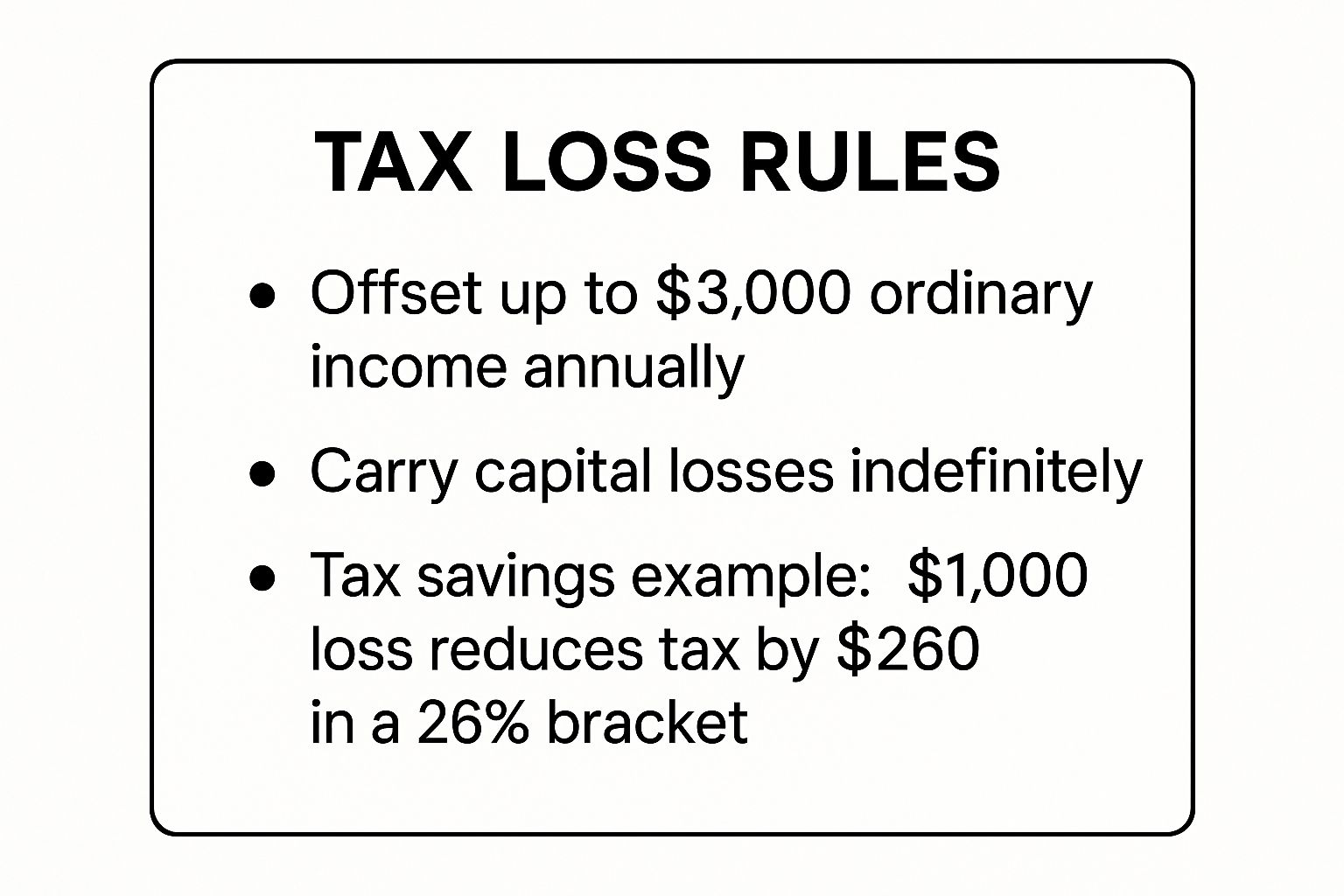
The real insight here is that losses aren’t just setbacks. From a tax perspective, they are valuable assets that can directly lower your tax bill by offsetting gains and even your regular income.
Make Sense of Self-Employed Retirement Plans
For business owners, retirement plans are a fantastic two-for-one deal: you build your personal wealth while scoring significant tax deductions. The contributions you make for yourself (and any employees) are typically deductible business expenses.
Choosing the right plan really depends on your business structure, income, and whether you have a team. Picking the right one before the deadline is key.
Comparing Small Business Retirement Plans
This table breaks down the most common retirement plans for small businesses, helping you see which one might be the best fit for your situation.
| Plan Type | Contribution Limit (Employee/Employer) | Best For | Setup Deadline |
|---|---|---|---|
| SEP IRA | Up to 25% of compensation, not to exceed $69,000 | Sole proprietors or single-owner businesses with high income. Simple to set up. | Tax filing deadline (including extensions). |
| SIMPLE IRA | Employee can contribute up to $16,000 (+ catch-up). Employer match required. | Small businesses with fewer than 100 employees who want an easy-to-administer plan. | October 1 for existing businesses. |
| Solo 401(k) | Employee contribution ($23,000) + employer contribution (up to 25% of comp), max $69,000. | Self-employed individuals with no employees (other than a spouse). Allows loans. | December 31 for employee contribution part. |
Each plan has its pros and cons, but understanding these key differences is the first step toward making a powerful financial decision for your future.
The Solo 401(k) is a fan favorite for a reason. It lets you contribute as both the “employee” and the “employer,” which often means you can stash away more money than with a SEP IRA, even at similar income levels.
A Smart Workaround for the SALT Cap
The $10,000 cap on state and local tax (SALT) deductions has been a major headache for business owners, especially those in high-tax states. Thankfully, many states have rolled out a clever solution: the Pass-Through Entity Tax (PTET) election.
Here’s how it works: The PTET election lets partnerships and S corporations pay state income tax at the company level on behalf of the owners. The business then deducts these state tax payments as a regular business expense—which isn’t subject to that pesky $10,000 cap. The owners then get a credit on their personal state tax returns. It’s a completely legal and effective way to sidestep the SALT deduction limit.
Putting these business-specific strategies into play requires a proactive mindset. For more great ideas on how to strengthen your financial position, check out the wealth of tax-saving tips that every business owner should know in our comprehensive guide.
Smarter Investing and Capital Gains Strategy

Most people see their investment portfolio as a wealth-building engine, but experienced investors know it’s also one of their most powerful tools for managing taxes. Your investment moves and your tax return aren’t separate things; they’re two sides of the same coin. With a few calculated decisions before December 31, you can make a real dent in the tax bill from your investment activity.
The trick is to stop being reactive. Instead of just sighing and paying investment taxes as a cost of doing business, you can get in the driver’s seat. Through smart selling, strategic gifting, and just paying attention to your accounts, you can actively shape your tax outcome.
The Art of Tax-Loss Harvesting
One of the most effective strategies in any investor’s year-end playbook is tax-loss harvesting. It sounds complicated, but the concept is simple: you sell investments that have gone down in value to purposefully create a “capital loss.”
Why on earth would you want a loss? Because you can use it to cancel out capital gains you’ve made from selling profitable investments.
Let’s say you sold some tech stock earlier this year and pocketed a $10,000 gain. Nice! But that’s a taxable event. As you look through your portfolio, you spot an ETF that’s down $7,000. By selling that loser ETF before the year closes, that $7,000 loss wipes out a huge chunk of your gain. Now, you only owe tax on $3,000 of gains, not the full $10,000.
What if your losses are bigger than your gains? Even better. You can use up to $3,000 of the excess loss to lower your regular taxable income—a fantastic benefit since that income is typically taxed at much higher rates. Any leftover losses can be carried forward to offset gains in future years.
A word of caution: The IRS is wise to this game. The “wash sale” rule prevents you from claiming a tax loss if you sell an investment and buy the same one (or something “substantially identical”) within 30 days before or after the sale. Make sure you wait at least 31 days if you want to buy back into the same asset.
Timing Your Asset Sales for Lower Rates
When it comes to capital gains, patience really can pay off. The tax code makes a huge distinction between short-term and long-term gains, and knowing the difference is fundamental to keeping your tax bill low.
- Short-Term Capital Gains: This is profit from any asset you’ve held for one year or less. The IRS taxes these gains at your ordinary income rate, which could be as high as 37%.
- Long-Term Capital Gains: This applies to assets held for more than one year. The tax rates are far more friendly: 0%, 15%, or 20%, based on your income level.
As the year winds down, scan your portfolio. See any profitable investments you’re thinking of selling that are close to that one-year holding period? If you can hold off for just a few more days or weeks to officially cross that one-year threshold, you could slash the tax hit on your profit. To dig deeper into the specifics, it’s worth understanding capital gains taxes and what you need to know for 2024.
Tax-Smart Gifting and Charitable Giving
You can also make your generosity work for you. If you plan on donating to a charity you care about, think about giving appreciated stock you’ve held for over a year instead of just writing a check. This strategy is a classic for a reason—it packs a one-two tax punch.
First, you generally get to deduct the stock’s full fair market value on the day you donate it. Second, and this is the best part, neither you nor the charity pays capital gains tax on all the growth. It’s a brilliant way to give more to a cause you support while getting a bigger tax break for yourself.
This is far more efficient than the alternative: selling the stock, paying taxes on the gain, and then donating what’s left.
Finally, a quick warning about mutual funds. Many funds are required to pay out their net capital gains to shareholders toward the end of the year. If you buy shares of a fund in late November or December, you could get hit with a taxable distribution for gains that happened all year—long before you were an owner. It’s an unpleasant surprise tax bill. Before you make a late-year purchase, always check when the fund plans to make its distributions.
When your finances get a bit more complicated than a steady paycheck and a 401(k), the usual tax advice just doesn’t cut it. If you’re dealing with international income, have significant assets, or want to get serious about charitable giving, your end of year tax planning needs a more sophisticated toolkit.
Let’s look past the standard deductions and dive into some advanced strategies. These aren’t just about saving a few bucks this year; they’re about structuring your finances for long-term tax efficiency.
Is a Roth Conversion Right for You?
A Roth conversion is a classic power move for long-term tax planning. The concept is simple: you move money from a traditional, pre-tax retirement account (like a 401(k) or traditional IRA) into a post-tax Roth IRA. The catch? You have to pay ordinary income tax on the entire amount you convert, right now, in the year you do it. Paying a big tax bill today might feel wrong, but it can be an incredibly smart play down the road.
The real payoff comes later. Once the money is in the Roth, all of its future growth and any qualified withdrawals are 100% tax-free. This is a huge advantage, especially if you think you’ll be in the same—or a higher—tax bracket when you retire.
Here’s a real-world example. Imagine a 45-year-old consultant who takes a sabbatical, resulting in a lower-income year. This is the perfect window to convert $50,000 from her traditional IRA. She’ll pay taxes on that amount at her current, lower rate. That money then has two decades to grow, and every single dollar she pulls out in retirement will be completely free from federal income tax.
Think of a Roth conversion as paying tax on the “seed” instead of the “harvest.” You’re essentially locking in today’s tax rates, shielding your future self from the risk of higher rates later on.
Getting Smart with Charitable Giving
If you’re passionate about giving back, you can make your generosity work harder for you. Going beyond simple cash donations opens up strategies that can amplify your impact and deliver serious tax benefits. One of the most powerful tools for this is the Charitable Remainder Trust (CRT).
A CRT is an irrevocable trust that you fund with appreciated assets, like stocks or real estate that have grown in value. In return, you or another beneficiary get a steady income stream from the trust for a set period or for life. Once the trust term is over, whatever is left goes to the charity you’ve chosen.
This single move accomplishes several things at once:
- You get an immediate partial tax deduction for funding the trust.
- By donating appreciated assets directly, you sidestep the capital gains tax you’d owe if you sold them first.
- It creates a reliable income stream for you or your family.
- You set up a significant future gift for a cause that matters to you.
It’s a fantastic strategy for anyone sitting on highly appreciated assets who also wants to secure an income and build a charitable legacy.
Tackling the Global Tax Puzzle
In our connected world, more and more people have to think globally about their taxes. Whether you’re an American working abroad, a remote employee for a foreign company, or a business owner with international clients, you can’t afford to get this wrong.
The most critical tool in your arsenal is the Foreign Tax Credit. This credit is designed to prevent you from being taxed twice on the same income. It allows you to subtract the income taxes you’ve already paid to another country from your U.S. tax bill. Meticulous record-keeping is absolutely key to claiming this credit correctly.
On top of that, the global tax landscape is constantly shifting. A 2025 survey from Deloitte revealed that for 70% of multinational corporations, adapting to digital tax processes and increasing transparency are top priorities. You can read the full global tax policy survey from Deloitte for more on these trends. Keeping an eye on international frameworks like the OECD’s Base Erosion and Profit Shifting (BEPS) initiative is crucial for staying compliant and managing your global tax picture effectively.
Answering Your Year-End Tax Questions
Even with the best-laid plans, a few nagging questions always seem to surface as the year winds down. I get these all the time from clients, so let’s clear up some of the most common points of confusion before you make your final moves.
Think of this as a quick Q&A to help you cross the finish line with confidence.
What if I Miss the December 31 Cutoff?
This is a big one. For most tax-saving moves, that December 31 date is a hard stop. If you’re planning to sell stock to harvest losses, make that big charitable donation, or prepay a business expense, the transaction must happen by the end of the year. Miss it, and you’ve missed your chance for this tax year.
But don’t panic just yet. There’s a crucial exception that gives you some breathing room: IRA contributions. You actually have until the tax filing deadline—usually mid-April of next year—to fund your IRA for the prior year. It’s a fantastic grace period that can still significantly lower your tax bill after the ball has already dropped.
How Much Can I Give Away Tax-Free?
Generosity is common around the holidays, and thankfully, the IRS has rules that make it easy to give without creating a tax headache. For 2024, you can give up to $18,000 to any single individual without any tax paperwork. This is the annual gift tax exclusion.
It gets even better for married couples. Together, you can give a combined $36,000 to one person. This is a powerful strategy we often see clients use to help children with a down payment or simply pass wealth to the next generation without triggering gift tax.
The key here is that this is a per-recipient limit, not a total limit. You could give $18,000 to your son, $18,000 to his wife, and another $18,000 to your grandchild, all in the same year, and you still wouldn’t need to file a gift tax return.
Itemize or Take the Standard Deduction?
This is the million-dollar question for so many people. The answer really just boils down to running the numbers. You should itemize only if your total deductible expenses add up to more than the standard deduction for your filing status.
So, what can you itemize? The big ones include:
- State and local taxes (often called SALT), but this is capped at $10,000 per household.
- Mortgage interest on your home.
- Donations to qualified charities.
- Medical expenses that exceed 7.5% of your adjusted gross income (a high bar for most people).
Let’s put it in perspective. For 2024, the standard deduction for a married couple filing a joint return is a hefty $29,200. If your itemized deductions don’t even come close to that figure, taking the standard deduction is the simple and correct choice.
Wading through these rules can feel overwhelming, but you don’t have to figure it all out on your own. The team at Allied Tax Advisors has spent decades crafting personalized tax plans that uncover every possible saving. Let us take the complexity out of your year-end planning and get you on the right track. Schedule your consultation today.