
When you sell a rental property for a profit, the IRS wants its piece of the pie—and that includes clawing back some of the tax benefits you enjoyed along the way. This is known as rental property depreciation recapture.
In short, the total amount of depreciation you claimed over the years is taxed at a special rate—up to a hefty 25%—when you sell. Think of it as the IRS’s way of settling the tab on the tax breaks you received while you owned the property.
How Depreciation Recapture Really Works

Most real estate investors love depreciation. It's a fantastic tax deduction that lets you write off a piece of your property's value each year, lowering your taxable rental income and improving cash flow. The deduction is meant to account for the wear and tear on the building as it ages.
But here’s the catch: depreciation isn't a permanent tax write-off. It’s more like a long-term, interest-free loan from the government. You get to reduce your taxes every single year you hold the property, but the bill comes due when you sell. That payback moment is rental property depreciation recapture.
The Big Tax Surprise Many Investors Face
The surprise usually hits when investors see their tax bill after a sale. Many assume their entire profit will be taxed at the favorable long-term capital gains rates, which are typically 0%, 15%, or 20%. That’s a common and costly mistake.
The IRS actually carves up your profit into two separate buckets:
- The Depreciation Recapture: This part equals the total depreciation you took (or were entitled to take) during your ownership. It gets taxed at a maximum rate of 25%.
- The Capital Gain: This is what's left of your profit after subtracting the recaptured amount. This portion is what qualifies for the lower long-term capital gains rates.
This split is critical. That 25% recapture rate can be a shock compared to the 15% or 20% capital gains rate you might have been planning for, leading to a much bigger tax payment than you anticipated.
Key Takeaway: Depreciation recapture is the mechanism that ensures the tax deductions you took over the years are "paid back" when you sell the property for a gain. It converts a portion of your profit from a low-tax capital gain to a higher-taxed recaptured amount.
A Simple Recapture Example
Let's walk through a quick scenario. Say you bought a rental property for $300,000. Over the next ten years, you claimed $50,000 in depreciation deductions. This lowers your property's adjusted tax basis to $250,000.
Now, you sell the property for $350,000. Your total gain is $100,000 ($350,000 sale price – $250,000 adjusted basis).
Here’s how the IRS breaks down that $100,000 gain:
- The first $50,000 is considered depreciation recapture and is taxed at your ordinary income rate, up to a maximum of 25%.
- The remaining $50,000 is a true capital gain, taxed at the more favorable long-term capital gains rate (0%, 15%, or 20%).
If you weren't aware of this rule, you might have budgeted for taxes on the full $100,000 at a 15% rate. The reality of a 25% rate on half of that profit makes a huge difference. This is exactly why getting a handle on depreciation recapture is a must for any investor who wants to protect their hard-earned returns.
How Rental Property Depreciation Really Works
Before we can tackle depreciation recapture, we need to get a solid handle on depreciation itself. Think of it as a fantastic tax benefit for real estate investors. It’s an annual deduction you can take to account for the wear and tear on your property, which lowers your taxable income and, ultimately, your tax bill. More cash in your pocket each year is always a good thing.
But, as with all things tax-related, the IRS has some very specific rules. You can't just write off the entire price you paid for the property. The land your building sits on doesn't wear out, so its value can't be depreciated. Your first move is always to figure out the property’s depreciable basis.
Calculating Your Depreciable Basis
This is simpler than it sounds. Your depreciable basis is just the property's purchase price minus the value of the land.
Let’s say you buy a rental house for $350,000. If an appraisal says the lot is worth $75,000, your depreciable basis is $275,000 ($350,000 – $75,000). That $275,000 is the magic number you'll use to calculate your annual tax deduction.
Once you have your basis, you'll use the standard depreciation schedule laid out by the IRS. For a closer look at the core ideas behind depreciation on investment property, this is a great resource.
The Standard Depreciation Schedule: MACRS
For residential rental properties, the go-to system is the Modified Accelerated Cost Recovery System (MACRS). It’s a mouthful, but the concept is straightforward. Under MACRS, the IRS says residential rentals have a useful life of 27.5 years.
This means you get to deduct a portion of your property's basis every year for 27.5 years. It works out to be about 3.64% of the depreciable basis annually.
Using our example, a $275,000 basis would give you a yearly depreciation deduction of around $10,000. That's $10,000 less rental income you have to pay taxes on. Simple as that.
While MACRS is the standard, some investors might use the Alternative Depreciation System (ADS), which stretches the timeline to 30 or 40 years, leading to smaller yearly write-offs. It's also worth noting that bonus depreciation, a rule that allowed for huge upfront deductions, is being scaled back from 80% in 2024 to 60% in 2025, which will change the math for many new purchases.
Heads Up: Depreciation Is Not Optional
Here’s a rule that trips up countless investors: the IRS considers depreciation mandatory. You must reduce your property's basis by the amount of depreciation you were allowed to take, even if you never actually claimed the deduction on your tax returns.
This is the "allowed or allowable" rule, and it’s a big deal. It means you can't sidestep depreciation recapture. If you forget to claim your depreciation deductions, you miss out on years of tax savings and still have to pay the recapture tax on the amount you should have claimed when you sell. You can learn more about the specifics in our complete guide to depreciation on a rental property.
At its core, the system is designed to give you a steady, predictable tax break over the life of your investment. But remember, every dollar of depreciation you claim today reduces your property's cost basis, setting the stage for the recapture tax when you eventually sell.
Calculating Your Depreciation Recapture Tax
Alright, let's roll up our sleeves and get into the numbers. Figuring out your depreciation recapture isn't nearly as scary as it sounds once you grasp the basic formula. The IRS actually keeps the core concept pretty simple.
The portion of your profit that gets hit with the recapture tax is simply the lesser of two numbers:
- The total depreciation you've claimed over the years.
- Your total gain from selling the property.
What this means is you’ll never pay recapture tax on more money than you actually made from the sale. Let’s walk through the steps to see how this plays out in a real-world scenario.
Step 1: Find Your Adjusted Cost Basis
First thing's first: you need to know your property's adjusted cost basis. This isn't just the price you paid. It's the original purchase price minus all the depreciation you've claimed (or were entitled to claim) while you owned it.
Let's say you bought a rental property for $400,000. Over the next 10 years, you claimed $100,000 in depreciation deductions on your tax returns.
- Original Cost: $400,000
- Accumulated Depreciation: –$100,000
- Adjusted Cost Basis: $300,000
This $300,000 figure is the new starting line the IRS uses to calculate your profit. This is why having clean, accurate financial records is non-negotiable; they're critical for understanding your property's performance and nailing your tax calculations. If you need help with this, learning about simplified bookkeeping for rental properties is a great place to start.
Step 2: Calculate Your Total Gain
Next up, you calculate your total gain from the sale. It’s a straightforward calculation: the sale price minus your adjusted cost basis.
Continuing our example, you sell that same property for $550,000.
- Sale Price: $550,000
- Adjusted Cost Basis: –$300,000
- Total Gain: $250,000
This $250,000 represents your total taxable profit. The next step is to figure out how the IRS wants to split it up for tax purposes.
Step 3: Determine the Recaptured Amount
This is where that "lesser of" rule kicks in. You simply compare your total gain to the total depreciation you've taken and choose the smaller number.
- Total Gain: $250,000
- Accumulated Depreciation: $100,000
In this scenario, the $100,000 in depreciation is the smaller figure. This entire $100,000 is your rental property depreciation recapture. The rest of your profit, the remaining $150,000, is treated as a long-term capital gain.
To put the whole calculation into perspective, here's a quick table breaking down our example.
Depreciation Recapture Calculation Example
| Calculation Step | Example Value | Description |
|---|---|---|
| Sale Price | $550,000 | The price you sold the property for. |
| Adjusted Cost Basis | $300,000 | Original price ($400k) minus depreciation ($100k). |
| Total Gain | $250,000 | The difference between sale price and adjusted basis. |
| Depreciation Recapture | $100,000 | The lesser of total gain ($250k) or depreciation ($100k). |
| Long-Term Capital Gain | $150,000 | The remaining portion of your total gain. |
As you can see, the process involves a few distinct steps, but each one builds on the last. You start with your basis, calculate the total gain, and then split that gain into two different tax buckets.
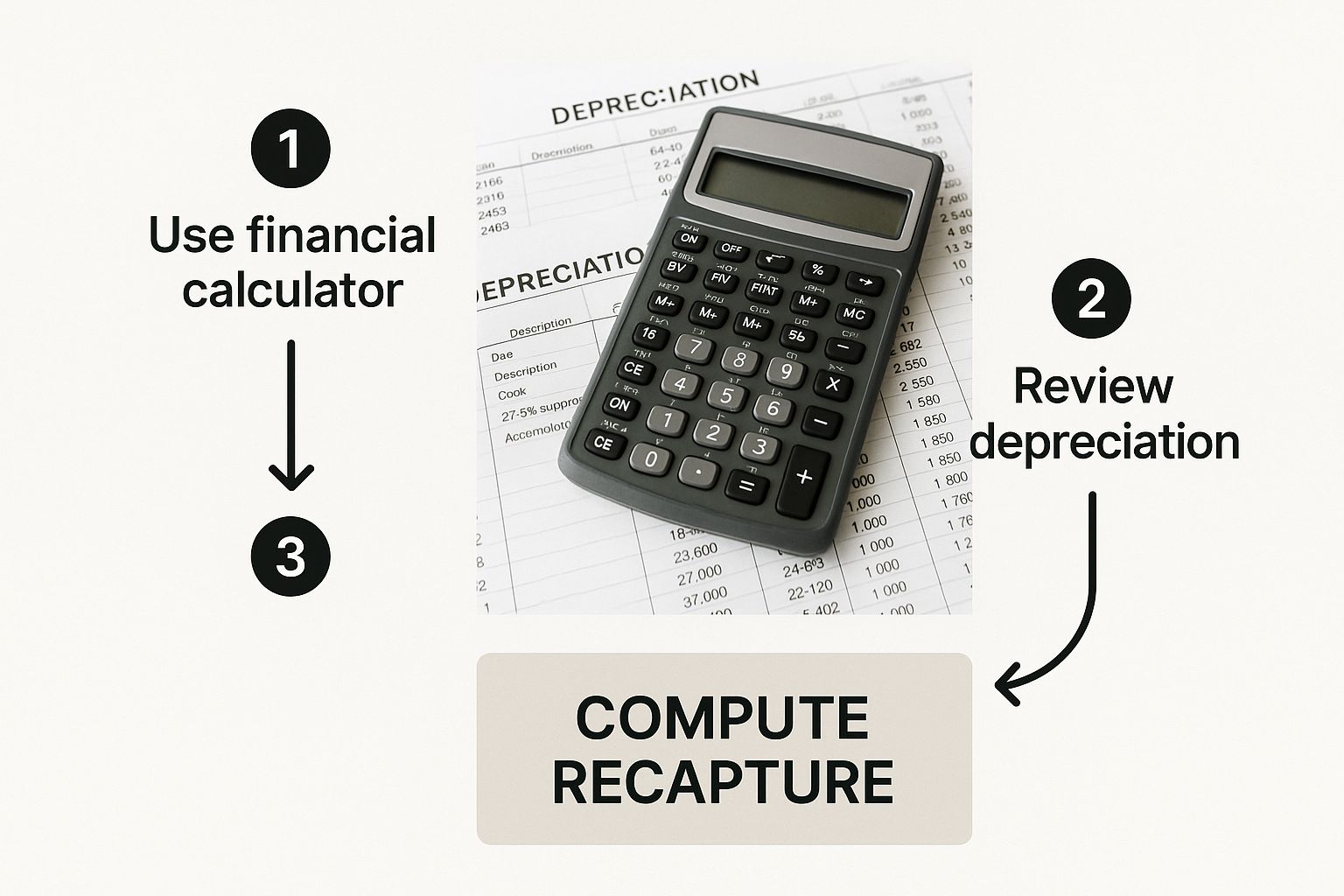
This visual really helps simplify the flow. You're taking your total profit and carving out the piece that came from depreciation deductions, which gets taxed differently.
What if Your Gain Is Less Than Your Depreciation?
Let's look at a different outcome to see the rule in action from another angle. Imagine the market was flat, and you only sold the property for $375,000.
- Sale Price: $375,000
- Adjusted Cost Basis: –$300,000
- Total Gain: $75,000
Now, we do our comparison again.
- Total Gain: $75,000
- Accumulated Depreciation: $100,000
Here, the total gain of $75,000 is the lesser amount. In this case, your entire profit is considered depreciation recapture. You would have $0 in long-term capital gains to report. This is a perfect illustration of how you are only taxed on the profit you actually make.
How Depreciation Recapture Is Actually Taxed
Knowing how much depreciation you have to recapture is one thing. Understanding how the IRS actually taxes that amount is the real key to avoiding a nasty surprise come tax time.
Here’s the deal: not all the profit you make from selling a rental property is treated the same. The IRS essentially splits your gain into two different buckets, and each one gets its own tax rate. This is where many investors get tripped up.
The Special Tax Rate for Recaptured Depreciation
The part of your gain that comes from depreciation is officially called unrecaptured Section 1250 gain. It’s a mouthful, I know. But all it really means is the profit you made simply because your property's tax basis was lowered by all those depreciation deductions you took over the years.
This specific slice of your profit gets special treatment. It isn't taxed at the favorable long-term capital gains rates (0%, 15%, or 20%). Instead, the IRS taxes it at your ordinary income tax rate, but with a catch—it’s capped at a maximum of 25%.
For most real estate investors, this means you'll pay a flat 25% tax on every dollar of recaptured depreciation. That’s a good bit higher than the 15% or 20% capital gains rate you were probably hoping to pay on the entire profit.
This rate difference is exactly why rental property depreciation recapture can make your final tax bill so much bigger than you expected. To get a better handle on the other side of the coin, our guide explains capital gains tax and how to minimize your tax liability.
A Tale of Two Tax Rates in Action
Let’s circle back to our previous example to see how this plays out with real numbers.
- Total Gain: $250,000
- Depreciation Recapture (Unrecaptured Section 1250 Gain): $100,000
- Long-Term Capital Gain: $150,000
Assuming you're in a higher income bracket, here’s how the IRS would tax your profit:
- Tax on Recaptured Depreciation: The first $100,000 is taxed at that special 25% rate.
- $100,000 x 0.25 = $25,000
- Tax on Capital Gain: The remaining $150,000 is treated as a true long-term capital gain, taxed at the 20% rate.
- $150,000 x 0.20 = $30,000
Your total federal tax bill from the sale comes out to $55,000 ($25,000 + $30,000). Had you just assumed the entire $250,000 profit was a capital gain taxed at 20%, you would have underestimated your tax liability by a painful $5,000.
What About Personal Property Inside the Rental?
Just when you think you have it figured out, the tax rules throw another curveball. We've been talking about the building itself, but what about all the other stuff inside it? Things like appliances, carpets, or any furniture you provided are handled differently.
In IRS-speak, these items are called Section 1245 property. The depreciation you took on them is recaptured at a much higher rate.
- Section 1250 Property (The Building): Recapture is taxed at that maximum rate of 25%.
- Section 1245 Property (Appliances, etc.): Recapture is taxed as ordinary income, which could be as high as 37% depending on your tax bracket.
This is a classic distinction in U.S. tax law. Let's say you put in $10,000 worth of new appliances and fully depreciated them over five years. When you sell, that entire $10,000 gets "recaptured" and taxed at your personal income tax rate, not the more friendly 25% rate.
This tiered system means you have to be meticulous. When you sell a property, you technically need to separate the gains from the building versus the personal property inside it, because each is taxed according to its own set of rules. It’s why good bookkeeping isn't just a suggestion—it’s essential.
Smart Strategies to Defer Recapture Tax

Seeing a huge tax bill from rental property depreciation recapture can feel like a gut punch after a successful sale. But it doesn't have to be your reality. With some smart planning, investors can legally push this tax obligation down the road, and in some cases, get rid of it entirely.
These aren't shady loopholes. They're well-established parts of the tax code designed for exactly these kinds of situations. The trick is to think about your exit strategy long before you put that "For Sale" sign in the yard. Let's walk through some of the most effective methods real estate investors use to protect their hard-earned capital.
The Power of the 1031 Exchange
If there's one strategy every investor should know, it's the Section 1031 exchange. Think of it as hitting the pause button on your tax bill. Instead of selling your property and pocketing the cash (which triggers the tax), you roll the entire proceeds from the sale directly into a new, similar investment property.
When you do this correctly, the IRS lets you postpone paying both the capital gains tax and the depreciation recapture tax. The tax doesn't just vanish—it gets carried over to the new property. This allows your investment to keep growing without a major tax event slowing it down.
But be warned: the 1031 exchange has some very strict rules and tight deadlines. You have to get it right.
- Like-Kind Property: You have to swap your property for another "like-kind" property. Thankfully, for real estate, this term is incredibly broad. You can exchange a duplex for a commercial building, an office for raw land, or a single-family rental for an apartment complex.
- 45-Day Identification Period: From the day you close the sale on your old property, the clock starts ticking. You have exactly 45 days to formally identify the properties you intend to buy.
- 180-Day Closing Period: You must complete the purchase and close on your new property within 180 days of selling the original one.
These timelines are non-negotiable. It's almost impossible to navigate this process without a qualified intermediary who lives and breathes these transactions. To really dig into the mechanics, you can learn more about what a 1031 exchange is and how it works.
Convert Your Rental into a Primary Residence
Here's another powerful strategy: change how you use the property. If your life circumstances allow for it, moving into your rental property and making it your primary residence can be a game-changer. This move potentially qualifies you for one of the most generous tax breaks on the books—the Section 121 exclusion.
This rule allows homeowners to exclude up to $250,000 in capital gains ($500,000 for a married couple) when they sell their main home. To qualify, you generally need to have owned the property for at least two years and lived in it as your primary home for at least two out of the last five years before the sale.
Important Caveat: While the Section 121 exclusion is fantastic for wiping out capital gains, it does not get rid of the rental property depreciation recapture tax. You will still owe tax (at a rate of up to 25%) on the total depreciation you claimed while it was a rental. Still, eliminating the capital gains tax can save you a fortune.
Using Losses to Your Advantage
Smart tax planning means looking at your entire financial picture, not just a single property in isolation. Do you have other investments—stocks, bonds, another property—that are currently in the red? This is where a strategy called tax-loss harvesting comes in handy.
If you sell those losing assets in the same year you sell your profitable rental, you can use the capital losses to cancel out your gains. The IRS makes you use capital losses to offset capital gains first. But if you have losses left over, you can use them to offset your ordinary income, which can include the gain you have from depreciation recapture. This can dramatically shrink, or even completely erase, your tax bill for the year.
The Ultimate Deferral: Inheritance
The final strategy is the most passive of all—simply hold onto the property for the long haul. When you pass away and leave your rental property to your heirs, the tax code gives them an incredible gift: a "step-up in basis."
This rule resets the property's cost basis to its fair market value on the date of your death. In one fell swoop, the slate is wiped clean. All the capital gains that built up over your lifetime and, crucially, all the depreciation you ever claimed are completely forgiven. Your heirs inherit the property as if they just bought it at its current value, permanently eliminating the depreciation recapture and capital gains taxes that you would have owed.
Answering Your Lingering Questions About Depreciation Recapture
Even after you get the hang of the basics, a few tricky scenarios often pop up for real estate investors. It's one thing to understand the formula, but it's another to see how it plays out in the real world. Let's tackle some of the most common questions I hear from clients to make sure there are no surprises when it's time to sell.
What if I Never Claimed Depreciation on My Taxes?
This is easily the biggest—and most costly—misunderstanding out there. Many investors think, "If I didn't take the deduction, I don't have to pay the recapture tax." It's a logical thought, but unfortunately, the IRS has a different take on it.
The tax code is built on an "allowed or allowable" principle. This means the IRS calculates your recapture tax based on the depreciation you could have and should have taken, whether you actually claimed it on your tax return or not.
The Hard Truth: You can't just opt out of depreciation. If you don't claim it, you lose out on years of tax savings, but you still get the full tax bill for recapture when you sell. It's the worst of both worlds.
If you've realized you've missed out on claiming depreciation, don't just let it go. It's worth talking to a tax professional right away. They can help you file an amended return or a Form 3115 (Application for Change in Accounting Method) to claim those missed deductions. It's far better to fix the mistake than to pay tax on a benefit you never actually received.
Do I Owe Recapture Tax if I Sell at a Loss?
Here's a bit of good news. The depreciation recapture tax only comes into play when you sell your property for a profit. The key is to remember that the amount recaptured is always the lesser of your total gain or the total depreciation you've taken.
So, if you sell for less than your adjusted cost basis, you have a capital loss, not a gain. With no gain, there's nothing to recapture.
Let's look at a quick example to see this in action:
- Original Purchase Price: $400,000
- Accumulated Depreciation: $80,000
- Adjusted Cost Basis: $320,000
Now, say the market takes a dip and you have to sell the property for just $300,000. In this case, you'd have a $20,000 capital loss ($300,000 Sale Price – $320,000 Adjusted Basis). Because there's no gain, your depreciation recapture tax is $0. In fact, you might even be able to use that loss to offset other investment gains.
How Do Capital Improvements Affect Recapture?
Making major upgrades—like putting on a new roof, overhauling the kitchen, or replacing the HVAC system—adds another layer to the calculation, but the underlying logic doesn't change. These big-ticket items aren't just one-time expenses; they are capitalized, which means they get added to your property's value and are depreciated over their own useful life, typically 27.5 years for a residential rental.
This has two important effects on your taxes:
- It Increases Your Cost Basis: The cost of the improvement gets added to your property's basis, which helps reduce your overall taxable gain when you eventually sell.
- It Creates More Depreciation: Each new improvement starts its own depreciation clock, giving you more deductions to claim each year.
When you sell the property, you have to add up all the depreciation you've taken—on the original building and on every single capital improvement you've made along the way. This grand total is what gets plugged into the rental property depreciation recapture calculation.
For example, if you claimed $80,000 in depreciation on the building and another $10,000 for that new kitchen, your total depreciation for recapture purposes is $90,000. This is why keeping clean, detailed records of every improvement and its depreciation schedule isn't just good practice—it's absolutely essential.
Navigating the world of depreciation recapture requires more than just knowing the rules; it demands careful planning from day one. The team at Allied Tax Advisors has spent decades helping real estate investors craft smart tax strategies that ensure compliance and maximize their returns. If you want to build a financial plan that accounts for every last detail, visit us at https://alliedtax.com to learn how our experts can support your financial journey.