
That moment your heart drops when you see an official IRS envelope in the mail is something most of us can relate to. But if that envelope contains a CP2000 notice, take a deep breath. This isn't an audit.
Think of it as the IRS raising its hand and saying, "Hey, we're seeing something a little different on our end. Can we compare notes?" It's a proposed adjustment, not a final bill.
So, What Exactly Is a CP2000 Notice?

At its core, a CP2000 notice is a computer-generated letter. The IRS runs a sophisticated program called the Automated Underreporter (AUR) system that acts like a massive digital bookkeeper. Its main job is to match the income you reported on your tax return against the information it receives from third parties—the companies that pay you.
When the numbers don't line up, the system flags the discrepancy and automatically sends out a CP2000.
These third-party info slips are probably familiar to you. They include forms like:
- W-2s from your job
- 1099-NEC or 1099-K if you do freelance work or get paid through apps like PayPal or Venmo
- 1099-INT showing interest you earned from a savings account
- 1099-DIV for any investment dividends
- 1099-B from a brokerage firm detailing stock sales
If a 1099-NEC from a client shows you were paid $5,000, but that income doesn't appear on your return, the AUR system will catch it. The CP2000 you receive will propose what your new tax bill would be if that $5,000 were included.
Why Did I Get One?
If you received one, you're not alone. The IRS's automated systems have become incredibly efficient at this kind of matching. In 2022, the IRS sent out over 13 million CP2000 notices. It's their go-to tool for closing the gap on unreported income.
Here's a quick summary to help you get your bearings.
CP2000 Notice at a Glance
| Key Aspect | What It Means for You |
|---|---|
| It's a Proposal | The IRS is suggesting changes to your tax return. It’s not a final bill or a formal audit. |
| It's Automated | A computer found a discrepancy between your return and third-party data (W-2s, 1099s). |
| Common Triggers | Usually stems from unreported income (a forgotten 1099), mismatched stock sales, or other simple errors. |
| Action is Required | You must respond by the deadline, even if you agree with the changes. Ignoring it will lead to a bigger problem. |
The most common reasons for getting one are simple human errors—forgetting about that side gig from last spring, missing the interest statement from a new bank account, or botching the cost basis on a stock you sold.
A CP2000 notice is an opening for a conversation. It’s your opportunity to agree, provide the correct information, or explain why you believe your original return was accurate before the IRS makes a final decision.
This notice is essentially highlighting a gap between your numbers and theirs. The process of sorting it out is a bit like conducting a gap analysis in a business—you need to figure out what’s missing and why. The good news is that it’s almost always a solvable problem.
Cracking the Code: What's Inside Your CP2000 Notice
Getting a letter from the IRS can feel intimidating, a bit like trying to read a legal document without a lawyer. The CP2000, with its official language and tables of numbers, is certainly no exception. But once you know how it's laid out, it becomes much less confusing.
Think of the notice as having a beginning, a middle, and an end. The first page gives you the big picture—the "what." The pages that follow show the math—the "how." And the last part tells you what to do next.
The Summary of Proposed Changes
Right up front, you'll see a summary of what the IRS thinks needs to be changed on your tax return. This is the bottom line, showing a side-by-side comparison of your original numbers versus their new, proposed figures.
This section will clearly lay out the proposed extra tax, plus any penalties and interest that have been tacked on so far. It's easy to see that total and feel a wave of panic, but take a deep breath. This is just a proposal, not a final bill you have to pay today.
The most important figure on this first page isn't the tax amount; it's the response deadline. You typically have 30 days from the date on the notice to respond. Mark this on your calendar immediately—missing it can seriously limit your options later on.
Explanation of Items: The Heart of the Notice
As you dig deeper into the notice, look for a section called "Explanation of Items" or something similar. This is where the real detective work begins, because this is where the IRS lays its cards on the table.
This part of the notice explains exactly what discrepancy their system flagged. It will pinpoint the specific income they have on record that doesn't seem to be on your tax return. For example, you might see something like this:
- Payer: Acme Freelance Co.
- Form: 1099-NEC
- Amount Reported to IRS: $4,500
- Amount on Your Return: $0
- Difference: $4,500
This breakdown is your roadmap. It tells you exactly what you need to investigate. You'll take this information and compare it against your own records—bank statements, invoices, and accounting software—to figure out if the IRS is right. Carefully reviewing this section is the critical first step to getting the situation sorted out.
Your Step-by-Step Action Plan to Respond
That envelope from the IRS can make your heart skip a beat, but a CP2000 notice isn't a reason to panic. It's simply a proposal, and you have a clear path to resolve it. The absolute worst thing you can do is ignore it. If you do, the IRS will automatically assess the proposed tax, tack on penalties and interest, and you’ll have a much bigger problem on your hands.
The good news is that you're in control of the next steps. Your response will fall into one of three buckets, all depending on what your own records show. So, before you do anything else, let's figure out which bucket you're in.
Start With a Thorough Review
Your first move is to play detective. Grab your copy of the tax return for the year on the notice and all the documents you used to prepare it. We're talking W-2s, every 1099, brokerage statements, and anything else that shows income or investment activity.
Line by line, compare your documents to what the CP2000 notice claims is missing or incorrect. Did a 1099-NEC from a small freelance gig slip through the cracks? Maybe your broker reported a stock sale with the wrong cost basis, making your gain look bigger than it was. Pinpointing the exact source of the mismatch is critical.
For an even clearer picture, it’s a smart move to see exactly what information the IRS has on file for you. You can do this by getting your official tax transcript. We have a detailed guide that explains how to get your IRS transcript online.
This simple infographic breaks down the initial steps you should take.
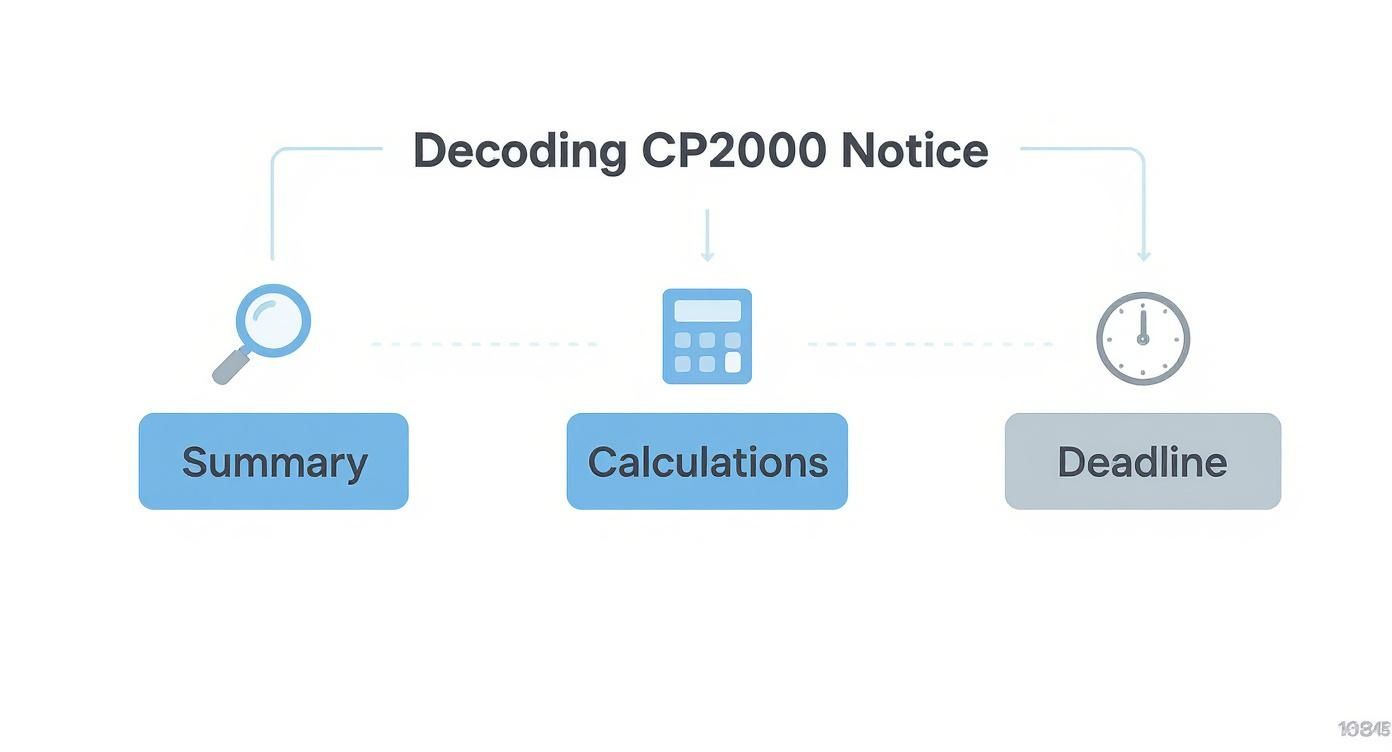
As you can see, a successful response starts with understanding the notice, checking the numbers, and, most importantly, respecting that deadline.
Choose Your Response Path
Once you’ve done your homework, you’ll know exactly how to proceed. The CP2000 notice itself includes a response form where you'll tell the IRS where you stand.
- You Agree with the Changes: If you look at your records and realize, "Yep, they're right," this is the simplest path. You'll check the box indicating you agree, sign the form, and mail it back. If you owe additional tax, you can include a check or follow the instructions for other payment options.
- You Partially Agree: This is a common scenario. Maybe the IRS is right about some unreported income, but they missed the associated expenses. For instance, they found $10,000 in business income, but you have records for $4,000 in legitimate business expenses that offset it. Here, you’ll check the "partially agree" box, attach a detailed explanation, and provide copies of your expense records.
- You Disagree with All Changes: If you’re confident your original return is 100% accurate, you need to make your case. Check the "disagree" box, and be sure to attach a signed letter explaining precisely why the IRS is mistaken, complete with supporting evidence.
No matter which path you take, your word alone isn't enough. Your response must be backed up by proof. Always, always include copies of any documents that support your position—corrected 1099s, receipts for expenses, or brokerage statements showing the right numbers.
A crucial final step: send your response using certified mail with a return receipt requested. This gives you irrefutable proof of when you sent it and when the IRS received it, protecting you from any "lost in the mail" issues. If you need to send supporting documents quickly and securely, you might want to learn how to send fax online.
Common CP2000 Triggers and How to Avoid Them
The best way to deal with a CP2000 notice is to never get one. The good news is that these notices are usually triggered by simple, preventable mistakes that create a disconnect between your tax return and the data the IRS gets from everyone else.
Think of it this way: the IRS has an automated system that plays a matching game. It gets a stack of forms (like 1099s and W-2s) from employers, banks, and clients that paid you. Then, it looks at your tax return to see if you reported all that same income. If a form is in their stack but missing from your return, the system flags it and out comes a CP2000.
Unreported Income from Side Hustles and Freelancing
One of the biggest culprits? Forgetting to report income from a side gig. If you made more than $600 from any single client as a freelancer or independent contractor, they are required to send you a Form 1099-NEC.
They don't just send it to you; they send a copy straight to the IRS. It's incredibly easy to lose track of one of these forms, especially if you had a one-off project early in the year. But the IRS computer won't forget. Your best defense is to keep a simple spreadsheet of all your freelance payments. When tax season rolls around, check your list against the 1099s you've received. If you know you earned over $600 from someone but don't have the form, reach out to them. Knowing when 1099s are due helps you stay on top of that process.
Errors in Reporting Investment Income
Investment income is another minefield for reporting mistakes. The discrepancies here can be a little more subtle.
- Forgotten Interest: Maybe you opened a new high-yield savings account for the great rate but forgot about the Form 1099-INT it would generate at the end of the year. Even a few dollars of interest has to be reported.
- Incorrect Cost Basis: When you sell a stock, you report the sale price and your cost basis—what you originally paid for it. If your brokerage reports a different cost basis to the IRS than you do, it can look like you had a bigger gain and, therefore, owe more tax.
- Missed Dividends: It’s easy to overlook dividends, which are reported on a Form 1099-DIV, especially if they are automatically reinvested.
The key to avoiding these mix-ups is to be meticulous. Before you even start filing, make a checklist of every single financial account you have: checking, savings, brokerage, crypto. Don't file until you've gathered the tax forms from every single one.
Other Common Mismatches
Beyond freelancing and stocks, plenty of other income sources can get lost in the shuffle. Did you take an early distribution from a 401(k) or IRA? That income is reported on a Form 1099-R, and if you miss it, you'll get a notice.
Even simpler things can cause a problem. Remember that part-time job you had for just two months at the start of the year? Forgetting to include that W-2 is a classic trigger for a CP2000.
Ultimately, the solution comes down to solid record-keeping. A little organization and a final checklist before you hit "submit" can ensure every piece of income is accounted for, dramatically lowering your chances of ever seeing that dreaded IRS envelope in your mailbox.
What to Expect After You Respond
So you’ve put together your response and sent it off to the IRS. Now what? The waiting game begins, and it can definitely be a little stressful. Knowing what could happen next can make the process a lot less intimidating.
Once the IRS has your response, the outcome will generally fall into one of three buckets. The resolution isn't always fast, either. It often takes around 60 days to hear back, and more complicated situations can drag on for several months. For a bit of perspective, in 2022, about 70% of these notices ended with some additional tax being owed. Another 20% resulted in no change at all, and a lucky 10% actually led to a refund adjustment. You can read the full analysis on DimovTax.com to get a better sense of the trends.
The Best-Case Scenario: The "No Change" Letter
This is the news you’re hoping for. If your explanation and documents clear everything up, the IRS will simply close the case with no adjustments to your tax return.
They'll send you a letter confirming that your original tax return stands as it was filed. That means no extra tax, no penalties, and no interest. The matter is officially done and dusted.
A Middle Ground: The IRS Accepts Your Partial Agreement
What if you agreed with some of the IRS's proposed changes but not others? If you provided a solid explanation for the items you disputed, the IRS will review your case.
If they agree with your corrections, you'll receive a revised notice. This updated letter will show a new, lower balance due based on the information you provided. From there, you can pay the adjusted amount or look into a payment plan to resolve the issue.
The Toughest Outcome: Disagreement and the Notice of Deficiency
This is the most serious path your case can take. If the IRS reviews your response but still disagrees with your position, they won't send you a bill just yet. Instead, they will issue what’s called a Statutory Notice of Deficiency. You might also see it referred to as a CP3219A or a "90-day letter."
Don't mistake this for a bill—it's not. This letter is your official green light to take your case to the U.S. Tax Court. You have a strict 90-day deadline from the date on the notice to file a petition if you want to fight their determination without paying the disputed tax first.
If you let that 90-day window close without filing a petition, the IRS will go ahead and assess the tax. A real bill will follow, and at that stage, your options for challenging the debt become much more restricted.
When You Should Hire a Tax Professional

While you can absolutely handle a simple CP2000 notice on your own, some situations are just too complex—and the stakes too high—to go it alone. Think of it this way: you might be able to fix a leaky faucet, but you’d call a plumber for a burst pipe flooding your basement.
Knowing when you're out of your depth is the key to getting the best possible outcome with the IRS. Calling in a pro isn't admitting defeat; it's a strategic move to protect your finances.
Red Flags That Signal You Need Help
There are a few scenarios where your first call after opening that IRS envelope should be to a tax expert. If you find yourself in any of these situations, it's time to consult with a qualified CPA or an Enrolled Agent.
- The Proposed Tax Bill Is High: If the IRS says you owe a substantial amount of money, the financial risk of making a mistake is just too great. Every detail in your response will matter.
- The Issue Is Complicated: This isn't just about a forgotten W-2. If the discrepancy involves cryptocurrency trades, the sale of inherited property, complex investment transactions with a disputed cost basis, or business income, you're in expert territory.
- You Feel Overwhelmed or Confused: Let's be honest—tax law is dense. If you don't fully understand what the notice is saying or feel unsure about how to build a solid case, that's a clear sign to get professional guidance.
A seasoned tax professional becomes your representative and your advocate. They speak the IRS's language fluently and know how to navigate the system to present your case accurately, all while protecting your rights.
Hiring an expert is an investment in your financial health and, frankly, your peace of mind. They can spot defenses you might have missed, take over all communications with the IRS, and work toward a resolution that you might not achieve on your own.
To understand the full scope of what an expert can do for you, you can learn how to resolve IRS issues with the help of a professional tax accountant and see what a difference expertise makes.
Still Have Questions About CP2000 Notices?
Even with a plan in place, it's completely normal to have a few questions lingering. Let's tackle some of the most common ones we hear from taxpayers who just found a CP2000 in their mailbox.
Is a CP2000 Notice an Audit?
No, it’s not an audit, and that’s a key distinction. An audit is a deep dive into your entire financial life, where the IRS might ask you to prove every single deduction, credit, and source of income you reported.
A CP2000 notice is much more focused. It's an automated flag raised by the IRS computer system because of one specific discrepancy. Think of it like this: a CP2000 is like a librarian pointing out a single overdue book, while a full audit is like that same librarian demanding to see every book you’ve checked out for the past three years.
What Happens If I Ignore the Notice?
Ignoring a CP2000 is probably the worst move you can make. If you don't reply by the deadline, the IRS simply assumes you agree with their proposed changes.
From there, they’ll send a Statutory Notice of Deficiency. Ignore that, and they'll formally assess the new tax, pile on penalties and interest, and start the collection process.
The bottom line is this: your right to easily challenge the IRS's proposal vanishes if you don't respond on time. This problem won’t solve itself—it will only grow larger and more costly.
Does Getting a CP2000 Mean I'm More Likely to Be Audited?
Not usually. The CP2000 program is an automated matching system. As long as you respond correctly, provide the necessary documents, and get the issue sorted out, it generally doesn't put you on a "watchlist" for future audits.
That said, a pattern of ignoring these notices or having major, unresolved issues year after year could definitely attract more scrutiny from the IRS down the road. The best strategy is always to handle it professionally and promptly.
Dealing with IRS notices can feel overwhelming, but you don’t have to go through it by yourself. The experts at Allied Tax Advisors can step in, review your entire situation, manage all the back-and-forth with the IRS, and work to resolve your case with the best possible outcome. Contact us today for a consultation.