
That letter from the IRS in your mailbox is rarely good news, and seeing a penalty tacked on can make your stomach drop. But don't panic. There's a provision called reasonable cause penalty abatement, and it’s a lifeline for taxpayers who genuinely tried to follow the rules but were derailed by circumstances they just couldn't control.
This isn't a get-out-of-jail-free card for ignoring your taxes. It's the IRS's way of acknowledging that sometimes, life gets in the way.
Understanding IRS Penalties and Reasonable Cause Relief
Think of IRS penalties as a nudge to encourage everyone to file and pay on time. The system is really designed to penalize willful neglect, not to punish a small business owner whose office was flooded or an individual caring for a gravely ill family member.
The key to getting relief is proving you acted with what the IRS calls "ordinary business care and prudence." It’s a bit of a mouthful, but it simply means you made the same effort a typical, responsible person would in your shoes. You weren't careless, and you weren't ignoring your duties—something major just stopped you from being able to comply.
Is It Even Worth Trying to Fight a Penalty?
Absolutely. A lot of people think challenging an IRS penalty is a losing battle, but the numbers tell a different story. The IRS knows that valid reasons for non-compliance exist, and they approve well-supported requests all the time.
In fiscal year 2022 alone, the IRS abated a staggering $50.9 billion in civil penalties out of the $73.6 billion they initially assessed. That’s nearly 70% wiped away. As The Tax Adviser reported on these findings, it's clear that with the right argument and solid proof, you have a very real chance.
What Counts as a "Good Reason"?
The IRS is pretty specific about what qualifies as a valid reason. They’re looking for significant, often unforeseen, events that directly prevented you from filing or paying. I’ve seen successful abatements for all sorts of situations, but some of the most common ones include:
- Death or Serious Illness: This could be your own incapacitation or that of an immediate family member who required your full attention.
- Unavoidable Absence: Being stuck somewhere unexpectedly during the tax deadline, like being stranded abroad.
- Natural Disasters: Fires, hurricanes, floods, or other events that destroyed your home, business, or essential records.
- Inability to Get Records: You tried everything to get the documents you needed (from a third party, for example), but they were simply unavailable.
- Bad Advice from a Pro: You hired a competent tax advisor, gave them all the correct information, and they still gave you the wrong advice.
The single most important element in your case is the timeline—what happened and when it happened. The IRS agent reviewing your request will also pull up your history. A clean track record of filing and paying on time goes a long way to show this was a one-time issue, not a pattern of behavior.
It’s just as important to know what won’t work. Simply forgetting the deadline or claiming you didn't know about a tax law are almost never accepted as reasonable cause. The IRS expects you to know your basic obligations.
Also, just not having the money to pay your tax bill usually isn't enough to get a failure-to-file penalty waived, though it can sometimes be a factor for a failure-to-pay penalty. To get a better handle on the different types of penalties you might be facing, it’s worth understanding the most common IRS penalties for late tax filing.
Now, let's walk through how to build a case that will get the IRS to say "yes."
Do You Qualify for Reasonable Cause Abatement?
Before you even think about drafting a letter, let’s get real about your situation. Does your reason for missing a tax deadline actually line up with what the IRS considers a legitimate hardship?
It’s a high bar. The IRS isn't looking for a simple excuse—they want a compelling story backed by solid proof. You need to show that you were sideswiped by circumstances beyond your control and that you still did everything a sensible person would do under those same conditions.
That core standard is what the IRS calls “ordinary business care and prudence.” It’s a broad term, but it boils down to this: did you act responsibly despite the difficult situation? This standard is the foundation for getting penalties waived, whether it's for filing late, paying late, or making an error on your return. You can read more about this legal standard and see how it plays out in actual court cases.
Unpacking What Counts as a Valid Reason
So, what kind of situations actually meet this standard? The IRS tends to grant relief in a handful of specific scenarios, and each one requires you to prove the event was unavoidable and directly prevented you from taking care of your taxes.
Here are the most common justifications I've seen succeed over the years:
- Death or Serious Illness: This applies to you or someone in your immediate family. We're not talking about a bad cold; the illness had to be so severe that it made managing financial affairs impossible. You were incapacitated or completely consumed by caregiving duties during that critical tax period.
- Natural Disaster or Catastrophe: This one is pretty straightforward. If a fire, hurricane, flood, or another major disaster destroyed your records or turned your life upside down, you have a strong case. The event must have made it physically impossible to file.
- Inability to Obtain Records: This isn’t an excuse for procrastination. It means you genuinely couldn't get the documents you needed from a third party—like waiting on a K-1 from a partnership—despite making repeated, documented efforts to get them on time.
- Mistaken Advice from a Tax Pro: This is tricky. You can't just throw your accountant under the bus. You have to prove you hired a competent professional, gave them all the right information, and then reasonably relied on their bad advice in good faith.
This flowchart breaks down the basic path to getting a penalty waived. It all starts with the notice, but the journey truly begins with having a valid, provable reason.
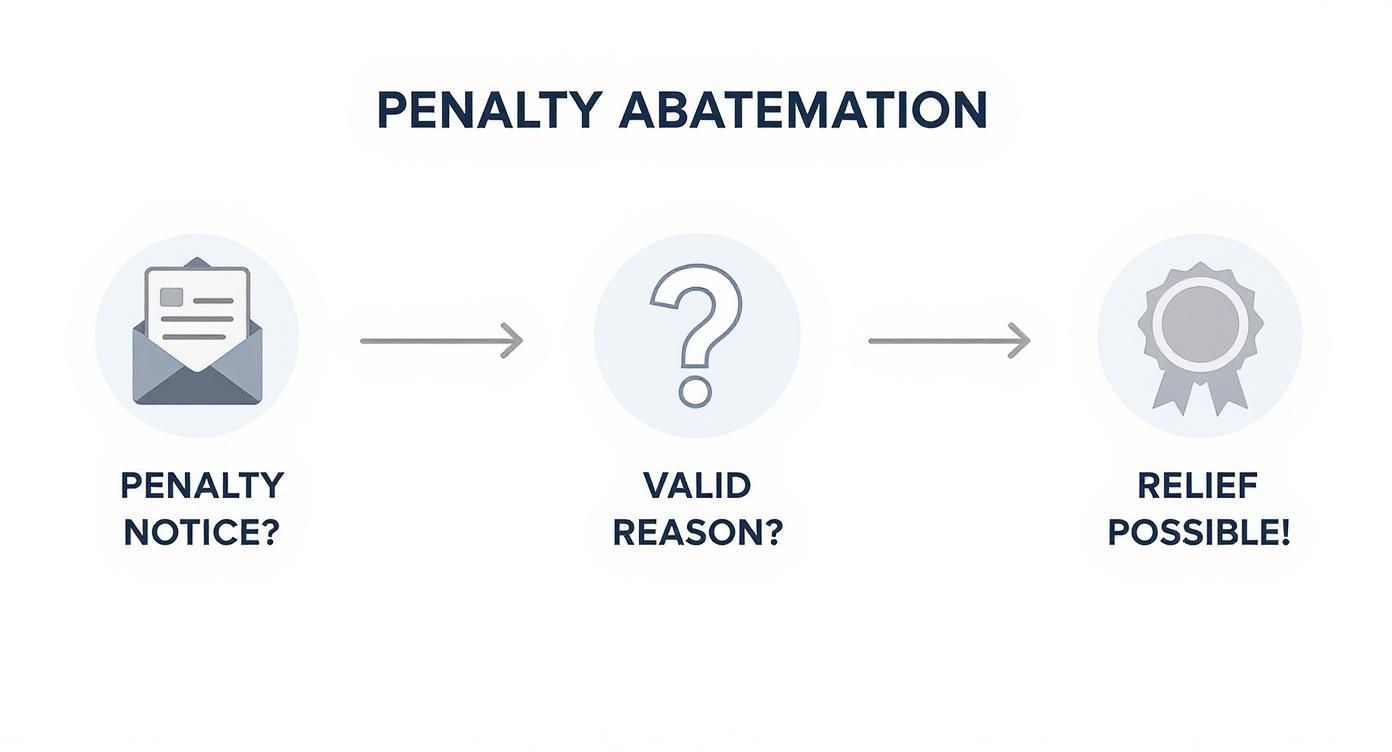
As the chart shows, that notice in the mail is just the first step. The real work is in demonstrating you have a legitimate reason that justifies relief.
Common Reasons for Reasonable Cause Claims
To help you assess your own situation, I've put together a table that breaks down the most common reasons people request abatement. It covers what the IRS is looking for, the kind of proof you'll need, and a realistic look at your chances.
| Reason | Required Evidence | Key Consideration | Success Likelihood |
|---|---|---|---|
| Serious Illness/Death | Hospital records, doctor’s letters, death certificate. | Must show incapacitation during the tax period. | High |
| Natural Disaster | FEMA declarations, insurance claims, photos of damage. | Must directly impact your ability to access records or file. | High |
| Records Unavailable | Dated letters, emails showing repeated requests for documents. | Must prove you were diligent and the delay was not your fault. | Medium |
| Bad Professional Advice | Engagement letter, copies of info given to pro, written advice. | Must show you provided accurate info and relied on the advice. | Medium |
| System/Postal Errors | IRS system outage notice, proof of timely mailing (certified mail receipt). | Errors must be verifiable and beyond your control. | Low to Medium |
These are the arguments that have the best shot, but success always comes down to the quality and credibility of your documentation. Without proof, even the best reason is just a story.
Real-World Scenarios and IRS Expectations
Let’s put this into practice. Imagine Sarah, a small business owner, whose mother was diagnosed with a terminal illness in March. Sarah became her primary caregiver, spending weeks at the hospital, and completely missed the April filing deadline.
Her request for reasonable cause penalty abatement would be strong. Why? Because she can provide hospital admission records, a letter from her mother's doctor explaining the severity of the illness and Sarah's essential role, and a clear timeline. This evidence paints a picture of someone whose focus was necessarily and unavoidably elsewhere.
Now, consider Mark, a freelancer who hired a CPA. He gave the CPA every income statement and receipt. The CPA then incorrectly told him that income from a foreign client wasn't taxable until the following year.
For Mark’s claim to work, he needs to show his engagement letter with the CPA, copies of the documents he supplied, and dated emails showing the specific advice he received and followed. This proves he acted prudently and was let down by an error that wasn't his fault.
A taxpayer's compliance history is an unspoken factor. If you have a decade of on-time filings and payments, the IRS is far more likely to see a recent mistake as an anomaly caused by a legitimate hardship. A spotty record makes it harder to prove this wasn't just another instance of negligence.
Reasons the IRS Almost Always Rejects
Just as important as knowing what works is understanding what doesn't. Wasting your time on a weak argument is a recipe for frustration. The IRS has heard it all, and these justifications almost never fly:
- Ignorance of the Law: "I didn't know" is never a valid excuse. Every taxpayer is expected to know their basic obligations.
- Forgetting the Deadline: A simple memory lapse or a mistake on your calendar won't cut it. It doesn't meet the standard of ordinary business care.
- Lack of Funds (for Failure-to-File): This is a critical distinction. While not having money to pay might help abate a failure-to-pay penalty, it is never an excuse for not filing the return itself. The IRS expects you to file on time, even if you can't pay a dime.
By honestly weighing your situation against these established IRS guidelines, you can figure out if you have a real shot at penalty abatement before you start the formal process.
How to Build a Case the IRS Can't Ignore
A compelling story is a great start, but when you're dealing with the IRS, it’s the proof that seals the deal. Your argument for reasonable cause absolutely has to be backed by an organized, undeniable package of evidence. You’re essentially building a case file that leaves no room for doubt, making it as easy as possible for the IRS agent to see things your way and approve the request.
The whole point is to create a clear, chronological narrative supported by official documentation. This isn't the time for a shoebox full of crumpled receipts; you need a professional presentation that shows you’ve done your homework.

Gathering the Right Kind of Proof
The specific documents you'll need hinge entirely on why you're asking for the penalty to be waived. The evidence must draw a direct line from the event you experienced to your inability to file or pay on time. Your documents need to establish a crystal-clear timeline, showing exactly when the event happened and how long its impact lasted.
Here are a few real-world examples of what that looks like:
- For a Medical Crisis: You’ll want to gather hospital admission and discharge papers, letters from doctors (on their official letterhead) detailing the illness and its severity, and maybe even records showing you were the primary caregiver.
- For a Death in the Family: A copy of the death certificate is non-negotiable. You could also include things like funeral programs or travel records if you had to fly out of state to manage arrangements.
- For Lost or Destroyed Records: This could involve insurance claims, police reports (if your records were stolen), or photos of the damage from a fire or flood. If there was a local or federal disaster declaration, include proof of that, too.
- For Bad Advice from a Tax Pro: This one demands a detailed paper trail. You'll need the engagement letter, copies of the exact information you gave the advisor, and any dated emails or letters that contain their incorrect guidance.
Pro Tip: I always tell my clients to create a cover sheet that lists every single document included, almost like a table of contents. Then, arrange all the documents chronologically. This simple step guides the IRS agent through your story from start to finish.
This level of organization does more than just look good. It shows you're serious and respectful of the agent's time, which can genuinely improve your odds.
Organizing Your Evidence for Maximum Impact
Once you have your documents, presentation is everything. A jumbled mess of papers can confuse the agent reviewing your case and weaken your argument before they even get through it. A well-organized file, on the other hand, tells a clear and persuasive story for you.
Here are a few tips that I've seen work wonders:
- Create a Timeline: On a separate sheet of paper, map out a simple timeline of events. For instance: "March 2: Mother admitted to hospital. March 15 – April 20: Acted as primary caregiver. April 18: Tax deadline missed." It gives the agent an at-a-glance summary.
- Highlight Key Dates: Don't be afraid to take a highlighter to your documents. Draw attention to the important dates, like the admission date on a hospital record or the date stamp on a CPA's email.
- Explain Each Document: In your cover letter, briefly explain the relevance of each piece of evidence. Something simple like, "Attached as Exhibit A is Dr. Smith's letter confirming my incapacitation from…" connects the dots for them.
This structured approach transforms a pile of papers into a coherent argument. And if you decide you need a tax professional to handle this for you, it’s smart to review the official IRS Form 2848 (Power of Attorney) instructions to make sure it's done right.
Filling in the Gaps in Your Story
What if you don't have a perfect paper trail? First, don't panic. If a specific document is missing, you can sometimes use third-party statements or affidavits to fill that gap. A sworn statement from a neighbor who saw the flood damage, for example, could support your claim of destroyed records.
Don't forget, your own tax history is a powerful piece of evidence. If you aren't sure about your past filing record, you can learn how to get your IRS transcript online. A clean history of on-time filing helps prove that this recent issue was an outlier—a bump in the road caused by extraordinary circumstances, not a pattern of negligence.
By methodically building your case with solid, well-organized proof, you're showing the IRS exactly what they're looking for: that you acted with "ordinary business care and prudence."
Crafting a Persuasive Abatement Request Letter
This is where all your hard work gathering evidence comes together. Your request letter is your chance to tell your story to the IRS, turning that stack of documents into a compelling narrative. Honestly, a well-written, persuasive letter can make or break your case for reasonable cause penalty abatement.
Your mission here is to be clear, direct, and professional. I get it—you might be frustrated or stressed—but keeping a respectful tone is non-negotiable. You're not demanding anything; you're explaining a tough situation to a real person who's just doing their job. A calm, factual approach will always serve you better.

The Anatomy of a Strong Abatement Letter
Every effective letter I’ve seen follows a simple, logical flow. Think of it in three parts: a straightforward introduction, the main body that tells your story, and a polite conclusion that sums it all up. This structure helps the IRS agent quickly grasp your situation and follow your reasoning.
- The Introduction: Jump right in. State your name, your Social Security Number (or EIN for a business), the tax year, the exact penalty amount, and the notice number you received. Make it clear from the first sentence that you are requesting a penalty abatement based on reasonable cause.
- The Body Paragraphs: This is the heart of your letter. Walk the agent through a chronological timeline of what happened. As you tell your story, refer to your supporting documents. For instance, you might write, "As you'll see in the attached hospital records, marked as Exhibit A…" This is where you prove you acted with "ordinary business care and prudence" but were simply overwhelmed by circumstances.
- The Conclusion: Briefly restate your request. Reaffirm that you believe your situation meets the IRS criteria for reasonable cause. Always end by thanking the agent for their time and consideration before signing your name.
A taxpayer’s sincerity and effort truly come through in the details. The most important thing you can do is show you tried your best to report and pay what you owed. Your letter needs to reflect that you take your tax obligations seriously and were only derailed by extraordinary events.
Example Letter Scenario 1: Medical Emergency
Let's see how this works in a real-world scenario. Here’s an example based on a taxpayer who had to deal with a sudden and serious family medical crisis.
Subject: Request for Penalty Abatement for Tax Year 2023 – [Your Name], SSN: XXX-XX-XXXX, Notice CP14
"I am writing to respectfully request the abatement of the failure-to-file penalty of $XXX.XX assessed for the 2023 tax year, as detailed in Notice CP14 dated [Date]. My failure to file on time was the direct result of a severe and unexpected medical emergency involving my spouse, which I believe constitutes reasonable cause.
From March 5, 2024, to April 30, 2024, I was the sole caregiver for my husband, who was hospitalized following a sudden heart attack. As documented in the attached hospital admission records (Exhibit A) and a letter from his physician, Dr. Emily Carter (Exhibit B), his condition was critical and required my constant presence.
During this intense period, I was simply unable to manage our financial affairs, including the timely filing of our joint tax return. I have a consistent history of on-time filing, which I hope demonstrates my commitment to my tax obligations. As soon as my husband’s condition stabilized, I immediately gathered our documents and filed our return on [Date of Filing].
I believe these circumstances show I acted with ordinary care but was unavoidably prevented from filing by the due date. I have enclosed all supporting documents and have already paid the underlying tax in full. Thank you for your consideration of this reasonable cause penalty abatement request."
Example Letter Scenario 2: Reliance on a Tax Professional
Now, let's switch gears to a small business owner who got bad advice. Notice how this letter's focus shifts to proving they did their due diligence when hiring and working with a professional.
Subject: Request for Penalty Abatement for Tax Year 2023 – [Business Name], EIN: XX-XXXXXXX, Notice CP220
"I am writing on behalf of [Business Name] to request an abatement of the accuracy-related penalty of $X,XXX.XX for the 2023 tax year, per Notice CP220 dated [Date]. This penalty resulted from an error on our return that was made due to our reasonable reliance on the advice of a competent tax professional.
We engaged the services of Certified Public Accountant John Davis to prepare our corporate tax return. As shown in our engagement letter (Exhibit A), we provided Mr. Davis with complete and accurate financial records well before the deadline, on February 15, 2024. This is also confirmed by the email correspondence included as Exhibit B.
Mr. Davis incorrectly advised us that certain revenues were not taxable until the next fiscal year. We relied on his professional advice in good faith. Upon being notified of the error by the IRS, we immediately contacted a new tax advisor, filed an amended return, and paid the additional tax due.
We believe we exercised ordinary business care by hiring a licensed CPA and providing him with all necessary information. The resulting error was not due to carelessness on our part, but rather to flawed professional advice. We respectfully request that the penalty be abated based on reasonable cause. Thank you for reviewing our case."
What to Do After You Submit Your Request
Sending off your request for reasonable cause penalty abatement is a big milestone, but the process doesn't end there. Now, the waiting begins. Knowing what to expect—and what you should be doing in the meantime—can take a lot of the stress out of the situation and keep your case moving forward. This part is all about patience, smart follow-up, and being ready for whatever comes next.
First, you need to accept that the IRS works on its own schedule. It’s completely normal for a response to take 90 to 120 days, and sometimes even longer if you filed during a busy season.
While you wait, don't just sit on your hands. If the penalty is tied to taxes you still owe, keep making payments on that underlying tax bill if you're able. Doing so stops more interest and penalties from piling up on the actual tax amount, which is a separate issue from the penalty you're trying to abate.
Tracking Your Request and When to Follow Up
You sent your request, hopefully via certified mail to get that all-important delivery confirmation. Now what? Give it time. Calling the IRS too soon won't speed anything up and will likely just lead to frustration.
However, if 120 days go by and you've heard nothing—no letters, no updates—it’s time to politely check in.
When you call, make sure you have this information at your fingertips:
- A copy of the penalty notice that started this whole process.
- Your Social Security Number (or EIN for a business).
- The specific tax form and year in question.
- The penalty abatement letter you sent, so you can refer to it.
Calmly explain that you’re just calling to check the status of a penalty abatement request you submitted on a specific date. The agent should be able to look it up and tell you if it's in their system and where it is in the review process.
My Advice: Keep a log of every single time you talk to the IRS. Write down the date, the agent's name and ID number, and a quick summary of what you discussed. This simple record can be a lifesaver if you run into delays or get conflicting information later on.
Understanding the Potential Outcomes
Ultimately, the IRS will come back with one of three decisions. Knowing what these are ahead of time will help you figure out your next steps without panicking.
- Full Abatement: This is what we’re hoping for. The IRS accepts your reasonable cause argument and wipes out the entire penalty. You’ll get an official notice confirming the adjustment.
- Partial Abatement: Sometimes the IRS agrees you had a valid reason, but only for part of the time you were non-compliant. They might reduce the penalty but not get rid of it completely.
- Denial: This happens when the IRS decides your situation doesn't meet their criteria for reasonable cause. You'll receive a notice explaining why they turned down your request.
Even if you get a full abatement, remember you still have to pay the original tax you owed. If you already paid the penalty, the IRS will issue you a refund. And don't get discouraged! Success rates can be surprisingly high, especially in complex cases. For instance, penalties tied to foreign information returns (like Forms 5471 or 5472) have seen huge abatement rates. From 2018 to 2021, penalties under sections like IRC §§ 6038 and 6038A were abated 74% of the time by the number of penalties and 84% by dollar amount.
What to Do If Your Request Is Denied
Getting a denial letter is disappointing, but it is not the final word. You absolutely have the right to appeal the decision.
The denial notice, which is often a Letter 854C, will clearly spell out your appeal rights and give you a deadline—usually 30 days from the date on the letter. You can ask for a conference with the IRS Independent Office of Appeals, which means a new, impartial official will take a fresh look at your case.
If things get complicated or you feel like you're not being heard, you can also reach out to the IRS Taxpayer Advocate Service. It’s an independent group within the IRS that helps people solve problems they can’t fix through the usual channels.
Common Questions About Penalty Abatement
Navigating the world of tax penalties can feel like a maze. Even after you've built a solid case and mailed your request, plenty of questions can pop up. Let's tackle some of the most common ones I hear from clients to give you some clarity and confidence.
What Is the Difference Between Reasonable Cause and First-Time Abatement?
It’s really easy to mix these two up, but they're fundamentally different paths to relief.
Think of First-Time Penalty Abatement (FTA) as the IRS's version of a "get out of jail free" card. It's an administrative waiver for taxpayers who have a clean record for the past three years. It's much simpler to qualify for, but it only works for a few specific penalties: failure-to-file, failure-to-pay, and failure-to-deposit, and only for one tax period.
Reasonable cause is a different beast entirely. It’s not about your past compliance history; it’s about why you couldn't comply this time. You need to show that specific, unavoidable circumstances got in your way, even though you tried to do the right thing. This argument can cover a much broader range of penalties (like accuracy-related ones) and can even apply to multiple tax periods if they were all affected by the same event. The catch? The burden of proof is much higher.
My advice is always to check if you qualify for First-Time Abatement first. It's the path of least resistance. If you don't, or if the penalty you're facing isn't covered, then a well-documented reasonable cause request is your next best move.
Can I Request Abatement Over the Phone?
While picking up the phone seems like the quickest way to get an answer, it’s almost never the right approach for a reasonable cause argument.
In very rare, simple cases, an IRS agent might grant relief over the phone if you're calling about a notice you just received. But don't count on it. A serious reasonable cause claim hinges on a detailed written explanation and a stack of supporting documents. There's just no way to properly present your evidence and make a persuasive case during a phone call.
For a claim that has a real chance of success, you need to put it in writing. Send it by mail—and I always recommend using certified mail with a return receipt. This creates an official paper trail and forces the IRS to review your entire file.
How Long Does the IRS Take to Respond?
This is the hard part: you have to be patient. IRS response times are all over the map, depending on their workload and how complex your case is. It's completely normal to wait 90 to 120 days for a response, and sometimes even longer, especially around tax season.
While you're waiting, keep paying the underlying tax you owe. This stops more interest from piling up. If the IRS does abate your penalty, they'll also remove any interest that was charged specifically on that penalty amount. If 120 days go by and you've heard nothing, it's perfectly reasonable to make a polite follow-up call to check on the status.
Dealing with IRS notices and building a strong case for penalty abatement can be a real headache. The team at Allied Tax Advisors brings decades of hands-on experience to the table, helping people and businesses get through their toughest tax problems. If you could use some expert guidance, visit us online to see how we can help protect your financial interests.