
Here’s the simple, unvarnished truth about capital gains tax in California: the state treats your investment profits just like your paycheck. That's right—it's all taxed as ordinary income.
This means there’s no special, lower tax rate for long-term gains, which is a major departure from how the federal system works. It's a fundamental difference that catches many successful investors off guard.
How California's Capital Gains Tax Really Works
Unlike the federal government, which gives you a tax break for holding investments for more than a year, California doesn’t play favorites. When you sell an asset for a profit—whether it's stocks, a piece of real estate, or even cryptocurrency—that profit gets lumped right in with the rest of your annual income.
Think of it this way: say your salary is $150,000. If you sell some stocks and lock in a $50,000 capital gain, California's Franchise Tax Board (FTB) sees your total income for the year as $200,000. That entire amount is then taxed according to the state’s standard progressive tax brackets.
The Federal System: A Quick Contrast
The IRS, on the other hand, puts your capital gains into two different buckets:
- Short-Term Gains: Profit from assets you held for one year or less. The IRS taxes these at your regular federal income tax rate.
- Long-Term Gains: Profit from assets you held for more than one year. These get special treatment, with lower tax rates of 0%, 15%, or 20%, depending on your income level.
California completely ignores this distinction. It doesn’t matter if you held an asset for two days or two decades. The profit is just more income, plain and simple.
To get a feel for how your total income (including gains) fits into the state's system, you can check out our complete guide to the 2024 California tax brackets explained.
To make this distinction crystal clear, here’s a simple table breaking down the two approaches.
Federal vs. California Capital Gains: A Quick Comparison
| Tax System | Long-Term Capital Gains Rate | Short-Term Capital Gains Rate | Key Takeaway |
|---|---|---|---|
| Federal (IRS) | Preferential rates (0%, 15%, 20%) | Taxed as ordinary income | Rewards long-term holding with lower taxes. |
| California (FTB) | Taxed as ordinary income | Taxed as ordinary income | Holding period doesn't matter; all gains are income. |
This table neatly sums up the core difference: the federal government rewards patience, while California does not.
The Highest Rate in the Nation
This unique "gains-as-income" model is exactly why California has a reputation for being tough on investors. It effectively gives the state the highest top marginal capital gains tax rate in the entire country.
California’s top capital gains tax rate is 13.3%—the highest in the United States. When you add federal taxes on top of that, the combined rate for high earners can approach a staggering 33%.
This high rate isn't an accident; it stems from past propositions that eliminated any special treatment for capital gains. For high-income individuals, a large gain can easily push them into that top 13.3% state bracket, creating a much larger tax bill than they might have anticipated. Grasping this reality is the first and most important step in crafting a smart tax strategy in the Golden State.
A Step-by-Step Guide to Calculating Your California Capital Gains Tax
Figuring out your California capital gains tax might seem daunting, but the actual formula is pretty straightforward. At its core, you simply take the asset's final sale price and subtract its cost basis. The result is your capital gain—or loss.
Think of cost basis as your total investment in an asset. It’s not just what you paid for it; it includes other critical costs that bump up your initial investment. Getting this number right is the key to lowering your taxable profit when you eventually sell.
Nailing Down Your True Cost Basis
To get an accurate picture, you need to add up a few key components:
- Original Purchase Price: This is the starting point—what you paid for the asset.
- Transaction Fees: Think brokerage commissions for stocks or the closing costs you paid when buying a house.
- Capital Improvements: For real estate, this means significant, value-adding upgrades like a new roof or a complete kitchen remodel, not just routine repairs.
By carefully calculating your cost basis, you ensure you're only taxed on your actual profit. Forgetting to include these adjustments is an easy way to accidentally overpay the Franchise Tax Board.
How Your Gain Becomes Taxable Income
Once you have your final capital gain, California’s process is unique. You don't apply a special, separate capital gains rate. Instead, you add that gain directly to all your other income for the year—your salary, freelance earnings, you name it.
This is where things get interesting. Your investment profit gets lumped in with your regular earnings to create one big pot of taxable income for the state.
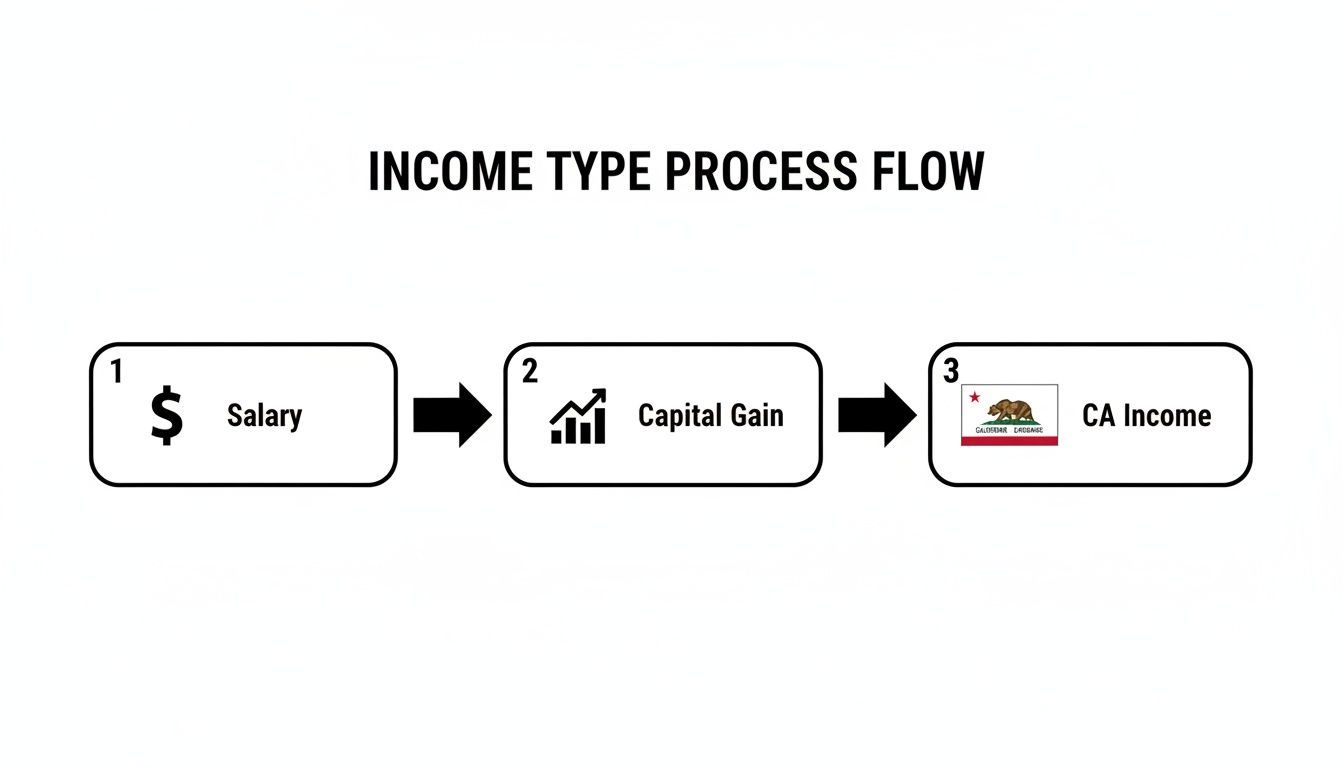
As you can see, in California, your capital gain flows right into the same bucket as your salary, creating a single, larger income figure that gets taxed by the state.
A big gain can really change your financial picture for the year, potentially pushing your total income into a much higher tax bracket. This is where California’s progressive tax system makes its presence felt, and it’s something you absolutely have to account for when planning a major asset sale.
The Bottom Line: In California, a capital gain isn't taxed separately. It's added to your total income, and that combined total determines which marginal tax bracket you fall into and how much state tax you'll owe.
Why Tax Brackets Can Amplify the Impact
Unlike the federal system, California taxes all gains—short-term and long-term—as ordinary income. This income is then subjected to the state's progressive tax brackets. For the 2024 tax year, these rates begin at a low of 1% and climb all the way to 13.3% for the highest earners. This structure has a huge effect on anyone selling stocks, flipping a rental property, or cashing out crypto gains.
Let's look at a quick example to see how this works in the real world.
To illustrate how income tiers work, here's a simplified look at a few of California's marginal tax brackets for a single filer.
Example California Marginal Tax Brackets (Single Filer)
| Taxable Income Bracket | Marginal Tax Rate |
|---|---|
| $0 – $10,412 | 1.0% |
| $10,413 – $24,684 | 2.0% |
| $24,685 – $38,959 | 4.0% |
| $38,960 – $54,081 | 6.0% |
| $54,082 – $68,350 | 8.0% |
| $68,351 – $349,137 | 9.3% |
| $349,138 – $418,961 | 10.3% |
| $418,962 – $698,271 | 11.3% |
| $698,272+ | 12.3% |
Note: These are simplified brackets for illustrative purposes. The actual brackets are adjusted annually for inflation.
As you can see, the more you earn, the higher the tax rate on your next dollar of income.
Now, let's apply this to a person.
- Scenario: A software engineer in San Diego earns a $150,000 salary.
- Asset Sale: She sells company stock she's held for five years, realizing a $100,000 long-term capital gain.
- California Taxable Income: Her total income for state tax purposes shoots up to $250,000 ($150,000 salary + $100,000 gain).
Without the gain, her salary would put her squarely in the 9.3% marginal bracket. But that extra $100,000 keeps her firmly in that same 9.3% bracket, meaning every single dollar of her gain is taxed at that rate. If her gain had been large enough to push her over the $349,137 threshold, those dollars would have been taxed at an even higher 10.3%.
This "bracket creep" is exactly why you have to be strategic. A single large sale can have a much bigger tax impact than you might expect.
Mastering Real Estate Capital Gains Tax in California

For most Californians, their home is more than just four walls and a roof—it's their single largest financial asset. When you decide to sell, understanding how taxes work is absolutely crucial to protecting the equity you’ve worked so hard to build.
Fortunately, both federal and California tax laws provide homeowners with a huge advantage. It's called the primary residence exclusion (or Section 121 exclusion), and it’s easily one of the most valuable tax breaks on the books.
Unlocking the Primary Residence Exclusion
This powerful rule lets you shield a massive chunk of profit from taxes when you sell your main home. To qualify, you just have to pass two simple tests:
- The Ownership Test: You must have owned the home for at least two of the five years right before the sale.
- The Use Test: You must have lived in the home as your main residence for at least two of those same five years.
If you check both boxes, you can exclude up to $250,000 of your capital gain from your income. For married couples filing a joint return, that exclusion doubles to a whopping $500,000.
Think about what that means. If you're a single filer who bought a house for $400,000 and later sell it for $600,000, your entire $200,000 gain is completely tax-free.
When Your Gain Exceeds the Limit
So, what happens if your profit is bigger than the exclusion amount? This is a pretty common situation, especially in California's pricey real estate market. Any gain above the $250,000/$500,000 threshold is taxable.
Here in California, that excess profit gets lumped in with your other income for the year and is taxed at your regular marginal rate. There’s no special break for it; it's just treated like any other income. This is where having professional real estate agents and brokerages on your side becomes invaluable for navigating high-stakes transactions.
The Investor’s Tool for Deferring Taxes
For real estate investors, the game changes. Their go-to strategy is the 1031 exchange, a powerful tool baked into the tax code that allows them to defer paying capital gains tax on the sale of an investment property.
It's essentially a swap. Instead of selling a property and cashing out, you roll the proceeds from that sale directly into the purchase of a new "like-kind" investment property. As long as you follow the very strict IRS rules and deadlines, you can kick that tax bill down the road, allowing your portfolio to grow without being slowed by taxes. You can learn more about what a 1031 exchange is and how it works.
Key Insight: A 1031 exchange is a tax deferral, not a tax elimination. Your original cost basis rolls over to the new property, so that deferred gain is still waiting for you when you eventually sell without doing another exchange.
Calculating Basis on Rental Properties
If you own rental properties, figuring out your cost basis isn't as straightforward as it is for your personal home. You have to account for depreciation.
Depreciation is an annual tax deduction you get to take to offset the wear and tear on your property. While it lowers your taxable income each year (which is great!), it also lowers your cost basis. When you sell, all the depreciation you claimed over the years gets "recaptured" and taxed.
This often surprises investors. It means a portion of your gain is taxed as ordinary income to pay back the tax benefits you got from depreciation.
The Nonresident Withholding Trap: Form 593
Finally, there’s a compliance rule that catches many sellers by surprise, particularly those leaving the state. California mandates that 3.33% of the total sales price be withheld and sent directly to the Franchise Tax Board (FTB) when the sale closes.
This withholding, which is handled on Form 593, is basically a prepayment on any potential capital gains tax you might owe. While you can sometimes get an exemption (like if it was your primary residence), it’s the default requirement. If you don't plan for it, you might be shocked to see a big chunk of your proceeds held back until you file your state tax return.
How California Taxes Stocks, Crypto, and Business Sales
While real estate tends to get most of the attention, capital gains in California can pop up from all sorts of places. Whether you're dealing with a stock portfolio, trading crypto, or selling the business you've poured your life into, each asset comes with its own quirks and strategic angles.
Getting a handle on these differences is key to managing your tax bill. The basic formula—sale price minus cost basis—is always the same, but the how of calculating that basis can change everything.
Navigating the World of Stock Sales
For anyone investing in the stock market, "cost basis" is rarely just a single number. If you've been buying shares of the same company over time at different prices, the method you use to decide which shares you sold can massively swing your taxable gain.
There are two main ways to go about it:
- First-In, First-Out (FIFO): This is the default setting for most brokerages. The IRS assumes you’re selling the oldest shares you own. If the stock has gone up over the years, FIFO will likely trigger the biggest possible capital gain because you're selling those earliest, lowest-cost shares first.
- Specific Identification: This method gives you control. You get to hand-pick which specific shares to sell. To shrink your tax bill, you could choose to sell the shares you bought at the highest price, which would reduce your gain. It demands careful record-keeping, but the tax savings can be well worth the effort.
Making the right choice here isn't just a minor detail; it can save you thousands. The holding period is just as crucial, and you can dive deeper into that in our guide covering short-term vs. long-term capital gains.
The Unique Tax Headache of Cryptocurrency
Cryptocurrency throws a real curveball at taxpayers. The IRS doesn't see Bitcoin or Ethereum as currency; it treats them as property. That one distinction changes the entire game.
Here's the takeaway: Every time you sell, trade, or even use crypto to buy a cup of coffee, you're creating a taxable event. If your crypto was worth more when you got rid of it than when you acquired it, you’ve got a capital gain to report.
That’s right—swapping some Ethereum for a new altcoin is a taxable sale of your Ethereum. The real nightmare is tracking the cost basis for every single one of those transactions across different exchanges and wallets. It gets complicated, fast.
Selling Your Business in California
For entrepreneurs, selling a business is a huge moment, often the result of years of grinding. The tax hit from that sale really boils down to how the deal is structured.
It usually comes down to one of two paths:
- Asset Sale: The buyer purchases the individual assets of the business—your equipment, inventory, customer lists, and so on. Buyers often prefer this because they get to "step-up" the basis of those assets and depreciate them.
- Stock Sale: The buyer simply purchases the owner's shares in the corporation. This is often much simpler and generally preferred by sellers, as the profit is typically treated as a more favorable capital gain.
The structure of the sale is a major negotiation point because it can create wildly different tax outcomes for the seller.
A Game-Changer for Founders: Qualified Small Business Stock
Luckily, California entrepreneurs and early-stage investors have a powerful tool at their disposal: the Qualified Small Business Stock (QSBS) exclusion. This incredible incentive, tucked away in Section 1202 of the tax code, allows you to potentially exclude 100% of your capital gains from the sale of eligible stock.
There are strict rules, of course. The company must be a C-corporation with gross assets under $50 million, and you have to have held the stock for at least five years. But if you qualify, it’s not just a tax break—it's a complete wipeout of federal capital gains tax on up to $10 million in gains. While California has its own rules and doesn't fully conform, the potential savings are still massive, making QSBS a critical strategy within the state's startup scene.
Proven Strategies to Minimize Your California Capital Gains Tax

Knowing the rules for California's capital gains tax is one thing. But the real goal is to legally and ethically reduce what you actually have to pay. With a few smart, proactive strategies, you can make a serious dent in your state tax bill and keep more of your profits where they belong—with you.
It all comes down to planning ahead. Simple decisions about when you sell an asset or how you structure your portfolio can mean a difference of thousands of dollars when you sit down to file your return with the Franchise Tax Board.
Harness the Power of Tax-Loss Harvesting
One of the most powerful tools any investor has is tax-loss harvesting. In simple terms, this means you intentionally sell some investments that are down to offset the gains from your winners.
Think of it like balancing the scales. Let's say you cashed in on a stock and made a $20,000 profit. If you have another investment that's sitting on a $15,000 paper loss, you could sell it. That loss directly cancels out a big chunk of your gain, meaning you’d only owe California tax on the net $5,000 profit.
Pro Tip: What if your losses are bigger than your gains for the year? You can use up to $3,000 of that excess loss to lower your regular taxable income. Any loss left over after that can be carried forward to offset gains in future years, making this a fantastic multi-year strategy.
Strategic Timing Is Everything
Since California treats capital gains just like any other income, when you take that profit is a huge deal. A large one-time gain can easily shove you into a higher marginal tax bracket. This doesn't just increase the tax on your profit; it can also raise the tax rate on your regular salary or business income.
This is where you can be clever. Think about postponing a big sale to a year when you expect your income to be lower. Are you planning to retire next year or take a sabbatical? Selling your asset then, when your income is naturally lower, could mean a good portion of that gain gets taxed at a much friendlier rate.
For real estate investors, timing is just as crucial. To get the most out of your properties, you should also look into the various investment property tax deductions available, as they can work hand-in-hand with your capital gains planning.
Other Proven Tax-Reduction Methods
Beyond timing your sales and harvesting losses, a few other tried-and-true methods can help chip away at your California tax bill. They do require a bit of foresight, but the savings can be well worth it.
- Contribute to Tax-Advantaged Accounts: Put as much as you can into retirement accounts like a 401(k) or a traditional IRA. Every dollar you contribute lowers your taxable income for the year, which can help keep your capital gain from being taxed in a higher bracket.
- Gifting Appreciated Assets: Instead of selling a stock and then giving the cash to your kids, consider gifting the stock directly. If they're in a lower tax bracket than you, they can sell it and pay tax at their much lower rate.
- Donating Appreciated Stock: This is a win-win. If you donate stock you've owned for more than a year directly to a charity, you generally get to deduct the stock's full market value and you never have to pay capital gains tax on the appreciation.
Plan for Estimated Tax Payments
Finally, here's a crucial point that trips many people up: a big capital gain almost always means you need to make estimated tax payments. The withholding from your regular paycheck is based on your salary, not on huge, one-off investment profits. It won't be enough.
To avoid a nasty surprise—and underpayment penalties—when you file, you have to be proactive. This means sending estimated payments to both the IRS and the California FTB during the year you realize the gain. It's the only way to stay on top of your tax bill and keep the government happy.
Frequently Asked Questions About California Capital Gains
Let's tackle some of the most common questions that pop up when you're dealing with California's capital gains rules. These are the tricky situations taxpayers often find themselves in.
How Does California Tax Inherited Property?
Good news here. When you inherit property in California, the state uses the same "step-up in basis" rule as the federal government. This is a huge advantage for beneficiaries.
Essentially, the asset's cost basis resets to whatever its fair market value was on the day the original owner passed away. If you decide to sell that asset right away, your capital gain will be very small—or even zero—because your starting point is its current value, not what the original owner paid for it years ago.
Do I Owe Tax If I Move Out of State?
This is a classic "it depends on the timing" scenario. California looks at when the gain was actually realized (i.e., when you sold the asset). If you were a California resident when you clicked "sell" on those stocks, you owe California tax on the full gain, no matter where you live when it's time to file your tax return.
For real estate, it's a bit different. If you're a nonresident selling property located in California, the state wants to make sure it gets its share. They enforce a mandatory withholding of 3.33% of the total sale price through Form 593.
What Happens If I Have a Capital Loss?
Don't think of a capital loss as just a bad investment—think of it as a valuable tax tool. Your first step is to use those losses to cancel out any capital gains you have for the year. This is a dollar-for-dollar reduction of your taxable profit.
But what if you have more losses than gains? You're in luck. You can deduct up to $3,000 of that excess loss against your regular income, like your salary. If you still have losses left over after that, you can carry them forward to wipe out gains in future tax years.