
It's a common point of confusion, but the difference between accounting and bookkeeping is actually quite simple. People often use the terms interchangeably, but they represent two distinct—and equally vital—roles in your business's financial health.
Think of it this way: bookkeeping is the daily recording of financial transactions. It’s the nitty-gritty work of tracking every dollar in and every dollar out. Accounting, on the other hand, is the high-level process of analyzing all that data to make smart, strategic decisions.
Bookkeeping lays the foundation, and accounting designs the house that stands on it. You can't have one without the other.
Building Your Financial Foundation

Getting a firm grasp on this distinction is the first real step toward taking control of your company’s finances. So many small business owners and real estate investors think they only need one or the other, but they are two sides of the same coin. Both are essential for any kind of long-term success.
Let's use an analogy. Imagine your business is a ship on a long voyage. Your bookkeeper is the crew member in the engine room, meticulously logging fuel consumption, tracking supplies, and ensuring every part is working as it should. They are recording what happens every single day.
Your accountant is the captain on the bridge. They use that logbook data to chart the course, navigate around storms (like a cash flow crunch or an audit), and make sure the ship reaches its destination profitably.
Why Both Are Non-Negotiable
A business simply can't survive for long without both functions firing on all cylinders. If the bookkeeping is sloppy, the captain has bad information and is essentially flying blind. But without strategic accounting, the ship is just adrift, burning fuel with no clear destination.
A solid, integrated system gives you a complete, honest picture of your financial reality. With proper accounting and bookkeeping, you can:
- Track Profitability: Know exactly where your money comes from and where it goes. No more guessing.
- Ensure Compliance: Stay on the right side of the IRS and avoid the stress and cost of penalties.
- Make Informed Decisions: Use real historical data to forecast performance and plan for smart growth.
- Secure Funding: Present lenders and investors with the clean, professional financial statements they demand.
Proper financial management isn't just about crunching numbers; it's about creating a predictable, stable, and scalable business. It transforms guesswork into strategy and anxiety into confidence.
The Core Components
At its heart, this financial foundation is built on a few key components. The bookkeeper is responsible for the general ledger, which is the master file of every single transaction your business makes. A critical part of this is the Chart of Accounts—a complete list of all the financial accounts your business uses. You can learn more about getting this right in our guide on how to set up a proper https://alliedtax.com/what-is-chart-of-accounts/.
This detailed record-keeping is what fuels the entire accounting process. A crucial part of building a strong financial foundation is effective tax planning, especially as you move through the financial year. An accountant steps in to analyze these records, prepare tax returns, create budgets, and advise on major financial moves. They are the ones who turn all that raw data into the actionable intelligence that drives your business forward.
Bookkeeping vs. Accounting: Key Roles and Responsibilities
So, what’s the real, on-the-ground difference between a bookkeeper and an accountant? It’s a common point of confusion. While the terms are often used interchangeably, they represent two distinct—but equally critical—functions in your financial workflow.
Think of it like this: a financial event happens, like a customer paying an invoice. The bookkeeper is the first person on the scene, recording exactly what happened. The accountant then steps in to analyze why it happened and what it means for your business's future.
Let's break down their specific roles.
The Bookkeeper’s Role: A Focus on Recording
Your bookkeeper is the diligent historian of your business. Their job is to create a complete and accurate log of every single financial activity as it occurs. This work is all about the details, happening on a daily or weekly basis. Without their precise records, any attempt at high-level financial strategy would be pure guesswork.
Core responsibilities of a bookkeeper typically include:
- Transaction Recording: Logging every sale, purchase, payment, and expense into the general ledger. This is the bedrock of all your financial data.
- Bank Reconciliation: Methodically comparing your bank statements against your books to make sure every dollar is accounted for and that everything matches perfectly.
- Accounts Payable and Receivable Management: Keeping a close eye on who you owe (payables) and who owes you (receivables) to keep your cash flow healthy.
- Payroll Processing: Making sure your team is paid correctly and on time, which includes handling wages, withholdings, and payroll taxes.
A bookkeeper’s primary goal is accuracy and organization. They ensure your financial data is clean, current, and compliant, creating the single source of truth for your business.
For example, a bookkeeper records that you spent $500 on software. That’s the fact. This clean data point then allows the accountant to step in and ask the strategic questions.
The Accountant’s Role: A Focus on Interpreting
An accountant takes the detailed records from the bookkeeper and translates them into actionable business intelligence. Their work is analytical and forward-looking, usually happening on a monthly, quarterly, or annual basis. They use the past to help you navigate the future.
We've put together a list of essential small business bookkeeping tips that can help you manage these processes more effectively.
Key responsibilities of an accountant often involve:
- Financial Statement Preparation: Creating the official reports—like the Income Statement, Balance Sheet, and Statement of Cash Flows—that tell the story of your business's performance.
- Data Analysis: Diving into those financial statements to spot trends, measure profitability, and identify potential risks or opportunities you might have missed.
- Tax Planning and Preparation: Building strategies to legally minimize what you owe in taxes and filing your annual returns. This is where advice on things like forming an S Corporation comes in.
- Budgeting and Forecasting: Using historical data to build roadmaps for the future, helping you plan for growth and make smarter spending decisions.
An accountant acts as your financial strategist. They might look at your numbers and point out that a certain service is less profitable than you thought, or notice that your revenue has hit a new level, making it the perfect time to change your business structure for tax savings.
Bookkeeping vs. Accounting At a Glance
To put it all together, this table shows a clear side-by-side comparison of the two roles.
| Aspect | Bookkeeping | Accounting |
|---|---|---|
| Primary Focus | Recording financial transactions | Interpreting and analyzing financial data |
| Timeline | Daily, weekly (real-time) | Monthly, quarterly, yearly (retrospective & forward-looking) |
| Main Output | Organized general ledger, reconciled accounts | Financial statements, tax returns, budgets, forecasts |
| Goal | To create accurate financial records | To provide strategic insights for decision-making |
| Nature of Work | Transactional and clerical | Subjective and analytical |
Ultimately, both accounting and bookkeeping are indispensable. You can’t have insightful analysis without accurate data, and accurate data is of little use without expert interpretation. A successful business needs both working in harmony.
Your Financial Workflow in Action
Knowing the difference between bookkeeping and accounting is a great start, but the real magic happens when you see them working together. Let's follow a single transaction from a receipt in your pocket to a major business decision. This is how a clean, modern financial system actually works day-to-day.
Picture this: you’re running an e-commerce business and just got back from a trade show. You have a handful of receipts for new inventory and a lunch meeting with a potential marketing agency. Your head is buzzing with ideas. Right there, the financial workflow kicks into gear.
This whole process is about turning raw data into real business intelligence.
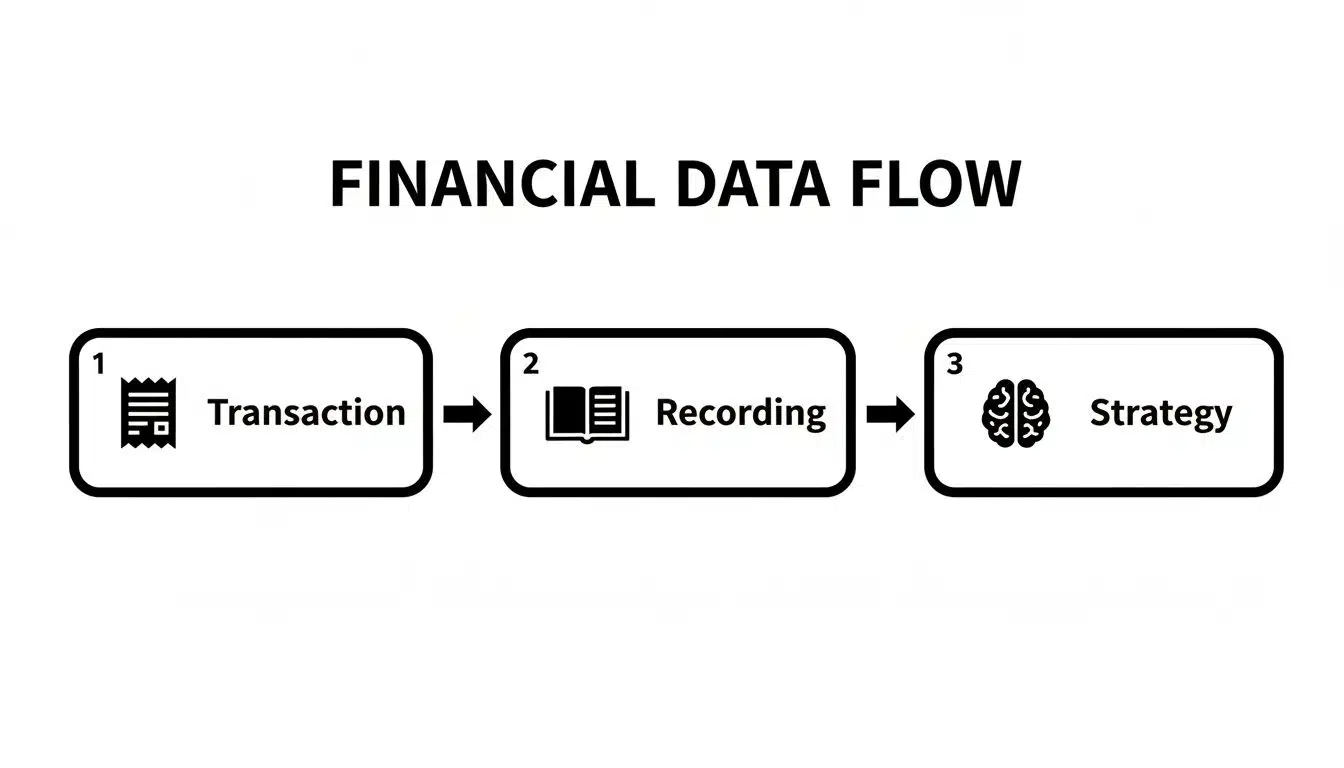
As you can see, a good system doesn't just record what happened—it sets the stage for smart decisions about what happens next.
Stage 1: Bookkeeping Captures the Data
The first step is all about capturing the details accurately. Forget dusty old ledgers; modern bookkeeping is about speed and precision, usually powered by smart software.
- Receipt Capture: You use your phone to snap photos of those trade show receipts. An app connected to your bookkeeping software instantly digitizes the vendor, date, and amount. No more shoeboxes full of paper.
- Transaction Categorization: In a program like QuickBooks, these expenses are automatically imported from your bank feed. The lunch gets categorized as "Meals & Entertainment," and the new inventory is coded to "Cost of Goods Sold."
- Bank Reconciliation: At the end of the month, your bookkeeper matches every transaction in your software to your bank statement. This is a crucial step to catch any errors, duplicate charges, or even potential fraud.
This obsessive record-keeping creates a clean, reliable set of books. Think of it as the quality raw material your accountant needs to do their job. To keep your finances running smoothly, finding the best accounting software is a game-changer for daily efficiency.
Stage 2: Accounting Provides the Insight
With organized books in hand, the accountant steps in. Their job isn't to re-check the bookkeeper's work but to interpret what the numbers are actually saying about your business.
First, they’ll run the key financial reports. The Profit & Loss (P&L) Statement might show your revenue is up, but so are marketing costs. The Balance Sheet will reflect that your inventory assets have grown. These reports are the direct output of all that careful bookkeeping. For a deeper dive, check out our guide on https://alliedtax.com/how-to-set-up-quickbooks/.
Then comes the real analysis. The accountant sees the spike in spending on meals and travel from the trade show. This prompts a question that goes beyond the numbers: "What was the return on that trip? Did we land any new accounts or partnerships?" Suddenly, you're not just looking at what you spent, but why you spent it and what you got for it.
An organized workflow turns bookkeeping data into a powerful tool for asking the right questions. It makes your finances a source of answers, not just a record of the past.
Stage 3: Strategy Drives the Decisions
This is where all the hard work pays off. The clean data and expert analysis now fuel tangible business strategy.
Let's say your P&L shows that despite strong sales, your net profit margin is shrinking. Your accountant investigates and finds that payroll expenses have climbed significantly faster than revenue. That's a critical insight.
Armed with this information, you can make an informed move. The conversation shifts from "Are we making money?" to "How can we become more profitable?"
This could lead to several strategic actions:
- Tax Planning: Seeing your increased profitability, the accountant might advise electing S Corporation status. This is a structural change that could potentially save you thousands in self-employment taxes.
- Budget Adjustments: The data clearly shows which marketing channels have the best return. You decide to reallocate your budget away from the underperformers and double down on what works.
- Audit Preparedness: If you ever get that dreaded notice from the IRS, there’s no panic. You have perfectly reconciled books and detailed records ready to go. The stress of an audit is almost eliminated when your financials are in order from day one.
From a simple lunch receipt to a major tax-saving decision, this cycle shows how diligent bookkeeping and sharp accounting work hand-in-hand. It's a continuous loop that protects your business and powers its growth.
Should You DIY or Outsource Your Finances?
So, you’re at a crossroads: should you wrestle with the numbers yourself or hand the reins to a professional? This is a huge decision for any business owner, and there's no magic one-size-fits-all answer. The right choice really comes down to your business's complexity, how much time you can realistically spare, and your own comfort level with finances.
Let's walk through what each path actually looks like in the real world.
Most entrepreneurs, myself included, start out doing their own accounting and bookkeeping. It makes perfect sense at the beginning. You save money and get a ground-level, unfiltered view of every dollar coming in and going out. But this path isn't for everyone—it demands a specific skill set and, more importantly, a serious time commitment.
When a DIY Approach Makes Sense
Handling your own books works best when your business is young and your financial life is simple. If you’re a freelancer with a handful of clients or running a small side hustle, you can absolutely manage this yourself. The transaction volume is low, and the complexity just isn't there yet.
To make it work, you really need to be:
- Organized to a Fault: This means being the kind of person who diligently tracks every single receipt, invoice, and payment without fail.
- Willing to Master Software: You'll need to get comfortable with tools like QuickBooks to categorize transactions and keep things balanced.
- A Curious Learner: You don’t need a degree in accounting, but you do need to grasp the basics, like what debits and credits are or how to make sense of a Profit & Loss statement.
The single biggest enemy of the DIY approach is time. As your business grows, the hours you spend on bookkeeping start to snowball. What began as a manageable task on a Sunday afternoon can quickly morph into a second job, stealing your focus from what you do best—serving customers and growing your company.
Eventually, almost every business hits a tipping point. It might be when you hire your first employee and have to deal with payroll. Or maybe it’s when you start selling in different states and have to navigate sales tax. For others, it's managing the depreciation on a rental property or figuring out the tax implications of crypto trades. That's usually the moment you know it's time for a change.
The Real Value of Outsourcing to a Pro
Bringing in an expert for your accounting and bookkeeping isn’t just about getting rid of a tedious task. It's a strategic move to reclaim your most valuable resource: your time. Think of all the hours you could pour back into sales, marketing, and innovation—the activities that actually generate revenue.
Outsourcing is an investment in expertise and peace of mind. It shifts your focus from recording the past to shaping the future, backed by a team of professionals dedicated to your financial health.
When you partner with a firm like Allied Tax Advisors, you get more than just a number-cruncher. You gain a strategic ally with benefits that are tough to replicate on your own.
Key Benefits of Outsourcing Your Finances:
- Instant Expertise: You immediately tap into a team of CPAs and enrolled agents who live and breathe tax law and financial strategy. They're the ones who can advise you on things like an S Corp election to save on taxes or find deductions you didn’t even know existed.
- Accuracy and Rock-Solid Compliance: Let's be honest, mistakes happen, but they’re far more costly when they involve your finances. Professionals ensure your books are clean, accurate, and audit-proof, which significantly lowers your risk and lets you sleep at night.
- From Bookkeeper to Strategic Advisor: A great outsourced accountant does more than just balance the books. They translate the numbers into actionable insights, helping you truly understand your profit margins, manage cash flow, and make smarter decisions about your next move.
- Invaluable Peace of Mind: Knowing your finances are in expert hands is a game-changer, especially when things get complicated. If you're a real estate investor tracking depreciation or a crypto trader reporting capital gains, that peace of mind is priceless.
At the end of the day, it's a simple cost-benefit analysis. How many hours a month are you spending on bookkeeping? Now, what’s your time worth? When you do the math, you’ll often find that the "cost" of your own time is far higher than a professional's fee—especially when you add in the strategic value and risk reduction they bring to the table.
How AI and Automation Are Shaping Modern Finance

The worlds of accounting and bookkeeping are changing fast, and the biggest driver is artificial intelligence. But this isn't about robots taking over. It’s about smart tools finally handling the repetitive, grunt work that has consumed financial professionals for decades.
Think of AI as an incredibly efficient assistant. It can sift through thousands of transactions, match payments to invoices, and flag anything that looks out of place—all in real time. This frees up your accountant or bookkeeper to focus on what really matters: strategy, advice, and solving the complex financial puzzles your business faces.
This isn't some far-off trend; it's happening right now. By 2026, an estimated 90% of finance teams are expected to be using at least one AI-powered tool. The need is obvious—a staggering 77% of routine financial tasks like data entry and basic reconciliation are perfect candidates for automation. You can read more about these and other accounting trends to see how the industry is evolving.
Automating the Tedious Work
At its heart, AI automation is about getting rid of the keyboard. No more hours spent manually typing numbers from receipts or invoices into a spreadsheet. Smart software now does it for you in seconds, and with far greater accuracy.
In practice, a tool can sync with your bank, instantly pull in transaction data, correctly categorize expenses based on past entries, and have everything ready for review. This shift delivers a few huge wins for your business.
- Drastic Reduction in Errors: Let's be honest, humans make typos. Automation all but eliminates these small mistakes, giving you cleaner and more reliable financial data from day one.
- Real-Time Financial Insights: Forget waiting until the end of the month for reports. With data processed instantly, you get a live look at your cash flow, profitability, and overall financial health whenever you want.
- Immense Efficiency Gains: When you automate the busywork, a financial pro can do in minutes what once took them hours. They can handle more complex issues, serve clients better, and provide deeper analysis.
From Record-Keeper to Strategic Partner
This newfound efficiency completely transforms the role your accountant plays. When they aren't buried in data entry, they have the time and the high-quality information needed to become a genuine strategic partner.
With AI handling the 'what,' financial experts are freed up to focus on the 'so what.' They can analyze trends, identify opportunities for tax savings, and help you make proactive decisions that drive growth.
For example, an AI might flag that one of your product lines has a consistently lower profit margin. Your accountant can then take that insight, investigate the root cause—be it supply costs or pricing—and advise you on a concrete plan of action. This is the kind of forward-looking, data-driven guidance that used to be a luxury for large corporations.
Modern accounting is no longer just about looking in the rearview mirror. It's about using technology to build a more profitable and resilient future. By blending the speed of AI with the experience of a human expert, your business gets the forward-looking financial management it needs to thrive.
Common Questions About Accounting and Bookkeeping
Alright, you understand the difference between the two roles. But how does it all play out in the real world? When you're in the trenches of running a business, practical questions always come up.
Getting the answers right from the start can save you a world of headaches (and money) down the road. Let's dig into some of the most common questions we hear from business owners just like you.
Can Bookkeeping Software Replace a Bookkeeper?
This is a question we hear all the time. And the answer is: yes, but only up to a certain point.
For a brand-new business with a handful of transactions, software like QuickBooks can be a fantastic tool to get you started. It helps you keep a basic record of money in and money out.
But think of it this way: you can buy the best hammer on the market, but that doesn't make you a carpenter. The software is just the tool; a bookkeeper is the skilled professional who knows how to use it correctly. As your business grows, things get complicated fast. Once you hire your first employee, manage inventory, or start selling to customers in different states, a bookkeeper's expertise becomes essential. They make sure everything is categorized correctly and keep you from making small mistakes that can turn into costly problems.
At What Point Does My Business Need an Accountant?
Most people think of an accountant as someone you call once a year for taxes. This is a huge misconception. You should bring an accountant into the loop far earlier—ideally, as soon as your financial decisions start having long-term consequences.
While your bookkeeper is focused on accurately recording the past, your accountant is your strategic partner for the future.
You absolutely need an accountant when you're:
- Planning for Taxes: A good accountant doesn't just file your taxes; they work with you all year to find ways to legally minimize what you owe.
- Changing Your Business Structure: Thinking of switching from a sole proprietorship to an S Corp or LLC? That decision has massive tax and legal implications that an accountant can help you navigate.
- Looking for a Loan or Investors: Banks and investors won't even talk to you without professional financial statements and a solid business forecast.
- Making Big Growth Decisions: An accountant translates your financial data into a roadmap, helping you budget, forecast cash flow, and decide when it's the right time to expand.
The smart move is to partner with an accountant before you think you need one, especially within your first year of business.
The most common and costly mistake we see is mixing business and personal finances. It creates a bookkeeping nightmare, makes it impossible to know if you're actually profitable, and can open you up to serious tax and legal trouble. From day one, open a separate business bank account and use it for everything business-related. No exceptions.
Getting this one simple step right is the best thing you can do for your business's financial health. It makes everything else so much easier.
Answering these questions is what we do every day. The team at Allied Tax Advisors is here to offer the clarity and expert guidance your business needs to grow and succeed. Learn more about our comprehensive services and how we can support your financial journey.