
You open the mailbox, see an IRS notice, and your stomach drops. Maybe it's a CP2000, maybe it's a balance due letter, maybe it's a notice that seems to contradict the return you already filed. Your first instinct is usually the same as everyone else's. Find the irs tax help line, call the number, and hope a real person can fix it quickly.
That's where many individuals lose time.
The IRS phone system isn't impossible to use, but it does punish sloppy preparation. The taxpayers who get the best results usually aren't luckier. They call the right line, at the right time, with the right documents in front of them, and they know exactly what they want before the first menu prompt starts talking.
That's the difference between a call that ends with “please call back later” and a call that moves your case forward. If your notice involves income mismatch issues, this guide pairs well with a practical walkthrough on what to do if you receive an IRS CP2000 notice.
Table of Contents
- That Sinking Feeling When You Need to Call the IRS
- The Right IRS Numbers and the Best Times to Call
- How to Prepare for a Successful IRS Call
- Navigating Automated Menus and Speaking with an Agent
- Beyond the Help Line Escalation Paths and Alternatives
- The Final Step When to Partner with a Tax Professional
That Sinking Feeling When You Need to Call the IRS
A lot of taxpayers call the IRS in the worst possible state of mind. They're worried, annoyed, and already assuming the call will go badly. That reaction makes sense. IRS notices are often technical, the deadlines matter, and even a simple issue can feel bigger than it is.
The dread gets worse when the notice doesn't clearly say what the IRS wants from you. One line mentions additional tax. Another mentions a response deadline. Somewhere in the middle there's a code you've never seen before. So you grab your phone before you've even found your return.
That's the wrong order.
The irs tax help line works best when you treat it like a case conference, not a panic button. Tax professionals do this every day. We don't call first and think later. We identify the notice, define the issue, gather the support, and then make the call with a narrow objective.
Don't call the IRS to “figure out what's going on.” Call to confirm a specific issue and get a specific action taken.
That shift matters. If your goal is vague, the call wanders. If your goal is precise, the agent can usually tell you yes, no, or what documentation is missing.
Here's the practical mindset to keep. The IRS phone system is a tool. Some problems can be solved in one call. Some can only be documented, escalated, or redirected. When you accept that reality, you stop expecting a perfect conversation and start aiming for the next useful step.
A useful step might be verifying that a payment posted, requesting a hold on collection activity, confirming an address change, or understanding which form the IRS wants next. That's progress. And with the right setup, progress usually comes faster than people expect.
The Right IRS Numbers and the Best Times to Call
Most articles stop at a list of numbers. That's only half useful. The better question is which line matches your issue closely enough to keep you out of a transfer loop.
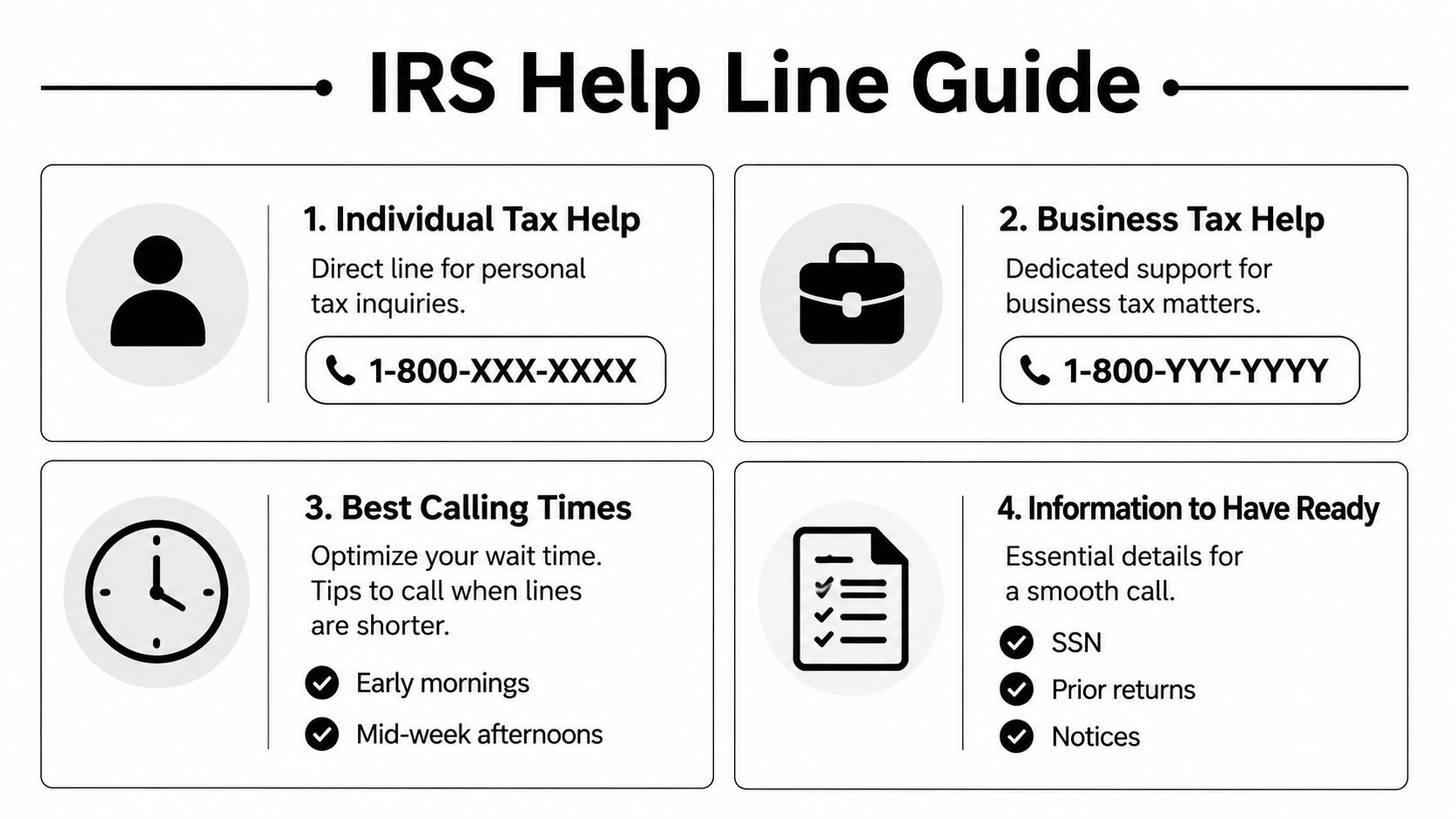
Know which line fits your issue
Here are the core lines that matter most in practice:
| Help line | Best for | Key detail |
|---|---|---|
| 800-829-1040 | Individual tax issues | General personal tax account questions |
| 800-829-4933 | Business tax issues | Business accounts, EIN matters, payroll and entity issues |
| 866-255-0654 | Tax professional e-Help Desk | e-file, e-Services, TIN matching, EFTPS, related technical issues |
| 877-777-4778 | Taxpayer Advocate Service | Escalation when normal channels aren't resolving a hardship case |
If you're a business owner, the business line is often the better route than trying to force a business problem through an individual queue. The IRS describes 800-829-4933 as the line for business and specialty tax matters, including BMF accounts, EIN assignments, forms such as 94x, 1041, 1065, and 1120S, excise issues, and federal tax deposits through its business telephone assistance contacts.
If you're a tax professional dealing with e-file application problems, TIN matching, or EFTPS access, the e-Help Desk is the specialist line. The IRS lists 866-255-0654 for those technical e-product issues in its e-Help Desk for tax professionals.
Use timing as a strategy
The IRS receives approximately 100 million calls annually, and a large share of that volume hits during filing season. During Filing Season 2024, IRS assistors handled 9 million calls, up from 7.7 million in 2023. Average wait times on main IRS phone lines dropped to just over three minutes, and the callback feature saved taxpayers an estimated 1.5 million hours of hold time, according to the National Taxpayer Advocate research report.
That sounds encouraging, but use it carefully. Main lines can perform much better than people expect. Specialized lines can still be slow.
A few timing rules help:
- Call when you can focus: Don't call while driving, working a register, or jumping between meetings. If an agent comes on, you need to be ready.
- Use callback when offered: If the system offers a callback, take it. It's one of the few taxpayer-friendly features in the current setup.
- Avoid calling without all records nearby: A short wait doesn't help if you spend the live call searching for a notice number.
- For business issues, have one entity in front of you: Don't mix a payroll notice, a sales tax issue, and an EIN correction for different entities in one call.
Practical rule: The best time to call is when you can stay organized, answer security questions fast, and keep notes. Call quality matters as much as call timing.
How to Prepare for a Successful IRS Call
Preparation is where most successful IRS calls are won. Once you reach a live assistor, the clock starts. If you hesitate on identity verification, can't explain the issue, or don't know what resolution you want, the conversation slows down immediately.

Build your call packet
Before you dial the irs tax help line, put the following in one folder or stack:
- The IRS notice itself: You need the notice number, date, tax year, and any response deadline.
- The tax return for that year: Agents often refer to a line item or filing status. You need to see exactly what was filed.
- Your identifying information: For individuals, that means Social Security details and current address. For businesses, that usually means the EIN and entity details.
- Supporting records: W-2s, 1099s, prior payment confirmations, cancelled checks, bank proof, payroll records, or correspondence already sent to the IRS.
- Your transcript if available: Transcripts often clarify whether the issue is a filing problem, a posting delay, or a balance computation issue.
If you haven't pulled your transcripts yet, use a secure walkthrough for how to get an IRS transcript online. Having the account transcript in front of you can change the call from guesswork into verification.
For small organizations, especially volunteer-run groups, this same packet discipline matters. If you're helping a nonprofit stay organized before calling, this guide to simplified tax reporting for smaller nonprofits is a useful planning resource because it focuses on keeping the records straight before compliance problems become phone problems.
Write your one sentence issue summary
Most callers talk too much at the start. Agents don't need the whole backstory first. They need the issue framed clearly.
Write one sentence on paper before you call. Examples:
- “I received a notice saying my 2022 return doesn't match reported income, and I need to confirm which document caused the change.”
- “My business made a payment, but the balance due notice doesn't reflect it.”
- “I need to set up a payment arrangement and confirm which periods are included.”
That sentence keeps you from rambling. It also helps the agent route the conversation correctly.
After that sentence, list three questions in priority order. Not seven. Three.
A good call list might look like this:
- Did the IRS receive and post my response or payment?
- What tax period and notice does the current balance relate to?
- What is the next required action from me?
A prepared caller sounds more credible because the facts are easier to follow. That usually leads to cleaner answers.
Decide the result you want
This is the part many taxpayers skip. They call to discuss. They should call to resolve.
Your desired result might be one of several things:
- Verification: You want confirmation that a return, payment, or response was received.
- Correction: You believe the IRS account is wrong and want the agent to identify the mismatch.
- Relief: You want a hold, a payment plan discussion, or instructions for penalty relief.
- Direction: You need to know exactly which form, address, or department should receive the next submission.
Different goals produce different calls. A verification call is short and factual. A correction call usually needs documents. A relief call may require a concise hardship or reasonable-cause explanation. A direction call is often about process and deadlines.
If you're a business caller using the business line, be even stricter. Keep the call to one entity and a narrow issue set. Business phone conversations go sideways when owners try to solve every open IRS problem in one sitting.
Navigating Automated Menus and Speaking with an Agent
The IRS phone tree frustrates people because it feels random. It isn't random. It's rigid. If you understand that, you stop fighting it and start using it.
What the published wait time does not tell you
Published IRS wait times can sound much better than your real experience. A detailed analysis noted that the IRS reported an 87% Level of Service during Fiscal Year 2025 with a three-minute average wait time, but that metric covered 35 Account Management phone lines that represented 70% of all IRS calls received in Fiscal Year 2024. Other lines not included in the traditional LOS calculation averaged 17 to 19 minutes during the 2024 filing season. The Installment Agreement or Balance Due line had a 46% Level of Service with an average wait time of 26 minutes as of April 19, 2025, according to this analysis of IRS taxpayer experience data.
That matters because many taxpayers call a line tied to a real problem, then assume the published average should apply to them. It often won't.
If your issue involves collections, installment agreements, identity verification, or another specialty queue, expect a rougher experience than the headline number suggests. The mismatch between public averages and actual specialty-line performance is one reason taxpayers feel blindsided.
How professionals handle the menu tree
Professionals approach automated menus with one goal. Get routed correctly the first time.
That means:
- Listen for the category that matches your actual issue: Don't choose the option that merely sounds fastest.
- Avoid guessing on business prompts: If your matter is tied to a business account, use the business path from the start.
- Don't overload one call: One taxpayer, one entity, one central issue. The more you stack, the more likely you are to get transferred or told to call back.
- Keep authentication ready before the menu ends: Once the agent joins, delays hurt momentum.
For tax professionals calling the e-Help Desk, the routing is more specialized. The IRS says the main menu on that line includes options for e-File and ERO or ITIN issues, e-Services, EFTPS, SAM, and FATCA, with sub-menu branches for individual returns, business and nonprofit matters, applications, and suitability in its technical support page for e-file providers.
For business owners using 800-829-4933, the cleanest practice is to prepare the EIN, notice ID, prior return, and the exact tax period at issue before you enter the queue. On the business line, clarity is everything.
How to start the live conversation
When the agent answers, don't launch into a long explanation. Open like this:
- State your name and whether you're calling about an individual or business account.
- Give the notice number or tax year immediately.
- Deliver your one-sentence issue summary.
- Ask your first priority question.
A strong opening sounds like this:
“I'm calling about a business account. I have the EIN and the notice in front of me. This is a BMF inquiry about a balance due notice for one quarter, and I need to verify whether a payment has posted and what period the notice covers.”
That opening does three things. It shows the agent you're organized, it narrows the issue, and it reduces the chance that the call drifts into general explanations.
If the issue is a business account, say that clearly. The business line is built for BMF inquiries. If you're calling about payroll tax deposits, an EIN assignment issue, or a notice tied to a specific return type, state that early rather than forcing the assistor to extract it from you.
Keep notes while the agent speaks. Record:
- The agent's ID number
- The date and time of the call
- Any reference or case number
- The exact action the IRS says it will take
- Any deadline given to you
Ask for the call reference number before the conversation ends. If there isn't one, note that too.
One more professional habit makes a big difference. Repeat the action item back to the agent in plain words. For example, “So the next step is that I fax the signed authorization and then wait for the account to update.” That catches misunderstandings before you hang up.
Beyond the Help Line Escalation Paths and Alternatives
Sometimes the irs tax help line is the wrong tool. Not because your issue isn't real, but because the phone system can't carry the full weight of a complicated case.

When the phone line is the wrong tool
A Treasury Inspector General report found that only 28% of callers to primary helplines reached a representative on the first attempt, according to USA.gov's IRS contact guidance. For straightforward issues, that may just be annoying. For urgent or technical matters, it can stop progress altogether.
Phone calls also break down when the issue requires documents the agent can't fully review on the spot, when multiple tax periods are involved, or when the account history is messy. In those cases, you need a different path, not more redials.
Three alternatives that often work better
Taxpayer Advocate Service
The Taxpayer Advocate Service is the escalation path for cases that aren't moving through normal channels and are creating real hardship. That might mean economic harm, repeated failed attempts to resolve the issue, or a process problem that's keeping the account stuck.
If your situation fits that pattern, learn the process for getting help from the IRS Taxpayer Advocate Service. The key is to present a clear timeline of what happened, what you already tried, and why the delay is harming you now.
IRS online account
Many taxpayers call when they do not need to. If the question is balance verification, payment history, transcript access, or basic account monitoring, the online account is often faster and cleaner than a phone queue.
Use the online portal first when the issue is informational. Save your call for issues that require judgment, correction, or escalation.
In-person Taxpayer Assistance Center
For some taxpayers, especially those dealing with identity issues, document-heavy problems, or repeated phone failure, an appointment at a Taxpayer Assistance Center is more effective than another call attempt.
This path also helps taxpayers who need a more structured interaction than an unstable hold queue can provide. Bring the same call packet you would use on the phone, plus any identity documents the appointment instructions require.
If one channel keeps failing, don't keep proving your patience. Change channels and move the case forward.
The larger point is simple. The IRS phone line is one access point, not the whole system. Taxpayers who get traction usually know when to stop dialing and switch methods.
The Final Step When to Partner with a Tax Professional
Some IRS problems stay manageable. Others don't.
If your issue involves an audit, an appeal, payroll tax exposure, an offer in compromise, multiple years of unfiled returns, an S corporation or LLC problem, rental property reporting, or crypto activity, the value of professional help rises quickly. These cases usually involve layered facts, deadlines, and strategy choices that don't fit well inside a phone call.
That need for human judgment is becoming more obvious as the IRS shifts more support toward digital tools. A source discussing IRS help tools states that TIGTA audits revealed AI systems mishandled 62% of crypto-related questions, which is a serious warning sign for taxpayers with nuanced reporting issues who rely only on automation in the IRS help resources page.
That doesn't mean the system is useless. It means you should match the tool to the problem. Routine account questions can often be handled directly. High-stakes issues usually need someone who can interpret transcripts, notices, filing history, and procedural options together.
If you've hit the point where every IRS call creates more confusion than clarity, you're probably past DIY territory.
If you need experienced help with IRS notices, audits, business tax issues, crypto reporting, rental-property tax compliance, or collection resolution, Allied Tax Advisors can step in and handle the process strategically. The goal isn't just to get someone on the phone. It's to solve the tax problem with the least friction and the clearest path forward.