
Most small businesses should expect bookkeeping services rates to land around $300 to $1,500 per month for ongoing work, while hourly billing commonly falls in the $30 to $90 range. Your actual cost depends far more on complexity and scope than on a generic national average.
If you're reading this, you're probably doing one of three things right now. You're comparing quotes that don't line up. You're trying to decide whether to keep doing the books yourself in QuickBooks. Or you're worried you're about to overpay for work that sounds simple until the monthly mess starts piling up.
That confusion is normal. Bookkeeping pricing looks inconsistent because many quotes aren't talking about the same service. One provider is offering basic transaction coding. Another is including reconciliations, payroll coordination, monthly reporting, and tax-ready books. In San Diego, where business owners are already watching overhead closely, the right question isn't "Who is cheapest?" It's "What level of support will keep my books clean, my tax filings accurate, and my time focused on running the business?"
Table of Contents
- Why Bookkeeping Quotes Can Seem So Different
- Decoding the Three Main Pricing Models
- Typical Bookkeeping Rates in 2026
- Key Factors That Influence Your Final Cost
- How to Choose the Right Service Level for Your Business
- Frequently Asked Questions About Bookkeeping Costs
Why Bookkeeping Quotes Can Seem So Different
A San Diego business owner gets three quotes for bookkeeping. One is cheap enough to feel risky. One is double the price. One promises "full-service" but never defines the work. That usually does not mean one firm is greedy and another is efficient. It means you are looking at three different service levels dressed up under the same label.
That is why price shopping alone leads people in the wrong direction. The right comparison is scope, review depth, and who is taking responsibility for accuracy.
Cheap bookkeeping usually means narrow bookkeeping
The lowest quote often covers transaction coding and bank reconciliations, nothing more. It may leave out cleanup work, accounts payable, receivables, payroll review, month-end close, correcting prior errors, and communication with your tax preparer. If those items are excluded, you are not buying a lower-cost version of the same service. You are buying less service.
The higher quote may include actual oversight. That means financial statements delivered on time, questions answered during the month, balance sheet issues caught before year-end, and books kept in a form your CPA can use without another round of cleanup.
Practical rule: If two proposals are far apart in price, assume they assign different levels of judgment, review, and liability until the provider proves otherwise.
Business owners run into this same issue in pricing their own services. This guide to optimizing business prices explains why bundled value changes price far more than a headline number does.
Focus on the service level you actually need
The smartest buying decision is to focus on the service level.
For some businesses, basic recordkeeping is enough. For others, it is a costly mistake. A restaurant with daily sales volume, payroll, and inventory concerns needs more than a consultant with a few monthly deposits and simple expenses. A San Diego contractor juggling job costs and subcontractors needs more review than a solo designer working cash basis with low transaction volume.
Use this filter when you review quotes:
- Basic support fits businesses that only need historical records entered and accounts reconciled.
- Monthly bookkeeping fits owners who need timely closes, dependable reports, and books that stay current.
- Integrated accounting support fits businesses that need bookkeeping tied to tax planning, entity decisions, owner compensation, and cash flow management.
Your accounting method also affects cost. If you are still deciding between cash and accrual reporting, this explanation of accrual and cash basis accounting will help, because the required work changes once reporting gets more formal.
My advice is simple. Do not buy bookkeeping as if it were a commodity. Buy the level of financial control your business needs. Data entry is cheap. Clean books that support tax strategy and decision-making are worth paying for.
Decoding the Three Main Pricing Models
A San Diego business owner gets two bookkeeping quotes for what sounds like the same job. One is hourly, one is a monthly retainer, and one more arrives as a fixed cleanup proposal after the provider reviews the books. The pricing model is not a detail. It changes your risk, your budget control, and the kind of service you are buying.

Hourly pricing
Hourly billing is the simplest model on paper. You pay for time worked, usually for cleanup, troubleshooting, training, or light ongoing support when your monthly activity is inconsistent.
Use this model if your need is narrow and temporary. It also makes sense at the start of an engagement when your records are too disorganized for any honest firm to quote a flat fee.
The problem is obvious. You cannot control the final invoice unless the scope is tight. If your books need follow-up questions, account research, corrected entries, or payroll fixes, the time keeps climbing. Businesses with employees should pay attention here, because payroll issues often spill into bookkeeping work. If you are budgeting for both, review typical payroll processing costs for small businesses alongside the bookkeeping quote.
Monthly flat-fee pricing
This is the right model for most established small businesses.
A monthly flat fee works best when your transactions, reporting needs, and workflow are reasonably consistent. You agree on a set scope, such as reconciliations, monthly closes, standard financial statements, and limited support during the month. That gives you predictable billing and gives the bookkeeper a reason to keep the books current instead of waiting for problems to pile up.
Flat-fee pricing only works when the scope is written clearly. If the proposal is vague, the price is meaningless. Ask what happens if you add another bank account, start invoicing customers, bring on payroll, need sales tax tracking, or fall behind for two months. At Allied Tax Advisors, that is usually where small business owners realize they are not comparing equal service packages.
Project-based pricing
Project pricing is for one defined outcome. Common examples include catch-up work, year-end cleanup, QuickBooks file repair, software conversions, and books that need to be fixed before a tax return can be prepared accurately.
This model is often the safest choice for messy books because it sets a target and a price upfront.
But be strict about the definition. "Clean up my books" is not a scope. "Reconcile bank and credit card accounts, clear uncategorized transactions, and correct the prior period balance sheet" is a scope. The more precise the deliverable, the less likely you are to get hit with change orders.
Why the same pricing model still produces very different quotes
Two firms can both offer a monthly fixed fee and still be miles apart in value. One may handle only transaction coding and reconciliations. Another may include monthly reviews, accrual adjustments, coordination with tax prep, and owner guidance on cash flow or compensation decisions.
Karbon explains this well in its bookkeeping services pricing guide. Higher-priced packages often include more than data entry. They include review, reporting, and advisory work that keeps tax and bookkeeping from drifting apart.
That same pricing logic shows up in other service categories. Compare how chatbot platform costs change based on usage, integrations, and support. Bookkeeping follows the same pattern. The model matters, but the actual question is what work is included once the engagement starts.
Typical Bookkeeping Rates in 2026
A San Diego business owner usually sees this problem after the first few quote requests. One firm says a few hundred dollars a month. Another quotes four figures. Both call it bookkeeping.
The gap usually comes down to service level. If you compare rates without defining what your business needs, you will either overpay for work you do not use or underbuy and end up with books that create tax, cash flow, and reporting problems later.

Basic bookkeeping
For a very simple business, basic monthly bookkeeping often falls in the lower end of the market, roughly a few hundred dollars per month. That usually fits a solo operator or small service business with light transaction activity, one or two bank accounts, and no real operational complexity.
Typical work at this level includes:
- Transaction categorization for routine income and expenses
- Bank and credit card reconciliation for a limited number of accounts
- Basic monthly reports such as a profit and loss and balance sheet
- Occasional support for bookkeeping questions
Buy this tier only if simple books are enough for how you run the company. If you need reliable monthly numbers for decisions, lender requests, or tax planning, this level runs out of usefulness fast.
Standard monthly bookkeeping
Most established small businesses land in the middle tier. In practice, this is often the range where bookkeeping becomes a regular monthly process instead of periodic cleanup.
A standard package usually includes a recurring close process, monthly financial statements, review of account activity, and follow-up on missing items before they turn into bigger problems. For many San Diego businesses, this is the minimum level that gives the owner usable numbers instead of a stack of coded transactions.
| Service area | What it usually means |
|---|---|
| Monthly close | Accounts are reconciled and reviewed on a set schedule |
| Financial reports | Monthly statements are prepared for owner review |
| Process discipline | Bank feeds, receipts, and account reviews are handled consistently |
| Error detection | Misclassifications and missing transactions are caught earlier |
Payroll often pushes a business into this tier or higher. If that applies to you, review these payroll processing costs for small businesses alongside your bookkeeping quote because payroll adds deadlines, liability, and more review work.
Advanced and integrated support
Once a business has payroll, receivables, payables, inventory pressure, multiple entities, or books that feed tax strategy, the price moves up for a good reason. The work is broader, the review standard is higher, and mistakes cost more.
This tier often includes:
- Payroll coordination or review
- Accounts receivable and accounts payable support
- Cleanup and catch-up work
- Multi-entity or more complex account structures
- Controller-style review so reports are ready for decisions
This is the level I recommend for owners who use their numbers to set compensation, manage cash, prepare for financing, or stay ahead of tax liabilities. Basic data entry will not carry that load.
Software can help reduce manual work, and many firms now build processes around automation. If you want context on that shift, see these accounting automation tools for UK professionals. Even with better tools, software does not replace review, judgment, or coordination with tax.
My advice is simple. Price bookkeeping by the consequence of getting it wrong, not by the cheapest monthly quote. A low fee for incomplete work usually turns into cleanup costs, missed tax planning, and bad decisions based on weak numbers.
Key Factors That Influence Your Final Cost
Bookkeeping fees don't move randomly. They move because the workload changes. In San Diego, local labor costs also matter. QuickBooks notes that the median annual pay for bookkeepers was $49,210 in 2024, and in higher-cost states like California, average pay is around $27 to $29 per hour, which helps explain why monthly fees commonly run $300 to $1,000+ with hourly rates of $30 to $90, as described in QuickBooks' guide to bookkeeper costs.
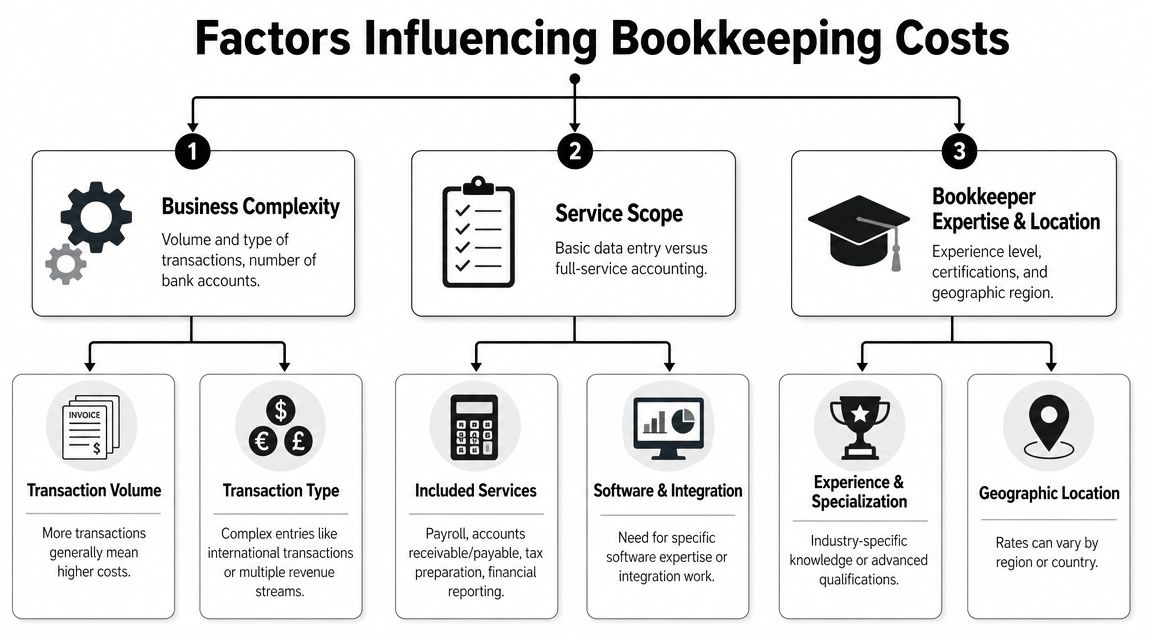
Transaction volume and account count
A business with a handful of monthly transactions is cheap to maintain. A business with constant card charges, deposits, subscriptions, transfers, and reimbursements is not.
More accounts also mean more reconciliation work. Every bank account, credit card, loan account, and payment platform adds another place for errors, duplicates, and timing differences to hide.
A provider isn't charging more because they feel like it. They're charging more because someone has to review more activity and resolve more exceptions.
Payroll and operational touchpoints
Payroll changes the engagement immediately. Once wages, tax withholdings, reimbursements, owner draws, and payroll journal entries come into the picture, the bookkeeping process gets tighter and more sensitive.
The same is true for:
- Accounts payable when bills need tracking and timing matters
- Accounts receivable when customer invoices and collections affect cash flow
- Sales tax workflows when taxable transactions need proper treatment
- Loan activity when principal and interest need to be split correctly
Each added touchpoint creates more monthly work and more chances for mistakes if nobody is watching closely.
Cleanup work and historical problems
Cleanup always costs more than maintenance. That's because the provider isn't just recording current activity. They're diagnosing what went wrong in prior months, finding missing support, untangling duplicate entries, and rebuilding the file into something usable.
Bad books usually don't fail all at once. Owners notice them when tax season arrives, cash doesn't match the reports, or a lender asks questions nobody can answer.
If your books are behind or unreliable, expect project pricing first and monthly pricing later.
Industry complexity matters more than owners expect
A consultant with straightforward invoices has a very different bookkeeping profile from a restaurant, contractor, e-commerce seller, or business with inventory. The more moving pieces you have, the less useful low-end bookkeeping becomes.
Some businesses need someone who understands merchant processors. Others need help tracking owner distributions or separating reimbursable costs. Others need books that line up cleanly with outside tax preparation.
Technology can help, but it doesn't eliminate judgment. If you're curious how automation is changing finance work more broadly, this review of accounting automation tools for UK professionals gives a useful outside perspective on where software helps and where human review still matters.
Local market reality in San Diego
San Diego business owners sometimes compare local quotes to low national numbers they found online and assume they're being overcharged. Usually they aren't. They're seeing the effect of California labor costs, higher service expectations, and the fact that local firms often support more than simple transaction entry.
That doesn't mean you should accept any quote blindly. It means you should judge the price against the workload, the responsiveness, and the downstream value of clean books.
How to Choose the Right Service Level for Your Business
You get a low quote, sign the engagement, and six months later your books are late, your CPA is asking cleanup questions, and you still do half the work yourself. That is what happens when you buy bookkeeping by price instead of by service level.
Choose based on what your business needs from the books each month. If you need clean reports for decisions, lender requests, payroll accuracy, sales tax support, or tax planning, basic transaction entry is not enough.

Start with the outcome, not the package name
Bookkeeping proposals use broad labels like "basic," "full-service," or "monthly support." Those labels mean very little. One firm's basic package may include reconciliations and month-end reports. Another's may mean little more than coding bank feeds.
Ask yourself four direct questions:
- Do I need books that are only recorded, or books that are reviewed?
- Do I need monthly reports for decisions, or just numbers for tax time?
- Do payroll, sales tax, loans, inventory, contractors, or owner distributions create risk if they are handled wrong?
- Will my tax preparer need to fix this work later?
Your answers tell you the service level you need.
A simple way to match service level to business stage
A very small business with low transaction volume and no payroll can often use a basic monthly process. The goal there is accuracy and consistency.
A growing company usually needs more than that. If money is moving through multiple accounts, payroll is active, customer invoicing matters, or bills need to be tracked properly, you need regular reconciliations, month-end close discipline, and reports you can trust.
An established business in San Diego often needs a higher level of support. At that point, bookkeeping affects tax strategy, cash management, owner pay, and planning. That work should not sit in a silo.
Ask better questions before you sign
Bad engagements usually start with vague scope. Fix that before you agree to anything.
Ask these questions and get the answers in writing:
What specific tasks are completed every month?
Ask for a list. Bank reconciliations, credit card reconciliations, loan tracking, accounts payable, accounts receivable, payroll posting, financial statements, and month-end close should be spelled out.What is not included?
This matters just as much as what is included. Cleanup, historical corrections, 1099 preparation, sales tax filings, and support during tax season often cost extra.When will my books be closed each month?
"Monthly bookkeeping" should end with completed books on a predictable schedule, not work that drifts indefinitely.Who reviews the work?
Data entry alone is cheap. Review catches misclassified transactions, duplicated expenses, uncategorized transfers, and balance sheet problems before they create tax issues.How will bookkeeping connect to tax and advisory work?
This is the question many owners skip, and it is usually the expensive mistake.
If you want a quick way to test whether a provider's scope is thin, compare it against this monthly bookkeeping checklist for small businesses. If key controls are missing, the lower fee is not a bargain.
Integrated support usually costs more and saves more
Cheap bookkeeping often creates expensive tax prep. The handoff fails because the books were never built for tax reporting, owner compensation decisions, or year-end adjustments.
I recommend integrated support once your business has real complexity. That means bookkeeping tied to tax, entity structure, payroll treatment, and periodic advisory input. Allied Tax Advisors is one example of a firm built around that model.
Pay for the level of bookkeeping that protects decisions, cash flow, and tax compliance. That is the standard that matters.
Frequently Asked Questions About Bookkeeping Costs
A San Diego owner gets two bookkeeping quotes. One looks cheap. Six months later, the books are late, payroll entries are wrong, and tax prep turns into a cleanup project. That is why these questions matter. You are not buying data entry. You are choosing the level of financial control your business will have each month.
Is software included in the monthly fee
Sometimes. Sometimes not.
Some firms include their accounting software and a basic app stack in the monthly price. Others require you to pay for QuickBooks and any connected tools separately. Ask for a written answer on software access, setup, historical cleanup, and integration support. If the proposal is vague, treat those items as extra charges.
Is a bookkeeper the same as an accountant or CPA
No.
A bookkeeper keeps records current and organized. An accountant or CPA handles higher-level work such as tax treatment, adjustments, compliance issues, and financial interpretation. Small businesses often need both. If your company has payroll, sales tax, multiple entities, contractor payments, or fast growth, basic bookkeeping alone is usually not enough.
Is DIY bookkeeping a smart way to save money
It can work for a very simple business. It fails quickly once volume and complexity increase.
If you have a handful of transactions, no payroll, and strong monthly discipline, doing it yourself may be reasonable for a period of time. Once you are sorting owner draws, loan activity, merchant fees, payroll journals, and tax payments, mistakes become expensive. The primary cost is not the software. The primary cost is bad financial information and year-end correction work.
How are cleanup or catch-up projects priced
Usually as a separate project.
That is the right approach. No responsible provider should quote a fixed monthly fee for ongoing bookkeeping without first seeing how much historical work is sitting in the file. If your books are behind, expect a catch-up engagement before monthly service begins. That gives both sides a clean starting point.
What should a growing business expect to pay
As noted earlier, prices rise with transaction volume, account complexity, payroll, and reporting needs.
A business with steady activity and clean systems may fit into a moderate monthly package. A growing company that needs accrual adjustments, job costing, sales tax support, or owner-level tax coordination will pay more. That is normal. In San Diego, the right question is not "What is the lowest monthly fee?" It is "What service level keeps the books accurate enough to run the business and file taxes without rework?"
How do I compare two bookkeeping proposals
Use this test:
Match the quote to your actual complexity
A solo consultant does not need the same service level as a restaurant, e-commerce company, or contractor.Check what gets delivered each month
You want reconciled accounts, usable financial reports, and a clear close process.Confirm who applies judgment
If nobody reviews classifications and balance sheet activity, errors stay buried until tax time.Look at response time and communication
Delayed answers create delayed decisions.Check whether tax coordination is built in
Books that are disconnected from tax planning usually cost more by year-end.
The cheapest proposal works only for a simple business with limited needs. For everyone else, a low quote often means thin scope, slow closes, and extra fees later.
If you're in San Diego and want help evaluating what level of bookkeeping your business needs, talk with Allied Tax Advisors. We can help you assess the scope, reporting needs, and tax impact so you choose a service level that fits the business you have now, not the one you had a year ago.