
You open the mailbox, see a government envelope, and your stomach drops. Many assume they need to write a long explanation, defend themselves, or call the IRS immediately. Usually, that's the wrong first move.
A good IRS response letter isn't generic. It's not a cover letter for your taxes, and it's not a place to vent. The notice you received dictates what belongs in your response, where it goes, and whether a response is even required. If you learn that one rule, you'll handle this far more effectively than someone using a copied template from a random forum.
When people ask me how to write a letter to the IRS, I usually slow them down before I speed them up. Read the notice. Identify the code. Match your response to the exact issue. Then write a short, factual letter with the documents the IRS asked for and nothing extra.
Table of Contents
- That Official Envelope Your Guide to the First Steps
- Before You Write Decode Your IRS Notice
- How to Structure Your Letter for a Clear Response
- Sample Wording for Common IRS Scenarios
- Your Pre-Mailing Checklist for a Perfect Submission
- After You Mail What to Expect and When to Call a Pro
That Official Envelope Your Guide to the First Steps
The worst response to an IRS envelope is silence. The second worst is a rushed, emotional letter that doesn't answer the actual issue.
Most IRS letters are manageable if you handle them in order. Open the notice. Read every page. Set it aside for a moment if you need to. Then come back and treat it like a paperwork problem, not a personal attack. That change in mindset matters because a written response often gives you the cleanest way to explain a discrepancy, send records, or preserve your position without the confusion of a phone call.
I've seen people make their case beautifully and still lose ground because they answered the wrong question. I've also seen very short, plain letters work well because they named the notice, addressed the exact tax year, and attached the right records.
A strong IRS letter doesn't sound impressive. It makes the reviewer's job easy.
If you need to gather records before writing, it helps to organize them first. Your own return, wage statements, prior correspondence, and account records should all be in one place. If you're also figuring out the logistics of Sending tax documents to IRS, make that decision after you confirm what the notice instructs. Some notices call for a mailed response to the address printed on the letter, and that instruction controls.
For account history, return details, or prior filing information, getting your IRS transcript online can help you compare the notice to what the IRS has on file. That's often the fastest way to spot whether the issue is missing income, a processing change, or something simpler like a payment posting problem.
Before You Write Decode Your IRS Notice
The notice is the roadmap. If you skip that and jump straight to drafting, you're guessing.
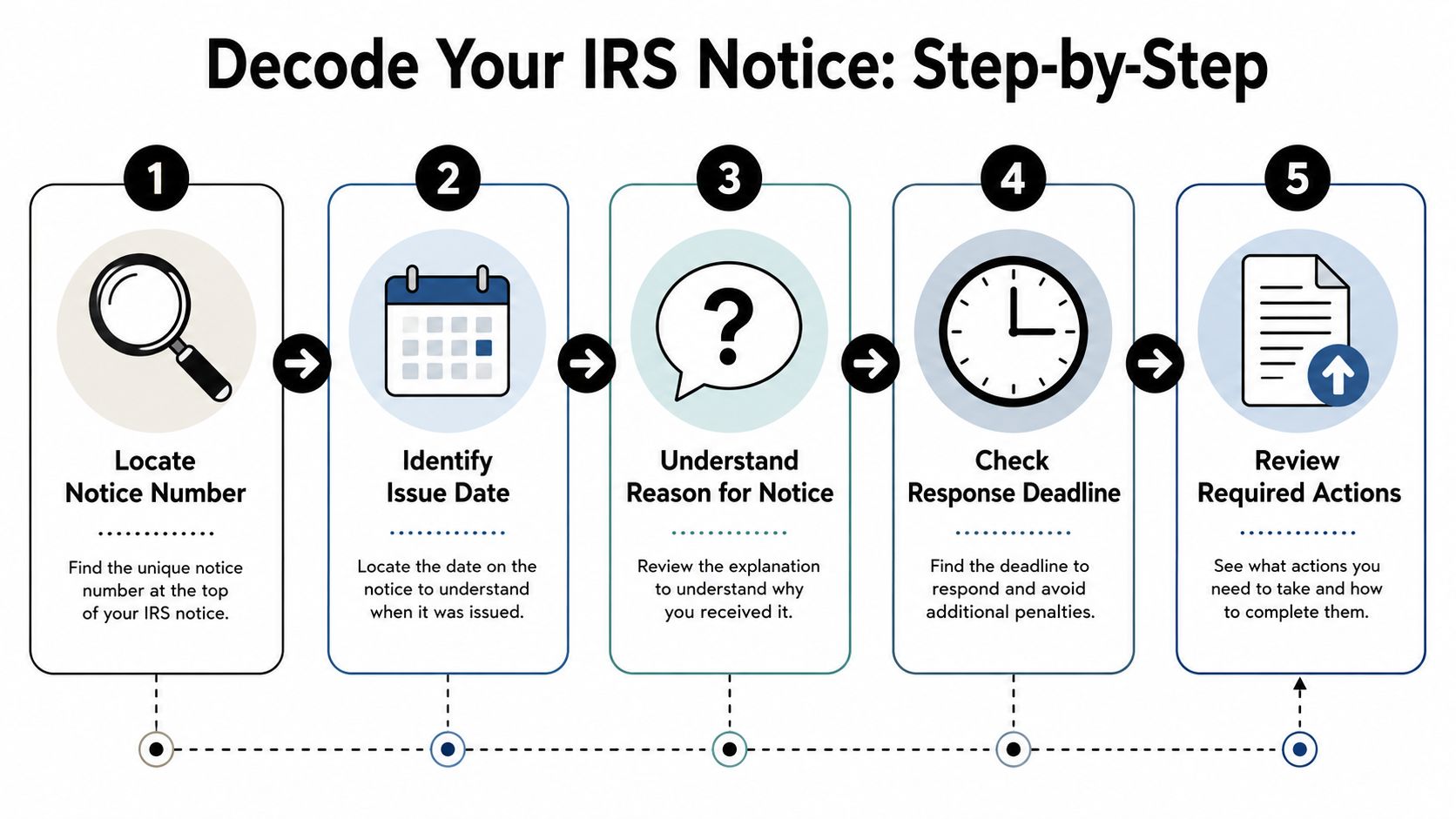
The IRS says most notices and letters are identified by a CP or LTR code, usually printed in the upper-right corner, and taxpayers should respond by the due date if one is listed. The agency also warns that taking prompt action can reduce additional interest and penalty charges, according to the IRS guidance on next steps after receiving a notice or letter.
Find the code before you draft anything
Start in the upper-right corner. Look for a code that begins with CP or LTR. That code matters because it tells you what kind of problem the IRS thinks exists.
Then look for these items in the notice itself:
- The tax year involved. Don't assume it's your most recent return.
- The issue date. That helps you track the response window.
- The stated reason for the notice. Read the explanation line by line.
- The due date. If there's a response deadline, calendar it immediately.
- The response instructions. The notice usually tells you whether to pay, send documents, dispute a proposed change, or keep the letter for your records.
If your notice is a proposed underreporting or mismatch issue, this overview of a CP 2000 notice can help you understand the kind of response the IRS usually expects. Don't use any guide as a substitute for the instructions on your own letter, but it can help you frame the issue correctly.
Read for instructions not emotion
People often read IRS notices as accusations. They're usually better read as processing events. The IRS is telling you one of a few things: it changed something, it thinks something doesn't match, it believes you owe a balance, or it needs documents.
That distinction changes how you write. A balance-due letter calls for one kind of response. A proposed adjustment calls for another. A request for supporting records calls for a document package, not a long narrative.
For households and small businesses that handle a lot of paperwork, tools used for practical data extraction for finance can help organize statements, invoices, or tax records before you respond. The value isn't in automation for its own sake. It's in reducing clerical mistakes when you're matching the notice to your records.
Practical rule: Don't write “I'm confused by this notice.” Write “I am responding to Notice CP____ for tax year ____ and I disagree with the proposed change because the attached records show ____.”
A generic IRS letter fails because it treats every notice the same. The better move is simpler. Identify the code, read the instructions, and let the notice tell you what your letter needs to do.
How to Structure Your Letter for a Clear Response
Once you know what the IRS is asking, the writing itself is straightforward. Keep it formal, short, and tied to documents.
The IRS explains that notices relate to specific account issues and that taxpayers should keep the notice for their records for three years from the filing date. The agency's notice guidance also supports a concise, dated, document-based response with a clear reference to the notice code and account year, as described on the IRS page for understanding your IRS notice or letter.

Start with identification details
An IRS letter should look more like a case response than a personal appeal. Put the identifying information at the top so the reviewer doesn't have to hunt for it.
Include:
- Your full legal name as it appears on the tax return
- Your mailing address that matches current records if possible
- A taxpayer identifier such as the last digits customarily used in correspondence for security, if appropriate to your mailing practice
- The notice number
- The tax year
- The date of your letter
Then open with one direct sentence. For example:
I am responding to Notice CP____ regarding tax year ____.
That sentence does more work than a long introduction. It tells the IRS exactly what file your letter belongs with.
Keep the body factual and easy to review
The body should answer four questions, in this order:
- What are you responding to
- Do you agree or disagree
- Why
- What documents are attached
If you agree, say so plainly and note what action you're taking. If you disagree, identify the disputed item and connect it to the records you've enclosed. Don't tell your life story unless the issue requires context.
Stick to facts the IRS can verify. Dates, amounts from your records, account descriptions, filing status details, corrected forms, and attached proof.
A useful structure looks like this:
- A one-sentence purpose statement.
- A short explanation of the issue.
- A clear statement of agreement or disagreement.
- A list of attached documents.
- A request for the IRS to review and update the account if appropriate.
Here's what doesn't work well:
- Emotional language such as “This is unfair” or “Your office made a mess of my life”
- Unfocused attachments that don't tie to the disputed issue
- Unclear requests where the IRS can't tell whether you're disputing, paying, or asking for relief
- Missing reference details such as the notice code or tax year
A clean closing is enough. “Please review the enclosed documents and let me know if you need any additional information” works. Then sign and date the letter.
Sample Wording for Common IRS Scenarios
Many online guides often make a mistake. They hand you one template and imply it fits every case. It doesn't. The wording should track the problem in the notice.
When you agree and are paying
A straightforward balance letter calls for a straightforward response. Don't overcomplicate it.
You might write something like:
I am responding to Notice CP____ for tax year ____. I agree with the amount shown in the notice. Enclosed is my payment and a copy of the notice for proper application to my account. Please update your records accordingly.
That works because it identifies the notice, states agreement clearly, and tells the IRS what's enclosed. If you can't pay in full, don't write as if you can. State the limitation directly and follow the payment instructions in the notice.
When you disagree with a proposed change
Specificity matters most. If the IRS proposed a change based on missing income, duplicate income, basis issues, or omitted deductions, your letter should target the exact item.
A practical draft might read:
I am responding to Notice CP____ for tax year ____. I disagree with the proposed change. The notice appears to treat ____ as taxable income / omit ____ / duplicate ____. Attached are copies of my supporting records, including ____, which support the treatment reported on my return. Please review the enclosed documents and reconsider the proposed adjustment.
That's enough. The documents carry the weight.
A short scenario table helps clarify the strategy:
| Scenario | Primary Goal | Key Documents to Include |
|---|---|---|
| Agree with balance due | Confirm acceptance and help payment post correctly | Copy of notice, payment documentation, brief signed letter |
| Dispute proposed adjustment | Show the IRS why the proposed change is incorrect | Copy of notice, relevant tax forms, statements, receipts, corrected summaries |
| Request penalty relief | Explain the reason for relief and support it | Copy of notice, written explanation, records supporting the cause |
| Request payment arrangement | Show intent to resolve the balance and ask for procedural next steps | Copy of notice, brief request letter, any forms or information the notice requires |
When you're asking for penalty relief
Penalty relief letters fail when they sound like apologies with no proof. If you're asking for relief, give a clean explanation tied to documents.
A usable version sounds like this:
I am responding to Notice CP____ for tax year ____. I request relief from the penalty assessed on my account. The circumstances that affected my compliance were ____. Attached are copies of records supporting this explanation, including ____. I respectfully request that the IRS review this information and consider removing the penalty.
Notice what's missing. No dramatic language. No anger. No broad claims that the IRS should “just waive it.” You are making a documented request, not arguing for sympathy alone.
When you need more time to pay
Some taxpayers freeze here and write nothing because they can't pay the full balance. That's a mistake. If the notice says you owe, respond based on the actual situation.
A simple letter can say:
I am responding to Notice CP____ for tax year ____. I am unable to pay the full balance at this time. I want to resolve this matter and request information on the available payment arrangement process, or I am submitting the requested form or materials for that purpose. Please apply this response to my account.
Keep the wording modest and accurate. Don't promise a payment plan the IRS hasn't approved yet. Ask for the next procedural step or submit the requested materials if the notice tells you what to file.
The best wording is usually the least dramatic wording. Your letter should help the IRS route and review your case, not persuade them with emotion.
Your Pre-Mailing Checklist for a Perfect Submission
Good content won't save a poorly handled submission. In IRS correspondence, procedure often matters more than style.
The best summary I can give is this: compare the notice with your return, include copies of supporting documents, and follow the dispute process exactly as instructed. That's consistent with the guidance summarized in this IRS letter-writing overview.
What goes in the envelope
Before you mail anything, lay the package out in order.
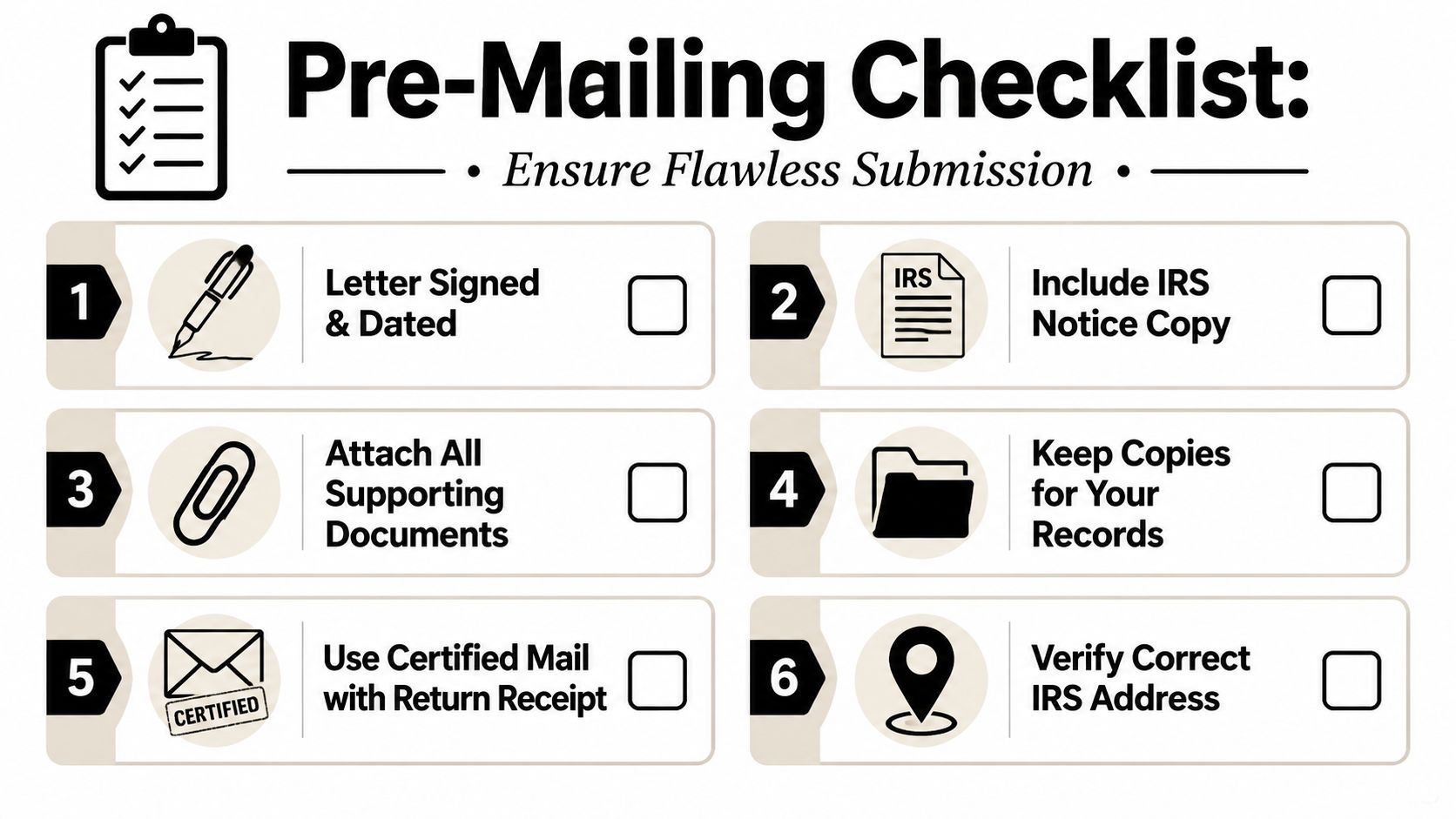
- Your signed and dated letter. Unsigned correspondence creates avoidable delays.
- A copy of the IRS notice. Put it behind your letter so the file can be matched quickly.
- Copies of supporting records. Use the documents that prove your point, not every tax record you own.
- Any notice-specific forms or pages. Some letters include a response page or voucher. If the notice instructs you to include it, include it.
Never send original records unless the IRS specifically requires originals. If you mail the only copy of a legal, banking, or tax document and it gets lost, you've created a second problem.
What to keep and how to send it
Make a complete copy of everything before it leaves your hands. That means the letter, the notice, and every attachment in the same order you mailed them.
Then confirm the address. Use the address printed on the notice, not a generic IRS address from memory. Different notices route to different processing locations.
For delivery, I strongly recommend certified mail with return receipt when you're sending an important response package. The point isn't formality. It's proof. If the IRS later says it didn't receive your response, mailing records matter.
Use this final check before sealing the envelope:
- Match the notice. Your letter should reference the correct notice code and tax year.
- Trim the package. Remove duplicate or irrelevant exhibits.
- Label attachments. If you include several records, mark them clearly so the reviewer can follow them.
- Keep your copy set. Store it with the notice and your mailing proof.
- Mail to the notice address. Don't substitute another address unless the notice says to do so.
After You Mail What to Expect and When to Call a Pro
After mailing, the job isn't over. It shifts from writing to tracking.
What happens after the IRS gets your letter
Keep your copy set and your mailing proof together. If the IRS sends a follow-up letter, you'll want to compare it to exactly what you submitted. Many problems get harder because the taxpayer no longer remembers what was sent.
Expect some waiting. The IRS may need time to review documents, post a payment, or send a second notice. During that period, don't send a new letter every few days unless the IRS specifically asks for more information. Repetitive submissions can muddy the file.
If your case involves document-heavy review, legal interpretation, or cross-referencing several records, the same kind of workflow thinking behind top AI solutions for legal teams can be useful conceptually. The lesson is simple: organized records and issue-specific analysis beat a long, improvised explanation.
When writing your own letter stops being the smart move
Some IRS matters are still DIY-friendly. Others aren't.
You should strongly consider professional help when:
- The notice involves an audit or appeal. Procedure and documentation become more exacting.
- You can't tell what the IRS changed. Confusion at the notice stage usually gets worse later.
- The amount at issue would materially affect your finances. This isn't the time for trial and error.
- You've already responded and the problem continues. At that point, the issue may need account analysis rather than another letter.
- Your records are incomplete or contradictory. A professional can help rebuild and present the file properly.
If you need representation or a structured response plan, professional tax accountant help for IRS issues is often the safer path. Firms such as Allied Tax Advisors also handle IRS resolution work, including notice responses and audit-related matters, which can be useful when the issue goes beyond a simple written reply.
If you received an IRS notice and want help drafting the right response, organizing your documents, or deciding whether the issue should be handled as a dispute, payment matter, or representation case, Allied Tax Advisors can help you review the notice and respond in a way that matches the IRS process.