
A 529 plan withdrawal is only federally tax-free when the money comes out in the same calendar year the qualified expense is paid, and your total withdrawals for that year can't be more than the beneficiary's adjusted qualified higher education expenses. Miss that calendar match, and a perfectly legitimate school bill can turn into a nonqualified distribution.
That's the trap parents hit all the time. You pay tuition, think you're covered, then the withdrawal lands in the wrong year, the paperwork looks fine, and the IRS still treats the earnings piece as taxable.
Table of Contents
- Why the Calendar Year Matters More Than Anything Else
- What Counts as a Qualified Education Expense
- How Nonqualified Withdrawals Get Taxed
- How to Request a Withdrawal Step by Step
- Penalty Exceptions Most Families Miss
- What to Do With Leftover 529 Money
- State Tax Recapture the IRS Will Not Catch
- When to Stop DIY-ing and Call a CPA
Why the Calendar Year Matters More Than Anything Else
A parent walks into tax season thinking the spring semester is covered because the tuition bill was paid with 529 money. Then the school billed in December, the withdrawal got pulled in January, and the earnings slice got hit with tax and penalty. That's not a paperwork nuisance. That's a timing mistake, and timing is everything with a 529 plan withdrawal.
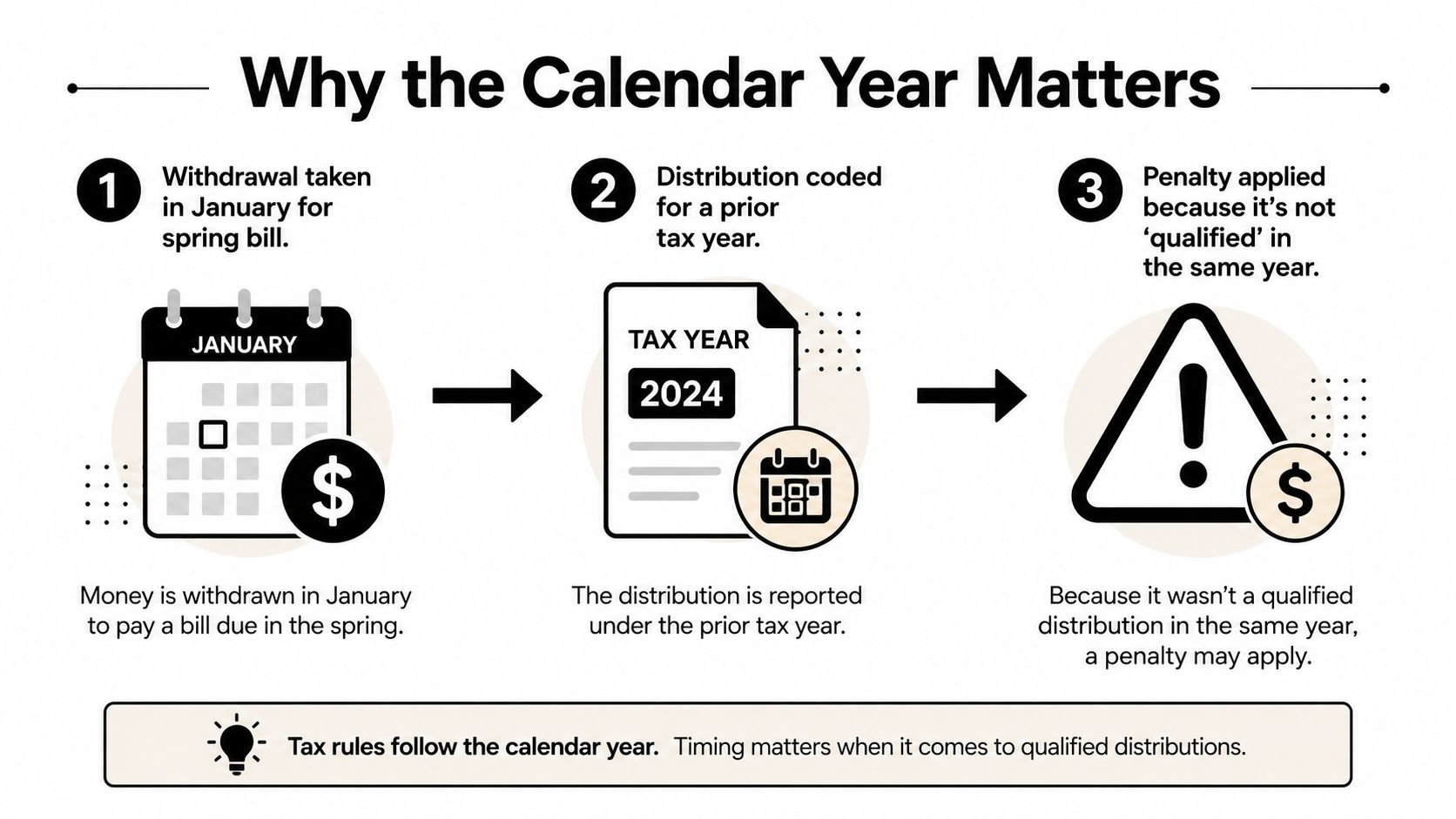
The IRS rule is plain. A distribution is federally income-tax-free only when it matches qualified education expenses in the same calendar year the expense is paid, not just the same academic year. The IRS also says qualified withdrawals are tax-free for eligible costs such as tuition, fees, books, room and board, and since 2018, up to $10,000 per year for K–12 tuition at public, private, or religious schools. Fidelity's guidance matches that same timing rule, because the expense must be paid and the cash request submitted in the same calendar year for the withdrawal to stay tax-free. IRS 529 plan questions and answers
Why spring and fall bills create problems
Spring semester bills often get paid late in one year, while the family doesn't request the withdrawal until January. That's where people get tripped up. The expense was educational, but the withdrawal missed the year-end match, so the earnings portion can become nonqualified.
Practical rule: Don't let the school calendar run your tax calendar. Let the payment date and withdrawal date run together.
Prepaying tuition can create the opposite problem. If you pull money too early for an expense that won't be paid until the next calendar year, you've still broken the rule. The cleanest approach is boring: pay the bill and take the distribution in the same calendar year, then keep the receipt and the 1098-T together in your file.
The mental model to use
Think of the 529 like a matched pair, not a spending account with a long fuse. The withdrawal and the expense need to sit on the same calendar line. If they don't, the IRS doesn't care that the money ultimately went to school.
What Counts as a Qualified Education Expense
Qualified spending is narrower than most parents assume. Tuition and required fees are the obvious ones. So are books, supplies, equipment, computer software, and room and board, but only when the student is enrolled at least half-time and the amount stays within the school's published cost of attendance for housing and meals. The IRS also allows K–12 tuition up to $10,000 per year. IRS 529 plan questions and answers
The line between qualified and nonqualified
Room and board only works when the student meets the half-time requirement and the withdrawal doesn't exceed the school's allowance. That matters more than people think, because families often try to run every dorm, apartment, and meal expense through the 529. If it's over the school cap, the excess isn't qualified.
| Expense | Qualified? | Notes |
|---|---|---|
| Tuition | Yes | Federal qualified expense |
| Required fees | Yes | Must be tied to enrollment |
| Books, supplies, equipment | Yes | Keep receipts |
| Computer software | Yes | Must be education-related |
| Room and board | Yes | Only for at least half-time enrollment and within school limits |
| K–12 tuition | Yes | Up to $10,000 per year under federal rules |
| Transportation | No | Not a qualified expense |
| Insurance | No | Not qualified |
| Sports fees | No | Not qualified |
| Extracurricular costs | No | Not qualified |
If you want a fuller breakdown of the categories families usually miss, use this guide to 529 plan qualified expenses.
What people wrongly try to include
Don't blur the line just because something supports education. A car ride to campus, a health plan, club dues, or activity fees doesn't become qualified just because a student needs it to function at school. The IRS line is stricter than family logic.
Kitchen-table test: If the expense wouldn't show up on a tuition or housing receipt, assume it's not qualified until proven otherwise.
That's the right standard because the penalty falls on the earnings slice of the withdrawal, and you don't want to guess your way into taxable income. Build your withdrawal list from the IRS categories, not from what feels school-related.
How Nonqualified Withdrawals Get Taxed
A nonqualified 529 withdrawal is not taxed on the whole amount. The contributions come back tax- and penalty-free, because they're your after-tax money. The earnings portion is the problem, since that part is generally subject to federal income tax plus a 10% federal penalty. Saving for College on unused 529 penalties
How the tax split works
If the withdrawal isn't fully qualified, the IRS only taxes the earnings slice, not your basis. That's why the math matters. A larger balance with more growth means more earnings exposure, while a newer account with mostly contributions has less taxable pain.
California can make the bill worse. Some guidance notes an additional 2.5% state income tax penalty on those taxable earnings, which brings the combined penalty to 12.5% on the earnings portion in California. Saving for College on unused 529 penalties
A simple example
Say you take a $20,000 nonqualified withdrawal from a 529 that contains $14,000 of basis and $6,000 of earnings. The $14,000 in contributions comes out tax- and penalty-free. The $6,000 earnings slice is the part exposed to ordinary income tax and the 10% federal penalty, and if California applies its additional penalty, that earnings slice gets hit harder. How 529 plan withdrawals are taxed
The key point is proportional treatment. Over-withdraw, and only the excess earnings become taxable, which is why the total year's withdrawals must stay within the beneficiary's adjusted qualified higher education expenses. The IRS timing rule and the annual expense cap work together, so an excess distribution doesn't just sit there harmlessly. 529 plan withdrawal tax rules
For families who need a broader estate and beneficiary lens, estate planning insights for family beneficiaries can help frame how distributions affect inherited and family-held assets in the practical world.
How to Request a Withdrawal Step by Step
Start by confirming the beneficiary is still eligible for the expense you're paying. Then log into the 529 portal, choose the amount, and decide whether the check goes to the school, the account owner, or the beneficiary. That choice matters because the plan's tax forms follow where the money went, and you want the form trail to match your records.
The clean sequence
- Verify the expense first. Make sure the bill is qualified and that the payment date and withdrawal date will land in the same calendar year.
- Enter the exact amount. Don't pad it for convenience. Pull only what the qualified expense supports.
- Pick the delivery method. Direct-to-school payments are easier to track, but account-owner and beneficiary payouts can still work if you document everything.
- Save the proof. Keep invoices, receipts, and the school's enrollment record with the withdrawal confirmation.
Keep the paper trail tighter than you think you need. If the IRS ever asks, you want the qualified expense and the withdrawal to line up without guesswork.
What shows up at tax time
Plans issue Form 1099-Q in January for withdrawals. That form is part of the record, but it doesn't by itself prove the distribution was qualified. Your receipts, tuition statement, and enrollment proof do that job. If the withdrawal was nonqualified, the 1099-Q becomes the starting point for reporting the taxable earnings on your return.
Don't wait for the plan to withhold anything
529 plans generally don't withhold federal taxes on nonqualified distributions, so you may need to handle the tax cost yourself later. That's why I tell parents to run the numbers before they touch the portal, not after the money is already gone. If you want the mechanics laid out in more depth, Allied Tax Advisors also covers how 529 distributions are taxable.
Penalty Exceptions Most Families Miss
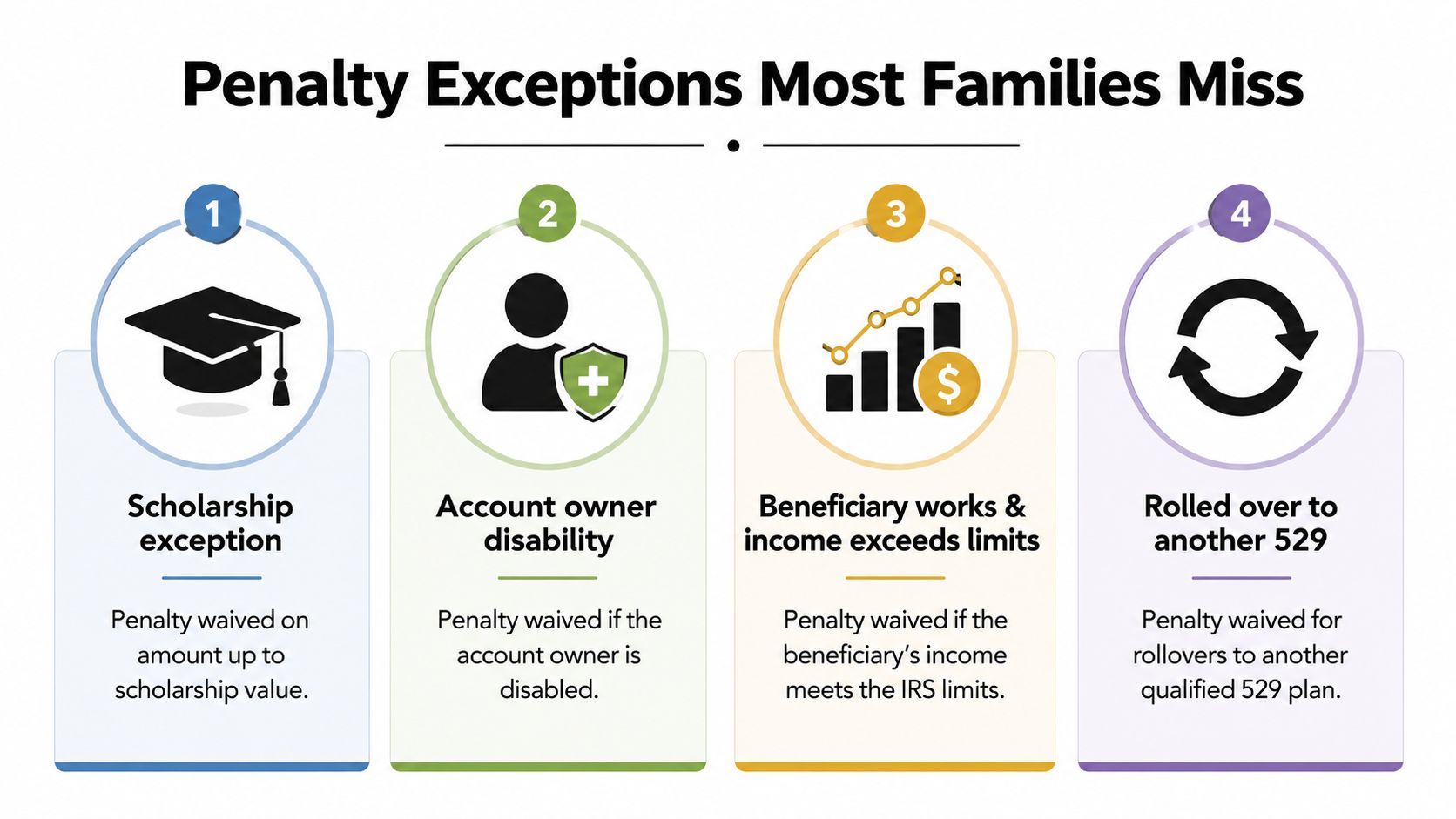
The 10% federal penalty isn't automatic in every bad outcome. Some withdrawals avoid the penalty if they fit one of the IRS exceptions. These are not loopholes. They're specific rules, and you either meet them or you don't.
The main exceptions
- Scholarships: The penalty is waived on withdrawals up to the amount of the tax-free scholarship.
- US military academy attendance: The penalty is waived on amounts equal to the value of the education provided.
- Death or disability of the beneficiary: The penalty can be avoided when the distribution fits those facts.
- SECURE 2.0 Roth IRA rollover: The 529 must have been open at least 15 years, and the lifetime rollover cap is $35,000 per beneficiary. Fidelity's 529 spending guide
How to decide which exception applies
Scholarships are the easiest to understand because the waiver tracks the scholarship amount. If the student earns a tax-free scholarship, you don't have to panic over the 10% penalty on a matching withdrawal. Just stay within the limit and document the award.
Disability and death are different. Those events can change the account's tax treatment, but only if the facts line up and the paperwork supports it. Don't assume compassion in the world translates into automatic tax relief.
The Roth rollover is the one families ask about most. It can be a smart cleanup move for leftover funds, but the 15-year age rule and the $35,000 lifetime cap make it a planning tool, not a dump-everything escape hatch. Fidelity's 529 spending guide
What to Do With Leftover 529 Money
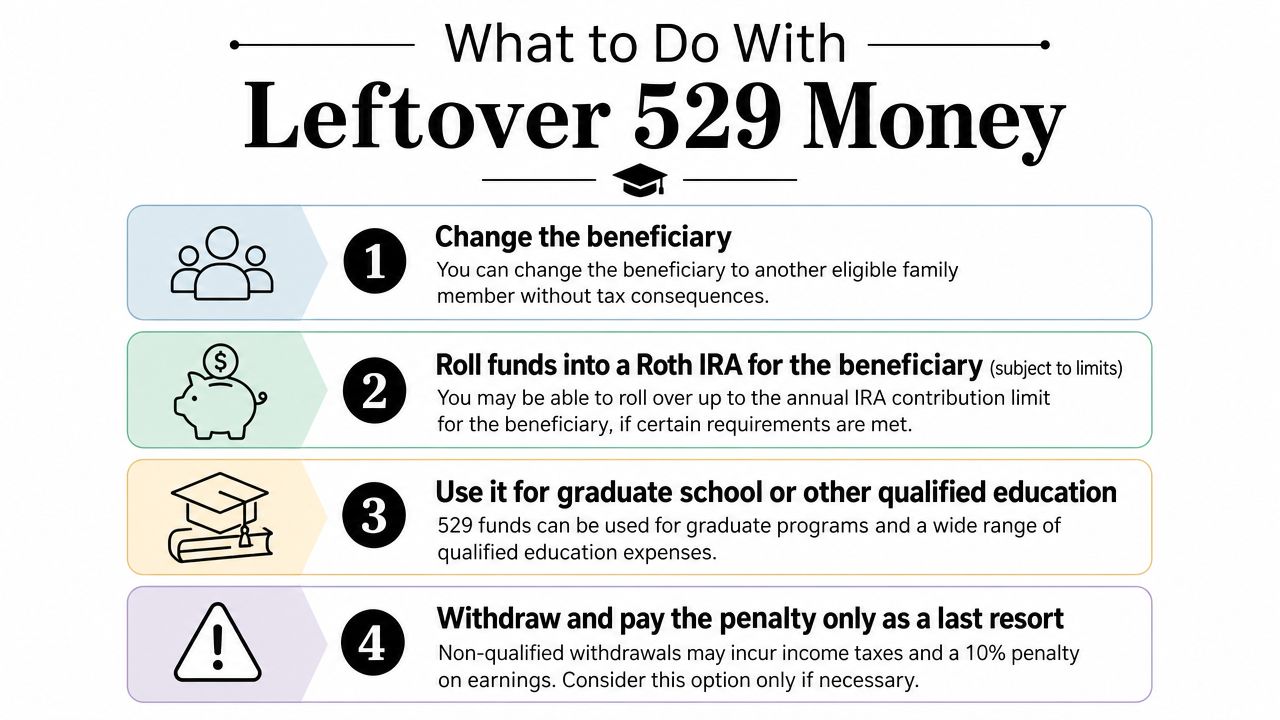
Don't default to “just withdraw it and pay the penalty.” That's usually the weakest move. If the child is done with school, the smarter first question is whether the money can stay in the family and keep working.
Better moves than a taxable withdrawal
Changing the beneficiary is the first option I'd look at. If there's a younger sibling, cousin, or another eligible family member, the money can keep its tax-favored status instead of being shoved into a taxable distribution. That's often the cleanest answer when another student is likely to need the funds later.
Holding the account for graduate school is the next obvious path. If the beneficiary may go on to more schooling, leave the funds parked. There's no prize for rushing a withdrawal just because the undergraduate bill is gone.
Student loans are another real use. Current guidance says funds can be used for student loan repayment, and that makes leftover balances more flexible than older articles suggest. If debt exists, check that route before you start talking yourself into a penalty. Fidelity's 529 spending guide
The Roth IRA rollover is the last major option. It can work, but only if the account has been open long enough and the beneficiary fits the rollover rules. The $35,000 lifetime cap means it's a planning tool for a limited slice of the balance, not a universal fix.
State Tax Recapture the IRS Will Not Catch
Federal tax treatment is only half the story. State rules can still bite you, especially if you claimed a state deduction on prior contributions. In California, a nonqualified withdrawal can trigger state income tax treatment on the earnings, and some states may recapture prior tax benefits even when the federal result is clean. That's the silent surprise most families miss.
The practical problem is simple. You may think the IRS is the only watchdog, but the state wants its turn too. If you took a state deduction earlier, the state can treat a later nonqualified use as a reversal of that prior benefit, which is why a federally tax-free result doesn't always mean a state-tax-free result. 529 plan tax deduction details
Why California families need to pay attention
California families should pay close attention to whether a prior deduction or state benefit was claimed. If the money later gets used outside qualified rules, the state return can look very different from the federal one. That's where people get surprised, because the IRS form looks manageable while the state bill shows up later.
States with no income tax don't create the same recapture problem, which is why location matters. But if you live in a state that gives a deduction or other benefit, assume the withdrawal can have a state-side consequence until you've checked the rules. Don't let the federal answer lull you into skipping the state return review.
The cleanest ways to reduce exposure are still the same family moves: change the beneficiary, keep the money qualified, or use a rollover path that fits the rules. A taxable distribution should be the last move, not the first one. 529 plan tax deduction details
When to Stop DIY-ing and Call a CPA
Do the basics yourself, but do them carefully. Match the withdrawal calendar to the expense calendar. Keep every receipt and tuition record. Confirm the beneficiary's status before each request. And run the math before any nonqualified use. That's the minimum standard.
Call a CPA when the return stops being a straight college-savings cleanup. Multi-state filings, blended family beneficiary changes, Roth IRA rollovers, large balances with prior state deductions, scholarship offsets, disability situations, and loan payoff planning are all places where the tax result can get messy fast. Those are not “I'll figure it out later” files.
If you want help from a firm that handles individual tax planning, state notices, and return preparation, Allied Tax Advisors is a reasonable place to start. A CPA can look at the withdrawal timing, the 1099-Q, and the state return together instead of treating them like separate puzzles.
A CTA for Allied Tax Advisors. If your 529 withdrawal touched a scholarship, a Roth rollover, a state deduction, or a year-end tuition payment, don't guess on the return. Contact Allied Tax Advisors and have a CPA review the withdrawal timing, the 1099-Q, and the state treatment before you file.