
You're not short on accounting software. You're short on time, clean books, and a clear answer to a simple question: who owns the numbers in your business? If you're closing the month late, chasing receipts, and wondering whether payroll and tax filings are getting handled correctly, small business accounting outsourcing is probably already on your radar. The mistake is treating it like a shopping trip for a vendor instead of an operating decision about how your company runs.
The right approach is blunt. Decide what stays inside, what gets handed off, and what level of accounting judgment you need before you compare firms. That's how you avoid the common pattern where an owner hires help, never defines the workflow, and then blames the provider when the problem was a broken operating model.
Table of Contents
- Why Outsourcing Accounting Is an Operating Decision First
- Running a Workload Audit Before You Talk to a Provider
- Choosing Between In-House, Local Firm, and Online Bookkeeping
- Onboarding and the 60-90 Day Transition Plan
- What Outsourcing Really Costs and What You Save
- Security, Compliance, and the Controls Owners Should Demand
- Turning an Outsourced Relationship Into Ongoing Advisory
Why Outsourcing Accounting Is an Operating Decision First
Most owners start in the wrong place. They compare prices, ask a friend for a referral, or search for the nearest CPA firm, then hope the relationship will sort itself out later. That's backwards. Outsourcing only works when the operating model is clear first, because the provider is stepping into a process, not rescuing a vague mess.
Small business owners are no longer doing this as a fringe experiment. In the Clutch survey reported in 2019, 37% of small businesses said they were already outsourcing at least some part of their business, and accounting was tied with IT as the most commonly outsourced process at 37% among outsourcers. The same survey found 52% planned to contract out some part of their business according to Bill.com's summary of the Clutch survey. That matters because it shows outsourcing had already become a mainstream operating choice before the COVID era, not a desperate last resort.
Start with workload, not vendor names
A real decision starts with one question, what accounting work needs your attention, and what only needs a reliable system? If you can't answer that, you're not ready to buy services yet. You're ready to map work.
That's the core distinction. A workload audit tells you whether you need a bookkeeper, a controller-level reviewer, tax support, payroll support, or some blend of all four. Once that's clear, the shortlist gets much smaller.
Practical rule: if you can't describe the work in plain language, you can't outsource it well.
The operating model also affects who should own the file, who approves payments, who reviews entries, and who talks to the tax authority if something goes wrong. That ownership structure is more important than a glossy proposal. If the provider doesn't fit the way you run the business, the contract won't save you.
For a practical starting point, find accounting help for startups is worth reading if you're still shaping what support you need. If you already know you need bookkeeping and tax support, an example of a service menu is Allied Tax Advisors accounting and bookkeeping, which shows how these services are commonly packaged for small businesses.
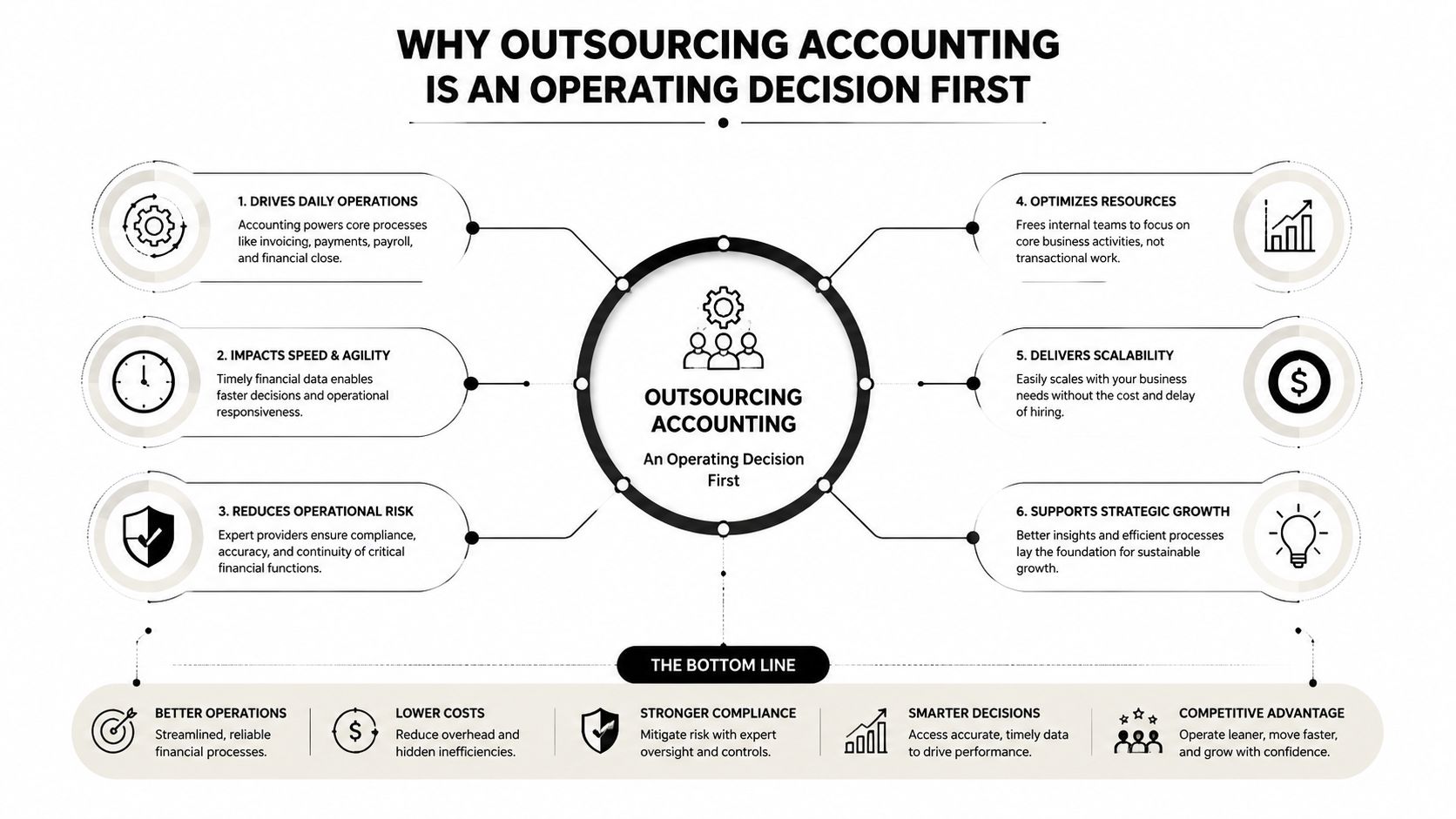
The main takeaway is simple. Pick the operating model first, then buy the service that fits it. That order protects you from scope creep, confusion, and the classic mistake of hiring a vendor for a job you never defined.
Running a Workload Audit Before You Talk to a Provider
A workload audit is just a full inventory of the accounting tasks your business is performing, or pretending to perform. Don't make it elegant. Make it complete. List every recurring task across bookkeeping, payroll, sales tax, accounts payable, accounts receivable, month-end close, management reporting, and advisory work.
Score each task on three axes
Once the list exists, score every task for frequency, regulatory exposure, and strategic value. Frequent tasks are candidates for standardization. High-exposure tasks need tighter controls. High-strategic-value tasks usually stay closer to the owner or an internal manager, even if the mechanics are outsourced.
Most owners get honest with themselves. They think they need to keep a task because it feels important, when really it only feels familiar. If the work is repetitive and rules-driven, it belongs in the outsourced lane. If it requires judgment about cash, growth, or entity structure, it may need a hybrid model.
Here's the discipline I use with clients:
- Bookkeeping cleanup: keep only if the business has unusual transactions or a controller on staff.
- Payroll processing: outsource if the rules are routine and approvals are clear.
- Sales tax and filings: outsource unless someone inside is already owning compliance.
- Monthly reporting: outsource the prep, keep interpretation close to management.
- A/R and A/P processing: outsource the mechanics, retain approval authority.
A task doesn't belong in-house just because the owner has always done it. It belongs where it can be done consistently, with the least friction and the clearest accountability.
Check your own bandwidth before you hand anything off
Outsourcing fails fast when the owner never makes time to manage it. Someone still has to review the numbers, answer questions, and approve a transition plan. If your calendar can't absorb that, you're not ready for a handoff.
Use a one-page fit checklist, then decide whether each function is in-house, hybrid, or fully outsourced. That one page should tell you where your bottlenecks are and where an outside team would create additional capacity. A simple template can help structure that inventory, and this small business bookkeeping template is a useful reference point if you want to build your own internal version.
The point of the audit isn't paperwork. It's clarity. Once the work is mapped, the provider conversation gets much sharper and much less expensive.
Choosing Between In-House, Local Firm, and Online Bookkeeping
The right model depends on complexity, not taste. A solo founder with a simple revenue stream and low transaction volume doesn't need the same setup as a business with payroll, inventory, multiple entities, or state filings. Too many comparison guides pretend these models are interchangeable. They aren't.
Compare control, not just price
An in-house bookkeeper gives you proximity and day-to-day access, but you also take on hiring, training, software setup, and turnover risk. A local CPA firm usually brings stronger review depth and tax coordination, but you may pay more for that oversight and deal with less day-to-day flexibility. A fully online or hybrid provider can give you cleaner workflows and better access to specialized systems, but only if communication and scope are tight.
The numbers on the board can be misleading. An hourly bookkeeper can look cheap until cleanup drags on. A flat-fee firm can look expensive until you realize payroll, month-end close, and tax-season support are bundled. The comparison is fully loaded monthly cost, not the first invoice.
| Model | Typical Monthly Cost | Controller-Level Expertise | Software Ownership | Best Fit |
|---|---|---|---|---|
| In-house bookkeeper | Higher fixed cost with benefits and overhead | Depends on the hire | Usually inside the business | Owners who need daily access and have management capacity |
| Local CPA firm | Mid to higher recurring fee | Usually stronger review and tax awareness | Often shared or firm-assisted | Businesses that want hands-on oversight and fewer software headaches |
| Online or hybrid bookkeeping | Usually more flexible and modular | Varies by provider depth | Often cloud-based and process-driven | Founders who want predictable workflows and remote collaboration |
Know the mismatch before it bites you
A one-person online bookkeeper is a bad fit for a company with multi-state sales tax complexity. A local firm that only wants annual clean-up is a poor fit for a business that needs weekly cash visibility. An in-house hire without review backup is fragile when that person is out sick or leaves.
One option worth considering in the local-firm category is Allied Tax Advisors, which combines bookkeeping, payroll via IRIS software, and advisory support under one roof. That doesn't make it the right answer for every company, but it does show what a broader operating model looks like when the accounting function is tied to tax and compliance.
The point is to choose the model that matches your actual workflow. Don't buy a brand when what you need is a system.
Onboarding and the 60-90 Day Transition Plan
A transition goes wrong when owners treat onboarding like a handoff of logins instead of a redesign of how the accounting function operates. If a provider rushes setup, they usually inherit a messy chart of accounts, unclear approval rules, and a close process that breaks under pressure. That shows up fast in payroll, cash visibility, and month-end close.
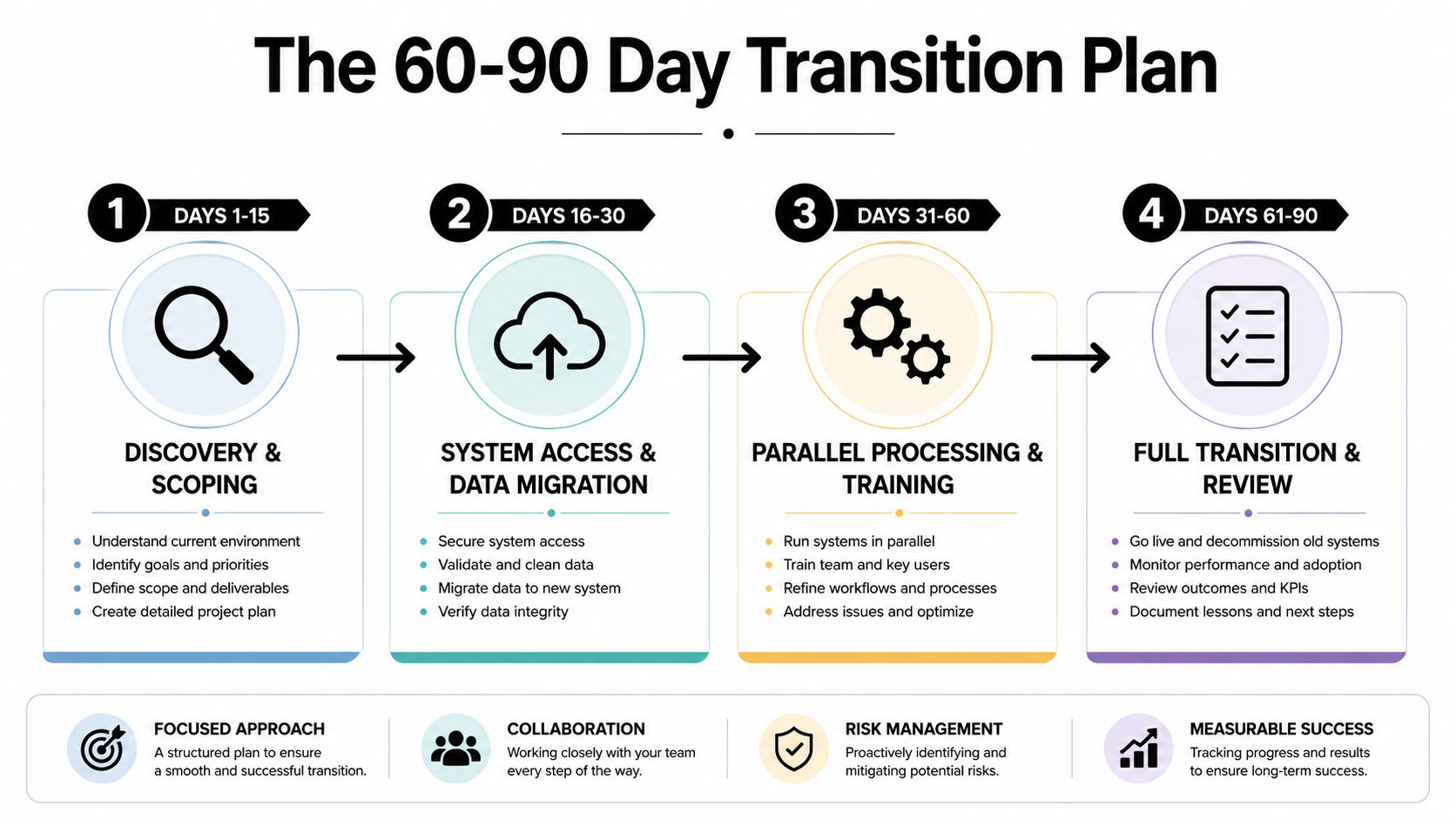
The handoff needs a sequence. One industry guide recommends 60 to 90 days to reach steady state as outlined in 1840 & Co.’s outsourcing guide, and another uses a three-phase structure of 2 to 4 weeks for preparation, 4 to 8 weeks for transition, and then ongoing optimization in Seal Global Holdings' guide. Those timelines point to the same operating reality, the work has to be cleaned, transferred, and stabilized before anyone should call it finished.
Start with cleanup, not access. Reconcile old balances, fix the chart of accounts, agree on the first month's deliverables, and only then widen software permissions. Run the first close in parallel so errors surface while both sides can still correct them.
Lock down the process on day one
Every recurring task needs a written SOP. A real process document tells the provider who approves entries, where source files live, how exceptions get handled, and what happens when a bank feed fails. If the main contact is unavailable, the work should still move.
Access controls deserve the same attention. Use role-based permissions, multi-factor authentication, and a client portal for documents instead of email chains. Keep the number of people with broad access as low as the work allows. The access design in 1840 & Co.’s outsourcing guide is the right instinct here, because sloppy permissions create preventable errors and make it harder to trace who did what.
Service-level expectations belong in writing before the first live month closes. Set month-end close dates, response times, escalation paths, and ownership for each deliverable so nobody is guessing under pressure. Without that, “transition” becomes drift with a nicer name.
A transition should end in steady state, not permanent onboarding. If the provider cannot get there, the operating model is wrong. For teams still comparing service bundles, Allied Tax Advisors bookkeeping services rates can help frame what a structured package should cover.
What Outsourcing Really Costs and What You Save
The only honest answer on cost is that it depends on what you include. A bare bookkeeping quote is not the same thing as a full accounting operating model. If you compare those as if they're equal, you'll make a bad decision and call it “budget discipline.”
Normalize the proposal before you compare it
A real outsourced package may include monthly bookkeeping, payroll processing, sales tax filings, year-end close, and occasional controller-level review. A leaner package may only cover categorization and reconciliation. If advisory is billed separately, that changes the math again.
The market data point that matters is the cost pattern versus in-house staffing. Current summaries of the finance and accounting outsourcing market report 30% to 40% average cost savings versus equivalent in-house operations, and some estimate 40% to 60% lower costs when benefits, overhead, and turnover are included as summarized in Eagle Rock CFO's 2026 report. Those savings are most believable when the work is routine and the comparison includes the full burden of employing someone.
Watch the pricing traps
Three pricing models cause trouble again and again.
- Per-transaction pricing can punish growth, because more activity means a bigger bill.
- Hourly billing can reward inefficiency if the scope isn't tightly managed.
- “All-inclusive” packages sometimes hide exclusions for payroll runs, tax filings, or cleanup work.
A clean proposal should show what's included, what's excluded, and what happens when your business grows or gets messy. If you're asking for a bookkeeping quote, normalize it to monthly fully loaded cost, then pressure-test the first year's ramp. That's the only way to compare apples to apples.
If you want a practical pricing reference point while you're reviewing quotes, bookkeeping service rates from Allied Tax Advisors can help you see how service scope changes the price structure.
The bigger point is this. Outsourcing isn't always cheaper in the narrowest sense, but it often costs less than carrying the same workload in-house once you account for payroll burden, software, and turnover. That's why small business accounting outsourcing keeps expanding beyond basic bookkeeping and into broader support.
Security, Compliance, and the Controls Owners Should Demand
Trust is not a control plan. Data protection is not a control plan either. If a provider is going to touch your bank activity, payroll, tax filings, and journal entries, you need concrete safeguards, not vague reassurance.
Demand controls you can verify
The controls that matter are straightforward. Use role-based access so no one has more visibility than they need. Require audit trails on journal entries. Push documents through a secure portal, not email attachments. Ask how the provider handles backups, incident response, and data return if the relationship ends.
Research on SMEs outsourcing accounting found that managers commonly worry about the criticalness of the function, loss of confidential information, and whether they can trust the provider. It also shows that data governance and accountability are still sticking points, not solved problems in the SME outsourcing research paper. That lines up with what buyers still ask in practice.
If the provider can't explain who owns the file, who owns the backup, and how data comes back to you on termination, keep looking.
Ask the uncomfortable questions early
You also want clarity on IRS representation, state notice handling, and what happens if the firm is acquired or a key contact leaves. A single point of contact can be helpful, but it becomes a risk when no one else knows your file. Bank-feed integrations and payroll connections also need monitoring, because those links can lapse.
For businesses that handle sensitive regulated information, this kind of discipline matters even more. If you need a deeper view of controlled processes and documentation standards, HIPAA compliance for SMBs is a useful resource because the underlying governance mindset carries over well.
The contract should do real work. Include service-level terms, data return on termination, and indemnification where appropriate. Don't rely on a handshake when the provider is holding core financial records.
Turning an Outsourced Relationship Into Ongoing Advisory
Most outsourced accounting relationships stop too early. They handle the bookkeeping, maybe the payroll, and then nobody uses the relationship to improve the business. That's wasteful. Once the numbers are clean, the work should move into decision support.
The cadence that works is simple. Use monthly close to review cash, margin, and open items. Use a quarterly tax-planning check-in to deal with estimated taxes, 1099 cleanup, sales tax nexus, and retirement planning. Bring the annual strategy session back to entity structure, compensation, and growth plans.
The value shows up when the accountant knows your business rhythm, not just your chart of accounts.
Your job as the owner is to keep a management rhythm. Thirty minutes a week for the dashboard. One monthly call with the lead accountant. One quarterly scope review so the engagement doesn't drift or bloat. If you do that, the provider becomes part of the financial operating system, not just a cleanup crew.
That's the upside of small business accounting outsourcing when it's done well. It doesn't just reduce back-office pain. It gives you a tighter operating cadence, better visibility, and a cleaner path to decisions that move the business.
If you're ready to stop patching accounting problems one month at a time, talk with Allied Tax Advisors. They work with small businesses on bookkeeping, payroll, tax compliance, and advisory support, which makes them a practical fit if you want outsourced accounting built around real operating controls instead of a generic vendor handoff.