
If you’re a landlord, there’s one tax form you absolutely need to get familiar with: IRS Schedule E (Form 1040), Supplemental Income and Loss. This is where the magic happens—or at least, where all your rental income and expenses come together. Think of it as the central hub for your property’s financial story for the year.
Getting a Handle on Your Rental Tax Duties

When you’re first diving into rental property taxes, Schedule E can seem a bit intimidating. But it’s really just a roadmap. It’s designed to guide you through the process of tallying up what your property earned and subtracting what you spent to keep it running.
Getting this right isn’t just about staying on the IRS’s good side. It’s about making sure you don’t pay a penny more in tax than you have to. When you track your finances carefully, you build a clear, defensible record of your rental business, which is your best defense against overpaying.
So, What’s the Point of Schedule E?
At its heart, Schedule E is a summarization tool. It brings all the financial ins and outs of your rental properties into one place, making it easy to see the bottom line. This includes the rent checks you deposited and the money you paid for that emergency plumbing fix. The final number you calculate here—your net profit or loss—gets carried over to your main Form 1040.
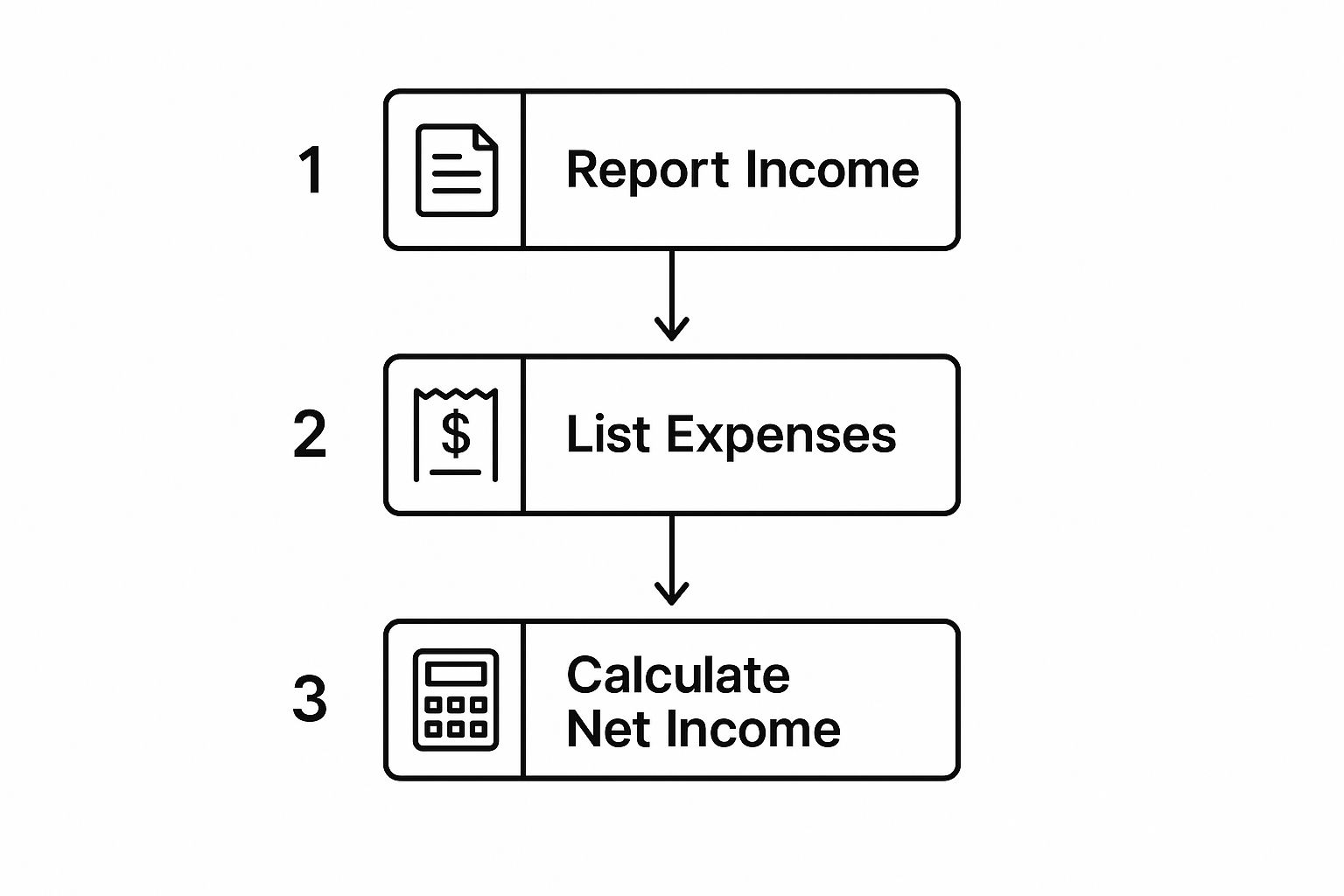
The process boils down to a few key activities:
- Listing all your income: You start by reporting your gross rental income, which is every dollar you collected before any deductions.
- Subtracting your costs: Next, you’ll list all your legitimate expenses. This covers everything from mortgage interest and property taxes to insurance premiums and repair costs.
- Finding your net figure: The difference between your income and expenses gives you your net profit or loss for the year.
To help you get oriented before diving into the line-by-line details, here’s a quick overview of how the form is laid out.
Key Sections of IRS Schedule E at a Glance
This table breaks down the main parts of the Schedule E form, helping you quickly understand where to report different types of financial information.
| Part of Form | What It Covers | Primary Purpose |
|---|---|---|
| Part I | Income or Loss From Rental Real Estate | This is the main section for most landlords. You list your properties, gross rent, and all associated expenses here. |
| Part II | Income or Loss From Partnerships and S Corporations | If you’re invested in a real estate partnership, you’ll report the income or loss from your K-1 form here. |
| Part III | Income or Loss From Estates and Trusts | This section is for reporting income you receive as a beneficiary of an estate or trust. |
| Part IV | Income or Loss From Real Estate Mortgage Investment Conduits (REMICs) | A more specialized section for those with investments in complex mortgage-backed securities. |
| Part V | Summary | This part aggregates the numbers from all other sections to give you a total income or loss to carry to your Form 1040. |
Understanding this structure makes filling out the form feel much more manageable. You can focus on the specific sections that apply to your situation, which for most landlords, will primarily be Part I.
In the United States, rental income must be reported on tax forms such as Schedule E (Supplemental Income and Loss) attached to Form 1040. The IRS requires taxpayers to accurately report rental income and allowable expenses—including repairs, depreciation, and mortgage interest—to calculate taxable income correctly. You can review the details on official IRS publications.
Who Actually Needs to File Schedule E?
The rule of thumb is pretty simple: if you receive rent from a property you own, you almost certainly need to file a Schedule E. It doesn’t matter if you own a large apartment complex or just rent out your old single-family home. The nuances of the taxation of rental properties make this form a non-negotiable part of being a landlord.
Let’s be clear: skipping this form or filling it out with half-baked numbers can attract penalties and unwelcome letters from the IRS. Taking the time to complete your rental income tax form correctly not only keeps you compliant but also helps you create a smooth, stress-free system you can rely on year after year.
Getting Your Paperwork in Order

Let’s be honest, the secret to a stress-free tax season isn’t some magic formula. It’s preparation. Before you even think about tackling a rental income tax form like Schedule E, you need to have all your financial records organized and ready to go. Doing this groundwork ahead of time is what turns a frantic scramble for receipts into a straightforward, almost mechanical process.
Think of yourself as a detective building a case. Your mission is to create an undeniable paper trail for every dollar that came in and every dollar that went out. When you have the evidence, filing is easy.
Tallying Up Your Income
First things first, let’s nail down your gross rental income. This is the total rent you collected for the year, before a single expense is subtracted. You can’t just pull a number out of thin air; the IRS wants to see proof.
Here’s the documentation you’ll need to have on hand:
- Bank Statements: This is why having a separate bank account for your rental is so critical. It isolates all your rental deposits, making it simple to add up the year’s total.
- Rent Rolls or Tenant Ledgers: A basic spreadsheet that tracks each tenant’s payments—who paid, how much, and when—is invaluable. It gives you a clean summary of your income at a glance.
- Digital Payment Records: Do your tenants pay through Zelle, Venmo, or another app? Make sure you download the annual transaction reports. These are your official records for those digital payments.
Add these up to get your final, master income figure. This is the number that goes on Schedule E, so you need to be confident it’s 100% accurate and fully supported by your records.
Tracking Down Your Expenses
With your income sorted, it’s time to gather the proof for every single deductible expense. This is where meticulous organization really pays off. Forgetting even a small receipt means you’re leaving money on the table and voluntarily paying more in taxes.
My Two Cents: Seriously, don’t throw anything away. A shoebox stuffed with receipts is a mess, but it’s a thousand times better than having nothing. The gold standard? Go digital. Use a simple spreadsheet or a dedicated app to snap photos of receipts and categorize expenses each month. It’s a game-changer.
Start by rounding up these key documents:
- Form 1098, Mortgage Interest Statement: Your mortgage lender will send this to you automatically. It spells out exactly how much deductible mortgage interest you paid.
- Property Tax Bills: Dig up the official statements from your county or city showing the property taxes you paid for the year.
- Insurance Statements: Gather the premium payment records for your landlord, liability, or flood insurance policies.
- Receipts for Repairs & Maintenance: This is a big category. It covers everything from the invoice for a major plumbing fix to the receipt for a new light fixture at Home Depot.
- Utility Bills: If you cover any utilities for your tenants (water, trash, gas, etc.), get those bills together.
Finally, you need the numbers for your property’s big-ticket items. This means the original purchase price of the building and any major improvements you’ve made, like a new roof, furnace, or a kitchen remodel. These figures are the foundation for your depreciation deduction—which is often the single largest tax break a landlord gets. To really get into the weeds on that, check out our guide on how to calculate depreciation on rental property.
Alright, let’s break down the Schedule E form. I know it can look intimidating at first glance, but once you get the hang of it, it’s really just a matter of plugging in the right numbers in the right places. Think of it less as a dreaded tax form and more as your end-of-year scorecard for your rental business.
Let’s walk through it line by line, so you can fill it out with confidence.
As you can see, you’ll start by identifying the property. You’ll enter the physical address and the property type, which tells the IRS exactly which asset you’re reporting on for the year.
Starting With Your Income
The action begins in Part I. First, you need to list out your properties and specify how many days each one was rented out versus how many days you used it yourself. This is absolutely critical, especially for vacation rentals, as the IRS has very specific rules about personal use.
Next up is Line 3, “Rents received.” This is where you’ll put your gross rental income—the total cash you collected from tenants before you paid any bills. This number should tie directly back to the income records you’ve been keeping all year. It’s a straightforward entry, but getting it right is the foundation for everything that follows.
A quick tip from experience: “Rent” means any payment from a tenant. Whether they paid by check, bank transfer, or a peer-to-peer app like Zelle or Venmo, it all counts. If money hit your account from a renter, the IRS sees it as income.
Once you’ve reported your income, the rest of the form is dedicated to subtracting all your costs. It’s a logical flow: what you earned, minus what you spent, equals your taxable profit.
Tallying Your Expenses
This is where you get to claw back some of that tax money. Lines 5 through 20 are your chance to account for every dollar you spent keeping your rental property running. Be meticulous here. Every legitimate expense you forget is money you’re just giving away to the IRS.
Here are some of the big ones you don’t want to miss:
- Line 5 (Advertising): Did you run an ad on Zillow? Put up a “For Rent” sign? Boost a post on Facebook? Those costs belong right here.
- Line 9 (Insurance): This is for your landlord insurance premiums. Don’t forget to include any separate policies you have, like flood or fire insurance.
- Line 10 (Legal and other professional fees): If you had to hire a lawyer for an eviction or a CPA to help with your books, this is where you deduct their fees.
- Line 12 (Mortgage interest): This is usually one of the biggest deductions for landlords. Your lender will send you a Form 1098 with the exact amount to enter here.
- Line 14 (Repairs): This one is for the day-to-day fixes that keep the property in good working order. I’m talking about things like patching a hole in the drywall, calling a plumber for a leaky sink, or replacing a burnt-out light fixture in a common area.
Try not to just lump everything together under “miscellaneous.” The IRS gives you specific lines for a reason, so use them. If you have a legitimate expense that truly doesn’t fit anywhere else, you can list it on Line 19, “Other.”
The Power of Depreciation
Now for my favorite part. The single most powerful tax deduction for real estate investors is depreciation, which you’ll claim on Line 18. This is a game-changer.
Unlike a repair, which is a one-off expense, the IRS understands that your building wears out over time. Depreciation lets you deduct a portion of your property’s value each year to account for that wear and tear.
For residential rentals, the magic number is 27.5 years. You’ll depreciate the building’s cost basis over that period. Your cost basis is generally what you paid for the property, minus the value of the land (since land doesn’t wear out), plus any closing costs or settlement fees you paid at purchase.
Let’s say your building has a cost basis of $275,000. Your annual depreciation deduction would be $10,000 ($275,000 / 27.5 years).
This is a “phantom” expense—you don’t actually write a check for $10,000, but you get to deduct it from your income as if you did. It’s a massive benefit that can dramatically reduce your tax bill, and it’s why understanding depreciation is non-negotiable for any serious landlord.
Finding Every Deduction and Avoiding Audit Triggers

Getting your rental income tax form filled out is one thing. But the real art is in optimizing it to legally reduce what you owe. This is where experienced landlords really gain an edge—by making sure they claim every single deduction they’re entitled to.
Frankly, a lot of landlords leave money on the table. They miss out on legitimate expenses not because they’re trying to cheat, but simply because they don’t know to look for them. You have to think beyond just the obvious costs like the mortgage payment and major repairs.
For example, what about the time you spend actually managing the place? If you have a dedicated space in your house where you handle all the administrative work, that could be a home office deduction. Did you drive over to the property to show it to a prospective tenant or let a plumber in? Those miles are deductible.
Uncovering Commonly Missed Deductions
It’s easy to remember the big-ticket items, but the smaller, everyday costs can add up to a significant amount by the end of the year. This is where keeping a meticulous log becomes your best friend.
I’ve seen these deductions get overlooked all the time:
- Professional Development: Did you attend a landlord seminar, buy a book on property management, or subscribe to a real estate journal? Deductible.
- Bank Fees: Those monthly service charges on the dedicated bank account for your rental property? Deductible.
- Tax Software and Prep Fees: The cost of the software you bought to file your taxes or the fee you paid an accountant to prepare your Schedule E is deductible.
- Travel for Management: As I mentioned, any mileage for trips to the property, the bank, or the hardware store for supplies can be claimed.
These little expenses are like slow leaks in your profit bucket. Tracking them ensures you’re not paying more in taxes than you absolutely have to. Taking a closer look at the specific rules for taxes on rental income can uncover even more ways to save.
A critical piece of advice I always give: Don’t ever think an expense is too small to track. A $5 bank fee might feel insignificant, but that’s $60 a year. If you have ten “trivial” expenses like that, you’ve just found a $600 deduction you would have otherwise thrown away.
Avoiding Common Audit Triggers
Just as important as finding every last deduction is steering clear of the common mistakes that catch the IRS’s attention. Certain errors on a Schedule E are notorious for raising red flags.
The biggest one? Misclassifying your expenses. The IRS has a very firm line between a repair and an improvement. A repair, like fixing a leaky faucet, is a current expense that you can deduct in full the year you pay for it. An improvement, on the other hand, like a full kitchen remodel, adds significant value and must be capitalized—meaning you depreciate its cost over several years.
Think of it this way: replacing a few cracked roof shingles is a repair. Replacing the entire roof is an improvement. Trying to write off a $15,000 roof replacement as a one-time repair is a textbook audit trigger.
Other common slip-ups include:
- Poor Documentation: You absolutely must have receipts, invoices, and bank statements to back up every single expense you claim. No receipt, no deduction.
- Incorrect Cost Basis: Using the wrong initial value for your property when you start calculating depreciation can throw all your numbers off for years to come.
- Mixing Personal and Business Expenses: It can be tempting, but deducting any cost related to your personal use of the property is a major no-no.
When you understand these common pitfalls, you can approach your rental income tax form with confidence. You’ll be able to claim every deduction you deserve without worrying about raising your audit risk.
A Look at Global and Regional Tax Rules
It’s a common trap for property investors to think tax rules are pretty much the same everywhere. But the familiar rental income tax form we use in the United States, Schedule E, is strictly an IRS creation. The moment you step outside U.S. borders, you’re playing a whole new ballgame with its own set of non-negotiable rules.
Getting this wrong can be costly. What you can deduct, how you calculate depreciation, and even when you need to file can change dramatically from one country to the next. If you try to apply the logic from your U.S. property to a rental abroad, you’re setting yourself up for serious compliance headaches and potential penalties.
Contrasting US and Canadian Rental Tax Systems
Let’s take a look right across the border. If you own a rental in Canada, you won’t be filing a Schedule E. Instead, Canadian landlords use a specific document called the T776 Statement of Real Estate Rentals to report their earnings to the Canada Revenue Agency (CRA).
The T776 requires a detailed breakdown of gross rents and specific expense categories, including:
- Utilities
- Insurance
- Property taxes
- Capital cost allowance (their version of depreciation)
This simple example drives home a crucial point for any real estate investor: tax compliance is hyper-local. Every country has its own framework tailored to its national tax structure.
The biggest mistake an investor can make is applying one country’s tax logic to another’s property. Always start with the assumption that the rules are entirely different and seek out local expertise to guide you.
Why Local Tax Rules Matter for Your Bottom Line
These regional differences are about more than just paperwork; they hit your net profit directly. Think about how much personal income tax rates vary around the world. A country with lower tax brackets could mean you keep more of your rental profit, even if the gross rent is identical to a U.S. property.
On the flip side, a country with high-income taxes could take a much bigger bite out of your returns. This is why localized research is so critical before you invest. You have to look past the property’s potential income and dig into how the regional tax system will shape what you actually take home.
For any U.S. landlord with foreign properties—or anyone even thinking about a global strategy—treating each property’s tax situation as a unique case isn’t just good advice. It’s fundamental to your success.
Common Questions About Rental Income Taxes
Even after you get the hang of the rental income tax form, some real-world situations can leave you scratching your head. Let’s walk through some of the most common questions I hear from landlords to clear things up and help you file with more confidence.
Do I Report Rent From a Room in My House?
Yes, if you’re renting out a room in the home you live in, that income almost always needs to be reported to the IRS. There’s one very specific exception: if you rent it for fewer than 15 days total during the entire year. If you hit that 15-day mark or go over, it’s time to report.
The tricky part here is a “house hacking” scenario is that you can’t deduct all of your expenses. You have to be meticulous about dividing costs like mortgage interest, property taxes, and utilities between your personal use and the rental portion. A common way to do this is by square footage. For example, if the rented room takes up 20% of your home’s total area, you can generally deduct 20% of those shared household expenses against your rental income.
What Is the Difference Between a Repair and an Improvement?
This is a big one. Honestly, it’s one of the most critical distinctions in rental property taxes, and getting it wrong can be a fast track to an audit.
A repair is something that just keeps your property in good working order. Think of it as maintenance. Fixing a leaky faucet, patching a hole in the drywall, or replacing a single broken windowpane are all repairs. You can deduct the full cost of these in the same year you pay for them.
An improvement, however, is a much bigger deal. It enhances, betters, or restores your property in a significant way. We’re talking about things like replacing the entire roof, adding a new deck, or a full kitchen remodel. You can’t just write these off in one go. Instead, you have to “capitalize” the expense and depreciate it over its useful life, which is several years.
The rule of thumb I always tell clients is simple: repairs maintain, while improvements enhance. Trying to pass off a $20,000 kitchen upgrade as a “repair” is a surefire way to get unwanted attention from the IRS.
Can I Deduct Travel Costs to My Rental Property?
Absolutely, as long as you’re careful with your records. You can deduct the ordinary and necessary costs of traveling to your rental property for business purposes, like collecting rent, meeting with a contractor, or performing maintenance.
The key here is that the primary purpose of the trip must be for your rental business. If you mix business with pleasure—say, you spend four days working on the property and then three days vacationing in the same town—you have to allocate your costs. You can only deduct the expenses that apply to the four business days. This is exactly why keeping a detailed mileage log and clear notes on what you did each day is non-negotiable.
What If I Find a Mistake on My Filed Return?
First off, don’t panic. It happens more often than you think. If you realize you made a mistake after you’ve already filed, the proper way to fix it is by filing an amended tax return.
You’ll use Form 1040-X, Amended U.S. Individual Income Tax Return. You will also need to attach a corrected Schedule E showing the right numbers. In most cases, you have three years from the date you filed the original return (or two years from when you paid the tax, whichever is later) to submit an amendment. It’s always, always better to be the one to find and fix your own mistake than to wait for the IRS to do it for you.
Navigating the details of your rental income tax form can feel like a maze, but you don’t have to go it alone. The team at Allied Tax Advisors focuses on rental property tax compliance, helping landlords just like you stay accurate and find every deduction you’re entitled to. Let’s simplify your tax season together.