
The Alternative Minimum Tax (AMT) is something of a shadow tax system. It runs in the background, parallel to the regular income tax system we all know. You essentially calculate your taxes twice—once the standard way and once under the more stringent AMT rules. You then pay whichever bill is higher.
The entire point is to make sure that people with high incomes, who might otherwise use a lot of deductions and credits to wipe out their tax bill, still pay at least a certain minimum.
A Parallel Tax Universe? What’s That About?

The idea of a parallel tax system sounds complicated, but its purpose is actually quite simple. The regular tax code is full of deductions and credits meant to encourage things like homeownership, business investment, or saving for retirement. For most people, these are helpful tax breaks.
But for some high-earners, stacking these benefits can slash their tax liability down to little or nothing. The Alternative Minimum Tax acts as a backstop to prevent this. It’s the government’s way of ensuring the tax system remains fair.
The Origin Story of the AMT
The AMT wasn’t just invented on a whim. It was a direct response to a major public outcry back in the late 1960s.
Congress was stunned to learn that 155 high-income households had managed to legally pay zero federal income tax. This news shook public confidence and led directly to the creation of the first version of the AMT in 1969. The goal was clear: make sure everyone with significant income contributes something.
How This Parallel System Actually Works
The AMT forces you to re-calculate your taxable income, but with fewer of the usual perks. You start with your income from your regular tax return and then add back a list of specific deductions and tax breaks that the AMT doesn’t allow.
This gives you a new, often higher, income figure called your Alternative Minimum Taxable Income (AMTI).
Think of it like this: The AMT strips away many common tax benefits to get a broader, more fundamental picture of your income. This wider base ensures that at least some tax gets paid.
Once you have your AMTI, you subtract the AMT exemption amount (if you’re eligible) and then apply the AMT tax rates. If the resulting tax—your “tentative minimum tax”—is more than your regular tax, you owe the difference.
So, what gets added back? The most common items include:
- State and Local Tax (SALT) Deductions: A big one. These are not deductible for AMT purposes.
- The Standard Deduction: If you take the standard deduction on your regular return, you can’t for the AMT calculation.
- Incentive Stock Options (ISOs): A portion of the value from exercised ISOs is often considered income for AMT, even if you haven’t sold the stock.
- Certain Miscellaneous Itemized Deductions: Many other itemized deductions get tossed out under AMT rules.
Essentially, the AMT rewrites the definition of your income for tax purposes. No matter which system you use, the calculation always begins with your income baseline. For a deeper dive into that starting point, take a look at our guide on what is adjusted gross income. Getting a firm grip on your AGI is a must before you can tackle the complexities of the AMT.
Do I Need to Worry About the Alternative Minimum Tax?
Figuring out if the Alternative Minimum Tax (AMT) applies to you isn’t as simple as looking at your income. There’s no single number that shouts, “You owe AMT!” Instead, it’s about a pattern of financial activities and deductions that can wave a red flag, suggesting you need to take a closer look at Form 6251.
While the AMT was originally designed to make sure the wealthiest Americans paid at least some tax, its reach has ebbed and flowed over the years. Your risk level depends on the combination of how much you earn and, more importantly, the specific types of deductions you claim. The main trigger is often a mix of a high income and very large itemized deductions.
The Classic AMT Profile: High Income Meets Big Deductions
The most common person to get pulled into the AMT system earns a healthy income but also significantly lowers their tax bill with major deductions on their standard return. This creates a big gap between their regular taxable income and what the AMT system considers their “real” income.
Think of it like this: your regular tax return might show a much smaller taxable income after you’ve subtracted all your deductions. The AMT calculation, however, makes you add many of those deductions right back in. This reveals a much higher income figure that it uses for its own separate tax calculation.
The biggest culprit here is often the State and Local Tax (SALT) deduction. If you live in a high-tax state like California or New York and you itemize, the hefty amount you write off for state income and property taxes is a massive AMT trigger. Why? Because under AMT rules, this deduction is completely disallowed.
Common Events That Can Trigger an AMT Review
Beyond your general income and deduction profile, certain financial events can dramatically increase your odds of facing the AMT. If any of these sound familiar, it’s a good signal to pay extra attention to your potential liability.
Here are some of the most common triggers that can push you into AMT territory:
- Exercising Incentive Stock Options (ISOs): This is a huge one. When you exercise ISOs, the paper profit—the difference between your exercise price and the stock’s market value (the “bargain element”)—counts as income for AMT purposes that year, even if you haven’t sold a single share.
- Realizing Large Capital Gains: While long-term capital gains are taxed at the same rates under both systems, a massive gain can push your overall income so high that you start to lose your valuable AMT exemption. This makes it far more likely your AMT calculation will result in a higher tax bill.
- Claiming Certain Tax Credits: Some credits are fantastic for lowering your regular tax, but they can’t be used to reduce your tentative minimum tax. This mismatch can leave you with an unexpected AMT payment.
The core problem is often a “timing difference.” You might get a great tax break right now under the regular rules (like with those ISOs), but the AMT system essentially says, “Not so fast,” and forces you to recognize that benefit as income immediately.
A variety of financial situations can put you on the AMT radar. The table below breaks down some of the most frequent triggers and who they tend to affect.
Common Triggers for Alternative Minimum Tax
This table outlines the common financial situations and tax items that can trigger the AMT, helping taxpayers identify their potential risk.
| AMT Trigger | Description | Who It Affects Most |
|---|---|---|
| State and Local Tax (SALT) Deductions | Claiming large deductions for state income, sales, and property taxes. This deduction is disallowed for AMT. | Taxpayers in high-tax states (e.g., CA, NY, NJ, IL) who itemize deductions. |
| Incentive Stock Options (ISOs) | The “bargain element” from exercising ISOs is counted as income for AMT in the year of exercise. | Tech employees, executives, and workers who receive equity-based compensation. |
| High Miscellaneous Itemized Deductions | These include things like unreimbursed employee expenses or tax prep fees (currently suspended but relevant historically). | Employees with significant work-related expenses not covered by their employer. |
| Large Long-Term Capital Gains | A very large capital gain can push income so high that the AMT exemption phases out, exposing other income to AMT. | Investors, business owners selling their company, or individuals with a major one-time sale. |
| Interest on Private Activity Bonds | Tax-exempt interest from certain municipal bonds issued for private projects is taxable under AMT. | High-net-worth investors seeking tax-free income streams. |
| Depreciation Adjustments | Businesses using accelerated depreciation methods may need to recalculate it more slowly for AMT. | Real estate investors and business owners with significant capital assets. |
Recognizing these triggers in your own financial life is the first step toward proactive tax planning and avoiding any unpleasant surprises when you file.
How Tax Law Changes Shifted the Landscape
The rules surrounding what is alternative minimum tax and who pays it have changed quite a bit over the years. The Tax Cuts and Jobs Act (TCJA) of 2017 was a game-changer, as it dramatically raised the AMT exemption amounts and the income levels where those exemptions start to phase out. The result? Far fewer people got hit by it.
Before the TCJA, the AMT was a much bigger headache for a lot more people. At its peak, it affected roughly 5 million taxpayers every year. The old exemption amounts weren’t adjusted for inflation, which led to “bracket creep”—a situation where more and more middle-income families were unintentionally swept up by a tax meant for the super-rich. You can explore a deep dive into historical data and projections from the Urban-Brookings Tax Policy Center to see just how its reach has evolved.
While the AMT is less of a threat today, it’s critical to remember that many of the TCJA’s changes are temporary and set to expire after 2025. If Congress doesn’t act, the AMT could come roaring back as a major concern for millions more Americans.
How the AMT Calculation Actually Works
The math behind the Alternative Minimum Tax can feel a bit like learning a new language, but it’s more straightforward than you might think. It’s essentially a step-by-step process of re-calculating your taxes using a different rulebook. The official guide for this is IRS Form 6251, Alternative Minimum Tax—Individuals.
Instead of starting from scratch, the calculation begins with a number you already know from your regular tax return and then methodically tweaks it. The goal is simple: figure out your tax bill under this parallel system and see how it stacks up against your regular tax.
Step 1: Start With Your Regular Taxable Income
The journey begins on Line 1 of Form 6251. While the form asks for your taxable income, it’s often more practical to start one step back with your Adjusted Gross Income (AGI). From there, you subtract either your standard or itemized deductions.
This starting point represents your income before you take all the deductions that the AMT views differently. Think of it as the clean slate on which the AMT builds its own version of your tax liability.
Step 2: Add Back Disallowed Deductions
This is where the two tax systems truly part ways. The next phase is all about identifying specific deductions you claimed on your regular return and adding them back into your income. Under AMT rules, these deductions simply aren’t allowed. These are officially known as “adjustments and preference items.”
For many taxpayers, the biggest adjustment is the state and local tax (SALT) deduction. If you itemized and deducted the maximum $10,000 for state income and property taxes, you have to add that entire amount back. As far as the AMT is concerned, that deduction never happened.
Other common add-backs include:
- The Standard Deduction: Took the standard deduction on your Form 1040? You must add it back. The AMT has no standard deduction.
- Incentive Stock Options (ISOs): The “bargain element”—the paper profit you made between the market value and what you paid to exercise the options—is counted as income for the AMT in the year you exercise.
- Certain Tax-Exempt Interest: Interest from specific “private activity” municipal bonds might be tax-free for your regular return, but the AMT considers it taxable income.
This process of adding back deductions creates a much broader definition of your income. It’s the AMT’s way of getting a more complete picture of your financial situation for the year.
This infographic helps visualize where the AMT exemption, a crucial part of the calculation, fits into the picture.
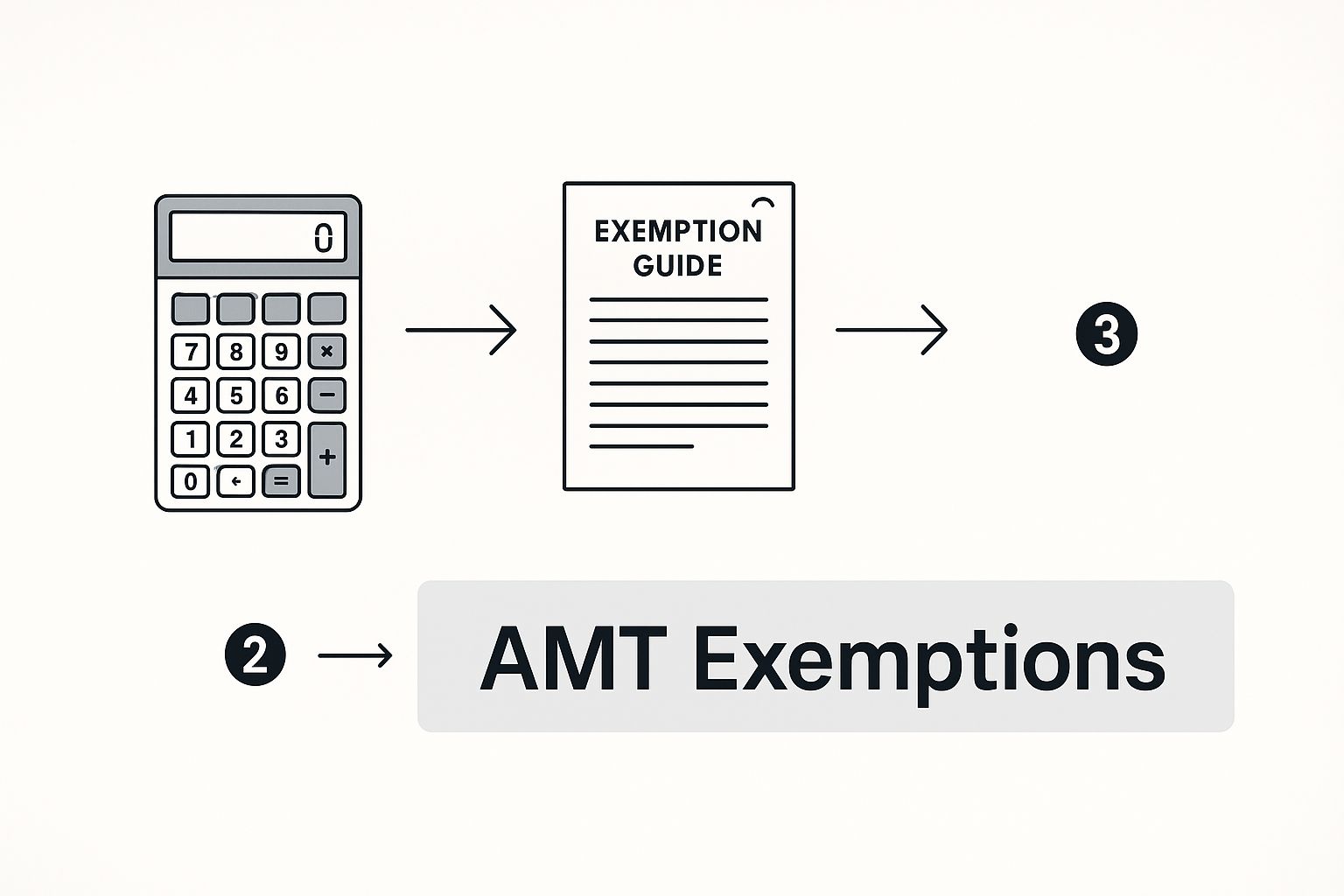
As you can see, after adjusting your income, the next key move is to subtract the AMT exemption to find your final taxable base.
Step 3: Subtract the AMT Exemption
Once you’ve added back all the necessary items, you arrive at a new income subtotal. Now for some good news: you get to subtract the AMT exemption. This is a generous deduction designed to shield a chunk of your income from this tax. The exact amount depends on your filing status and is adjusted for inflation each year.
Crucial Point: The AMT exemption isn’t guaranteed. It starts to phase out once your income hits a certain threshold. For every $4 your income is over this threshold, your exemption is reduced by $1. This phase-out can quickly expose more of your income to the AMT, particularly for higher earners.
After you subtract your eligible AMT exemption, you’re left with your Alternative Minimum Taxable Income (AMTI). This is the number that the AMT rates will be applied to. If you’re curious how your own numbers might look, using an AMT tax calculator can help clarify if you might owe alternative minimum tax by running through these very steps.
Step 4: Apply the AMT Rates and Compare
We’re in the home stretch. The final step is to calculate your “tentative minimum tax.” Unlike the seven-bracket regular tax system, the AMT keeps things simple with just two tax rates:
- A 26% rate is applied to your AMTI up to a certain level (this threshold is adjusted annually).
- A 28% rate is applied to any AMTI above that threshold.
The result is your tentative minimum tax. You then place this number side-by-side with your regular tax liability from your Form 1040. The law says you have to pay whichever one is higher. If your tentative minimum tax is the bigger number, the difference between the two is the Alternative Minimum Tax you owe.
How AMT Adjustments and Preferences Work
To really get a handle on the Alternative Minimum Tax, you have to look at what makes it so different from the regular tax system you’re used to. The whole engine behind the AMT is driven by two things: adjustments and preference items.
These are basically just tax benefits you get to enjoy on your regular return that the AMT system snatches back. When you calculate your potential AMT, you have to “add back” these specific items to your income.
Think of it like this: the regular tax code and the AMT code are two different rulebooks for defining your income. The AMT rulebook is much stricter and doesn’t allow for certain popular deductions. By forcing you to add them back, it makes your taxable income look a lot bigger, ensuring everyone pays at least a certain floor amount of tax.
The Most Common AMT Triggers to Watch Out For
The official list of adjustments on IRS Form 6251 is pretty long, but in my experience, a few usual suspects are responsible for pushing most people into AMT territory. If you can spot these on your own return, you’ll know if you’re at risk.
Here are the big three you absolutely must add back to your income when doing the AMT math:
- The Standard Deduction: This one is straightforward but has a huge impact. If you take the standard deduction on your Form 1040, you get zero deduction for it under the AMT rules. You have to add the entire amount back, which can instantly inflate your income base.
- State and Local Tax (SALT) Deductions: This is probably the single most common reason people get hit with the AMT. That deduction for state and local income, sales, and property taxes—currently capped at $10,000 for regular tax purposes—is completely wiped out for the AMT. You have to add back every single dollar you deducted.
- Incentive Stock Options (ISOs): For anyone with employee stock options, this is a classic AMT trap. When you exercise your options, the “bargain element” (the gap between the stock’s market value and your lower purchase price) is counted as income for the AMT that year. This is true even if you haven’t sold a single share.
Let’s look at a quick example: Say you live in a high-tax state and take the full $10,000 SALT deduction. In the same year, you exercise ISOs with a $50,000 bargain element. For AMT purposes, you’ve just added $60,000 back to your income. An adjustment like that can easily push your tentative minimum tax bill higher than your regular one.
The AMT Exemption: A Built-In Shield
Okay, so after adding back all those deductions, you’re left with a much higher income figure. It sounds scary, but thankfully, the tax code throws you a lifeline: the AMT exemption. This is a very large, built-in deduction meant to protect a big chunk of that recalculated income from the tax.
This shield isn’t for everyone, though. It’s really designed to help middle-income taxpayers avoid the AMT, not high earners. Once your income climbs past a certain point, that exemption starts to shrink.
Here are the exemption amounts and the income thresholds where they begin to phase out for 2024:
| Filing Status | 2024 AMT Exemption | Phase-out Starts at |
|---|---|---|
| Single | $85,700 | $609,350 |
| Married Filing Jointly | $133,300 | $1,218,700 |
| Married Filing Separately | $66,650 | $609,350 |
The phase-out rule is aggressive: for every $4 your income is over the threshold, your exemption gets cut by $1. This can wipe out the exemption pretty quickly for high-income folks, making it far more likely they’ll owe the AMT. It’s the system’s way of keeping the tax focused on those with higher earnings, just as it was originally intended.
Smart Strategies To Minimize Your AMT Bill

Knowing what the Alternative Minimum Tax is and how it’s calculated is the first step. The real magic, though, happens when you start planning ahead to manage it. The goal is to make smart, proactive decisions throughout the year about when you earn income and when you take deductions. Doing this can often reduce—or even completely wipe out—your AMT liability.
This isn’t about finding sketchy loopholes. It’s about recognizing that the regular tax system and the AMT operate under two different sets of rules. By understanding those differences, you can legally time your financial moves to your advantage, smoothing out your income and keeping you out of the AMT’s grasp.
Time Your Income And Deductions Carefully
One of the most powerful strategies is simply controlling the timing of your income and deductions. The AMT famously disallows certain big deductions, with state and local taxes (SALT) being the most common culprit. This makes timing those payments incredibly important.
For instance, imagine you’re on track to get hit by the AMT this year. In that case, it could be smart to delay paying your fourth-quarter estimated state income taxes until January. Since the SALT deduction gives you zero benefit under the AMT anyway, you lose nothing by waiting. If you expect to be back in the regular tax system next year, pushing that payment allows you to claim a deduction when it will actually count.
On the flip side, if you’re facing the AMT this year but probably not next, you might consider pulling some income into the current year. Your income will be taxed at the flat 26% or 28% AMT rates, which could easily be lower than the top-tier regular tax rates you might pay in a future, higher-income year.
Master Your Incentive Stock Options
Incentive Stock Options (ISOs) are a fantastic perk for building wealth, but they are also a notorious AMT landmine. The moment you exercise your options, the “bargain element”—the spread between the stock’s fair market value and your discounted purchase price—is counted as income for AMT purposes. This can create a huge, “phantom” income spike that triggers the AMT, even if you haven’t sold a single share.
When it comes to ISOs, strategic timing is everything.
- Exercise and Hold: This is the classic AMT trap. You exercise your options and hold the stock past December 31. The bargain element gets added to your income for AMT calculations, potentially resulting in a massive tax bill on money you haven’t technically received.
- Exercise and Sell (Disqualifying Disposition): If you sell the shares in the same year you exercise them, it’s called a “disqualifying disposition.” You’ll lose the special long-term capital gains treatment, but the income is recognized for both regular tax and AMT at the same time. This closes the gap between the two systems and can prevent you from owing any AMT.
- Spread Exercises Over Several Years: Don’t exercise a huge block of options all at once. By spreading them out over a few years, you can keep the annual bargain element small enough to stay under the AMT exemption threshold, avoiding the tax completely.
Key Takeaway: The game with ISOs is to prevent a massive gap from opening up between your regular taxable income and your Alternative Minimum Taxable Income (AMTI). A disqualifying disposition or spreading out your exercises keeps these two numbers much closer, neutralizing the AMT threat.
Claim The Minimum Tax Credit
If you do get hit with an AMT bill, don’t despair—the story isn’t over. The IRS offers a valuable lifeline called the Minimum Tax Credit. This credit allows you to gradually reclaim the AMT you paid in prior years. It’s specifically designed to correct for “timing differences,” where the AMT made you pay tax on income sooner than the regular system would have, like with ISOs.
You can carry this credit forward indefinitely and use it in future years whenever your regular tax bill is higher than your tentative minimum tax. You’ll use Form 8801, Credit for Prior Year Minimum Tax, to figure out how much you can claim. Think of it as an interest-free loan you gave the government, which you get to collect back over time.
This credit is just one of many tools at your disposal. To learn more about lowering your overall tax burden, you may want to read our guide on how to reduce your tax bill with top deductions and credits you might be missing. Smart tax planning is all about knowing which levers to pull and when.
Got More Questions About the AMT? We’ve Got Answers.
Even after you get the hang of the basics, the Alternative Minimum Tax has a way of throwing curveballs. It’s natural for specific scenarios to pop into your head. Let’s tackle some of the most common questions that come up once people start digging into the details.
I Paid the AMT Last Year. Can I Get That Money Back?
This is probably one of the most frequent—and smartest—questions people ask. The short answer is yes, you often can, but not as a simple refund. Instead, the tax code gives you a way to recover it over time through the Minimum Tax Credit.
Think of it like this: The AMT sometimes forces you to pay tax on certain income sooner than the regular tax system would. The Minimum Tax Credit is the government’s way of saying, “Okay, you prepaid some tax, so we’ll let you apply that prepayment to your bill in a future year.”
This credit is specifically for “timing differences,” like the big one with Incentive Stock Options (ISOs), where the AMT sees income years before your regular tax return does. You can claim this credit using Form 8801, Credit for Prior Year Minimum Tax. It allows you to reduce your regular tax liability in future years, but only when your regular tax is higher than your AMT. It’s a crucial tool for making sure you aren’t permanently overtaxed.
Do Huge Capital Gains Automatically Mean I’ll Owe AMT?
Not directly, but a massive capital gain can absolutely push you over the edge. It’s a bit of a paradox. The tax rates for long-term capital gains and qualified dividends are actually the same under both the regular tax and AMT systems. So, the gain itself isn’t the problem.
The real issue is that a large capital gain inflates your overall income, your Alternative Minimum Taxable Income (AMTI). As your AMTI skyrockets, it blows past the threshold where the AMT exemption starts to phase out.
Losing that AMT exemption is the critical tipping point. The exemption is designed to shield a big chunk of your income from the AMT. When that shield shrinks or vanishes, way more of your income is suddenly exposed to the flat 26% and 28% AMT rates. That’s when your tentative minimum tax is very likely to jump above your regular tax bill.
So, it’s not the gain itself but the high income it creates that sets the AMT trap.
Is the Alternative Minimum Tax Here to Stay?
It sure seems like it. The AMT has been a fixture in the U.S. tax code since it was first introduced back in 1969. While Congress constantly tinkers with the exemption amounts and income thresholds, the core idea of this parallel tax system has proven incredibly durable. People have been talking about repealing it for decades, but it’s still with us.
The biggest recent shake-up came from the Tax Cuts and Jobs Act (TCJA) of 2017, which significantly raised the AMT exemption amounts. This one change pulled millions of taxpayers out of the AMT’s clutches.
But here’s the catch: those higher exemptions are temporary and set to expire after 2025. If Congress doesn’t act, the exemptions will snap back to their much lower, pre-TCJA levels. That would throw millions of middle and upper-middle-income families right back into the AMT, just like in the old days.
Are We the Only Country with a Tax Like This?
The U.S. version is famous (or infamous), but the concept of a minimum tax is definitely not unique. You can find similar systems around the world, though they are most often aimed at corporations, not individuals.
For example, India has its own ‘Alternative Minimum Tax’ that applies a flat 15% rate to the adjusted book profits of corporations to ensure they pay a baseline of tax. The idea recently gained even more global momentum with the introduction of a “Global Minimum Tax” targeting huge multinational companies. If you’re curious, you can learn more about how different countries handle this at the Inter-American Center of Tax Administrations. It just goes to show that ensuring a basic level of tax fairness is a challenge for governments everywhere.
What’s the Difference Between the Individual AMT and the Corporate AMT?
They share a name and a general purpose—to act as a tax backstop—but they are completely different animals.
- Individual AMT: This is the one we’ve been talking about, calculated on Form 6251. It’s for individuals, trusts, and estates. Its job is to make sure high-income people with lots of deductions still pay a fair share.
- Corporate AMT (CAMT): This was brought back to life by the Inflation Reduction Act of 2022. It’s a 15% minimum tax slapped on the financial statement profits (“book income”) of America’s largest corporations—we’re talking those with average annual profits over $1 billion. The goal is to stop giant companies from reporting massive profits to Wall Street while paying little or no income tax.
The rules, the math, and who they apply to are entirely separate. If you’re an individual or own a small business like an S Corp or LLC, you only need to worry about the individual AMT.
Navigating the fine points of what is alternative minimum tax and building a smart plan around it can feel overwhelming. Whether it’s timing your deductions just right or managing your stock options, the right moves can have a huge impact on your bottom line. At Allied Tax Advisors, our team of CPAs and enrolled agents specializes in creating personalized tax strategies to guide you through these challenges and improve your financial health.
Discover how our expert tax services can help you achieve peace of mind and long-term success.