
The Earned Income Credit (EITC) is one of the most powerful tools in the U.S. tax code for working people with low-to-moderate incomes. It’s not just another line item on your tax form; think of it as a financial boost that rewards your hard work. It can slash the taxes you owe and, in many cases, lead to a substantial tax refund, putting much-needed money back in your pocket.
What Is the Earned Income Credit, Really?

It’s crucial to understand that the EITC is a refundable tax credit, which sets it apart from a simple tax deduction. A deduction just lowers the amount of your income that gets taxed, but a credit reduces your actual tax bill, dollar-for-dollar.
The magic word here is "refundable." This means that if your EITC is more than the tax you owe, the IRS doesn't just keep the difference—they send it to you as a refund. You can get a check back even if you owe zero in taxes. This feature is what makes the EITC a vital financial support for millions.
The core purpose of the EITC is to supplement wages and serve as a powerful anti-poverty tool. It's designed to encourage work by giving a meaningful financial leg-up to those who need it most.
Simply put, this credit helps close the gap between what people earn and what it costs to live. It provides critical relief for hardworking American families and individuals every single year.
To get a quick overview of what the EITC is all about, here’s a simple breakdown.
EITC At a Glance
This table summarizes the core components of the Earned Income Tax Credit.
| Feature | Description |
|---|---|
| Credit Type | Refundable tax credit |
| Primary Goal | To supplement wages and reduce poverty for working individuals and families. |
| How It Works | Directly reduces your tax liability. If the credit is larger than your tax, you get the difference back as a refund. |
| Main Beneficiaries | Low-to-moderate income workers, especially those with qualifying children. |
Understanding these basics is the first step toward claiming this valuable credit.
A Brief History and Its Impact
The EITC isn’t a new idea; it’s been a cornerstone of social policy for decades. First introduced in 1975, it was designed to offset the bite of Social Security taxes and give people an incentive to work rather than rely on welfare.
Since then, it has become one of the most effective anti-poverty programs in the country. Just look at the numbers: for the 2022 tax year, about 23 million taxpayers claimed the EITC, receiving a staggering $57 billion in credits. This shows just how essential it is for the financial health of working families nationwide. To learn more about its journey over the last five decades, you can read more about the 50th anniversary of the EITC.
Who the EITC Is Designed For
At its heart, the EITC targets a specific group of taxpayers. While the fine print can get a little tricky, the credit is generally aimed at:
- Working Families with Children: The most generous credits are reserved for households with qualifying children, as the program is heavily focused on supporting their upbringing and well-being.
- Low-to-Moderate Income Workers: There are strict income caps you must meet to qualify. This ensures the benefit is directed to those within specific earning thresholds.
- Individuals Without Qualifying Children: A smaller, but still helpful, credit is also available for eligible workers who don't have children, acknowledging their contributions as well.
Getting a clear grasp on the EITC is your first step toward claiming a benefit you may have rightfully earned through your hard work.
Do I Qualify for the Earned Income Credit?

Trying to figure out if you qualify for the Earned Income Credit can feel like a maze. The IRS has a list of rules you have to meet, but they’re not as intimidating as they seem. Let's break them down one by one.
At its core, this credit is for people who work. The most basic rule is that you must have earned income. This is simply money you make from a job, whether you're working for a company or for yourself. It covers your salary, wages, tips, and any net profit from your own business or farm. Things like interest from a savings account, stock dividends, or unemployment checks don't count as earned income.
Core Eligibility Rules You Must Meet
Before you even think about income limits or kids, there's a foundational checklist everyone has to pass. Think of these as the absolute must-haves. If you don't meet these basic requirements, the other details won't matter.
You must meet all of the following:
- Have a valid Social Security Number: This isn't just for you. Your spouse (if you're filing together) and any children you claim for the credit need one too.
- Be a U.S. citizen or a resident alien all year: There are specific, complex rules for non-resident aliens, but they generally aren't eligible for the EITC.
- Do not file Form 2555 (Foreign Earned Income): If you're excluding income earned abroad, you can't also claim this credit.
- Have limited investment income: For the 2023 tax year, your income from investments needs to be $11,000 or less.
Your tax filing status is another big piece of the puzzle. You absolutely cannot claim the EITC if you use the married filing separately status. Your options are single, head of household, qualifying surviving spouse, or married filing jointly.
Here's a common stumbling block: You cannot be a qualifying child on someone else's tax return. If your parents can claim you as a dependent, you're out of luck for the EITC, even if you have a job and meet the income rules.
Income and Family Size Requirements
Once you've cleared the basics, the next hurdle involves your income and the size of your family. The EITC is specifically designed to help low-to-moderate-income workers, so your earnings have to fall within certain brackets. These income limits adjust based on whether you're single or married and how many qualifying children you have.
The magic number the IRS looks at is your Adjusted Gross Income (AGI). If you need a refresher on the specifics, you can learn more about what is Adjusted Gross Income in our guide. The bottom line is that both your earned income and your AGI must be below the official threshold for your situation.
Here’s a quick breakdown of the income limits for the 2023 tax year (for the return you file in 2024):
| Number of Qualifying Children | Income Must Be Less Than (Single, Head of Household, or Widowed) | Income Must Be Less Than (Married Filing Jointly) |
|---|---|---|
| 0 | $17,640 | $24,210 |
| 1 | $46,560 | $53,120 |
| 2 | $52,918 | $59,478 |
| 3 or more | $56,838 | $63,398 |
Of course, figuring out who counts as a qualifying child has its own set of very specific tests—relationship, age, residency, and more. We’ll dive into those details later so you can be completely sure about where you stand.
How Is the Earned Income Credit Calculated?
The Earned Income Tax Credit isn't a one-size-fits-all number. Think of it less like a fixed coupon and more like a personalized benefit that adjusts based on your unique financial situation. The three main ingredients that determine your final credit amount are your earned income, your filing status, and how many qualifying children you have.
I like to explain the calculation using a roller coaster analogy. As your income starts to climb from zero, your credit amount actually goes up with it—this is the phase-in period, or the climb up the first big hill. Your credit grows and grows until your earnings hit a certain sweet spot, which is where you receive the maximum possible credit for your family size.
Once you hit that peak, the credit stays at its maximum for a short while as your income increases a bit more. But after that, the ride begins its descent. As your income continues to rise, the credit amount slowly shrinks. This is the phase-out. Eventually, if your income passes the upper limit for your filing status and family size, the credit disappears completely.
The Key Factors in Your Calculation
At its core, your final EITC amount comes down to how your earnings and family structure interact. While the IRS has detailed lookup tables to find the precise figure, the logic behind it is pretty straightforward.
The connection between your income, your kids, and your credit is the fundamental principle here. This infographic does a great job of showing how all the pieces fit together.
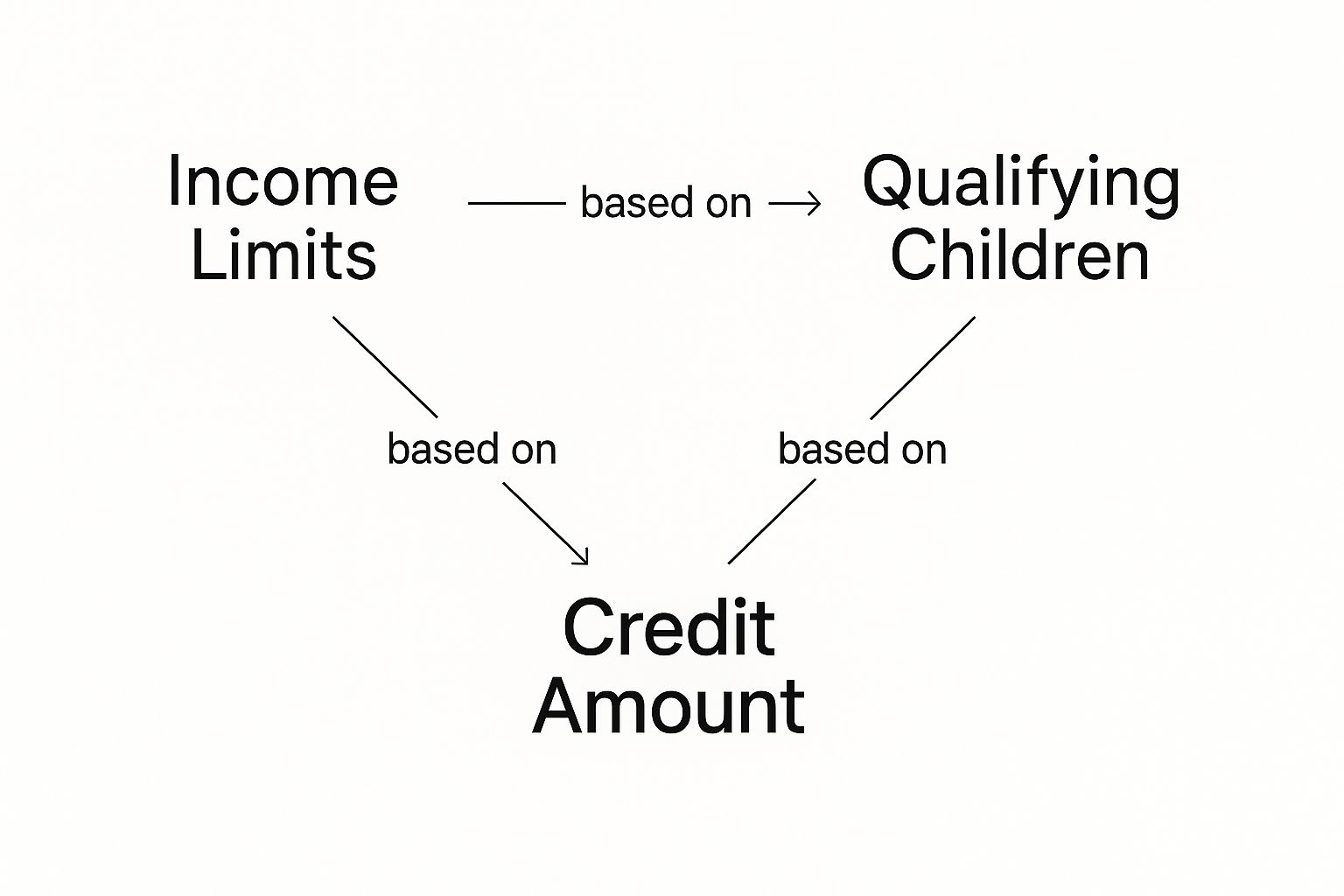
As you can see, both your income level and the number of children you claim directly feed into the calculation. A change in either one can make a huge difference in your tax refund.
To give you a clearer picture of how much the credit can vary, here's a look at the maximum amounts available for the 2023 tax year (which you file in 2024).
EITC Maximum Credit Amounts by Number of Children
| Number of Qualifying Children | Maximum Credit Amount |
|---|---|
| 0 | $600 |
| 1 | $3,995 |
| 2 | $6,604 |
| 3 or more | $7,430 |
As the table shows, the benefit scales significantly to provide more support to working families with more children.
Seeing the EITC in Action
Let's walk through a couple of real-world examples using figures from the 2023 tax year to see how this plays out.
-
Example 1: A Single Filer with No Children
Imagine a single person with an annual earned income of $12,000. They fall squarely within the income range for someone with no kids. For them, the EITC would be around $458—not a life-changing sum, but certainly a helpful financial boost. -
Example 2: A Married Couple with Two Children
Now, picture a married couple filing a joint return. They have two children and a combined household income of $28,000. Their income puts them right in that plateau phase, meaning they qualify for the maximum credit of $6,604. This shows just how impactful the EITC can be for families.
This structure is designed to deliver the most substantial help to lower- and middle-income families who are in the workforce.
The Easy Way to Check: The EITC Assistant
You don’t have to pull out a calculator and wrestle with those complex tax tables on your own. Thankfully, the IRS offers a fantastic free tool called the EITC Assistant.
This interactive guide walks you step-by-step through a series of simple questions about your family, income, and filing status.
Using the tool is by far the easiest and most reliable way to get a solid estimate of whether you qualify and how much your credit might be. It’s the perfect first step to take before filing your taxes, giving you a clear idea of what to expect from this powerful credit.
A Simple Guide to Claiming Your EITC

Realizing you qualify for the Earned Income Tax Credit is one thing, but actually claiming it correctly on your tax return is where the rubber meets the road. Let's walk through a clear action plan, breaking down the process so you can get the credit you've earned without the usual tax season stress.
The secret to a smooth filing experience is simple: get organized first. Before you even think about tax forms or software, take the time to gather all your crucial documents. A little prep work upfront saves you from that frantic last-minute search and helps you avoid costly mistakes.
Gathering Your Essential Paperwork
Think of this part like getting all your ingredients ready before you start cooking. When everything is laid out, the actual process becomes much faster and far more accurate.
- Proof of Identity: You’ll need the Social Security cards for yourself, your spouse if you're filing together, and every child you're claiming for the EITC. Make sure they're the actual cards or official documents, not just photocopies.
- Income Statements: This means tracking down every W-2 form from your jobs and any 1099 forms if you earned money as a freelancer or independent contractor.
- Other Financial Records: Pull together any other documents showing income you received, like from a small business or investments. This helps confirm you fall within the EITC income limits.
With all your paperwork in hand, you're ready to tackle the filing process with confidence.
Filing Your Return and Claiming the Credit
When it’s time to file, you’ve got a few different paths you can take.
Most people today use tax software, which makes things incredibly straightforward. These programs are designed to ask you simple, direct questions to see if you qualify for the EITC. If you do, the software automatically fills out the required forms for you.
Of course, you can also hire a tax professional. An experienced advisor can manage the entire filing process, ensuring everything is accurate while also looking for other opportunities to increase your refund. For more ideas, you can check out our guide on how to maximize your tax refund.
A critical piece of the puzzle is a form called Schedule EIC. If you have a qualifying child, you absolutely must attach this form to your tax return. It's where you list each child's name, Social Security number, and relationship to you.
Don't forget about free tax help! Programs like the Volunteer Income Tax Assistance (VITA) provide free basic tax prep for people who qualify. This is generally for those who make $64,000 or less, have disabilities, or speak limited English. The volunteers are certified by the IRS and know exactly how to handle EITC claims.
No matter which route you choose, the most important thing is to file accurately. Double-check—and then triple-check—all Social Security numbers and income amounts. An accurate return is your best defense against frustrating delays or a notice from the IRS.
The Broader Impact of the Earned Income Credit
The Earned Income Credit does a lot more than just chip away at your tax bill or hand you a refund. Think of it as a stone tossed into a pond—the ripples of positive change spread far beyond a single family's bank account. It’s one of the most powerful anti-poverty tools we have, giving millions of working families and individuals a much-needed financial boost.
When that EITC refund hits, it often goes straight to work covering essential, everyday needs. For some, it’s the money to finally catch up on rent. For others, it means paying for a long-overdue car repair or just buying groceries without having to anxiously check the balance. It's a critical lifeline that creates breathing room in a tight budget, helping families build a more stable foundation.
Fueling Local Economies and Communities
But the impact doesn't stop at the front door. When people spend their EITC refunds, they’re spending it locally—at the neighborhood grocery store, the corner auto shop, and Main Street retailers. This spending directly fuels the community, supporting local jobs and helping small businesses thrive.
You can think of the EITC as a yearly economic stimulus, perfectly aimed at the communities that need it most. By putting money directly into the hands of people who will spend it immediately, the credit creates a powerful cycle of local economic activity.
This isn't a one-off event. It's a predictable, annual lift for regional economies all across the country. It’s a perfect example of how supporting individual families builds stronger, more resilient communities for everyone.
A Powerful Investment in the Future
The EITC isn’t just about short-term relief, either. Study after study has shown that its benefits have a lasting impact, especially for children. When families receive the credit, we see significant improvements in a few key areas:
- Improved Health: Research connects the EITC to better health for both mothers and babies. With a little extra money, families can afford more nutritious food and better prenatal care.
- Enhanced Education: Kids in families receiving the EITC tend to do better in school, earn higher test scores, and are more likely to head off to college.
- Greater Earnings: All those positive educational outcomes pay off down the road, often leading to higher lifetime earnings for these children when they grow up and join the workforce.
The sheer scale of this program highlights its importance. Total EITC payouts grew from over $42 billion in 2000 to nearly $65 billion by 2013 (adjusted for inflation), showing a real commitment to supporting low-income workers. And with a participation rate of around 79%, it's clear the credit is reaching the people it was designed to help. Learn more about the EITC’s role in community economic stability.
Ultimately, the EITC is far more than just a tax break—it’s a powerful investment in our nation’s future.
Avoiding Common EITC Mistakes and IRS Audits
The Earned Income Credit is one of the most powerful tax breaks available, but its detailed rules also make it a hotspot for honest mistakes. Because errors are so frequent, returns claiming the EITC often get extra scrutiny from the IRS. The best way to file with confidence is to know where the common tripwires are hidden.
By far, one of the biggest pitfalls involves correctly identifying a qualifying child. The IRS has very specific tests for relationship, age, residency, and joint returns, and you have to meet every single one. For example, that nephew you generously support might feel like your dependent, but if he didn't live with you for more than half the year, he won't qualify you for the EITC.
Another common mistake is filing status. This one is simple but absolute: you cannot claim the EITC if your filing status is married filing separately. There are no exceptions to this rule.
Navigating Tie-Breaker Rules
So, what happens when more than one person could claim the same child, like in the case of divorced or separated parents? The IRS doesn't leave it up for debate; they have a clear set of "tie-breaker" rules to determine who gets to claim the credit.
Here’s how it works:
- If only one of the adults is the child's parent, the parent gets to claim the child.
- If both adults are the child's parents, the claim goes to the parent the child lived with the longest during the tax year.
- If the child lived with each parent for the exact same amount of time, the parent with the higher adjusted gross income (AGI) wins the tie-breaker.
Knowing these rules ahead of time can prevent frustrating disputes with a co-parent and keep you out of the IRS's line of sight.
The consequences of getting an EITC claim wrong can be pretty steep. Not only would you have to repay the credit, usually with interest, but you could also face accuracy penalties or even be banned from claiming the EITC for anywhere from two to ten years.
Your best defense against an audit is simply getting it right the first time. Meticulously double-check every Social Security number, every income figure, and every detail on your return. If you want to make sure you're getting every penny you deserve, you can learn more about top deductions and credits you might be missing on our blog. A little extra time and care upfront protects your refund and provides invaluable peace of mind.
Common EITC Questions, Answered
Once you get past the basics of the Earned Income Credit, the real-world questions start to pop up. Let's walk through some of the most common situations people find themselves in and clear up the confusion.
Practical EITC Scenarios
Here are a few frequent questions we hear from taxpayers trying to figure out if the EITC applies to them.
Can I Claim the EITC If I Am Self-Employed?
Yes, you certainly can. If you work for yourself—as a freelancer, gig worker, or small business owner—your net earnings count as "earned income" for the EITC.
Just make sure you report your income correctly on Schedule C and pay your self-employment taxes. The key here is net earnings. This is the profit you have left after you’ve subtracted all your legitimate business expenses. If your business has a loss for the year, your earned income from that source is considered zero.
Should I File Taxes If My Income Is Too Low?
Absolutely. This is one of the most important things to understand about the EITC. Because it's a refundable credit, you can get money back even if you don’t owe a single dollar in income tax.
Many people who fall below the standard income threshold for filing simply don't file a return. But if you're eligible for the EITC, you must file a tax return to get it. Failing to file is like leaving a check on the table—money that could be worth thousands of dollars to you and your family.
The best part? The money you get from the EITC is not considered taxable income. It also won't count against you for federal benefits like SNAP, Medicaid, or public housing, so it's a pure financial boost.
Can Students Claim the Earned Income Credit?
It’s possible, but it can be tricky. Being a student doesn't disqualify you on its own, but you still have to meet all the other EITC requirements, like the income limits.
The biggest hurdle for students is the "qualifying child" rule. You can't claim the EITC if you yourself are considered a qualifying child for someone else (like your parents). This is often the case for full-time students under the age of 24, which makes them ineligible to claim the credit on their own return.
The credit’s impact is massive. Back in 2018, the EITC pulled about 5.6 million people, including nearly 3 million children, out of poverty. Research shows that without this credit, the number of children living in poverty would have been over 25% higher. You can dig into more of this powerful data from the Center on Budget and Policy Priorities.
Figuring out the EITC and other tax credits can feel overwhelming. The team at Allied Tax Advisors offers personalized, expert guidance to make sure you get every credit and deduction you’re entitled to. We're here to help you maximize your refund and gain financial peace of mind. Visit us at https://alliedtax.com to learn more.