
When you're dealing with Form 1099-DIV, timing is everything. For businesses paying out dividends and for the investors receiving them, a few key dates on the calendar are non-negotiable.
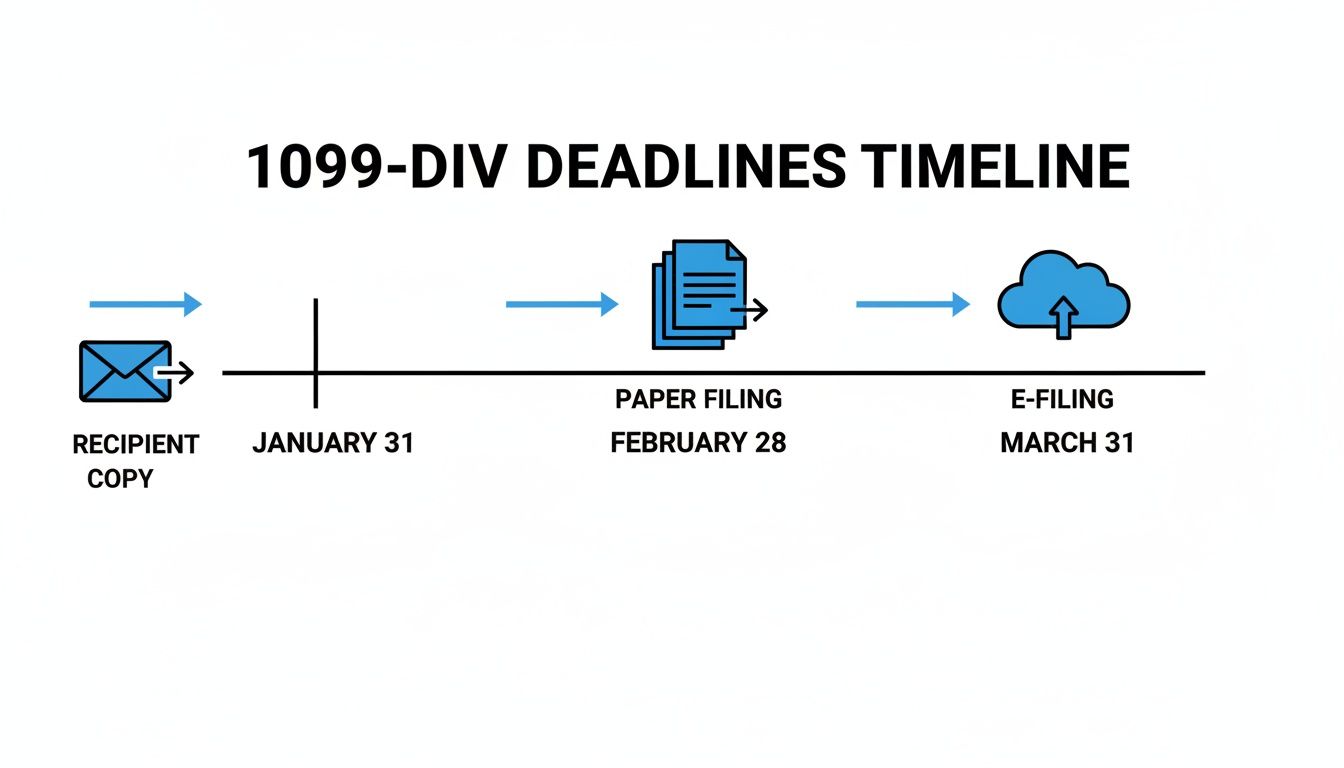
The most important deadline to circle is January 31. This is the absolute latest that payers can send out the 1099-DIV forms to the recipients—the investors who earned the dividends. Getting this form out on time is crucial because it gives people the information they need to file their own taxes accurately.
After that first deadline is met, the payer’s next job is to report the same information to the IRS. This is where things split into two different paths, depending on how you file.
Understanding the Key 1099-DIV Deadlines
Think of the 1099-DIV deadlines as a three-step process. First, you inform the individual. Then, you inform the government. The method you choose for that second step determines your final deadline.
If you’re filing paper forms with the IRS, you need to have them postmarked by February 28. This old-school method requires a bit more lead time.
However, the IRS strongly encourages electronic filing by offering a later deadline. If you e-file, you have until March 31 to submit your forms. This extra month is a clear incentive to go digital, which helps the IRS process returns much more efficiently.
This timeline gives a great visual breakdown of the key dates.
These dates are specific to the 1099-DIV, but many other information returns follow a similar pattern. You can see how these compare by reading our guide on when 1099s are due.
To break it down simply, here’s a quick overview of the deadlines you can't afford to miss.
1099-DIV Deadlines at a Glance
This table summarizes the essential deadlines for furnishing Form 1099-DIV to recipients and filing it with the IRS, highlighting the different dates for paper and electronic submissions.
| Filing Task | Deadline |
|---|---|
| Furnish Recipient Copies (Copy B) | January 31 |
| File with IRS (Paper) | February 28 |
| File with IRS (Electronically) | March 31 |
Remember, these dates are firm. Missing the January 31 deadline to get forms to recipients can cause immediate problems, and there’s no extension for it. While there are ways to get an extension for filing with the IRS (which we'll discuss later), it’s always best to hit these original targets to avoid penalties and keep the process smooth.
Why Are There Two Different Deadlines for the Same Form?
At first glance, it seems a little odd that Form 1099-DIV has two separate due dates. Wouldn't one deadline for everything be simpler? The answer is that this split timeline is completely intentional. The IRS designed it this way to create a smooth, logical workflow for the entire U.S. tax system.
Think of it like a relay race. The company paying you dividends has to pass the baton (your 1099-DIV) to you first. Only after you have it can you run your leg of the race, which is filing your personal tax return.
The first deadline—getting the form to you, the recipient, by January 31—is all about empowering the individual. The IRS mandates this early handoff so that millions of investors have the dividend information they need well before the April tax deadline. If you didn't get this form first, you'd be left guessing how much income to report, which would cause a cascade of errors and amended returns down the line.
The Logic Behind Staggered Deadlines
Once you and millions of other taxpayers have your forms, the system's focus shifts to verification. The later deadline for companies to file these same forms with the IRS gives the agency the master dataset it needs to cross-reference the income you report on your return. This two-step process is a fundamental check and balance that keeps the system honest.
For the 2024 tax year, for example, the deadline to mail your 1099-DIV was January 31, 2025. But the company's deadline to file with the IRS is different depending on how they file. If they're mailing in paper forms, their deadline is February 28. If they file electronically, they have until March 31. You can dig deeper into these timelines by reviewing some helpful insights on when 1099s are due.
This tiered system accomplishes two key things:
- It puts you, the taxpayer, first. Getting the information into your hands is the top priority for a smooth tax season.
- It pushes businesses toward efficiency. That later March 31 e-filing deadline is a powerful nudge for companies to ditch slow, error-prone paper filing.
Why E-Filers Get More Time
The IRS isn’t just being nice by giving electronic filers an extra month. It’s a strategic move. When businesses file electronically, the IRS can process the information infinitely faster and more accurately. It virtually eliminates manual data entry errors, slashes administrative costs, and lets the agency verify income almost instantly.
By offering a later 1099-DIV due date for e-filing, the IRS creates a powerful incentive that benefits the entire tax ecosystem. It encourages payers to adopt modern, efficient processes, which in turn helps the IRS manage its immense workload more effectively.
Ultimately, the staggered deadlines create a perfectly logical domino effect. The company reports to you, you report to the IRS, and the IRS uses the company's filing to confirm what you reported. This systematic flow is why meeting both the recipient and the IRS 1099-DIV due date isn't just a suggestion—it’s essential for keeping the whole tax system running.
The Real Cost of Missing a 1099-DIV Deadline
Let's be clear: missing a 1099-DIV due date isn't a simple paperwork hiccup. It's a costly mistake, and the IRS has a very specific set of financial penalties to make sure you feel the sting. Think of it less like a forgotten email and more like a credit card bill—the longer you let it slide, the more expensive it gets.
These deadlines aren't arbitrary. They're the backbone of the tax reporting system. When a payer is late, it throws a wrench in the works for the investor, who needs that 1099-DIV to file their own taxes accurately and on time. The IRS enforces these rules strictly to prevent a cascade of delays and errors.
The Escalating Penalty Structure
The IRS penalty system is tiered, and it’s designed to get your attention. The fines are calculated per form, and they climb sharply the longer you wait.
If you file within 30 days of the deadline, the penalty is $60 per form. If you file more than 30 days late but before August 1st, that jumps to $130 per form. Wait until after August 1st, or don't file at all, and you’re looking at $340 per form. These amounts aren't static; they've been increased over the years, a clear signal from the IRS about how seriously they take compliance. For more background on these penalty amounts, you can find helpful insights on the history of 1099-DIV penalties at boomtax.com.
For a company issuing hundreds or thousands of 1099-DIVs, you can see how quickly this adds up. A small delay can easily turn into a five-figure problem. It’s a powerful motivator to get things right the first time.
The Highest Price: Intentional Disregard
Beyond accidental lateness, there’s a much more serious offense: intentional disregard. This isn’t for businesses that made an honest mistake or got overwhelmed. This is for payers who knowingly and willfully choose not to file.
How does the IRS prove intent? They look at the pattern of behavior. A history of non-compliance, ignoring repeated notices, or actively trying to hide the payments can all be used as evidence. The consequences here are in a totally different league.
If the IRS finds you guilty of intentional disregard, the penalty skyrockets to $680 per form—with absolutely no maximum cap. This is the financial equivalent of a five-alarm fire, often triggering deeper audits and scrutiny. Knowing the full range of risks is crucial. If you're worried about where you stand, our guide on how to avoid costly IRS penalties for late tax filing is a great place to start.
What to Do About Filing Extensions and Corrections
Even the most organized businesses run into snags. Life happens, delays pop up, and sometimes mistakes are made on tax forms. The good news is that the IRS has clear procedures for handling both filing extensions and correcting errors on Form 1099-DIV.
Getting these situations right from the start can save you a world of headaches and potential penalties down the road.
Requesting a Filing Extension
If you see the IRS filing deadline approaching and know you won't make it, don't panic. You can request a 30-day extension by filing Form 8809, Application for Extension of Time to File Information Returns.
But there's a huge catch here, and it’s something people often miss.
This extension gives you more time to file your forms with the IRS. It does not change the deadline for getting the 1099-DIVs into the hands of your recipients. That January 31 date is set in stone.
It's also important to remember that an extension to file is never an extension to pay. For more details on this, you can find some helpful clarifications on tax filing extensions that break down the distinction.
Making Corrections the Right Way
So, what happens if you’ve already sent out and filed the 1099-DIV, only to spot an error? Maybe you put a number in the wrong box or listed an incorrect Taxpayer ID Number (TIN). You can't just ignore it—you have to file a corrected form.
The process is fairly straightforward. You’ll need to fill out a brand new Form 1099-DIV with all the correct information. The most important step is to check the “CORRECTED” box located at the very top of the form. This little checkmark tells the IRS to replace the original, incorrect form with this new one.
Mistakes happen, but some are more common than others. Here’s a quick look at the typical errors that require a corrected 1099-DIV.
Common Reasons for Filing a Corrected 1099-DIV
| Error Type | Description | Action Required |
|---|---|---|
| Incorrect Dollar Amount | One or more of the dividend boxes (e.g., Box 1a, Box 1b) has the wrong value. | Issue a new form with the accurate amounts in the correct boxes. |
| Incorrect Recipient Info | The recipient's name, address, or Taxpayer ID Number (TIN) is wrong. | File a corrected form to update the personal details. A TIN error is especially critical. |
| Wrong Form Filed | You sent a 1099-DIV but should have used another form, like a 1099-INT for interest. | Void the original 1099-DIV (by filing a corrected form with all zeros) and file the correct form type. |
| Incorrect Payer Info | Your business's name, address, or TIN was entered incorrectly on the form. | Submit a corrected form to ensure the IRS can properly associate the filing with your business. |
Once the corrected form is ready, you need to send it to both the recipient and the IRS, following the same process you used for the original. Taking care of corrections quickly shows the IRS you’re on top of your responsibilities.
Fixing old tax documents can sometimes get tricky, especially if the errors go back a few years. If you're curious about the general rules for fixing past tax issues, our guide on how far back you can amend taxes offers some great insights into the timelines.
A Practical Compliance Checklist for Payers and Recipients
When it comes to the 1099-DIV, a little preparation goes a long way for both the business sending the form and the investor receiving it. Hitting the deadlines and avoiding penalties is all about knowing your role. Let's break down the essential steps for each side to make tax season a whole lot smoother.

For Payers: Businesses and Brokers
As a business, getting ahead of the 1099-DIV season is the best way to avoid the last-minute scramble and the sting of penalties. A structured plan is your best friend.
- Get Recipient Data Right—Early. Don't wait until January to chase down paperwork. You should be collecting and verifying a Form W-9 for every single recipient well before year-end. Double-check that their name, address, and Taxpayer Identification Number (TIN) are perfect, as this is where most filing errors begin.
- Mark Your Calendar. Plug these dates into your calendar with big, bold reminders: January 31 is your deadline to get the forms to recipients. For the IRS, it’s February 28 if you're filing by paper, and March 31 if you're e-filing.
- Choose Your Filing Method. Decide early if you'll be paper filing or e-filing. Keep in mind, the IRS mandates e-filing if you have 10 or more information returns of any type combined, so for most businesses, e-filing is the default.
- Lock Down Your Data. You're handling sensitive financial information. When sending documents, security has to be a top priority. For instance, if your workflow involves older tech, it’s worth understanding the security of fax communication to know the risks.
For Recipients: Investors
Once that 1099-DIV lands in your mailbox or inbox, the ball is in your court. A few simple checks will ensure your tax return is accurate and keeps you off the IRS's radar.
The 1099-DIV is a cornerstone of dividend income reporting. The IRS sees millions of these forms every year, so they’ve gotten very good at spotting when the numbers don't add up.
The moment you receive your 1099-DIV, your first step should always be verification. Cross-reference the figures on the form with your own brokerage statements and records to catch any discrepancies immediately.
Here’s what you should be looking for:
- Review for Accuracy: Is your name spelled correctly? Is your address right? Most importantly, does the TIN match your Social Security Number? Then, look at the numbers. Do the amounts in Box 1a (Total Ordinary Dividends) and Box 1b (Qualified Dividends) line up with what your own records show?
- Understand Key Boxes: Get familiar with what each box represents. For example, Box 2a reports capital gain distributions, which are treated very differently for tax purposes than ordinary dividends. Knowing the difference is key to filing correctly.
- Follow Up if It’s Missing: If you know you should have received a 1099-DIV but it’s nowhere to be seen by mid-February, don't just wait. Reach out to the payer directly. You can't just ignore the income—the IRS already has a copy of that form and expects to see it on your return.
By following these simple guidelines, what often feels like a daunting compliance task becomes a manageable, routine part of the year for everyone involved.
Frequently Asked Questions
When you're dealing with Form 1099-DIV, a lot of specific "what if" scenarios can pop up. It's completely normal. Here are some straightforward answers to the questions we hear most often about the 1099-DIV due date and other common situations.
What Happens If a Deadline Falls on a Weekend or Holiday?
This is a great question and a common source of confusion. The IRS keeps it simple: if a filing deadline lands on a Saturday, Sunday, or a legal holiday, the due date automatically rolls over to the next business day.
So, if January 31 happens to be a Sunday, your deadline to get those forms to recipients shifts to Monday, February 1. This handy rule applies across the board, whether you're talking about the February 28 paper filing date or the March 31 e-filing deadline.
Do I Have to Issue a 1099-DIV for Small Dividend Amounts?
In most cases, you only have to send a Form 1099-DIV if you paid someone $10 or more in dividends for the year. If the total is less than that, you're usually off the hook.
But there’s a big exception to watch out for: backup withholding. If you had to withhold any federal income tax for any reason (like a missing or incorrect tax ID number), you absolutely must file a 1099-DIV to report it. This is true no matter how small the dividend payment was.
Can I Email 1099-DIV Forms to Recipients?
Yes, you can, but it’s not as simple as just attaching a PDF. You have to get the recipient’s explicit consent first. Think of it as an "opt-in" system, not an "opt-out." They must actively agree to receive their form electronically before you send it.
To do this by the book, you need to clearly explain how they can get a paper copy if they want one, what their consent covers, how long it lasts, and how they can revoke it later. Just firing off an email without this prior agreement doesn't count as officially furnishing the form in the eyes of the IRS.
What If a Recipient Loses Their 1099-DIV?
It happens all the time. If a recipient loses their form or says they never got it, they’ll likely contact you for a new one. As the payer, you should be ready to provide a duplicate copy promptly.
This is why it's a smart business practice to keep copies of every 1099-DIV you issue for at least four years. It not only helps you solve recipient issues quickly but also ensures you have all your ducks in a row if the IRS ever comes knocking.
Feeling buried in tax forms and staring down deadlines? The experts at Allied Tax Advisors are here to cut through the confusion. We help individuals and businesses navigate the complexities of tax compliance so you can stay on track and penalty-free. Let us manage the details while you focus on what you do best. Visit us at https://alliedtax.com to see how we can support you.