
The whole process of filing back taxes really boils down to three key stages: figuring out which years you missed, digging up the income documents for those years, and finally, filling out and sending the right forms to the IRS. It sounds like a mountain to climb, but once you have a clear plan, it's a lot more manageable. The very first step is getting your hands on your official IRS tax history.
Your First Move Tackling Unfiled Taxes
That feeling of having unfiled taxes hanging over your head can be paralyzing, I get it. But the first step to making it go away is actually pretty straightforward. Before you can fix the problem, you have to know exactly what you're up against. That means pinpointing which tax years are missing and seeing what the IRS already has on record about your income.
Let's put the panic aside. The key is to get one specific document that will serve as your roadmap.

Find Your Starting Point with an IRS Transcript
The most powerful tool at your disposal is your IRS tax transcript. Think of it as your official tax report card. It shows which years the IRS has a return for you and, more importantly, which years they don't. It also lists all the income information that was reported to them by your employers (W-2s) or clients (1099s), which is a lifesaver when you're trying to piece together your financial history from years ago.
You can request transcripts directly from the IRS website. I usually recommend getting the "Record of Account Transcript" because it conveniently bundles all the key information into a single document.
Pro Tip from an Insider: The IRS typically focuses its collection muscle on the last six years of unfiled returns. But don't mistake this for a legal get-out-of-jail-free card—it's just their internal policy. To truly get compliant and have peace of mind, especially if you owe a lot, filing all delinquent returns is always the best move.
The Six-Year Policy and Why It Matters
The IRS has an unwritten rule to generally look back six years. For someone buried under a decade of unfiled returns, this can be a huge relief and a practical place to start. Focusing on the most recent six years will usually get you back into the system and put a stop to most collection threats.
But—and this is a big but—there are critical exceptions:
- You Owe a Lot: If the IRS has reason to believe you owe a significant amount of tax for older years, they absolutely can and will look beyond that six-year window.
- Signs of Fraud: If there's any hint of intentional tax evasion, all bets are off. There is no time limit on how far back the IRS can go in cases of fraud.
- You're Owed a Refund: This one is on you. You have a strict three-year deadline from the original due date of a tax return to file it and claim any refund you might be owed. After that, the money is gone for good.
That three-year refund window is no joke. By mid-April of the 2025 tax filing season alone, the IRS had already processed a mind-boggling 140,633,000 individual tax returns. While most people file on time, millions of taxpayers miss that deadline every year and end up forfeiting their own money.
To help you get organized, here's a quick table outlining your first moves.
Quick Guide to Getting Started with Back Taxes
This table breaks down the initial actions you need to take. It's designed to give you a clear, organized start to the back tax filing process.
| Action Item | Why It's Important | Where to Go |
|---|---|---|
| Request IRS Transcript | It's your official record. It confirms unfiled years and shows all reported income (W-2s, 1099s). | Request online at the official IRS.gov website. |
| Check State Tax Records | States have their own filing requirements. California's FTB is separate from the IRS. | Visit the California Franchise Tax Board (FTB) website or your state's tax agency. |
| Prioritize Your Filing | Focus on the last 6 years for IRS compliance and any year you might be due a refund (within 3 years). | Review your transcripts to create a year-by-year filing plan. |
Getting these first steps right sets the stage for a much smoother process.
For a broader overview of the topic, this comprehensive guide on late tax returns is a great resource. However, navigating the nuances of IRS policy and communication can be tricky. If you're feeling stuck, it often helps to understand how to resolve IRS issues with the help of a professional tax accountant.
Gathering Your Documents for Past Returns
Alright, you've figured out which years are missing. Now comes the part that can feel like a bit of a scavenger hunt: pulling together all the financial documents for each of those unfiled returns. This might seem like the biggest hurdle, but there are some straightforward ways to tackle it, including a few shortcuts the IRS provides.
Think of each tax year as its own separate file. Your job is to fill that file with documents showing what you earned and where you spent money in ways that could lower your tax bill.
Building Your Income File
First things first: you have to document all of your income. The good news is the IRS already has a record of most of this, since employers, banks, and clients are required to report what they paid you. Your goal is to collect your copies of these records so your return matches what they have on file.
Start by looking for these common income forms for each year:
- W-2s from Employers: If you were an employee, you should have one from every company you worked for.
- 1099 Forms: This is a big category. You could have a 1099-NEC for freelance income, a 1099-INT for bank interest, a 1099-DIV for stock dividends, or even a 1099-R for a retirement plan distribution.
- Other Income Records: Sold some stock? You'll need a 1099-B. Received unemployment benefits? Look for form 1099-G.
Let's be real—the paperwork can be a lot. It's estimated that for the 2024 tax season alone, Americans will spend a collective 7.1 billion hours on their taxes. Facing back taxes adds another layer to that, but getting your documents in order is the single most important first step you can take.
What to Do When Documents Are Missing
It’s completely normal if you don't have a W-2 from that job you left seven years ago. Don't let a few missing pieces of paper stop you in your tracks.
The IRS has an incredibly helpful tool that can fill in most of these blanks: the Wage and Income Transcript.
This transcript is your secret weapon. It’s a line-by-line list of all the income information that was reported to the IRS under your Social Security number for a given year—W-2s, 1099s, you name it. It essentially serves as a substitute for those missing forms, giving you the exact numbers you need to prepare an accurate return. Our guide explains exactly how to get your IRS transcript online.
A California-Specific Note: The state's Franchise Tax Board (FTB) works a lot like the IRS. If you're filing old state returns and can't find your income forms, you can request a "Transcript of Tax Return" from the FTB through your MyFTB account or by mail. This is a must-do for getting your California returns right.
Uncovering Deductions and Credits
With your income sorted, the focus shifts to finding ways to reduce your tax bill. This is where you have to do the digging, because the IRS won't have records of your deductible expenses. The goal here is to lower your taxable income as much as possible.
Start by sifting through old bank and credit card statements for potential write-offs:
- Business Expenses: If you were a freelancer or ran a small business, search for anything from supplies and software to mileage and home office costs.
- Student Loan Interest: The interest you paid is often deductible.
- HSA Contributions: Money you put into a Health Savings Account can usually be deducted.
- Charitable Donations: Find receipts or bank records for any contributions you made to qualified charities.
Even if your records aren't perfect, do your best to reconstruct those expenses. Every single legitimate deduction you claim directly lowers the tax you owe, which in turn reduces the penalties and interest that have been piling up. A well-documented return is always your strongest position.
Preparing and Filing Your Past Due Returns
You've gathered your documents, which is often the biggest hurdle. Now, it's time to actually prepare and file those old tax returns. This part is all about precision—you can't just use this year's forms and call it a day.
Every tax year is a snapshot in time with its own unique forms, instructions, and tax laws. Using a current Form 1040 for a return from five years ago is a non-starter; the tax brackets, standard deductions, and available credits were all different back then. The good news is the IRS keeps a comprehensive archive of prior year forms and instructions on its website, so finding the exact documents you need is surprisingly straightforward.

E-Filing vs. Paper Filing for Back Taxes
These days, e-filing is the default for most people. The shift away from paper is a global trend; a 2025 OECD report even noted that across reporting jurisdictions, 90% of personal income tax returns are now filed electronically. You can see more on this digital tax administration transition and its impact directly from the source.
But when it comes to back taxes, this digital convenience has its limits. This is a critical distinction that trips up a lot of taxpayers.
Here’s the breakdown:
- E-Filing: Tax pros and most software can typically e-file returns for the current tax year and the two previous years. For instance, during the 2025 tax season, you could electronically file returns for 2024, 2023, and 2022.
- Paper Filing: For any returns older than that, you have no choice. You must prepare and mail a physical, paper copy to the IRS.
So, if you’re filing a 2018 return in 2025, it has to go in an envelope. There’s no getting around this rule.
The Right Way to Mail Your Returns
When you have to file a paper return, how you mail it is everything. Tossing it in a mailbox and hoping for the best is a huge gamble. You need absolute proof that you sent it and, more importantly, that the IRS received it.
Always, always send your back tax returns using USPS Certified Mail with a return receipt requested.
This isn't just a friendly tip; it's your most important safeguard. That little green postcard you get back in the mail is your legal, court-admissible proof of the delivery date and location. If the IRS ever claims your return is missing, this document ends the argument.
Our Pro Tip: We tell every client this: Make a complete copy of the entire package you're sending—the signed return, all schedules, and every W-2 or 1099. Staple your certified mail sticker and the green return receipt card directly to your copy. File it away somewhere safe, forever. This simple habit has saved our clients from enormous headaches.
Your Step-by-Step Filing Checklist
Whether you're tackling this yourself or working with a professional like us, a consistent process for each unfiled year is key to getting it right.
- Get the Correct Forms: Head to the IRS's "Prior Year Forms & Instructions" page. Find and download the specific Form 1040 and any related schedules for the exact year you're filing.
- Complete the Return Carefully: Using your gathered documents, meticulously fill out your income, adjustments, deductions, and credits, referring to that year's specific instructions.
- Sign and Date It: This sounds obvious, but you'd be surprised how often it's missed. An unsigned return is an invalid return. The IRS will reject it, and any penalties and interest will just keep piling up.
- Assemble the Package: Attach copies of your W-2s or any forms showing federal tax withholding to the front of your Form 1040. Arrange all other schedules and forms in sequential order behind it.
- Mail to the Right Address: The IRS mailing address varies depending on your state and whether you're including a payment. Double-check the form instructions for the correct IRS service center.
Following these steps methodically ensures each return is accurate, complete, and properly documented, which is exactly what you need to finally get right with the IRS.
What About All Those Penalties and Interest?
Okay, you've taken the massive step of getting your back taxes filed. That's a huge win. But now comes the part that makes everyone's stomach drop: the bill. It’s rarely just the tax you originally owed. The IRS tacks on penalties and interest, and that total can be a real shock. Let's break down what you're looking at so you can face it head-on.
When you file late and owe, you're usually staring down two main penalties. They might sound similar, but they're calculated very differently and can stack up faster than you'd think. It’s critical to understand the math.
The Two Big Penalties: A Breakdown
First up is the Failure to File penalty. This is typically the bigger, more painful one. It kicks in the moment you miss the filing deadline (including any extensions) and is calculated at a steep 5% of the unpaid taxes for each month your return is late. The good news? It maxes out at 25% of what you owe.
The second is the Failure to Pay penalty. This one hits you for not paying the tax shown on your return by the deadline. It’s a bit gentler, calculated at 0.5% of your unpaid taxes per month, but it also has a 25% cap.
Here’s where it gets tricky: if both penalties apply in the same month, the IRS adjusts the calculation. The Failure to File penalty gets reduced by the Failure to Pay amount, so the combined penalty for that month won't exceed 5%.
And then there's the interest. The IRS charges interest on everything—the original unpaid tax and the penalties that have been added. It compounds daily. This is the snowball effect that can turn a manageable tax debt into a mountain, making procrastination the most expensive decision you can make.
Your Secret Weapon: How to Request Penalty Relief
Now for some good news. These penalties aren't always a life sentence. The IRS knows that life happens, and they have programs that can reduce or even completely wipe out penalties if you have a solid reason. Your two best shots are what's known as First-Time Penalty Abatement and proving reasonable cause.
The First-Time Penalty Abatement (FTA) is an incredible lifeline from the IRS. Think of it as a one-time "oops" card for an otherwise good taxpayer.
Our Pro Tip: If you have a squeaky-clean track record for the past three years—meaning you filed and paid everything on time—you have a fantastic chance of getting the Failure to File, Failure to Pay, and Failure to Deposit penalties waived for a single tax year. We always check for this first; it’s the cleanest, quickest path to relief.
Don't Qualify for FTA? Argue for Reasonable Cause
If the FTA isn't an option, your next move is to build a case for reasonable cause. This means you have to show the IRS that you really did try to do the right thing but were derailed by circumstances completely out of your control. Be warned: simply not having the cash to pay your tax bill doesn't count as a valid reason for failing to file.
To win a reasonable cause argument, you need a powerful story supported by hard evidence. The IRS might consider situations like these:
- Death or Serious Illness: A major medical crisis, either yours or an immediate family member's, that left you unable to handle your financial affairs.
- Disaster Strikes: Your records were lost in a fire, flood, or another casualty. We’ve seen this happen with California wildfires, and it’s a legitimate reason.
- Bad Advice: You were given demonstrably wrong advice from a tax professional you had every reason to trust.
- Undue Hardship: You can prove that paying the tax when it was due would have caused a significant, serious financial hardship.
Let’s imagine a client of ours, a small business owner in San Diego, who was hospitalized for a month with a sudden illness right before the April tax deadline. They were physically incapable of preparing and filing their return. By providing hospital records and a note from their doctor, they can build a compelling case for reasonable cause. The key is to document everything—dates, events, records—to create a timeline that supports your story.
Handling a Tax Bill You Cannot Afford
So you've ripped off the Band-Aid, filed your back taxes, and now you’re staring at a bill from the IRS that makes your stomach drop. It’s a gut-wrenching moment, but take a deep breath. This isn't the end of the road.
The IRS actually has several well-established programs for people in this exact situation. They understand that not everyone can just write a check for thousands of dollars. Knowing what these options are is the first real step toward getting this behind you without spiraling into financial chaos. Let's walk through the most common solutions.
Set Up an IRS Installment Agreement
The most common path forward is an Installment Agreement, which is just the IRS’s term for a monthly payment plan. For most people, this is the simplest solution.
If you owe less than $50,000 in combined tax, penalties, and interest, you can often apply online and get approved in minutes. This is a solid choice if you have a consistent income and can realistically chip away at the debt each month. Just remember, interest and penalties don't stop accruing until the balance is zero, so it always pays to knock it out as fast as you reasonably can.
Settle Your Debt with an Offer in Compromise
But what if a payment plan isn't even in the cards? What if your financial situation is so tight that any monthly payment feels impossible? This is where an Offer in Compromise (OIC) becomes a possibility.
An OIC is an agreement with the IRS to settle your tax debt for less than the full amount you owe. It’s a powerful tool, but let's be clear: the IRS doesn't hand these out easily. They are very selective.
To even be considered, you have to prove serious financial hardship. The IRS will put your finances under a microscope, looking at:
- Your ability to pay (income vs. necessary living costs)
- Your current and future earning potential
- The equity in your assets (home, cars, bank accounts, etc.)
The IRS has to be completely convinced that they won't be able to collect the full amount owed before the collection statute runs out. We see this with clients who have lost a business, faced a major medical crisis, or experienced a life event that permanently altered their financial reality. Our firm has an in-depth guide that further explains what an Offer in Compromise is and what it takes to qualify.
A Quick Note for Californians: The California Franchise Tax Board (FTB) has its own versions of these relief programs. You can set up an installment agreement or apply for an OIC with the state, but it's a completely separate process from the IRS. The rules are similar but not identical, so don't assume that qualifying for one automatically means you'll qualify for the other.
Request Currently Not Collectible Status
For those in the most challenging financial predicaments, there's another option: Currently Not Collectible (CNC) status. This is a temporary pause button.
When you’re placed on CNC status, the IRS agrees to stop aggressive collection actions—like levying your bank account or garnishing your wages—because you've demonstrated you can't even afford basic living expenses.
This isn't forgiveness. The debt is still there, and penalties and interest will keep piling up. The IRS will also check in on your financial situation periodically, and if your income recovers, they will absolutely expect you to start paying again. For a better long-term strategy, incorporating principles of effective financial planning is crucial to avoid finding yourself in this position again.
IRS Tax Debt Resolution Options at a Glance
Trying to figure out which path is right for you can be confusing. Each option is designed for a very different financial situation. This table breaks down the basics to give you a clearer picture of where you might fit.
| Payment Option | Best For | Key Requirement | Relevant IRS Form |
|---|---|---|---|
| Installment Agreement | Taxpayers who can afford monthly payments over time. | A clear ability to pay off the debt within the collection period. | Form 9465 |
| Offer in Compromise | Taxpayers with significant financial hardship and limited assets. | Proof that you cannot pay the full amount now or in the future. | Form 656 & Form 433-A |
| Currently Not Collectible | Taxpayers who cannot afford basic living expenses. | Documentation of severe financial distress. | Form 433-A or 433-F |
Facing a massive tax bill is intimidating, but it's a problem with a solution. By understanding these programs, you can stop feeling helpless and start taking proactive steps to resolve the debt and finally move on.
Common Questions About Filing Back Taxes
Even when you have a plan to get caught up, a few key questions always seem to surface. We hear these from clients all the time, and knowing the answers can make all the difference in tackling unfiled returns with confidence.
One of the biggest concerns is always about timing. How long does the IRS have to come after you for old tax debt?
This is all about the Collection Statute Expiration Date (CSED). The IRS generally has a 10-year window from the date your tax is officially assessed to collect what you owe. After that decade is up, the debt is typically wiped clean. But—and this is a big but—certain actions can pause that clock, such as submitting an Offer in Compromise or filing for bankruptcy.
Can I Still Get a Refund from an Old Return?
Yes, but you have to act fast. This is one of the most critical and time-sensitive questions we get. The IRS gives you a strict three-year deadline from the original due date of the return to file and claim any refund you were owed.
Let's put that in real terms. Your 2021 tax return was due in April 2022. That means you have until April 2025 to file it and get your money back. If you miss that date, the U.S. Treasury gets to keep your refund forever. No appeals, no exceptions.
What Happens If I Just Ignore My Unfiled Taxes?
I can't stress this enough: ignoring the problem is the absolute worst thing you can do. The consequences start bad and get much, much worse.
First, the penalties and interest start piling up, making your debt grow daily. If you wait long enough, the IRS will eventually take matters into its own hands and file a Substitute for Return (SFR) for you. This is not a friendly gesture. An SFR is a bare-bones return based only on the income data they have, with zero deductions or credits you might be entitled to. It guarantees you'll owe the maximum amount possible.
Once that happens, the IRS can get serious about collecting. This is when they start using tools like:
- Federal Tax Liens: A public legal claim against your assets, which destroys your credit.
- Wage Garnishments: They'll work directly with your employer to take money from your paycheck before you even see it.
- Bank Levies: The IRS can simply seize funds directly from your bank accounts without warning.
Facing a tax bill you can't pay feels overwhelming, but you have options. It's not an all-or-nothing situation.
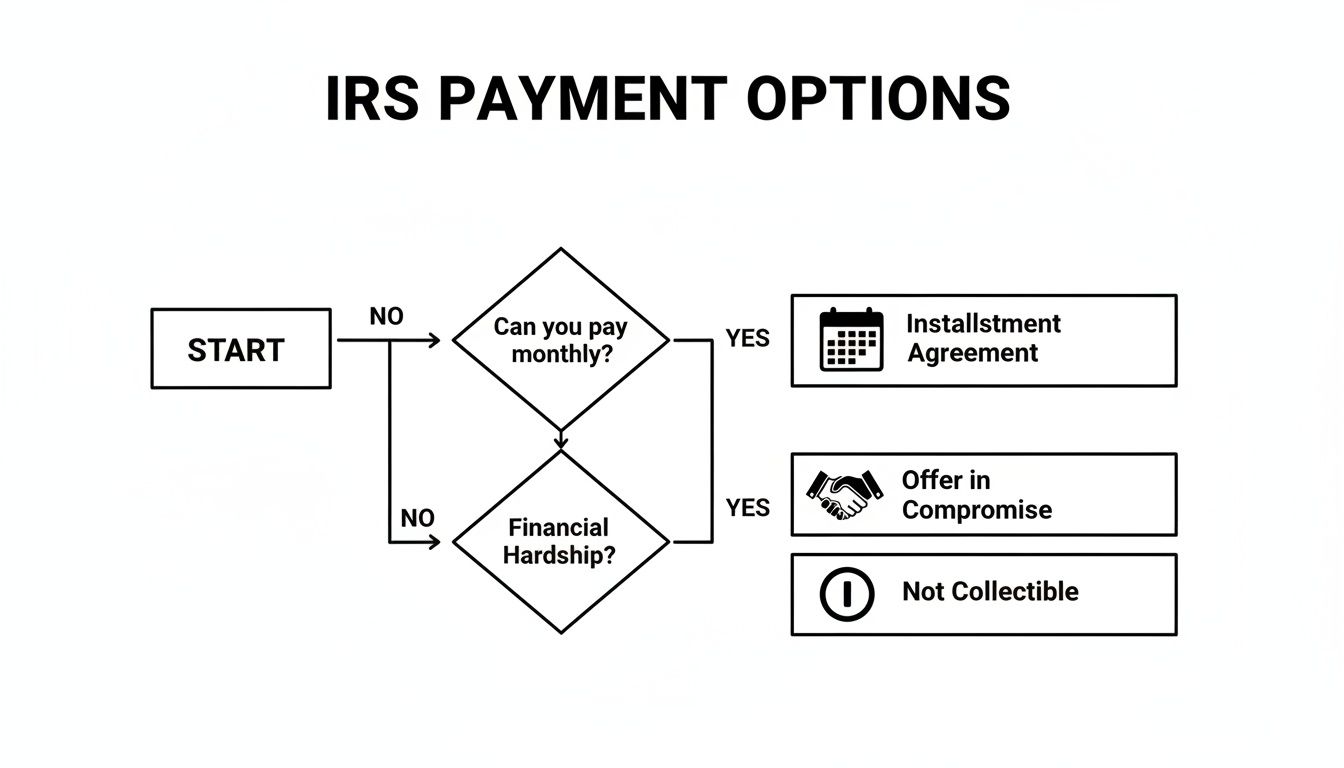
As you can see, proactive solutions like an Installment Agreement or an Offer in Compromise are designed for people who address their debt head-on. Don't let fear paralyze you; there's always a path forward.