
When it comes down to it, the single biggest difference between accrual and cash basis accounting is timing. That’s the whole ballgame.
With accrual accounting, you record revenue the moment you earn it and expenses the moment you incur them—it doesn't matter when the money actually moves. On the flip side, cash basis accounting is all about the money trail. You only log transactions when cash physically enters or leaves your bank account.
Accrual vs. Cash Basis: A Quick Overview
Picking the right accounting method is one of those foundational business decisions. It directly affects your tax bill, how you manage cash flow, and the story your financial statements tell about your company's health. Both methods track income and expenses, but when they record them creates two completely different financial pictures.
Core Concepts of Each Method
The accrual method is built on what's called the matching principle. The goal is to match your revenues with the specific expenses that helped you earn them, all in the same accounting period. This gives you a much more accurate look at your actual profitability. For example, say you finish a big project for a client in December but don't get paid until January. Accrual accounting says you record that income in December when the work was done.
Cash basis is much more straightforward. Think of it like balancing your personal checkbook. If cash comes in, you record it as revenue. If you write a check or pay a bill, that's an expense. Using that same example, the income from your December project wouldn't hit the books until January when the client's check clears. It gives you a crystal-clear, real-time view of your cash on hand.
Quick Comparison: Accrual vs. Cash Basis Accounting
For a birds-eye view of how these two methods stack up, this table cuts straight to the chase, highlighting the core differences you'll need to consider.
| Feature | Cash Basis Accounting | Accrual Basis Accounting |
|---|---|---|
| Revenue Recognition | When cash is received | When revenue is earned |
| Expense Recognition | When cash is paid | When an expense is incurred |
| Financial Picture | Shows immediate cash flow | Shows long-term profitability |
| Complexity | Simple and intuitive | More complex, requires deeper bookkeeping |
| Best For | Small businesses, sole proprietors | Larger businesses, companies with inventory |
This table makes it easy to see the main trade-offs. You're essentially choosing between simplicity and a more detailed financial narrative.
Key Takeaway: This choice isn't just a matter of bookkeeping style; it fundamentally shapes how you, potential lenders, and even the IRS see your company's performance. Accrual gives a true picture of profitability, while cash tells you exactly what’s in the bank right now.
Getting these fundamentals right is a critical first step, as we cover in our guide to basic accounting for small business. Each approach has its own strengths and is better suited for different types of businesses and goals.
A Detailed Comparison of Accounting Methods
To really get a handle on the difference between accrual and cash basis accounting, you have to look past the textbook definitions and see how they play out in the real world. The method you choose fundamentally changes the story your books tell, shaping everything from how you measure profit to how you plan for the future.

This isn't just about when you log a transaction. It’s about what you’re measuring. Do you need to know how much cash is in your bank account right now, or are you trying to understand your company's actual profitability over a period of time?
Understanding the Cash Basis in Action
The cash basis method is refreshingly simple. Think of it like a personal checkbook: money that comes in is revenue, and money that goes out is an expense. This gives you an immediate, crystal-clear snapshot of your cash position at any given moment.
Let’s say you’re a freelance graphic designer. In March, you wrap up a project and send out an invoice for $5,000. The client doesn't pay you until April. If you're using the cash basis, that $5,000 revenue simply doesn't exist in March. It only gets recorded in April, when the payment actually hits your bank account.
This straightforwardness is its biggest advantage. For a sole proprietor or a small service business with no inventory, cash flow is king. The cash method aligns perfectly with that priority, making bookkeeping feel much more intuitive.
How Accrual Basis Creates a Different Financial Picture
The accrual basis works on a more complex idea called the matching principle. At its core, this concept demands that you record revenues when they are earned and match them with the expenses you incurred to generate them. The result is a far more accurate picture of your profitability.
Let's go back to our graphic designer. With accrual accounting, you’d book that $5,000 as revenue in March—the month you finished the work and actually earned it. At the same time, you'd create an "Accounts Receivable" entry on your balance sheet, showing that you're owed $5,000. When the payment arrives in April, the transaction just moves the balance from Accounts Receivable to your cash account; it doesn't count as new revenue for April.
This method smooths out the financial bumps, giving you a more consistent view of your company’s performance over time. For a deeper dive, check out this excellent guide on Cash Basis v Accruals accounting: what’s the difference?.
The Core Operational Difference: Cash basis tells you what you have. Accrual basis tells you what you've earned and what you owe. This distinction is crucial for understanding your company's underlying financial health beyond just the cash in the bank.
Comparing Profitability and Liquidity
Your choice of accounting method has a direct impact on how profitable your business looks on paper versus how much cash it actually has. For the exact same period, one method might show a huge profit while the other reveals a much stronger cash position.
Imagine a consulting firm that lands a massive $100,000 contract in December. They complete all the work that month but won't get paid until February.
- Accrual View: The firm records $100,000 in revenue for December. Their year-end reports look fantastic. But behind the scenes, they might be scrambling to make payroll in January.
- Cash Basis View: The firm records $0 in revenue from that contract in December. Their year-end profit looks weak, but their books accurately reflect their tight cash situation.
This really highlights the trade-off. Research backs this up; one study of firms between 2010 and 2014 found that businesses using the accrual method reported profits that were 15-20% higher on paper, mostly from recognizing unpaid invoices as revenue. In contrast, businesses on the cash basis showed 12% better short-term liquidity because their financials were a direct mirror of their cash on hand.
Nuances in Day-to-Day Bookkeeping
The day-to-day work of bookkeeping is also quite different. Cash basis accounting is generally simpler, often boiling down to just recording deposits and payments as they happen.
Accrual accounting, on the other hand, demands more attention to detail. It involves:
- Tracking Accounts Receivable: Keeping a close eye on all outstanding invoices to make sure clients pay on time.
- Managing Accounts Payable: Maintaining a record of all bills you owe to vendors, even if you haven't paid them yet.
- Prepaid Expenses: Accounting for things paid for in advance, like an annual insurance premium, and then expensing it month by month.
- Unearned Revenue: Recording payments you've received for work you haven't done yet.
While this adds a layer of complexity, it arms managers with the rich data needed for serious financial planning, budgeting, and performance analysis. It paints a full picture of all your financial obligations and future revenue streams.
Navigating IRS Rules and Tax Implications
Your choice between cash and accrual accounting isn't just a bookkeeping preference—it’s a decision with serious tax consequences. Understanding the IRS rules is non-negotiable, as they can either give you flexibility or lock you into a specific method. When tax season rolls around, the difference between these two methods becomes crystal clear.
For most small businesses, the deciding factor is the gross receipts test. This is the key that unlocks the simpler cash basis method for tax reporting. The IRS sets clear thresholds that give most small and mid-sized businesses the freedom to choose what works best for them.
The Gross Receipts Threshold: A Game-Changer for Small Business
The Tax Cuts and Jobs Act (TCJA) of 2017 completely changed the landscape here. Before the TCJA, the rules were much tighter, often pushing growing businesses into the more complicated accrual method before they were really ready for it.
Starting in 2018, the IRS set a new, much higher threshold. Businesses with average annual gross receipts under $25 million over the three prior years could suddenly stick with cash basis accounting. This was a massive leap from the old $5 million limit and opened the door for over 90% of small businesses to use the simpler cash method. It was a huge win for business owners, giving them far more control over their tax planning.
This threshold is also indexed for inflation, so you have to keep an eye on the current number. For 2024, the limit is around $30 million, which continues to provide a lot of breathing room for small business owners.
When the IRS Puts Its Foot Down
While the gross receipts test gives many businesses a choice, it’s not a free pass for everyone. In some cases, the IRS mandates the accrual method, no matter how much revenue you bring in.
The big one is inventory. If your business buys, produces, and sells physical goods, the IRS generally requires you to use the accrual method. This is all about the matching principle—making sure the cost of your goods is matched with the revenue they generate in the same period.
This rule typically applies to:
- Retail stores with physical products.
- E-commerce businesses that hold their own stock.
- Manufacturers that produce and sell goods.
Why the IRS Cares So Much About Inventory: The IRS sees inventory as a major income-producing factor. If you used the cash method, you could theoretically buy a massive amount of inventory on December 31st, write it all off as an expense, and slash your tax bill—even if none of it has been sold. Accrual accounting closes that loophole.
The IRS gets into the nitty-gritty of these rules in guides like Publication 538, "Accounting Periods and Methods."
The screenshot below, taken from Publication 538, highlights the core criteria the IRS wants businesses to think about when picking an accounting method.
At the end of the day, the IRS just wants you to be consistent and choose a method that clearly reflects your income.
Playing Your Cards Right: Tax Strategy for Each Method
Beyond just staying compliant, your accounting method unlocks different strategies for smart tax planning. The right approach can directly impact your cash flow and lower your tax burden. For a deeper dive into these strategies, check out our guide on tax planning for small businesses.
With cash basis accounting, you have more hands-on control over your taxable income from year to year. As December 31st gets closer, you could:
- Delay Invoices: Hold off on sending invoices until January, pushing that income into the next tax year.
- Pay Expenses Early: Prepay for things like rent, insurance, or supplies in December to bulk up your deductions for the current year.
On the flip side, the accrual basis can sometimes create "phantom income." This is when you've earned revenue and sent an invoice, but the cash isn't in your bank account yet. You still owe taxes on that income, even if the client doesn't pay you until the next year, which can create a temporary cash flow squeeze. The upside, however, is a much more stable and predictable picture of your profitability, which is gold when you're doing long-term planning or trying to get a loan.
How to Choose the Right Accounting Method
Picking an accounting method isn't just a box to check for tax season. It's about choosing the financial language your business will speak. The right one gives you a clear, honest picture of how you're really doing and helps you make smarter decisions.
What works best hinges entirely on your company's specifics—your industry, how cash flows in and out, your size, and where you plan to be in a few years. There’s no single "best" option, only the one that gives you the most useful information. A brand-new freelancer just needs to know if they have enough cash to pay the bills, while a growing company chasing investors needs to show long-term profitability.
What Does Your Business Actually Need?
First, take a hard look at where you are now and where you're headed. Is your main goal just managing day-to-day cash, or are you building a business that you might one day sell? The answer to that question will point you in the right direction.
For most new businesses, freelancers, and small service providers, the cash basis is the logical place to start. It’s simple, straightforward, and lines up perfectly with a focus on immediate cash flow. You know exactly how much money is in the bank at any given moment, which makes it much easier to juggle expenses and avoid coming up short.
But if your plans include getting a business loan, bringing on investors, or selling the company down the road, the accrual basis is non-negotiable. Lenders and investors need to see the true financial health of your business, which includes money you're owed (accounts receivable) and bills you have yet to pay (accounts payable). The cash method just can't provide that depth of insight.
The right method aligns your financial reporting with your strategic objectives. Cash basis is about managing the present; accrual basis is about planning for the future.
This flowchart from the IRS is a great starting point, focusing on the all-important gross receipts rule.
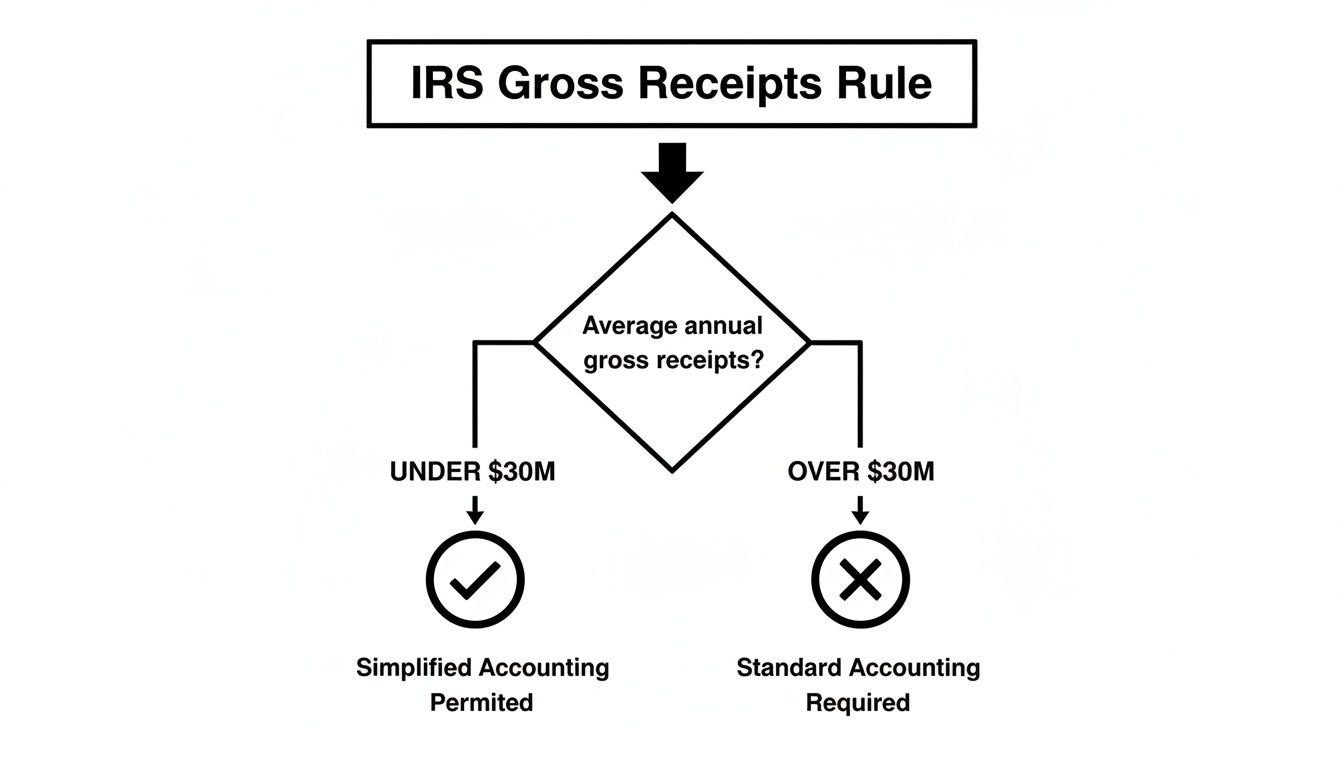
As you can see, if your business averages less than the current annual threshold—which is around $30 million—you typically have the flexibility to choose either method for your tax filings.
How Your Industry Plays a Role
Your line of work can also push you toward one method over the other. Some business models just naturally fit better with a certain accounting style because of how they operate and recognize revenue.
Real Estate and Rental Properties
For property investors, the accrual method gives a much more accurate picture of an asset's performance. It lets you match big, non-cash expenses like depreciation directly against the rental income earned in the same period. This shows you the property's real profitability, not just its cash flow.
Construction and Project-Based Services
The construction industry is a classic example where accrual accounting is king. Projects can stretch on for months or even years, with huge costs racked up long before the final check comes in. Accrual accounting provides a more reliable way to track profitability based on invoices and project milestones, avoiding the misleading ups and downs of cash-only reporting. In fact, a 2023 survey found that 65% of U.S. contractors preferred it for bids over $5 million. You can find more details in this in-depth research on contractor preferences.
Cryptocurrency Investors
The crypto world adds its own wrinkles. A casual investor might just track gains on a cash basis (when they sell for dollars), but a business that actively deals in crypto usually needs the accrual method. This becomes critical if they pay employees or vendors in crypto, since the value of that transaction has to be recorded when it happens, not just when it’s eventually converted to fiat currency.
Making the Final Call: A Quick Checklist
While you can change your accounting method later, it involves getting IRS approval and can be a headache. It's much better to make a smart choice from day one. Run through this checklist to see where you land:
- Business Size: Are your average gross receipts well under the $30 million threshold? If so, you have a choice. If you're over, accrual is likely your only option.
- Inventory: Do you sell physical products? If you hold inventory, the IRS generally requires you to use the accrual method.
- Business Model: Are you a service business with simple transactions (leans cash) or do you handle long-term projects with complex billing (leans accrual)?
- Growth Plans: Are you planning to look for loans or investors anytime soon? If yes, you'll need accrual-based financial statements that are GAAP-compliant.
- Tax Strategy: Do you want the ability to time payments and income at year-end to manage your tax bill (cash basis)? Or would you rather have a more stable, predictable tax picture based on performance (accrual basis)?
By thinking through these factors, you can make a decision that goes beyond a textbook definition. You can choose the accounting method that gives you the clarity you need to guide your business toward its goals.
Practical Implementation and Bookkeeping
Understanding the theory is one thing, but putting your accounting method into practice is where the rubber meets the road. While most modern accounting software can flip between cash and accrual reports on the fly, your day-to-day bookkeeping has to consistently follow your chosen method. This isn't just for consistency—it's essential for accuracy and staying compliant.
Getting started with cash basis is pretty straightforward. Your main job is to record transactions when money actually hits or leaves your bank account. Think of it like balancing a checkbook; it’s a direct, real-time reflection of your cash flow.
Accrual bookkeeping, on the other hand, is a different beast. It requires a more sophisticated approach, forcing you to manage accounts that don't even exist in the cash world. This gives you a much deeper view of your financial health, including what you're owed and what you owe.
Managing Accrual and Cash in Your Books
The real difference in your daily workflow comes down to tracking transactions that haven't settled yet. If you're using the accrual system, you'll live inside two key accounts:
- Accounts Receivable (A/R): This is the running tab of money customers owe you for services or products you've already delivered. You log this as revenue the moment you send the invoice, not when the check arrives.
- Accounts Payable (A/P): This is the opposite—it’s the money you owe suppliers for expenses you've racked up but haven't paid for yet.
These accounts are the engine of the accrual method's "matching principle," which lines up your revenues with the specific expenses that helped generate them. Regardless of your method, a solid grasp of concepts like double-entry bookkeeping principles is non-negotiable for keeping accurate records.
The cash method just sidesteps all of this. With no A/R or A/P to worry about, you only record revenue when a payment lands in your account and an expense when you actually pay the bill. Simple as that.
Key Insight: Software like QuickBooks can generate either a cash or accrual report for analysis. But your official accounting method dictates how you must record transactions. An accrual-based business has to enter invoices and bills when they are created, not just when cash changes hands.
Using QuickBooks for Your Chosen Method
Accounting software makes life easier, but it doesn't do the thinking for you. Setting it up correctly is crucial. While accrual accounting often requires more expertise and can lead to 25% higher bookkeeping costs for small businesses, powerful tools can bridge that gap. In fact, some studies show that leveraging QuickBooks effectively can trim this extra cost by up to 40%.
To get these results, you have to configure the software properly from day one. Our guide on how to set up QuickBooks walks you through the foundational steps to make sure your system is aligned perfectly with your chosen accounting method.
The Complexities of Changing Your Method
What happens when your business outgrows the cash method? Switching from cash to accrual (or vice versa) is a major move, and it’s not something you can just decide to do. You need formal permission from the IRS.
This isn’t as simple as toggling a setting in your software. The process involves filing IRS Form 3115, Application for Change in Accounting Method. This form is notoriously complicated and almost always requires a professional's help to get it right.
If you don't file the form or make a mistake during the switch, you could face serious compliance headaches, misstated income, and even penalties. The transition requires careful adjustments to ensure transactions aren't double-counted or missed entirely. Trust me on this one—you’ll want to consult a tax professional to navigate the change smoothly and correctly.
Frequently Asked Questions
When you're trying to get the hang of accounting methods, a few key questions always seem to pop up. Let's clear the air on some of the most common ones so you can feel confident about which path is right for your business.
Can I Use Different Methods for Bookkeeping and Taxes?
This is a common point of confusion, but the short answer is no. The IRS is big on consistency. Whichever method you use for your tax returns—cash or accrual—is the same one you must use to keep your official financial books.
This rule is in place to stop businesses from cherry-picking methods to artificially lower their taxable income for a given year. While accounting software like QuickBooks is flexible enough to run reports in either format for your own internal review (like seeing your cash flow even if you're on accrual), your official, declared method has to be used consistently. If you need to make a switch, you have to get formal permission by filing IRS Form 3115.
Is My Business Size the Only Factor to Consider?
Not by a long shot. While the IRS gross receipts threshold is a critical benchmark, it’s just one piece of the puzzle. The way your business operates, whether you hold inventory, and your plans for the future are just as important when weighing the difference between accrual and cash basis accounting.
Think about a small tech startup. It might be well under the revenue threshold, but if the founders plan on chasing venture capital, they absolutely need to be on the accrual method. Investors and lenders simply won't take you seriously without it; they need the complete financial picture that only accrual accounting can provide.
The Bottom Line: Your choice should be about your operational reality and future ambitions, not just this year's revenue. Accrual accounting is the language investors and banks speak.
Is Accrual Accounting Always the Better Option?
Definitely not. The "best" method is the one that fits your specific business like a glove. There’s no question that accrual accounting gives a more accurate, long-term view of profitability, and it’s the non-negotiable standard for larger companies, especially any business that handles inventory.
But for the legions of freelancers, sole proprietors, and small service businesses out there, the straightforward nature of the cash basis method is often far more practical. It gives you an immediate, easy-to-understand snapshot of the cash you actually have on hand. It also offers some great tax-planning flexibility as the year winds down. When your business operations don't warrant the extra complexity, sticking with the simpler method is usually the smartest call.
Choosing and sticking with the right accounting method is a cornerstone of your company's financial health. At Allied Tax Advisors, our team of CPAs and enrolled agents is here to help you sort through these decisions, making sure your bookkeeping is compliant, efficient, and perfectly aligned with where you want to take your business. Contact us today to build a strong financial future.