
The choice between a single-member LLC (SMLLC) and an S Corp really boils down to one thing: simplicity versus savings. An SMLLC is the path of least resistance, keeping your administrative life clean and simple. The S Corp election, on the other hand, opens the door to potentially big savings on self-employment taxes, but it asks for more effort in return.
So, which one is right for you? It all depends on whether you value operational ease more than tax optimization at this stage of your business.
Understanding the Core Trade-Offs
Picking a business structure is a huge decision. In fact, learning how to choose your business structure is one of the most important first steps you'll take, setting the foundation for your taxes and growth for years to come. While a default SMLLC and an LLC taxed as an S Corp give you the exact same shield from personal liability, they are worlds apart when it comes to taxes and paperwork.
Simplicity vs Savings
For a solo business owner, the single-member LLC is the default starting point. The IRS sees it as a "disregarded entity," which is just a fancy way of saying your business income and expenses flow directly onto your personal tax return via a Schedule C. This is its biggest selling point—it’s incredibly straightforward, with minimal administrative headaches.
Now, that same LLC can file a form with the IRS (Form 2553) to be taxed as an S Corporation instead. This move makes things more complex but can be a game-changer for your bottom line. You essentially become an employee of your own company and must pay yourself a "reasonable salary," which gets hit with standard payroll taxes. The rest of the company's profit can be paid out to you as a distribution, which is not subject to self-employment taxes. That’s the magic behind the S Corp savings.
At its heart, the decision is a gut check: Are the potential tax savings from an S Corp election worth the added complexity of running payroll and keeping more formal company records?
SMLLC vs S Corp Key Differences at a Glance
Let's put the key differences side-by-side. This table gives you a quick snapshot of a default single-member LLC versus an LLC that has chosen to be taxed as an S Corp.
| Factor | Single-Member LLC (Default Taxation) | LLC with S Corp Election |
|---|---|---|
| Primary Advantage | Unmatched simplicity and low administrative burden. | Potential for significant self-employment tax savings. |
| Taxation Method | All profits pass through and are subject to the 15.3% self-employment tax. | Income is split between a salary (taxed) and distributions (not subject to SE tax). |
| Administrative Work | Minimal; no formal meetings or payroll required for the owner. | Formal requirements including running payroll, holding meetings, and filing corporate tax returns. |
| Ownership Rules | Highly flexible; can have foreign owners or be owned by other entities. | Restricted to a maximum of 100 U.S. citizen or resident shareholders. |
| Best For | New businesses, freelancers, and owners prioritizing ease of operation. | Profitable businesses looking to optimize their tax liability. |
Seeing it laid out like this really clarifies the trade-offs. You're either choosing the simple, hands-off approach of the default LLC or stepping up to the more involved, but potentially more profitable, S Corp structure.
How Taxation Creates the Core Difference
When you're trying to decide between a single-member LLC vs S corp, the conversation almost always comes down to one thing: taxes. While both structures give you that crucial limited liability protection, the way the IRS treats your profits couldn't be more different. Getting a handle on this distinction is the key to choosing the right path for your business and your wallet.
By default, the IRS sees a single-member LLC as a "disregarded entity." That’s just a fancy way of saying they don't view your business as a separate taxpayer. All the money you make (and lose) simply "passes through" to your personal tax return, which you’ll report on a Schedule C.
It sounds simple, and it is. But there’s a major catch: self-employment taxes.
The Burden of Self-Employment Tax on an SMLLC
Every single dollar of net profit your SMLLC makes gets hit with self-employment tax. This tax, which covers your Social Security and Medicare contributions, is a flat 15.3% and comes right off the top—before you even start calculating your regular income taxes. For a growing business, this can take a huge bite out of your earnings.
Let's say your freelance design business, operating as a standard SMLLC, brings in $80,000 in net profit. That entire $80,000 is subject to the 15.3% tax. You’d owe roughly $12,240 in self-employment taxes alone. This is exactly where the S Corp election starts to look very appealing.
The core trade-off is clear: A default SMLLC offers administrative ease but taxes every penny of profit. An S Corp introduces more complexity but provides a strategic way to reduce that tax burden.
How an S Corp Splits Income to Save on Taxes
Choosing to have your LLC taxed as an S Corp completely changes the game. You're no longer just a business owner; you're also an employee of your own company. This unique setup lets you divide your company's income into two different buckets:
- A Reasonable Salary: You have to pay yourself a "reasonable salary" for the actual work you do. This income is subject to FICA payroll taxes (15.3%), which is split between you (as the employee) and your company (as the employer).
- Distributions: Any profit left over after paying your salary and other business expenses can be taken as a distribution. And here's the magic—distributions are not subject to self-employment or FICA taxes.
This chart gives you a quick snapshot of the trade-offs you're looking at with each structure.
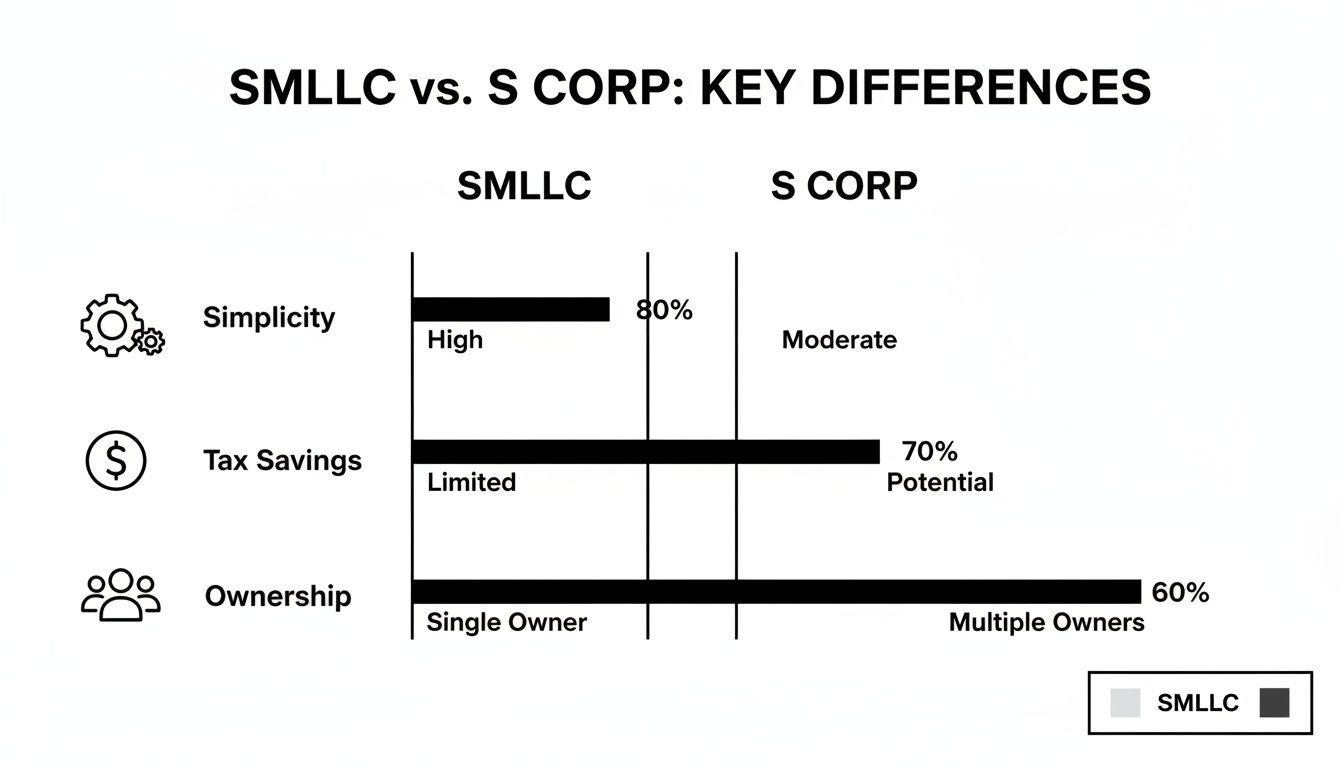
As you can see, the S Corp opens the door to serious tax savings, but you have to be willing to give up some simplicity and navigate a few more ownership rules.
A Real-World Tax Savings Scenario
Let's put some real numbers to this. The potential to slash your self-employment tax bill is easily the biggest draw for making the S Corp election, especially once your profits start climbing.
Imagine your LLC has a net income of $100,000. As a default SMLLC, the full amount is subject to that 15.3% tax, meaning you owe $15,300 right off the bat.
Now, let's say you elect S Corp status. You pay yourself a reasonable salary of $60,000. That salary gets hit with the 15.3% FICA tax, which comes out to $9,180. But the remaining $40,000 in profit? You can take that as a distribution, and it’s completely free from self-employment taxes.
Here’s a side-by-side breakdown:
| Tax Structure | Net Profit | Subject to SE/FICA Tax | Tax Owed | Potential Savings |
|---|---|---|---|---|
| Default SMLLC | $100,000 | $100,000 (100% of profit) | $15,300 | $0 |
| LLC as S Corp | $100,000 | $60,000 (Reasonable Salary) | $9,180 | $6,120 |
In this case, simply by filing one form with the IRS and running payroll, you've put an extra $6,120 back in your pocket for the year.
Mastering the S Corp election is a cornerstone of smart tax planning strategies. As your business grows, the savings can become substantial, easily covering the added administrative costs. For a deeper dive into the numbers, you can learn more by understanding the S corp tax rate in our detailed guide.
Formation and Compliance: Simplicity vs. Formalities
Beyond taxes, the day-to-day reality of running a single-member LLC vs. an S corp is where you'll feel the biggest difference. While both shield your personal assets, their formation and ongoing upkeep couldn't be more different. The right choice often comes down to being honest with yourself about how much administrative work you’re truly willing to take on.
A single-member LLC is refreshingly simple. Getting started usually means filing a single document with your state—often called the Articles of Organization—and paying a fee. After that, the ongoing requirements are usually pretty light, typically just an annual report and a renewal fee.
This straightforward approach is a huge plus for freelancers, consultants, and new entrepreneurs who just want to get to work without getting bogged down in corporate red tape. You don't have to worry about mandatory board meetings, keeping official minutes, or running formal payroll for yourself.
The Step-Up to S Corp Rules
Choosing to be taxed as an S corp changes your relationship with your business entirely. It adds a whole new layer of administrative duties. An S corp is a tax status, not a business entity itself, so you first have to be an LLC or corporation. Once you make that election, you have to start acting like a corporation to keep your liability protection intact.
This brings a handful of non-negotiable tasks that a standard single-member LLC owner never thinks about. This extra work is the direct trade-off for those potential tax savings.
You’ll be responsible for new formalities, including:
- Adopting Bylaws: This is a formal document that lays out the operating rules for your company.
- Holding Meetings: You'll need to conduct and document initial and annual meetings for shareholders and directors, even if you’re the only one in the room.
- Keeping Corporate Minutes: This means maintaining a written log of all major business decisions made during those meetings.
- Running Payroll: You must formally process payroll for yourself as an owner-employee, which includes withholding and paying employment taxes on your salary.
The sheer simplicity of the single-member LLC is what keeps many entrepreneurs from making the switch. While an LLC just needs its articles of organization filed, an S corp structure demands bylaws, board meetings, annual minutes, and designated officers. This isn't just paperwork—it translates to real costs. In fact, S corps can rack up 15-25% higher annual administrative expenses, which is a major reason many small businesses decide to stick with the default LLC structure.
The Real Cost of Staying Compliant
Moving from a simple LLC to an S corp isn't just about filing a few extra forms; it comes with tangible costs in both time and money. Running payroll, for example, almost always means paying for a payroll service, adding a recurring monthly expense. You'll also spend more of your own time—or pay your accountant more—to handle the separate corporate tax return (Form 1120-S).
These added operational demands are exactly why the S corp election isn’t for everyone. It’s a strategic move that makes the most sense when your business profits are high enough that the tax savings more than cover these new administrative headaches and costs.
The core question becomes: Is the money you save on self-employment tax worth the time and expense of running your business like a formal corporation?
Ultimately, this choice reflects where your business is today and your personal tolerance for administrative tasks. For someone just starting out or dealing with unpredictable income, the LLC's simplicity is priceless. But for an established business with consistent, healthy profits, the compliance burden of an S corp becomes a manageable and worthwhile investment to unlock significant tax advantages. You can explore more about different business structure types in our guide.
Planning for Future Growth and Ownership
Choosing a business structure isn't just about your tax bill this year; it’s about laying the foundation for where you want your company to go. When you're weighing a single-member LLC vs S corp, you're really deciding how you want to grow, who you can partner with, and how you might one day exit. The choice you make today directly shapes how you can scale down the road.
A single-member LLC is incredibly flexible by design. It's built to grow with you. You can start out on your own and then, when the time is right, bring on new partners or take on investment without having to overhaul your entire legal structure.
This built-in adaptability is one of the LLC's biggest draws. It allows your ownership structure to be as dynamic as your business.
Welcoming New Partners and Investors
Let’s say you've found the perfect co-founder or an investor—who happens to not be a U.S. citizen—wants to give you a cash injection. If you're an LLC, this is relatively simple. You just update your operating agreement to add the new members and outline their ownership stakes.
The LLC model has almost no strings attached when it comes to ownership. This means you can add:
- An unlimited number of members.
- Members who are non-U.S. citizens or residents.
- Other companies, like corporations or even other LLCs, as members.
This "open door" approach makes the LLC a great fit if you see future collaborations or international investment on the horizon. It keeps your options for funding and partnerships wide open.
The core difference really boils down to scalability. An LLC is built for flexible growth and can accommodate all kinds of ownership structures. An S Corp, on the other hand, puts you in a much more rigid box, which can seriously limit how you bring in new partners and capital.
The Strict Ownership Rules of an S Corp
While the S corp can offer some compelling tax perks, those savings come with a trade-off: very strict ownership rules handed down by the IRS. These limitations aren't flexible and can become a major headache for a business planning to grow in certain ways. Once you elect S corp status, you’re locked into a specific ownership framework.
Here are the main restrictions you'll run into with an S corp:
- A 100-Shareholder Limit: You can't have more than 100 owners, period.
- U.S. Residents Only: Every single shareholder must be a U.S. citizen or a legal resident.
- No Entity Owners: You can't have another corporation, LLC, or partnership as a shareholder.
- One Class of Stock: You're only allowed to issue one type of stock. This means all shareholders must have the same economic rights, like how distributions are paid out.
These rules create a clear dividing line between the two entities. It’s no surprise that LLC formations have exploded in popularity. By 2020, entrepreneurs were registering over 2.5 million new LLCs each year, while S corp formations hovered under 800,000. That 3-to-1 ratio often comes down to founders prioritizing long-term flexibility over a short-term tax strategy. You can find more analysis on these critical entity differences from Weaver.com.
So, what’s the bottom line? If your future plans involve bringing on a diverse group of partners, chasing venture capital, or attracting foreign investment, the S corp’s rigid rules could stop you in your tracks. The LLC's simplicity and adaptability make it a much safer, more scalable bet for any business with big ambitions.
How to Make the S Corp Election
If the potential tax savings of an S corp have you convinced, your next move is to make the official election with the IRS. Here's something a lot of business owners miss: an S corp is a tax status, not a separate legal business entity. You don't "form" an S corp. Instead, you set up an LLC (or a C corporation) and then tell the IRS you want it to be taxed as an S corp.
This is a critical distinction. Your business is still an LLC under state law, keeping all its legal protections and operational flexibility. But for federal tax purposes, it will now play by S corp rules. The process itself boils down to one very important piece of paper.
The Role of IRS Form 2553
The entire S corp election hinges on filing one document correctly: Form 2553, Election by a Small Business Corporation. This is how you formally notify the IRS of your choice. It's not optional. If you don't file this form—and have it accepted—your single-member LLC will just continue being taxed as a disregarded entity.
To complete the form, you’ll need some basic info about your business handy:
- Your Employer Identification Number (EIN)
- The date your LLC was officially formed
- Your state of formation
- The names and signatures of all members (for a single-member LLC, that’s just you)
Key Insight: Filing Form 2553 is more than just paperwork. It's a declaration to the IRS that you’re moving from paying self-employment tax on all your profits to the salary-and-distribution model. This decision immediately triggers new responsibilities, most importantly, running payroll.
Critical Filing Deadlines You Cannot Miss
When it comes to the S corp election, timing is everything. The IRS has strict deadlines, and missing them can push your tax savings back an entire year. Getting these dates right is non-negotiable.
You have two main windows to file Form 2553:
For a New Business: You have two months and 15 days (that's 75 days) from the start of your business's first tax year. For most new LLCs, the clock starts ticking on the date of formation.
For an Existing Business: You need to file by the 15th day of the third month of the tax year you want the election to take effect. For most businesses, which run on a calendar year, that deadline is March 15.
If you miss that window, your S corp status will typically only apply to the next tax year. That means you’ll miss out on a whole year of potential savings. While the IRS does have a process for late-filing relief, it's a hassle and isn't guaranteed. Given how much is on the line, it’s always a good idea to work with a tax pro to make sure it's done right and on time. You can dive deeper into the specifics in our guide on what is form 2553.
When to Choose an S Corp Over an LLC
So, how do you actually make the call between a single-member LLC and an S corp? It really boils down to an honest look at your business’s numbers, how much administrative work you’re willing to put up with, and where you see your company heading. Forget a generic pro/con list; a practical checklist is a much better way to figure this out.
Answering a few pointed questions will give you a clear, personalized verdict on whether the tax savings are actually worth the added red tape.

This isn't just theory. This is about applying the concepts directly to your business to find the structure that truly fits.
Your Decision Checklist
Walk through these questions to see if making the S corp election is the right strategic move for you right now. Be brutally honest with your answers—it's the only way to know if the benefits will genuinely outweigh the burdens.
1. Is Your Net Income High Enough?
This is the big one. Let's be real: the main draw of an S corp is saving money on self-employment taxes. But those savings have to be substantial enough to cover the new costs you'll incur. We're talking about payroll services and potentially higher accounting fees, which can easily add up to $1,500 to $3,000+ per year.
A good rule of thumb I've seen play out time and again is to start seriously considering the switch once your business consistently nets $40,000 to $50,000 a year after all your expenses. If you're making less than that, the administrative costs will likely eat up any tax savings, leaving you with more work for no financial gain.
2. Are You Prepared for the Administrative Lift?
Running an S corp means you have to operate more like a "real" corporation. It's not optional. Are you ready to commit to these non-negotiable tasks?
- Running formal payroll for yourself, which means withholding and remitting taxes on time.
- Holding annual shareholder meetings, even if you're the only person in the room.
- Keeping detailed minutes from those meetings and formally documenting major business decisions.
- Filing a separate business tax return (Form 1120-S) on top of your personal return.
If your gut reaction to that list is dread, the beautiful simplicity of a default single-member LLC might be worth more to you than the potential tax savings.
The core decision hinges on this: Are you willing to trade the operational simplicity of an LLC for the potential tax savings of an S corp? Your answer reveals your priority—ease of use or financial optimization.
3. Do You Meet the Strict Ownership Requirements?
This last one is a simple knockout question. The IRS has rigid rules about who can own an S corp, and there's no wiggle room. All owners must be U.S. citizens or legal residents.
If you have any plans to bring on foreign investors, or if you envision another company becoming a partner down the road, the S corp structure will immediately slam the door on those opportunities. It's a dealbreaker.
So, how did you do? If you can confidently answer "yes" to all three questions—your profits are there, you're ready for the formalities, and the ownership rules are no problem—then making the S corp election is probably a smart financial strategy for your business.
Frequently Asked Questions
Even after you've weighed the pros and cons, the single-member LLC vs. S corp decision can leave you with a few nagging questions. It's one thing to understand the concepts, but it's another to know how they play out in the real world. Let's tackle some of the most common follow-up questions I hear from business owners.
Think of this as the final once-over to make sure you're moving forward with total confidence. We'll get into the practical side of things, from what happens if you change your mind to what the IRS really means by a "reasonable" salary.
Can I Switch Back to an LLC from an S Corp?
You can, but it’s not like flipping a switch. Reverting your S corp election is a formal process that carries some pretty serious long-term weight. You have to file a statement of revocation with the IRS, and once it's done, you're generally locked out from re-electing S corp status for five years.
This five-year rule is a big deal. It’s why you have to be absolutely sure before you pull the trigger on revoking your S corp status. I always recommend talking it through with a tax pro to fully understand the financial fallout and sidestep any unexpected tax bills on your business profits.
What Is a Reasonable Salary for an S Corp Owner?
This is the million-dollar question, and the IRS answer is frustratingly vague: a "reasonable salary" is what a similar business would pay for the services you provide. There’s no secret formula or magic number. The IRS just looks at the whole picture—your duties, your experience, your industry, and even your geographic location.
Failing to pay yourself a reasonable salary is one of the biggest red flags for an IRS audit. They can reclassify your distributions as wages, hitting you with back taxes, interest, and penalties. Documenting how you arrived at your salary is a critical compliance step.
Don't just guess. Do your homework. Look up compensation data for your role and keep detailed records that justify the salary you land on. Taking this step seriously from the get-go is the best way to protect yourself and prove your S corp’s tax structure is legitimate.
Does an S Corp Offer Better Liability Protection?
No, and this is probably the most common myth out there. A single-member LLC and an S corp provide the exact same degree of personal liability protection. That legal shield—often called the "corporate veil"—is what separates your personal assets from your business debts.
The protection comes from your legal entity (the LLC), not your tax election (the S corp). The single member LLC vs S corp debate is purely about taxes and administrative upkeep, not about how strong your liability shield is. No matter which you choose, the only way to keep that protection intact is to maintain a strict separation between your business and personal finances. If you start mixing funds, a creditor could argue to "pierce the corporate veil," putting your personal assets at risk.
At Allied Tax Advisors, we specialize in helping small business owners navigate these critical decisions. From S Corporation filings to ongoing payroll and bookkeeping, our team ensures your business is structured for maximum savings and full compliance. Let us handle the complexities so you can focus on growth. Learn more about our business services at https://alliedtax.com.