
Ever heard of IRS Form 2553? It might sound like just another number in the tax code, but for the right small business, this form is a game-changer. It's the official document you file to get your business taxed as an S Corporation, and it can unlock some serious tax savings.
What Form 2553 Really Does
Think of Form 2553 as an application. You're telling the IRS, "Hey, I'd like to change how you tax my company." By default, an LLC or C Corporation has its own set of tax rules. Filing this form lets you opt into a different system—the S Corp system.
This isn't just a minor tweak; it fundamentally changes how your business's profits are handled. Instead of the company itself paying corporate income tax, the profits and losses are "passed through" directly to the owners. You then report this income on your personal tax returns. This structure is the key to sidestepping a major headache known as double taxation.
So, What's Double Taxation?
This issue primarily hits traditional C Corporations. It’s a frustrating one-two punch that works like this:
- The corporation makes a profit and pays corporate income tax.
- Then, it distributes some of that after-tax profit to its shareholders as dividends.
- The shareholders now have to pay personal income tax on those same dividends.
Essentially, the same dollar gets taxed twice—once when the company earns it and again when the owner receives it.
An S Corp election, made possible by Form 2553, completely eliminates that first layer of federal tax. Profits flow straight to the owners, get reported on their personal returns, and are taxed only once.
This single strategic move can reshape your company's entire financial outlook, potentially saving you thousands of dollars every year. If you're weighing your options, getting to know the ins and outs of an S Corporation is a crucial step. Filing Form 2553 is what turns that smart tax strategy into a reality. We'll dig into the specific benefits and who qualifies next.
The Financial Benefits of an S Corp Election
Let's get right to it. The biggest reason business owners file Form 2553 is to save money on taxes. While steering clear of the infamous C corp "double taxation" is a huge plus, the real magic happens with how you can reduce your self-employment tax bill.
For many small business owners, self-employment taxes (that’s Social Security and Medicare, or FICA) can be a significant financial drain. An S corp changes the game by letting you split your income into two different types: a salary and distributions.
Reasonable Salary vs. Distributions
As an owner who is active in the business, the IRS requires you to pay yourself a reasonable salary for the job you do. This salary is treated like any other W-2 employee's wages, meaning it's subject to those FICA taxes.
Here's where it gets interesting. Any profits left over after paying that salary can be paid out to you as a distribution. These distributions are not subject to self-employment tax. That’s a game-changer.
Let’s put some numbers to it. Say your business brings in $120,000 in profit for the year.
- As a sole proprietor or single-member LLC, that entire $120,000 is hit with self-employment tax. Ouch.
- With an S corp, you might determine that a fair salary for your role is $60,000. Only this portion is subject to FICA taxes.
- The remaining $60,000 can be taken as a shareholder distribution—free from self-employment taxes.
This simple infographic breaks down the tax flow difference between a C corp and an S corp.
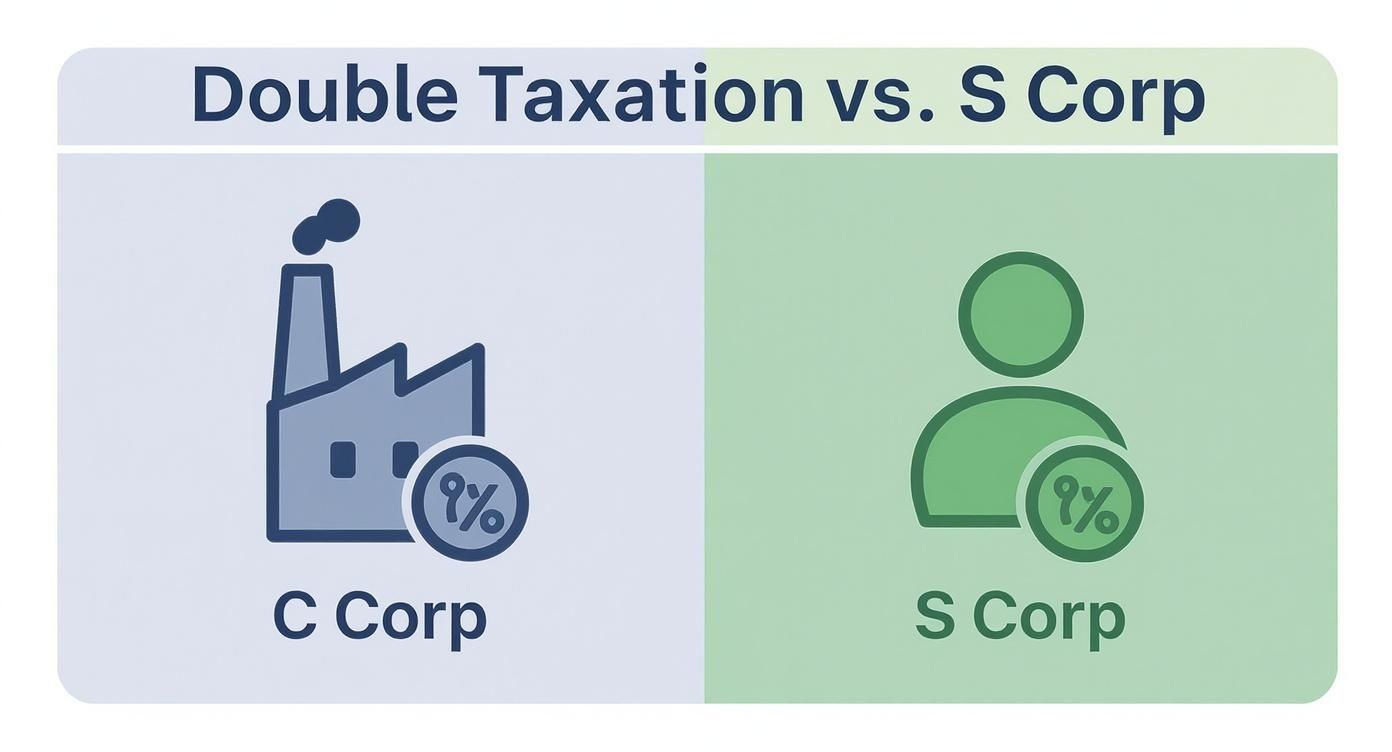
As you can see, the S corp’s pass-through structure is far more direct. Profits flow straight to the owner, getting taxed just once. To get deeper into the numbers, check out our guide on the tax rate on S corp distributions.
This powerful tax strategy is a major reason why the S corp remains such a popular business structure in the U.S. It offers a smart, legal way to keep more of your hard-earned money.
Beyond the tax savings, becoming an S corp can also boost your business's credibility in the eyes of banks and potential partners. And if your business happens to have a tough year and posts a loss, those losses can often be passed through to your personal tax return to help offset other income.
Are You Eligible for S Corp Status?
So, you're interested in the tax advantages of an S corporation. That’s great, but before you get too far, we need to pump the brakes and make sure your business actually qualifies. The IRS has a very specific set of rules, and they aren't suggestions—they're non-negotiable.
Think of it like this: not every business can just flip a switch and become an S corp. You have to fit into a particular mold first. Getting this right from the start saves you a ton of headaches and potential rejection from the IRS.
Let's walk through the core requirements.
Domestic Corporation
This one's straightforward: Your business must be a domestic corporation. That simply means it has to be created and organized right here in the United States. If your company is based abroad, S corp status isn't an option.
Allowable Shareholders
This is where things get a little more detailed. The IRS is particular about who can own a piece of an S corp.
- 100-Shareholder Limit: Your company can't have more than 100 shareholders. This keeps S corps in the realm of small to medium-sized businesses.
- Who Can Be a Shareholder: Shareholders must be individuals (who are U.S. citizens or resident aliens), certain trusts, or estates.
- Who Can't Be a Shareholder: This is a big one. Partnerships, corporations, and non-resident aliens are not allowed to be shareholders.
One Class of Stock
This rule often trips people up, but the concept is simple. An S corp can only have one class of stock.
This means that all shares must have identical rights when it comes to distributions (profits) and liquidation (company assets). You can't create a special class of stock for founders that gets paid out differently than stock for later investors. Everyone has to be treated the same, proportionally to their ownership.
Key Analogy: Imagine you're serving a cake. With the one-class-of-stock rule, everyone gets a slice of the exact same cake. Some slices might be bigger than others based on ownership percentage, but nobody gets a piece with extra frosting or special filling that others don't.
Before you go any further, use this checklist to see where you stand. It's a quick way to vet your business against the IRS's requirements.
Quick S Corporation Eligibility Checklist
Use this table to quickly verify if your business meets the IRS requirements for S Corp status before filing Form 2553.
| Requirement | What It Means | Common Mistake to Avoid |
|---|---|---|
| Domestic Business | Your company must be formed and operate in the U.S. | Trying to elect S corp status for a foreign-based entity. |
| Shareholder Limit | You have 100 or fewer shareholders. | Not counting all individual owners, which can push you over the 100 limit. |
| Shareholder Type | All shareholders are individuals, estates, or specific trusts. | Having a partnership or another corporation as a shareholder. |
| Citizen/Resident Status | All individual shareholders are U.S. citizens or resident aliens. | Overlooking the residency status of a shareholder; non-resident aliens are not allowed. |
| One Class of Stock | All shares have identical rights to profits and assets. | Creating different stock classes with varying dividend or liquidation rights. |
If you can confidently check every box, you're on the right track to filing Form 2553. If not, you'll need to make some changes to your business structure before you can proceed.
For a deeper dive into how this compares with other popular structures, check out our guide on S Corp vs LLC for small businesses.
Navigating the Form 2553 Filing Deadlines
When you're dealing with the IRS, timing is everything. This is especially true when filing Form 2553 to elect S Corp status. Get it wrong, and you could push those valuable tax benefits off to the next tax year—a costly mistake for any business.
The rules are pretty specific and depend on whether your business is just getting started or has been around for a while.

For an existing C Corp or LLC that wants to make the switch, you have a very specific window. You must file Form 2553 no later than two months and 15 days after the beginning of the tax year you want the S Corp status to kick in.
So, if your business runs on a standard calendar year (January 1 to December 31), your deadline is March 15. It’s a tight turnaround, and as tax experts often highlight when explaining how to make an S corporation election, it's a date you absolutely cannot miss.
For a brand-new business, the clock starts ticking on day one. You have the same window—two months and 15 days from your official date of incorporation—to get your form filed.
What Happens If You Miss the Deadline?
Life happens, and sometimes deadlines get missed. Did you just lose your chance for the whole year? Not necessarily.
The IRS offers a lifeline called late election relief. It's not a free pass, but it gives you a chance to make your S Corp election retroactive to the beginning of the year, even if you filed late.
To get this relief, you'll need to show you had a "reasonable cause" for not filing on time. Think of it as explaining your side of the story to the IRS with a legitimate reason for the delay.
So, what does the IRS consider a "reasonable cause"? Here are a few common scenarios:
- You honestly believed your business was already an S Corp from its inception.
- You were following the guidance of a tax professional who gave you incorrect advice.
- The person in charge of filing the form was seriously ill or otherwise incapacitated.
The most important thing is to act as soon as you realize the mistake. Don't wait. You'll need to file the late Form 2553 and attach a detailed statement explaining your reasonable cause for the delay. This is your official request for relief.
A Practical Guide to Filling Out Form 2553
Let's be honest, staring at an IRS form can be intimidating. But think of Form 2553 as a simple application, not a final exam. You're just providing the basic, but essential, details about your business to get the ball rolling.
First up, you'll need your company’s legal name, address, and Employer Identification Number (EIN). It’s crucial that this information matches exactly what the IRS already has on file. You'll also need the date you incorporated and the state where you did it—this establishes your business's official birthday and home base.
Key Election Details
The next big decision is the effective date of your S corp election. This is where those deadlines really matter. You'll need to pick a date that follows the IRS rules, which is usually the start of the current tax year or the beginning of the next one. Getting this right is key to a smooth approval.
Juggling tax forms and deadlines is a lot easier with the right software. Many professionals rely on specialized platforms like Drake Tax Hosting for your tax preparation needs to keep everything accurate and organized.
Crucial Step: The Shareholder Consent Statement
This part of the form is non-negotiable. Every single person who owns a share of the company must sign and date the consent statement. It’s the official proof that everyone is on board with becoming an S corp.
Filing and Final Steps
Once the form is complete and signed, you can't just upload it online. Form 2553 has to be mailed or faxed to the IRS. The right mailing address or fax number depends on where your business is located, so be sure to check the official IRS website for the correct service center.
A pro tip? Many people choose to fax the form. It gives you an instant transmission receipt, which is great for peace of mind. While the S corp itself is unique to the U.S., the idea of pass-through taxation has influenced tax laws around the globe, making Form 2553 a blueprint for similar structures worldwide.
Common Questions About S Corp Elections
Even after you've got the basics down, a few nagging questions about Form 2553 usually pop up. It's totally normal. Let's walk through some of the most common sticking points that business owners run into so you can move forward with confidence.
What Happens If I Miss the Filing Deadline?
We've all been there—an important deadline just slips by. Missing the IRS deadline for Form 2553 is a common fear, but don't panic just yet. You might have a way out.
Normally, if you miss the window (the first two months and 15 days of your tax year), your S Corp election won't kick in until the next tax year.
However, the IRS has a provision for "late election relief." If you have a reasonable cause for filing late—maybe you got some bad advice from a professional or had another legitimate reason—you can file the form after the deadline. You'll just need to attach a statement explaining exactly why you were late and ask the IRS to make the election retroactive to the start of the year.
Can My LLC Become an S Corp?
Absolutely. In fact, it's one of the most powerful tax strategies out there for small business owners.
An LLC isn't a corporation by default, so it's a two-step dance. First, you file Form 8832, Entity Classification Election, which basically tells the IRS, "Hey, I want my LLC to be treated like a corporation for tax purposes."
Once that's done, you file Form 2553 to make the S Corp election. This simple process is what allows LLC owners to potentially slash their self-employment tax bills by paying themselves a reasonable salary and taking the rest of the profits as distributions.
Confirmation From the IRS
After you send in Form 2553, don't expect instant confirmation. The IRS will mail you an official approval, which is usually a CP261 notice. It typically shows up within 60 to 90 days. If three months go by and you haven't heard anything, it's probably a good idea to give them a call and check on the status.
If you're wrestling with the details or just want to make sure you're getting it right, understanding the role of a business lawyer can be a game-changer. Getting expert advice can help you sidestep costly mistakes and ensure you've checked all the right boxes.
At Allied Tax Advisors, we live and breathe this stuff so you don’t have to. We specialize in helping businesses just like yours navigate these critical decisions. Whether you're thinking about an S Corp election or need a solid tax plan for the future, our team is here to give you the clarity you need. Learn more about our business tax services.