
You open the mailbox, see the IRS logo, and your pulse jumps. Few read an IRS notice calmly. They skim for the amount due, the deadline, and the words that sound the worst.
That reaction is normal. It’s also the moment when a lot of taxpayers make their first mistake. They assume the notice is final, they put it aside because they feel overwhelmed, or they pay without first checking whether the penalty is correct, challengeable, or eligible for relief. In the world of civil penalty irs problems, those are very different paths with very different outcomes.
A civil penalty notice is serious, but it is not the end of the conversation. It is the start of a process. If you understand how the penalty was assessed, what kind of penalty it is, and whether the IRS followed the right procedure, you may have more room to respond than the notice suggests.
That IRS Notice Arrived Now What
The first job is simple. Slow down and read the notice all the way through. Look for the tax year involved, the type of return, the stated reason for the penalty, and the response deadline. If the notice mentions a mismatch, underreporting issue, or proposed adjustment, the penalty may still be in a stage where facts and records matter a great deal.

A lot of taxpayers assume an IRS penalty is fixed because the notice uses firm language. The data tells a different story. In fiscal year 2022, the IRS assessed $73.6 billion in civil penalties but also abated $50.9 billion, which was over two-thirds of the assessed amount, according to the IRS’s collections, activities, penalties, and appeals statistics. That matters because it shows an assessed penalty is often negotiable, contestable, or reducible.
What to do in the first forty eight hours
You don't need to solve everything immediately. You do need to avoid making the file worse.
- Confirm the notice type: Check whether you received a balance due notice, an underreporter notice, or an examination-related notice. The response options differ.
- Protect the deadline: Put the response date on your calendar and set a reminder well before it.
- Pull your tax records: Find the filed return, proof of filing, proof of payment, and any bookkeeping support tied to the tax year in question.
- Avoid guessing on the phone: If you call the IRS before understanding the issue, you may miss key facts or fail to ask the right questions.
- Match the issue to the records: A late-file penalty, payment problem, and accuracy penalty each require a different response.
If your notice is a mismatch or proposed adjustment notice, this guide on what to do if you receive an IRS CP2000 notice is a useful place to start.
Practical rule: The notice tells you what the IRS believes. It does not tell you whether the IRS is right.
Fear is common, but delay is expensive
Taxpayers often freeze because they don't know whether the problem is small, technical, or dangerous. That uncertainty causes lost time, and lost time usually means fewer options. Penalties can continue, interest can build, and IRS correspondence can move from informational to collection-focused.
A better approach is to treat the notice like a file that needs diagnosis. Identify the penalty. Confirm the tax period. Check whether the IRS is asking for payment, explanation, or documentation. Then decide whether the strongest response is correction, abatement, procedural challenge, or negotiated resolution.
Decoding the Most Common IRS Civil Penalties
The Internal Revenue Code contains more than 150 types of civil penalties, a figure that has grown nearly tenfold since 1954, as discussed in this overview of IRS civil penalties. Most taxpayers won’t run into most of them. But they do need to identify the one stated on the notice, because the defense for one penalty can be useless against another.
A simple way to think about these penalties is to compare them to traffic violations. Some punish lateness. Some punish nonpayment. Some punish getting the return wrong in a way the IRS believes matters.
The three penalties most people see
Failure to file is the tax version of never showing up. The government views a missing return as a core compliance problem because the IRS can't even begin to measure the tax correctly until the return is filed.
Failure to pay means the return may be filed, but the balance wasn't paid when due. The IRS still penalizes this, but usually less aggressively month to month than failure to file.
Accuracy-related penalties apply when the IRS says the return understated tax because of negligence, disregard of rules, or substantial understatement. In such cases, bookkeeping quality, documentation, and professional reporting judgment become central.
Common IRS Civil Penalties at a Glance
| Penalty Type | Governing IRC Section | Penalty Rate & Calculation | Maximum Penalty |
|---|---|---|---|
| Failure to File | IRC Section 6651(a)(1) | 5% of unpaid tax for each month or part of a month the return is late | 25% |
| Failure to Pay | IRC Section 6651(a)(2) | 0.5% of unpaid tax for each month or part of a month the tax remains unpaid | 25% |
| Accuracy-Related Penalty | IRC Section 6662 | 20% of the underpayment for negligence or disregard of rules | 20% |
| Fraud Penalty | IRC Section 6663 | 75% of the underpaid amount | 75% |
Why the penalty label matters
The same taxpayer conduct can trigger different legal consequences depending on timing and facts. A late return with unpaid tax points toward failure to file and failure to pay. A filed return with omitted income points toward accuracy-related penalties. A payroll issue can raise a different class of exposure altogether.
That’s why I tell people not to use the phrase “IRS penalty” as if it were one thing. It isn’t. The category determines the roadmap.
- If the issue is filing lateness: The first question is often whether the delay can be excused or forgiven.
- If the issue is nonpayment: The analysis shifts to payment status, installment arrangements, and whether you acted promptly once you knew the balance.
- If the issue is accuracy: You need to examine records, reporting positions, and whether the IRS can support its adjustment.
A penalty notice is easiest to fight when you can name the exact penalty and match it to the exact defense.
What taxpayers get wrong
Many people argue fairness before they argue fit. They say, “I didn’t mean to” or “I’ve always paid my taxes.” Those facts can help in the right context, but they don't answer the first legal question. The first question is whether the IRS applied the right penalty under the right facts.
That matters even more for people with rental properties, crypto transactions, S corporation filings, or late information reporting. Those files often contain multiple moving parts. One notice may refer to one line item, while the core issue began in bookkeeping, basis tracking, payroll timing, or bad year-end reporting.
How the IRS Assesses and Compounds Penalties
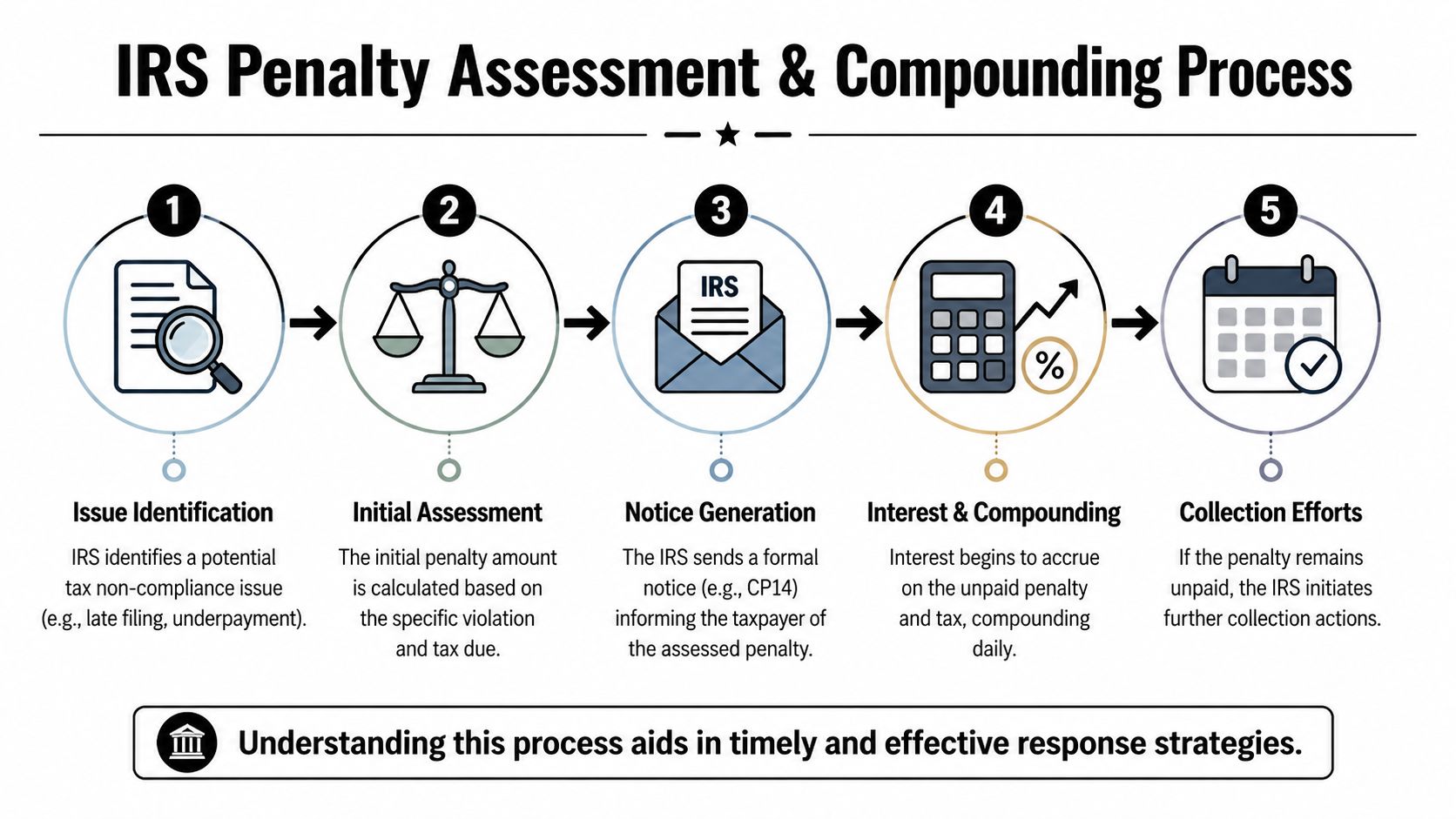
An IRS penalty usually starts with a trigger. A return arrives late. A payment doesn't post on time. A mismatch appears between what you filed and what third parties reported. An examiner reviews the return and proposes an adjustment. Once the IRS identifies the issue, it calculates the penalty under the applicable code section and generates a notice.
That administrative sequence sounds dry. Financially, it isn't.
What the notice is really telling you
A notice typically gives you four things. The tax period. The type of tax. The amount the IRS says is due. The date by which it expects payment or response.
Read those items before you focus on anything else. Taxpayers often react to the total without checking whether the notice is proposing a change, demanding payment on an already assessed balance, or inviting documentation before the IRS finalizes its position.
Where the real cost comes from
The dangerous part of civil penalties isn't only the initial charge. It’s the interaction between multiple penalties and interest over time.
When failure-to-file and failure-to-pay penalties apply at the same time, they can reach a combined maximum of 47.5% of the unpaid tax, and interest then accrues on both the original tax and the growing penalty balance, potentially doubling the amount owed in just a few years under typical interest rates, as explained in this discussion of civil tax penalties.
That’s why delay usually costs more than people expect. A taxpayer may think, “I’ll deal with this after busy season,” or “I need a few months to get organized.” Meanwhile the balance keeps moving.
A practical way to read the progression
Think of the process in stages:
- Detection: The IRS identifies late filing, late payment, underreporting, or another compliance problem.
- Assessment: The system or examiner applies the penalty rules.
- Notice: You receive the written communication.
- Growth: Interest continues unless the matter is resolved.
- Collection: If ignored, the account can move deeper into IRS collection channels.
The cheapest day to deal with a penalty is usually the day you understand it.
What works and what doesn't
What works is prompt review, document gathering, and a targeted response. If the notice is wrong, challenge the facts. If the penalty is valid but removable, pursue abatement. If the IRS skipped a required procedural step, attack the penalty on that basis.
What doesn't work is sending a vague hardship letter with no supporting records, paying a penalty you don't understand just to stop the stress, or assuming that silence buys time. In IRS files, silence usually invites more notices, not more flexibility.
Your Step-By-Step Guide to Penalty Abatement
Penalty abatement is where taxpayers can often get real relief, but only if they choose the right lane. The two most common lanes are First-Time Abatement and reasonable cause. They are not interchangeable.

First-Time Penalty Abatement is often overlooked. Some studies suggest up to 70% of eligible small businesses fail to request it. To qualify, you generally need a 3-year clean compliance history, all required returns filed, and the tax paid or arranged to be paid, according to this primer on IRS penalties and abatement.
First-Time Abatement when the file is otherwise clean
FTA is the closest thing the IRS has to a one-time pass for certain common penalties. It is best for taxpayers who had a problem this time but have been compliant otherwise.
Use FTA when the facts are ordinary and your history is strong. Don’t waste time writing an emotional narrative if you qualify cleanly. Ask for the relief that fits.
FTA checklist
- Check the prior three years: You want a clean recent history for the relevant filing and payment compliance.
- Make sure returns are filed: The IRS usually won’t reward a taxpayer who is still missing required returns.
- Fix the payment status: Full payment or an arrangement to pay can matter.
- Request the right relief: Ask specifically for First-Time Penalty Abatement rather than a generic “forgiveness” request.
- Keep account records: IRS transcripts and notice copies help confirm what was assessed and when.
Reasonable cause when something disrupted normal compliance
Reasonable cause is different. Here, you are telling the IRS that you exercised ordinary business care and prudence, but circumstances still prevented compliance. This route is more fact-intensive and more documentation-driven.
Good reasonable cause arguments usually involve real disruption, not inconvenience. Serious illness. A death in the immediate family. Natural disaster. Loss of records tied to events outside your control. In some cases, reliance on a professional may be part of the story, but it needs to be framed carefully and supported by facts.
What usually fails is the soft explanation. Being busy. Not liking the amount due. Assuming an extension covered payment. General disorganization. Changing bookkeepers without oversight.
Build the file before you draft the request
Strong abatement requests read like evidence packets, not apologies.
- For illness or medical emergency: Gather treatment records, hospital paperwork, physician letters, and a timeline showing how the event affected filing or payment ability.
- For casualty or disaster issues: Collect insurance claims, police or fire reports, repair records, and proof of record loss.
- For death or family crisis: Include death certificates, estate paperwork, travel records, or correspondence showing the disruption period.
- For professional reliance arguments: Keep engagement letters, emails, draft returns, organizer submissions, and notes showing what information you provided and when.
- For all requests: Attach the notice, identify the tax period, and state the exact penalty relief requested.
If you need a deeper walkthrough, this guide to reasonable cause penalty abatement is helpful.
Common mistake: Taxpayers send Form 843 with almost no exhibits. The IRS is much more likely to remove penalties when the facts are documented, dated, and tied directly to the compliance failure.
Where Form 843 fits
Form 843, Claim for Refund and Request for Abatement, is often the formal vehicle for asking the IRS to remove penalties. It isn't magic by itself. The result depends on the explanation and support behind it.
A good submission does three things well. It identifies the penalty. It states the legal basis for relief. It proves the story with records. If the account also involves broader collection pressure, this resource on settling a tax debt with the IRS gives a useful overview of the documents and preparation that often matter when tax debt and penalty issues overlap.
Challenging Penalties on Procedural Grounds
Most taxpayers think they can fight a penalty only by proving they had a good excuse. That’s incomplete. Sometimes the better argument has nothing to do with your excuse and everything to do with whether the IRS followed the law before asserting the penalty.

Under IRC Section 6751, most civil penalties are invalid unless the initial determination to assess them is approved in writing by a supervisor. Courts have repeatedly invalidated penalties where the IRS couldn't prove timely written approval, and recent rulings have tightened the timeline for when that approval must occur, as discussed in this analysis of Section 6751 supervisory approval requirements.
What this means in plain English
An IRS employee usually can't just decide to hit you with a discretionary civil penalty and move on. For many penalties, the law requires written supervisory approval before the penalty is formally locked in at the required stage.
That creates a distinct line of defense. You are not arguing, “I had reasonable cause.” You are arguing, “Show me that the IRS followed the mandatory approval rule.”
When this argument matters most
This issue often matters in audit files, proposed accuracy penalties, and other examiner-driven cases where the timing of internal approval can be challenged. It is less about emotional facts and more about paper trail discipline.
Here’s the practical scenario. An examiner proposes a penalty. The taxpayer disputes the adjustment. The representative asks for proof that the immediate supervisor approved the initial determination in writing at the proper time. If the IRS can’t produce it, or if the approval came too late, the penalty itself may fail even if the underlying tax adjustment survives.
Ask two separate questions. Is the penalty factually justified, and was it procedurally approved?
How to raise the issue effectively
You don't need to accuse the IRS of bad faith. You need to ask the right question and preserve it in the record.
- Request the approval record: Ask for the written supervisory approval supporting the penalty determination.
- Check timing carefully: The issue is not only whether approval exists, but whether it happened when the law required.
- Review the notice trail: In examination matters, documents tied to proposed adjustments can matter.
- Keep the argument separate: Don’t bury a procedural challenge inside a broad hardship letter.
- Use appeals if needed: Procedural defects often become more powerful when clearly framed for administrative review.
This is one of the most overlooked areas in civil penalty irs defense because it doesn't feel intuitive to taxpayers. They focus on what they did wrong. The law also cares whether the government did its part correctly.
When to Stop DIY and Call a Tax Professional
Some penalty cases are manageable with a clean transcript, a straightforward history, and one obvious abatement request. Others are not. The problem is that taxpayers often can't tell which type of case they have until they’ve already said the wrong thing, missed a deadline, or paid money they might have avoided.
The do-it-yourself approach gets riskier when the file becomes layered. Multiple notices. More than one tax year. Mixed issues involving filing, payment, and accuracy. Business records that aren’t complete. Any audit setting. Those files require strategy, not just responsiveness.
Red flags that call for representation
A few situations should make you pause before handling the matter alone.
- Fraud or negligence language appears: If the notice mentions fraud, negligence, or disregard of rules, the consequences are more significant, and your written response matters more.
- The issue touches payroll taxes: Business payroll matters can expose owners and responsible persons to uniquely serious consequences.
- You have crypto, rental, or business complexity: These files often involve basis, substantiation, information reporting, and accounting-method questions that can spill into penalties fast.
- The IRS is examining the return: Once you're in an audit environment, factual, legal, and procedural arguments need to line up.
- You need both abatement and collection relief: A good penalty defense can be weakened if the account resolution plan is poorly handled.
Why experience changes outcomes
A seasoned representative doesn’t just fill out forms. They sort the file into the right arguments in the right order. They know when to request transcripts, when to use Form 843, when to raise reasonable cause, and when a procedural challenge under Section 6751 deserves priority.
They also know what not to argue. That matters. Weak arguments can distract from strong ones and give the IRS an easy reason to deny the request.
If your case has more than one moving part, your response should be coordinated rather than improvised.
The cost question
People hesitate because they don't want to pay for representation when they already owe the IRS. That concern is understandable. But a penalty case isn't just about current cash flow. It's about preserving defenses, avoiding avoidable additions, and keeping a tax issue from turning into a larger financial problem.
If you're weighing your options, this guide on how to negotiate with IRS helps frame what effective tax resolution work involves.
Frequently Asked Questions About IRS Penalties
Can the IRS assess civil penalties even if I didn't intend to break the rules
Yes. Civil penalties often don't require bad intent. Late filing, late payment, and many accuracy issues can be assessed without any finding of fraud. Intent still matters, but usually as part of your defense, your abatement request, or the severity of the penalty asserted.
What is the Trust Fund Recovery Penalty
The Trust Fund Recovery Penalty is tied to unpaid payroll taxes that an employer withheld from employees but did not properly turn over. It is one of the most serious business tax exposures because the IRS can look past the company and examine who was responsible for collecting, accounting for, and paying those taxes. If payroll taxes are involved, casual handling is a mistake. These cases usually require close review of authority, check-signing power, business roles, and account history.
Can crypto activity trigger accuracy-related penalties
Yes, it can. Cryptocurrency reporting problems often start with missing cost basis records, incomplete transaction histories, wallet-to-wallet transfer confusion, or failure to recognize taxable events correctly. If the IRS believes those mistakes caused an underpayment, it may look at accuracy-related penalties. The defense usually turns on record reconstruction, return preparation methodology, and whether the reporting position was reasonable based on the available information.
What if my penalty abatement request is denied
A denial doesn't always end the matter. The next step depends on how the request was made, what the IRS said in response, and whether the weakness was legal, factual, or documentary. Sometimes the better move is to supplement the file with stronger records. In other cases, an administrative appeal or a fresh procedural argument is more effective than repeating the first request.
Should I pay first and argue later
Sometimes yes, sometimes no. It depends on the type of notice, whether the penalty is already assessed, whether interest is still building, and whether payment affects your practical advantage. Some taxpayers pay to stop escalation and then seek relief. Others should challenge first because the notice is still proposed or because the stronger move is to dispute the liability before collection deepens.
Is calling the IRS enough to get penalties removed
For clean first-time cases, a phone request can work. But many denials happen because the caller doesn't frame the request properly, doesn't know what relief fits, or can't answer account questions in real time. Once the facts are disputed, the notice history is messy, or the issue involves an audit or multiple years, written submissions and a coordinated strategy usually produce a better record.
Are all penalties eligible for the same kind of relief
No. Different penalties have different rules, and the same relief method doesn't apply evenly across all categories. That’s why naming the exact penalty matters before requesting removal. A taxpayer who asks for the wrong kind of relief can lose time and credibility even when a better argument was available.
If you're dealing with IRS penalties and want a clear strategy before the situation gets more expensive, Allied Tax Advisors can help you evaluate the notice, identify the exact penalty, and determine whether the strongest path is abatement, procedural challenge, or negotiated resolution. A focused review early in the process often protects more options than a rushed response after deadlines pass.