
The first tuition bill often creates a strange mix of emotions. You feel proud because you planned ahead and built a 529 account over many years. Then the practical question hits: what can you pay for without turning a smart savings decision into a tax problem?
That question comes up even more in places like San Diego, where education costs rarely arrive in a neat, simple package. Tuition may be straightforward, but rent, meal costs, laptops, books, testing fees, and financial aid all start overlapping. Families who've read a few basic checklists still end up asking the same thing: which expenses are really safe to cover with 529 money?
The good news is that the rules are manageable once you see the pattern. A 529 plan can be a powerful tax-advantaged tool, but the tax-free treatment depends on matching withdrawals to the right expenses at the right time. If you're also thinking about broader planning issues, this guide on 529 plan tax deduction rules can help frame the bigger picture.
Table of Contents
- Your Guide to Tax-Free Education Savings
- Defining Qualified Higher Education Expenses
- Navigating Higher Education Costs
- Expanded Uses K12 Tuition Loans and Apprenticeships
- Understanding Taxes and Penalties on Withdrawals
- Strategic Planning and Recordkeeping Tips
- Maximize Your 529 Plan with Confidence
Your Guide to Tax-Free Education Savings
A 529 plan works best when you treat it like a tool with clear instructions, not a general education wallet. Many families assume that if an expense feels school-related, it must count. That's where trouble starts.
The dividing line is whether the cost is a qualified expense under the tax rules. If it is, the earnings portion of the withdrawal can remain tax-free. If it isn't, part of the withdrawal may become taxable, and a penalty can apply.
Think of the account as a locked tax-free container. The money goes in, it grows, and you realize the tax benefits only when you use it for the right purpose. The plan isn't trying to trick you, but it does expect accurate matching.
Practical rule: Don't ask only, “Is this education-related?” Ask, “Is this one of the specific 529 plan qualified expenses allowed under the rules?”
That distinction matters for families paying college bills, parents considering private school tuition, and adults using education savings in newer ways. The rules have broadened over time, but broader doesn't mean unlimited.
A calm approach helps. Start with the core categories, confirm the student's school or program fits the requirements, then match each withdrawal to actual records. Families who do that usually avoid the messy situation where tax season becomes a reconstruction project.
Defining Qualified Higher Education Expenses
The IRS uses the term Qualified Higher Education Expenses, often shortened to QHEEs. In plain language, that means the approved list of education costs that can support a tax-free 529 withdrawal.
An easy analogy is an IRS-approved shopping list. If the expense is on the list and tied to an eligible educational institution, you're generally in the tax-free spending zone. If it's off the list, you should assume caution until you've confirmed otherwise.
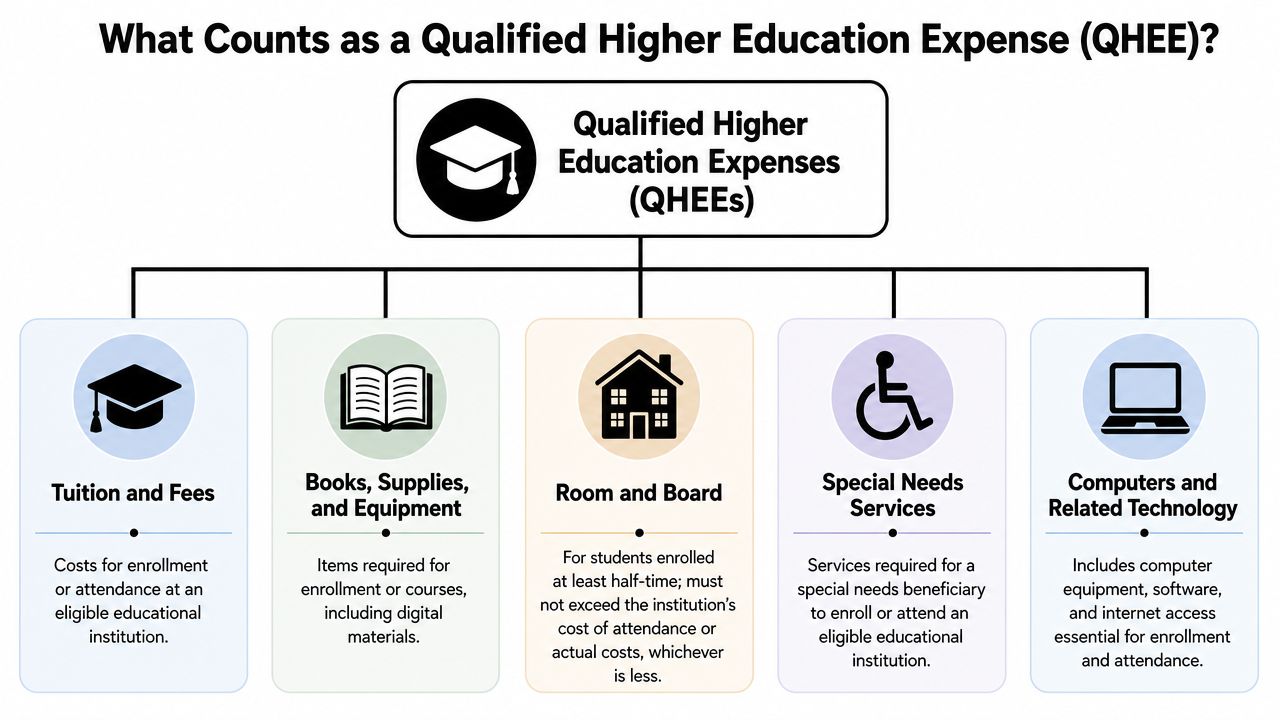
Under current U.S. tax law, QHEEs include tuition, fees, books, supplies, and equipment required for courses of instruction, plus room and board up to the institution's published cost-of-attendance allowance for an eligible educational institution, as described in Smart529's explanation of qualified 529 expenses.
The main buckets to remember
For most families, the approved list breaks into a few practical categories:
- Tuition and required fees are the foundation. If the school charges it for enrollment or attendance, the analysis usually begins with these.
- Books, supplies, and equipment can qualify when they're required for the student's courses.
- Room and board can qualify, but many families accidentally over-withdraw funds for these costs.
- Technology often belongs in the conversation because computers, software, and internet access may be tied to attendance and coursework.
- Special needs services may also qualify when they're required for the beneficiary to enroll or attend.
One reason people get confused is that other tax rules use different definitions. For example, families who are used to reading about healthcare deductions may have seen narrow analyses of what qualifies in another context, such as doula services as qualified medical expenses. The lesson carries over here: tax law is category-specific. An expense can feel reasonable and still fail the rule if it doesn't fit the defined bucket.
What this definition means in real life
Qualified doesn't mean convenient. It means documented and matched.
If a college publishes a room-and-board allowance, that number matters. If a course requires a lab fee or specific equipment, that requirement matters. If a family buys extra items because they're helpful but not required, those items need a closer look.
The safest way to think about 529 plan qualified expenses is this: the stronger the paper trail between the expense and the student's actual educational need, the stronger your tax position usually is.
Navigating Higher Education Costs
College spending looks simple from a distance and messy up close. Tuition is only one part of the bill. Once you add housing, food, books, software, and gear for class, the line between qualified and non-qualified can blur fast.
If your student is also applying for aid, it helps to understand the broader aid process early. A practical primer on how to apply for FAFSA can make it easier to see how grants, loans, and 529 withdrawals fit together.
Tuition and required fees
Tuition is usually the easiest category because schools bill it directly. Required enrollment fees also tend to fit cleanly when they're part of attending the institution.
Where families slip is assuming every charge on a student account is automatically qualified. Some charges may be administrative, optional, or unrelated to coursework. When in doubt, read the billing line items rather than relying on the total.
Books supplies and required equipment
This category is broader than many parents expect, but only if the items are tied to the student's courses. Required textbooks are the obvious example. Required lab materials, course packets, and similar instructional items can also fit.
The word required matters. If the professor or program requires the item, your file is stronger. If the student just prefers a nicer version, that may be harder to support.
Computers and technology
Technology often belongs on the qualified side when it supports enrollment or attendance. A laptop used for coursework is the classic example.
The safer mindset is functional, not aspirational. Buy what the student needs for school. If a purchase looks primarily personal or entertainment-focused, treat it cautiously.
Room and board and the San Diego housing problem
Room and board creates the most confusion because families naturally compare the withdrawal to what they spent. The tax rules care about more than that.
Existing 529 guidance rarely explains the issue for high-cost areas like San Diego: off-campus rent may feel reasonable, but the tax result depends on how that rent lines up with the school's published cost-of-attendance room-and-board allowance. Schwab notes that this gap leaves families guessing, especially when different schools in the same city publish very different housing allowances in its discussion of 529 eligible expenses and room-and-board limits.
Here's the practical point. A student may rent an apartment near campus, pay for groceries, and still have to cap the qualified 529 amount based on the school's official allowance and the student's enrollment status. That's why off-campus housing needs more than receipts. It needs comparison.
In expensive markets, the risk usually isn't that housing seems too lavish. The risk is that the family withdraws more than the school's allowed room-and-board figure.
A simple workflow helps:
- Get the school's published room-and-board allowance for the student's status.
- Collect actual rent and food records for the same period.
- Use the lower supportable amount if the rules require a cap.
- Match the withdrawal timing to the calendar year of the expense.
Here's a quick reference point:
| Expense Category | Generally Qualified | Generally Not Qualified |
|---|---|---|
| Tuition | Required tuition charged by the school | Optional charges unrelated to enrollment |
| Fees | Required enrollment or course fees | Personal or elective service charges |
| Books and supplies | Required course materials | Optional extras not tied to coursework |
| Technology | Computer or software tied to attendance or coursework | Items bought mainly for personal use |
| Housing and meals | Eligible room and board within the school's published allowance and applicable rules | Amounts above the allowed limit or unsupported living costs |
| Transportation | Rarely fits within the core qualified categories | Commuting, gas, parking, flights |
| Insurance | Usually outside the approved list | Health, renters, or similar insurance costs |
Expanded Uses K12 Tuition Loans and Apprenticeships
The modern 529 plan is more flexible than many families realize. It's no longer limited to the traditional college-only model that older guidance often assumed.
The biggest shift started with the Tax Cuts and Jobs Act, which expanded qualified expenses to include up to $10,000 per year per beneficiary for K-12 tuition beginning in tax year 2018, according to the IRS's 529 plan questions and answers. Later, the SECURE Act expanded eligible uses again.
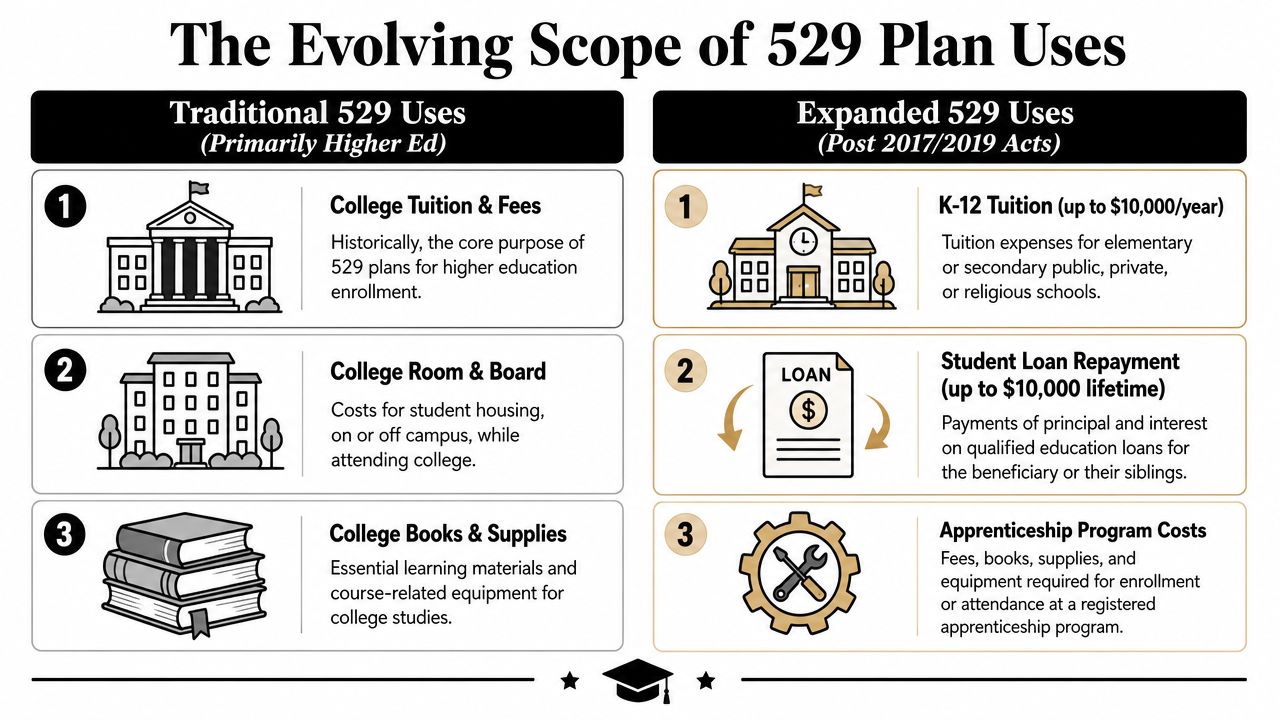
Fidelity notes that a key milestone came in 2019, when the SECURE Act added certain student-loan repayments up to a lifetime limit of $10,000 per individual and costs for registered apprenticeship programs. Fidelity also notes that by 2023 there were approximately 16.3 million Section 529 plan accounts nationwide in its overview of 529 spending rules and expanded uses.
K12 tuition
For families paying private or religious school tuition, this expansion changed the conversation. Before that federal shift, 529 plans were generally associated with higher education.
That doesn't mean every elementary or secondary school cost qualifies. The key point is tuition. If you're comparing private school budgets, a neutral cost overview like Queens Online School's cost breakdown can help you frame the cash-flow side before deciding how a 529 distribution fits into the plan.
Student loan repayment
This feature is useful, but it's narrower than people expect. The rule allows certain student-loan repayments, yet the tax-free amount is capped over the individual's lifetime.
That means families shouldn't treat this as an unlimited back-end cleanup tool. If parents, grandparents, or multiple account owners are involved, coordination matters because the relevant cap applies across 529 accounts linked to that person.
Registered apprenticeship programs
This is one of the most important updates for families whose student is pursuing a hands-on training path rather than a four-year degree. Qualified costs can include fees, books, supplies, and equipment required for participation in a registered apprenticeship program.
That matters because it places vocational training inside the same planning conversation as college. A family can support a beneficiary pursuing a different path without assuming the 529 account has lost its value.
Why these expanded uses matter
The broader list of 529 plan qualified expenses reflects how education works now. Students move through private K-12 schools, community college, trade programs, apprenticeships, and loan repayment at different stages.
A 529 plan is no longer just a college tuition bucket. It's an education funding tool with multiple lanes, but each lane still has guardrails.
Understanding Taxes and Penalties on Withdrawals
The tax benefit of a 529 doesn't disappear all at once. It changes when part of a withdrawal stops matching qualified expenses.
What makes a withdrawal non-qualified
A withdrawal becomes problematic when the amount taken out for the year exceeds the beneficiary's adjusted qualified higher education expenses for that same year. When that happens, the earnings portion tied to the excess withdrawal is generally taxable as ordinary income, and a 10% federal penalty can apply to that earnings portion, as explained in this overview of how 529 withdrawals are taxed.
That's the rule families need to keep in mind when they pull money for expenses like transportation, health insurance, or housing above what the school's cost-of-attendance framework supports. The issue is often over-withdrawing, not bad intent.
A simple way to think about the tax hit
The tax law uses a prorated approach. In plain terms, each withdrawal contains some original contributions and some earnings. If part of the withdrawal turns out to be non-qualified, only the earnings slice of that non-qualified part gets taxed and penalized.
You asked for a step-by-step example, and the safest way to explain it here is conceptually rather than with invented percentages. Suppose you withdraw money for an expense that doesn't qualify. You don't pay tax on the entire withdrawal automatically. Instead, you isolate the earnings portion inside that non-qualified amount. That earnings portion becomes the piece exposed to ordinary income tax and the federal penalty.
Keep one sentence in mind at withdrawal time: the tax problem usually attaches to the earnings portion of the excess amount, not the full distribution.
Families also need to remember that state tax issues can ride along with the federal result. Some states may recapture prior benefits or deny favorable treatment when the federal return shows taxable 529 earnings. That's why a small mismatch can become a bigger headache later.
A practical safeguard is simple:
- Match by calendar year: Withdraw in the same year you pay the expense.
- Match by category: Tie each withdrawal to a specific qualified cost.
- Match by records: Keep invoices, billing statements, and receipts together.
Strategic Planning and Recordkeeping Tips
The families who get the most value from a 529 usually don't focus only on the investment account. They manage the interactions around it. Grants, scholarships, employer assistance, tax credits, housing rules, and family-owned accounts can all change how much of a withdrawal remains safely qualified.
That's why strategy matters as much as the expense list itself.
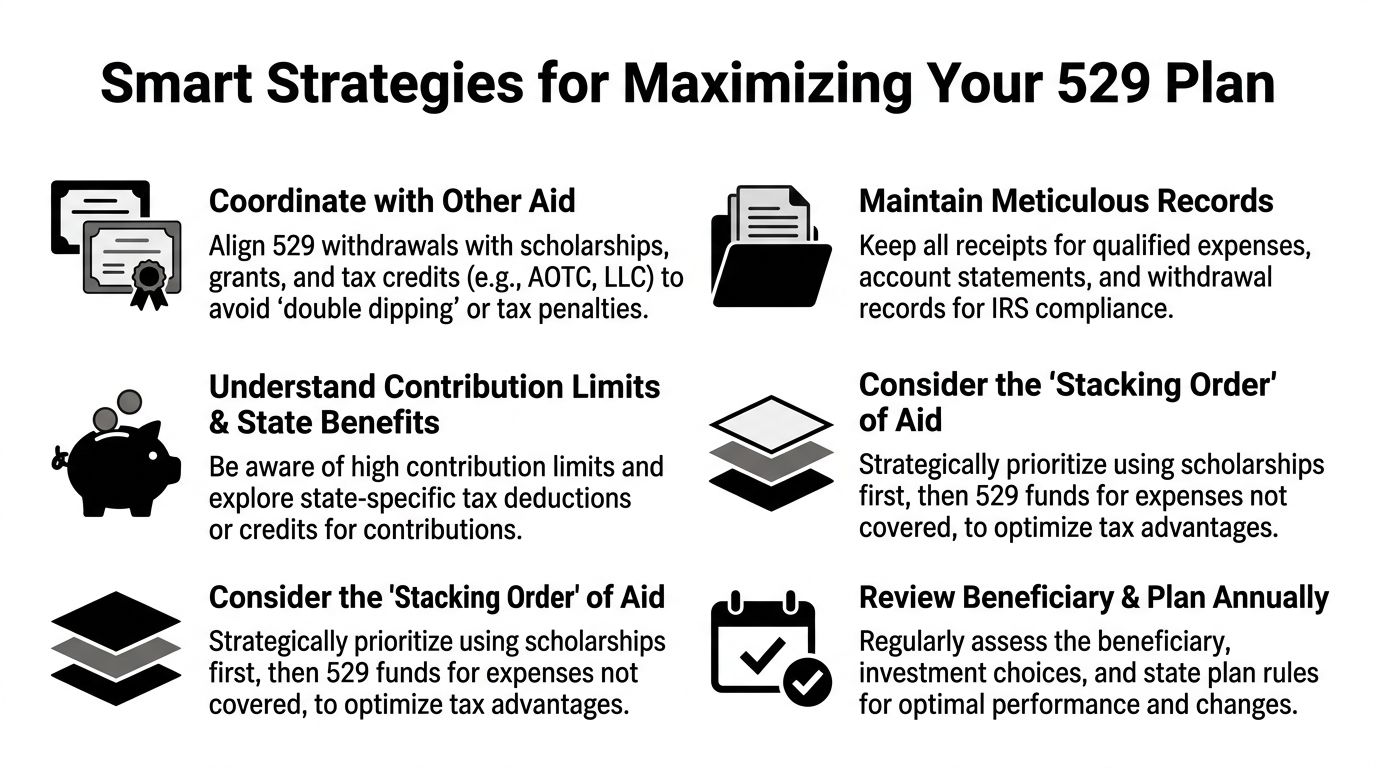
Coordinate 529 withdrawals with other aid
One of the easiest mistakes is double counting. Parents often assume that if the student had tuition, books, and training costs, the 529 withdrawal must be fine. But the pool of expenses can shrink once scholarships, grants, employer support, or other assistance step in.
Saving for College points out that people often assume expenses such as SAT-prep tutoring or a trades certification automatically preserve all tax benefits, while overlapping help like Pell Grants, employer-sponsored training, or state-backed apprenticeship subsidies can reduce the qualified 529-covered amount in its discussion of what you can pay for with a 529 plan.
That means planning should happen before the withdrawal, not after.
If another source already paid part of the education cost, don't let the 529 distribution claim the same dollars.
This issue can also overlap with family tax planning. For example, when grandparents help with education funding, tax and dependency questions can affect the broader plan. Articles on related issues, such as whether grandparents can claim grandchildren on taxes, can help families understand how education support fits into the larger return.
Build a paper trail before you need one
Good records aren't busywork. They're your defense if a withdrawal is ever questioned.
For each year you take money from the account, keep a file with:
- School billing statements that show tuition and required fees
- Receipts for books and supplies tied to actual coursework
- Housing records such as leases, dorm contracts, and meal-plan bills
- Cost-of-attendance documentation from the institution
- Loan statements if 529 funds are used for permitted loan repayment
- Grant and scholarship notices so you can reduce the qualified pool appropriately
- 529 distribution records and account statements that show timing and amount
A digital folder works well if you label it by tax year and beneficiary. Families with more than one 529 account should also keep a simple log of who withdrew what and why.
A practical checklist for families
This is the approach I'd suggest to a client who wants fewer surprises:
- Start with the school or program record. Don't estimate. Use the actual bill, actual allowance, or actual statement.
- Subtract expenses already covered elsewhere. If aid or subsidies paid part of the cost, adjust the 529 plan.
- Review unusual items separately. Off-campus rent, testing costs, certifications, and training expenses deserve a second look.
- Keep every withdrawal tied to one purpose. Avoid vague transfers into checking with no clear documentation trail.
- Reconcile before year-end. It's far easier to correct a mismatch while documents are fresh.
California families should be especially careful with documentation and state-level treatment when federal and state rules don't line up perfectly. The safest habit is consistency: if you can't explain the expense and show the support clearly, pause before using 529 funds for it.
Maximize Your 529 Plan with Confidence
The core idea is simple. 529 plan qualified expenses determine whether your withdrawals stay tax-free.
For most families, that means three things. First, know the traditional higher education categories well, especially room and board. Second, understand the newer options such as K-12 tuition, limited student loan repayment, and registered apprenticeships. Third, coordinate every withdrawal with your records, your aid package, and the calendar year in which the expense was paid.
You don't need to memorize the tax code to use a 529 wisely. You do need a method. Pull the school records, compare them to the withdrawal, adjust for outside aid, and keep your support in one place. That's what turns a complicated account into a useful planning tool.
If your family's situation involves off-campus housing, multiple 529 accounts, financial aid overlap, or California tax questions, it's smart to get personalized guidance before you move money.
If you want help reviewing withdrawals, documenting qualified expenses, or building a year-by-year education tax strategy, the team at Allied Tax Advisors can help you sort through the rules and create a plan that fits your family's goals.