
You’ve probably heard of Adjusted Gross Income (AGI), but have you ever heard of its lesser-known but arguably more important cousin, Modified Adjusted Gross Income (MAGI)?
Think of MAGI as a special government formula. It's the number the IRS uses to figure out if you qualify for some of the most valuable tax deductions and credits out there. It starts with your AGI and then adds back a few specific deductions to get a clearer picture of the money you actually had available to you throughout the year.
Why MAGI Is The Most Important Number Not On Your Tax Return
Here’s a little secret: you won't find a line for "Modified Adjusted Gross Income" anywhere on your Form 1040. It’s not a number you report yourself. Instead, it’s a calculation the government runs behind the scenes to see what you're really working with financially.
Let's use an analogy. Your AGI is like your base salary. Your MAGI, on the other hand, is closer to your total compensation package—it includes your salary plus certain financial perks that, while not taxed, still represent resources you can access.
The whole point of MAGI is to level the playing field. It prevents people from using certain tax deductions to make their income look lower on paper, which could let them qualify for benefits meant for those with genuinely fewer resources.
The AGI to MAGI Connection
To really grasp MAGI, you have to start with AGI. Your Adjusted Gross Income is your total gross income minus a specific list of "above-the-line" deductions—things like traditional IRA contributions or the interest you paid on student loans. For a complete rundown, check out our guide on how Adjusted Gross Income affects your tax refund.
From there, the journey to MAGI is simple. You take your AGI and add back some of those very same deductions. Why? Because from the government's perspective, the money you used for those deductions was still income available to you.
Essentially, MAGI is just your AGI with certain items like tax-exempt interest or foreign earned income added back in. This gives the IRS a much more complete view of your financial situation.
To make this crystal clear, here’s a quick side-by-side comparison.
AGI vs MAGI at a Glance
| Metric | Adjusted Gross Income (AGI) | Modified Adjusted Gross Income (MAGI) |
|---|---|---|
| Calculation | Gross Income – Above-the-Line Deductions | AGI + Certain Deductions Added Back |
| Location | Found on Line 11 of Form 1040 | Not listed on Form 1040; must be calculated |
| Primary Use | The foundation for calculating taxable income | Determines eligibility for tax credits & deductions |
When you boil it down, your MAGI is a gatekeeper. It controls your access to a whole host of tax-saving opportunities.
Here are just a few of the major benefits tied directly to your MAGI:
- Roth IRA Contributions: Your ability to contribute to a Roth IRA is determined by your MAGI.
- Premium Tax Credits: If you get health insurance through the ACA marketplace, your MAGI determines your eligibility for subsidies.
- Student Loan Interest Deduction: Your MAGI dictates whether you can deduct the interest you paid on student loans.
How to Calculate Your MAGI Step by Step
Figuring out your Modified Adjusted Gross Income can sound complicated, but it's really just a matter of simple addition, not some nightmare from algebra class. The whole process boils down to one formula: take your AGI and add back a few specific deductions. The trick is just knowing which items to add back for the program you're dealing with.
I like to use a baking analogy. Think of your Adjusted Gross Income (AGI) as the flour—it’s the base ingredient for everything. The “add-backs” are the other ingredients, like sugar, salt, or eggs. If you’re baking a cake, you’ll add different things than if you’re baking bread. In the same way, the deductions you add back to your AGI will change depending on the specific tax benefit or credit you’re trying to qualify for.
This visual gives you a great overview of the basic calculation flow.
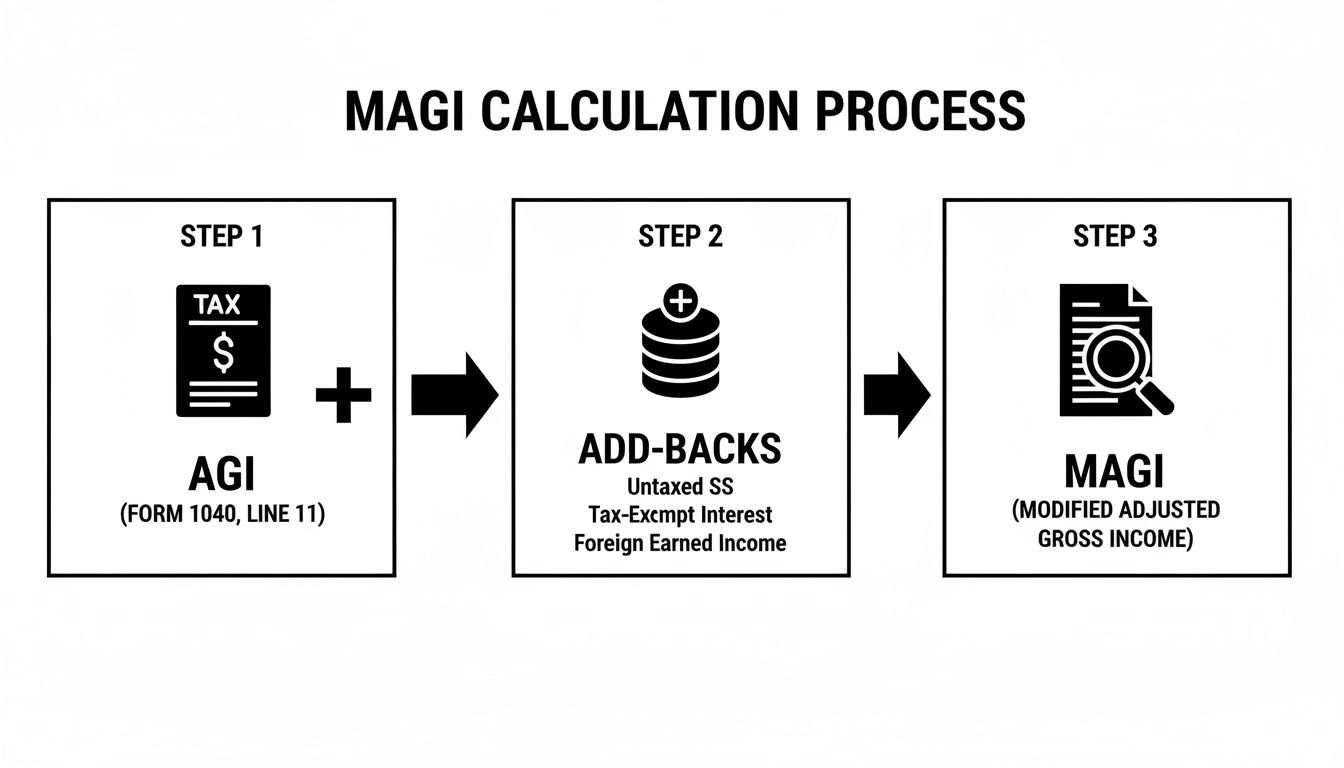
As you can see, getting from AGI to MAGI is a clear, additive process that gives the government a truer sense of your actual financial picture.
Step 1: Start with Your Adjusted Gross Income
Your AGI is the starting line for any MAGI calculation. The good news is you don’t have to calculate it from scratch—it’s a figure you can pull directly from your completed tax return.
You’ll find your AGI on line 11 of your IRS Form 1040. This number is what’s left after you subtract certain "above-the-line" deductions (like traditional IRA contributions or student loan interest) from your total gross income. For a deeper dive, check out our guide on how the IRS calculates your Adjusted Gross Income.
Once you have that AGI number, you’re ready for the next step.
Step 2: Identify the Necessary Add-Backs
This is where the "modification" happens, and it's the most important part of the puzzle. The government essentially asks you to add back certain deductions you already took to get a more accurate picture of your income. It's their way of leveling the playing field.
The list of add-backs isn't always the same; it changes depending on the specific tax rule you're looking at. However, there are a few usual suspects that pop up all the time.
The whole point of "add-backs" is to create a fairer standard. By adding back certain non-taxed income sources or specific deductions, the IRS can base eligibility for federal programs on a more complete measure of your financial resources, not just your taxable income.
Here are some of the most common items you’ll need to add back to your AGI:
- Student Loan Interest Deduction: That interest you paid on student loans? The amount you deducted to lower your AGI often gets added right back in.
- Tax-Exempt Interest: This is a big one. It usually includes interest you earned from investments like municipal bonds. While that income isn't subject to federal tax, it’s still considered part of your financial resources for MAGI purposes.
- Foreign Earned Income Exclusion: If you work abroad and exclude a large chunk of your income from U.S. taxes, that excluded amount is typically put back into the calculation for MAGI.
- Non-Taxable Social Security Benefits: The portion of your Social Security benefits that you didn't pay income tax on is often added back.
- Deducted Traditional IRA Contributions: If you contributed to a traditional IRA to lower your AGI, that contribution amount is frequently added back.
Step 3: Put It All Together with a Simple Formula
Once you have your AGI and your specific list of add-backs, the final step is just basic math. The formula never changes:
AGI + Specific "Add-Back" Deductions = MAGI
Let’s walk through a quick example. Imagine a single filer named Alex wants to find out if she’s eligible to contribute to a Roth IRA.
- Find AGI: Alex looks at her tax return and finds her AGI on Form 1040, line 11. It's $130,000.
- Identify Add-Backs: For Roth IRA purposes, she needs to add back her student loan interest deduction and any tax-exempt interest. This year, she deducted $2,500 in student loan interest and earned $1,000 in tax-exempt municipal bond interest.
- Calculate MAGI:
- $130,000 (AGI)
- $2,500 (Student Loan Interest)
- $1,000 (Tax-Exempt Interest)
- = $133,500 (MAGI)
Alex's MAGI for determining her Roth IRA eligibility is $133,500. As we'll get into next, this is the number she'll compare against the IRS income limits to see if she can contribute.
Why MAGI Has More Than One Definition
Here’s where things get tricky, and where a lot of people make mistakes. Modified Adjusted Gross Income isn't one single number on your tax return. It's more like a Swiss Army knife—it has different tools for different jobs.
The IRS has created several different versions of the MAGI calculation, each designed to test your eligibility for a specific tax break or program. This is a critical point. The MAGI formula that determines if you can contribute to a Roth IRA is different from the one used for Obamacare subsidies, and that one is different from the calculation used to see if your Social Security benefits are taxable.
You have to use the right formula for the right situation. Getting this wrong can lead to some painful and expensive problems, like having to unwind a Roth IRA contribution you weren't allowed to make or getting a smaller-than-expected tax refund because you miscalculated your health insurance credit.
The MAGI for Roth IRA Contributions
For millions of people, the Roth IRA is a cornerstone of their retirement plan. But your ability to contribute is limited by your income, and the gatekeeper is a very specific MAGI calculation. If your MAGI is too high, the amount you can contribute gets reduced, and eventually, it drops to zero.
To figure out your MAGI for Roth IRA purposes, you start with your AGI from your tax return and then add back a handful of specific deductions you might have taken. These include:
- Traditional IRA Deduction: If you deducted contributions to a traditional IRA, you have to add that amount back.
- Student Loan Interest Deduction: The interest you paid and deducted on student loans gets added back in.
- Foreign Earned Income Exclusion: Any income earned overseas that you excluded from your U.S. taxes.
- Foreign Housing Exclusion or Deduction: Similar to the above, this applies to housing costs for Americans working abroad.
- Exclusion for U.S. Savings Bond Interest: If you cashed in savings bonds to pay for education and didn't pay tax on the interest, that gets added back.
- Employer-Paid Adoption Benefits Exclusion: Adoption assistance from your employer that was excluded from your income is also added back.
By adding these specific items back to your AGI, the IRS gets a more complete picture of your actual earnings to determine if you qualify for this retirement savings powerhouse.
The MAGI for Premium Tax Credits
The Premium Tax Credit, a core piece of the Affordable Care Act (ACA), is the subsidy that helps people afford health insurance through the marketplace. Your eligibility for this credit hinges on—you guessed it—another unique MAGI formula.
Thankfully, this version is often a bit simpler. To calculate your MAGI for the Premium Tax Credit, you take your AGI and add back just three potential items:
- Tax-Exempt Interest: This is interest you earned from investments like municipal bonds.
- Untaxed Foreign Earned Income: Any income earned abroad that you excluded from your U.S. taxable income.
- Non-Taxable Social Security Benefits: This is the portion of your Social Security benefits (including disability) that isn't taxed.
This particular calculation gives the government a broad view of your household's available resources to see if you qualify for help with your health insurance premiums.
The MAGI for Social Security Taxation
Many retirees are shocked to find out that their Social Security benefits might be taxable. The deciding factor is a figure the IRS calls your "combined income," but it's really just another name for a specific MAGI calculation.
To determine if your Social Security benefits are taxable, the IRS calculates your "combined income." This is just another name for a specific MAGI formula designed for this exact purpose.
The formula here is pretty straightforward. You simply take your AGI and add back two things:
- Tax-Exempt Interest
- One-Half (50%) of Your Social Security Benefits
If that total—your "combined income"—goes over a certain threshold ($25,000 for single filers or $32,000 for married couples filing jointly), then a portion of your Social Security benefits becomes taxable.
To help visualize how these calculations differ, we've put together a quick comparison table.
Common MAGI Calculations by Program
This table illustrates how the MAGI calculation differs based on the specific tax benefit, showing which 'add-backs' are required for each program.
| Tax Benefit / Program | Common Add-Backs to AGI | Primary Purpose |
|---|---|---|
| Roth IRA Contribution | IRA Deduction, Student Loan Interest, Foreign Income/Housing, etc. | Determines eligibility for contributing to a Roth IRA. |
| Premium Tax Credit (ACA) | Tax-Exempt Interest, Non-Taxable Social Security, Foreign Income. | Calculates household income for health insurance subsidies. |
| Social Security Taxation | Tax-Exempt Interest, 50% of Social Security Benefits. | Determines if a portion of your Social Security income is taxable. |
The main takeaway should be clear: the definition of what is modified adjusted gross income really depends on why you're asking. You always need to pinpoint the specific tax benefit you're looking at and use the precise MAGI recipe that goes with it.
Real-World MAGI Calculation Examples
Theory is one thing, but seeing how Modified Adjusted Gross Income works with real numbers is where it all starts to click. Abstract rules about "add-backs" can feel fuzzy until you see them applied to everyday situations. By walking through a few common scenarios, you can see exactly how the MAGI formula can impact your wallet and your eligibility for key tax benefits.
Let's put the math into action. We’ll look at three different taxpayers: a single tech professional aiming for a Roth IRA, a couple with rental income needing health insurance subsidies, and a retiree trying to figure out Social Security taxes. Each example starts with a clear Adjusted Gross Income (AGI) and builds from there, line by line.

Example 1: The Single Tech Professional and Her Roth IRA
Meet Sarah, a software developer with a growing side hustle. Her goal is simple: max out her Roth IRA contributions for the year to build up her retirement savings tax-free. Her ability to do that hinges entirely on her MAGI.
Here’s a snapshot of Sarah's finances:
- Salary from tech job: $120,000
- Income from freelance design work: $25,000
- Traditional 401(k) contributions: $10,000
- Student loan interest paid: $2,500
- Health Savings Account (HSA) contributions: $3,000
First, we need to find her AGI.
- Gross Income: $120,000 (salary) + $25,000 (freelance) = $145,000
- Above-the-Line Deductions: $10,000 (401k) + $2,500 (student loan interest) + $3,000 (HSA) = $15,500
- Adjusted Gross Income (AGI): $145,000 – $15,500 = $129,500
Now, for the important part. To see if she can contribute to a Roth IRA, we have to calculate the specific MAGI for that purpose. For Roth IRAs, the IRS makes us add back the student loan interest deduction.
- Start with AGI: $129,500
- Add back Student Loan Interest Deduction: + $2,500
- Roth IRA MAGI: $132,000
Since Sarah’s MAGI of $132,000 falls comfortably below the IRS income phase-out range for single filers, she's clear to make the full contribution to her Roth IRA. Good news for her retirement fund!
Example 2: The Married Couple with Rental Income
Next up, let’s look at Mark and Jessica. They’re a married couple who own a small rental property and need to buy health insurance through the Affordable Care Act (ACA) marketplace. They're hoping to qualify for the Premium Tax Credit to keep their monthly premiums manageable.
Here's their financial picture:
- Mark's W-2 Income: $45,000
- Jessica's W-2 Income: $30,000
- Net Rental Income (after expenses): $10,000
- Tax-Exempt Interest from Municipal Bonds: $2,000
- Traditional IRA Contributions: $6,000
Let’s calculate their AGI.
- Gross Income: $45,000 + $30,000 + $10,000 + $2,000 = $87,000
- Above-the-Line Deductions: $6,000 (IRA contributions)
- Adjusted Gross Income (AGI): $87,000 – $6,000 = $81,000
For the Premium Tax Credit, the MAGI calculation has its own specific rules. We have to add back their tax-exempt interest and any non-taxable Social Security benefits (which they don't have).
- Start with AGI: $81,000
- Add back Tax-Exempt Interest: + $2,000
- ACA Premium Tax Credit MAGI: $83,000
Their MAGI of $83,000 is the magic number the healthcare marketplace will use to determine their eligibility and the size of their subsidy.
Example 3: The Retiree and Social Security Taxes
Finally, we have David, a retiree who's trying to figure out if he'll owe taxes on his Social Security benefits. This all comes down to his "combined income," which is just another name for a specific MAGI calculation.
Here are David’s income sources:
- Pension Income: $20,000
- Traditional IRA Distributions: $15,000
- Total Social Security Benefits Received: $24,000
- Tax-Exempt Interest: $5,000
His AGI calculation is pretty straightforward.
- Gross Income: $20,000 (pension) + $15,000 (IRA) + $5,000 (interest) = $40,000
- Adjusted Gross Income (AGI): $40,000
Now, let's plug this into the special MAGI formula for Social Security. We need to add back his tax-exempt interest and, critically, one-half of his Social Security benefits.
Calculating Combined Income (MAGI) for Social Security
- Start with AGI: $40,000
- Add back tax-exempt interest: + $5,000
- Add one-half of Social Security benefits ($24,000 / 2): + $12,000
- Total Combined Income: $57,000
Because David's combined income of $57,000 is well over the $25,000 threshold for single filers, a hefty portion of his Social Security benefits (up to 85%) will unfortunately be subject to income tax.
As you can see, a small change in MAGI can have a big impact. For instance, a head of household with an $80,000 AGI and $5,000 in tax-exempt interest would have a MAGI of $85,000. That simple add-back could partially phase them out of the Child Tax Credit, costing them hundreds of dollars. If you're curious about more complex tax situations, you can learn more about how MAGI is calculated on SmartAsset.com.
Using Smart Tax Planning to Manage Your MAGI
Knowing what MAGI is gets you halfway there. The other half—the part that really makes a difference—is actively managing it. With a few proactive financial moves, you can strategically lower your MAGI and open the door to valuable tax credits and deductions that might have seemed out of reach. This isn't about shady loopholes; it's about using the tax code as intended to improve your financial picture.

The basic principle couldn't be simpler. Your MAGI starts with your AGI, so anything you do to reduce your AGI will almost always reduce your MAGI right along with it. This direct link gives you a surprising amount of control over your tax situation.
Lowering Your AGI to Get a Handle on MAGI
Some of the most effective strategies for managing MAGI are all about reducing your Adjusted Gross Income. These moves don't just lower your taxable income; they can help you qualify for things like the ability to contribute to a Roth IRA or get a bigger Premium Tax Credit.
Here are a few powerful tactics to consider:
- Max Out Pre-Tax Retirement Contributions: Bumping up your contributions to a traditional 401(k) or 403(b) is one of the most straightforward ways to lower your AGI. Every dollar you put in is subtracted from your gross income before anyone even looks at your AGI.
- Fund a Health Savings Account (HSA): If you're on a high-deductible health plan, the HSA is a tax-advantaged powerhouse. Your contributions are tax-deductible, the money grows tax-free, and you can pull it out tax-free for qualified medical expenses.
- Contribute to a Traditional IRA: Even with a retirement plan at work, you might still be able to deduct contributions to a traditional IRA. It's another direct way to chip away at your AGI.
Key Takeaway: Think of your 401(k), traditional IRA, and HSA as more than just savings accounts. They are your primary tools for actively managing your AGI and, by extension, your MAGI.
If you're looking for even more ways to get ahead, we put together a guide with 8 smart tax planning strategies for individuals in 2025 that's packed with additional ideas.
Advanced Strategies for Investors and Business Owners
Once you’ve covered the basics, you can get into more specific tactics, especially if you have investments or run your own business. These strategies take a bit more finesse but can lead to some serious tax savings.
For investors, tax-loss harvesting is an essential technique. It’s the practice of selling investments at a loss to cancel out the capital gains you've made elsewhere. Since capital gains pump up your AGI, offsetting them with losses directly pulls your AGI—and your MAGI—back down.
Business owners and the self-employed have their own set of powerful tools. A great resource on this topic is Mastering Taxes on Self-Employed Income in Canada, which covers the fundamentals. A couple of key strategies include:
- Timing Your Expenses: You can be strategic about when you buy business equipment or supplies. Making those purchases before the year ends increases your deductions, which lowers your business's net income and, in turn, your personal AGI.
- Setting Up a Retirement Plan: Opening and funding a retirement plan like a SEP IRA or Solo 401(k) allows for huge pre-tax contributions. This can drastically reduce your taxable income for the year.
Putting these strategies into practice requires some foresight and a good grasp of the tax rules. They're incredibly effective, but they aren't one-size-fits-all. Careful planning is a must to make sure these moves fit your larger financial goals and are done correctly to avoid any unpleasant surprises.
When Should You Call in a Pro for MAGI Planning?
Getting a handle on your Modified Adjusted Gross income is a huge step toward smarter financial planning. It’s empowering. But let's be realistic—sometimes, the DIY route just won't cut it, especially when your financial life gets a little messy.
When a lot of money is at stake, a small mistake in your MAGI calculation can have some seriously expensive consequences. Knowing when to raise the white flag and call a professional is just as important as knowing how the formula works.
Red Flags: When to Hire an Expert
Certain life events or financial setups can twist your tax situation into a pretzel. These are the moments when professional advice isn't just helpful; it's essential.
You should seriously consider reaching out to us at Allied Tax Advisors if any of these sound familiar:
- You're a Real Estate Investor: Juggling depreciation, navigating the maze of passive activity loss rules, and timing your capital gains is a high-stakes game. One wrong move can blow up your MAGI and leave you with a massive, unexpected tax bill.
- You're a High-Income Earner Approaching Retirement: This is IRMAA territory. A small, seemingly innocent miscalculation in your MAGI can lock you into paying thousands more per year for Medicare Parts B and D. It's a classic MAGI trap that requires careful navigation.
- You're Facing a Major Financial Windfall: Selling a business, inheriting a significant sum, or cashing in on stock options will send your income through the roof. A tax pro can help you create a strategy before the event to soften the MAGI blow.
The true value of a tax advisor isn't just about getting your taxes filed right. It’s about looking ahead. We help you structure your income and investments to legally and ethically minimize your MAGI, unlocking savings and benefits you might never have found on your own.
Ultimately, a tax professional does more than just ensure compliance. We help you navigate the tricky parts and find opportunities to save money that most people completely miss.
Your Top MAGI Questions, Answered
It's one thing to understand the definition of MAGI, but it's another to apply it to your real life. Let's tackle some of the most common questions that pop up when you start digging into the details.
"Where Is MAGI on My Tax Return?"
This is probably the number one question we hear, and it's a perfectly logical one. The confusing answer is: it's not there. You won't find a single line on your Form 1040 that's labeled "Modified Adjusted Gross Income."
Think of MAGI not as a number you report, but as a number you calculate for a specific purpose. You always start with your Adjusted Gross Income (AGI) from line 11 of your tax return. Then, depending on what you're trying to qualify for, you add back specific deductions. The IRS usually includes a worksheet with its forms—like the one for the Premium Tax Credit—to walk you through the math.
"Is MAGI the Same as Taxable Income?"
Nope, they're two completely different figures used for entirely different jobs.
- Taxable Income is what the IRS uses to figure out how much tax you actually owe. It’s your AGI minus either the standard deduction or your itemized deductions.
- Modified Adjusted Gross Income is the gatekeeper. The IRS uses it almost exclusively to decide if you're allowed to take certain credits or deductions in the first place.
Simply put, one determines your tax bill, while the other determines your eligibility for tax breaks.
"How Do Roth IRA Contributions Affect My MAGI?"
This is a bit of a trick question. Your contributions to a Roth IRA have zero effect on your MAGI. Since you make those contributions with after-tax money, you don't get a deduction for them, which means your AGI (the starting point for MAGI) is unchanged.
The real relationship works the other way around: your MAGI is the critical number that determines if you’re even eligible to contribute to a Roth IRA. The IRS has strict income phase-outs based on MAGI. If your income is too high, your ability to contribute gets reduced or even disappears completely, making MAGI a key figure to manage for your retirement strategy.
"Can I Actually Lower My MAGI to Qualify for More Credits?"
Yes, you can, and you absolutely should if it makes sense for your financial plan. This is where proactive tax planning really pays off. Since your AGI is the foundation of your MAGI, anything you do to lower your AGI will almost always lower your MAGI right along with it.
By strategically reducing your AGI, you can trigger a positive domino effect. A lower MAGI might suddenly make you eligible for things that were just out of reach, like contributing to a Roth IRA, getting a bigger health insurance subsidy, or deducting your student loan interest.
Some of the most effective strategies include maxing out your pre-tax 401(k) or traditional IRA contributions, funding a Health Savings Account (HSA), or using tax-loss harvesting in your investment portfolio to cancel out capital gains.
Trying to piece together the MAGI puzzle on your own can feel overwhelming. You don’t have to go it alone. The experts at Allied Tax Advisors specialize in creating personalized tax strategies to help you manage your MAGI, stay compliant, and unlock new financial opportunities. Contact us today for a consultation.